What does bluegill eat?
What is established about how bluegill feeds, kept separate from what anglers infer from it.
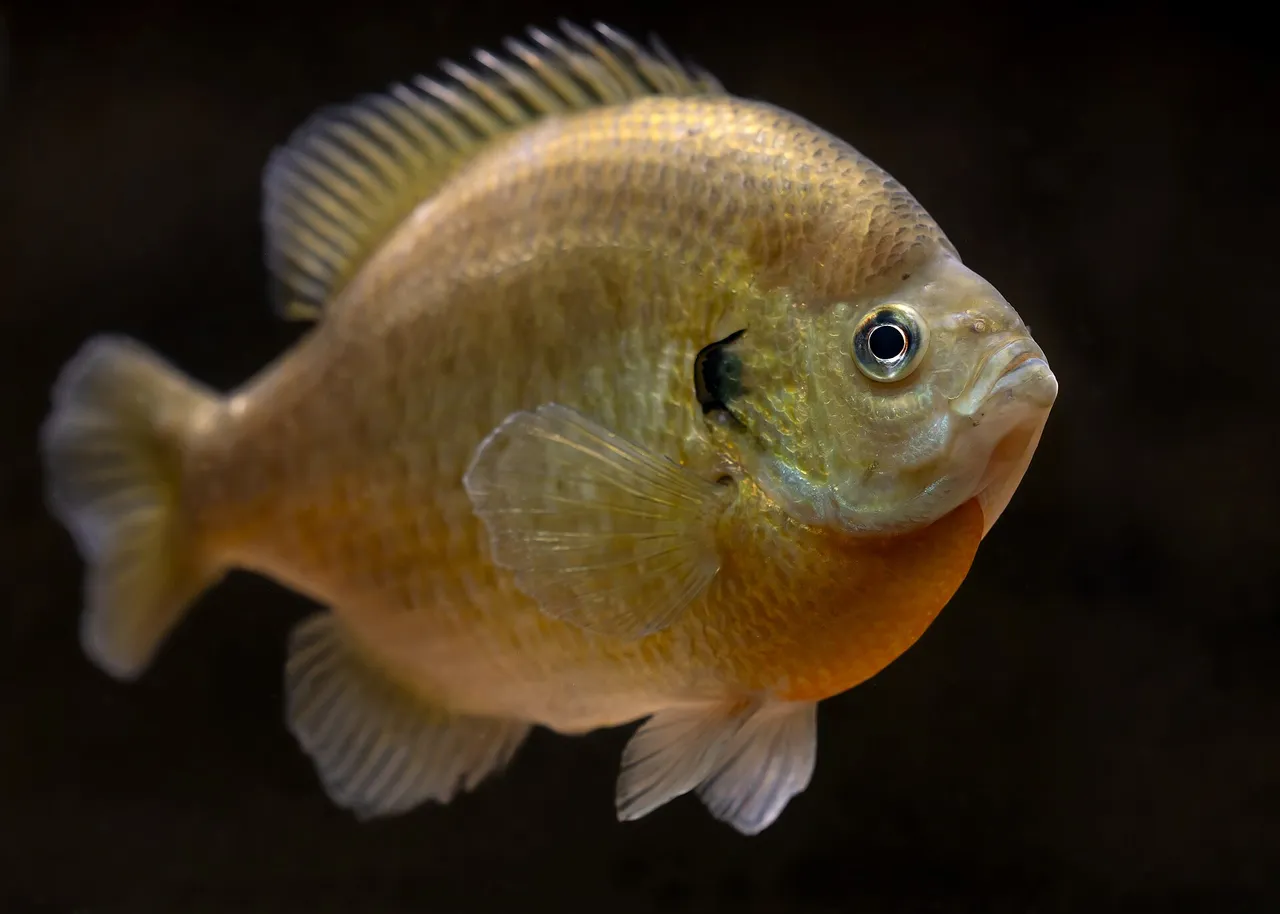
How this was identified, and who took it
Identified by: The solid dark opercular flap with no pale margin, the very small mouth and the long-based dorsal fin together identify the species and separate it from pumpkinseed. Photographed in an aquarium.USFWS Mountain Prairie — Public domain, via Wikimedia Commons — source, licenceWhat is known about how it feeds
A bluegill's mouth is the smallest thing about it in proportion, and it is the fact that governs the whole diet.
The mouth is small and adapted to picking rather than engulfing. Everything the fish eats has to pass through that constraint, so the diet is made of items an angler would struggle to see: midge and mayfly larvae, tiny crustaceans, snails, drifting zooplankton, and fish eggs where it can reach them. The single verified relationship, aquatic insect larvae at group level, is the mainstay across the range.
That anatomical ceiling means there is no ontogenetic shift to piscivory. A large bluegill eats more of the same things rather than different things, which is unusual among the species on FishingHQ and is the reason bluegill remain forage for everything larger throughout their lives.
Feeding is visual and diurnal, conducted over and among weed, timber and structure in shallow water. The deep, laterally compressed body is a manoeuvrability adaptation for exactly that environment, and it is also what makes the fish difficult for a gape-limited predator to swallow.
Bluegill are the most heavily stocked panfish in North America and are the standard forage species in largemouth bass management, which means a great deal of what is known about their population dynamics comes from managing them as food rather than as a catch.
Overpopulation and stunting are the characteristic problem: where predation is insufficient, bluegill reproduce beyond the food supply and the population becomes numerous and small.
The food
Prey with a verified dietary link to this fish. Each entry carries its own evidence, and each is written at the precision the source actually used: a named species where the source named one, a group or food category where it said “polychaetes”, “crustaceans” or “detritus” and meant it. That is why this list is shorter than the animal’s real diet rather than longer.
- Aquatic insect larvae as prey — a group rather than a species: the evidence names the group
Bluegill feed principally on aquatic insect larvae and small crustaceans taken from weed and sediment, which is the basis of their role as forage and as a panfish.
Food with no page of its own here yet
These are real components of the diet, listed as plain text because FishingHQ has no page for them yet. Inventing pages to make the list look fuller would be the fabrication this whole approach exists to prevent.
- zooplankton
- snails
- small crustaceans
- fish eggs
- very small fish
What anglers do with this
Everything below is interpretation, not finding. It is what experienced anglers conclude from the biology above, and the reasoning is usually sound and almost never tested. It is separated from the biology deliberately.
The small mouth is the fact that converts, and it converts into the commonest beginner's error and its correction: an offering sized for a bass cannot be taken by a bluegill, and the fish that appear to be nibbling without being caught are fish that physically cannot take what is being offered.
The visual, diurnal, shallow-structure feeding converts into straightforward location reasoning.
The stunting problem has an angling consequence that is not interpretation: on many waters, removing numbers of small bluegill is a management measure rather than a depletion, and local guidance sometimes encourages it. What applies is a question for the relevant authority.
What this does not establish
One group-level relationship for a broad invertebrate diet. Composition varies with water body and season, and nothing here establishes proportions. The account describes a species whose populations are frequently managed rather than wild.
Where this connects
These are the baits, lures, methods and explainers FishingHQ already joins to this fish — which is why the list is sometimes short. They are not chosen for this page, and a link here means an evidenced relationship exists, not that it follows from the diet.
Methods used for it
Where it lives
This page covers feeding. The Bluegill record covers identification, lifecycle, seasonal behaviour, handling and the sources behind all of it.
Reviewed 2026-08-12.