What does smallmouth bass eat?
What is established about how smallmouth bass feeds, kept separate from what anglers infer from it.
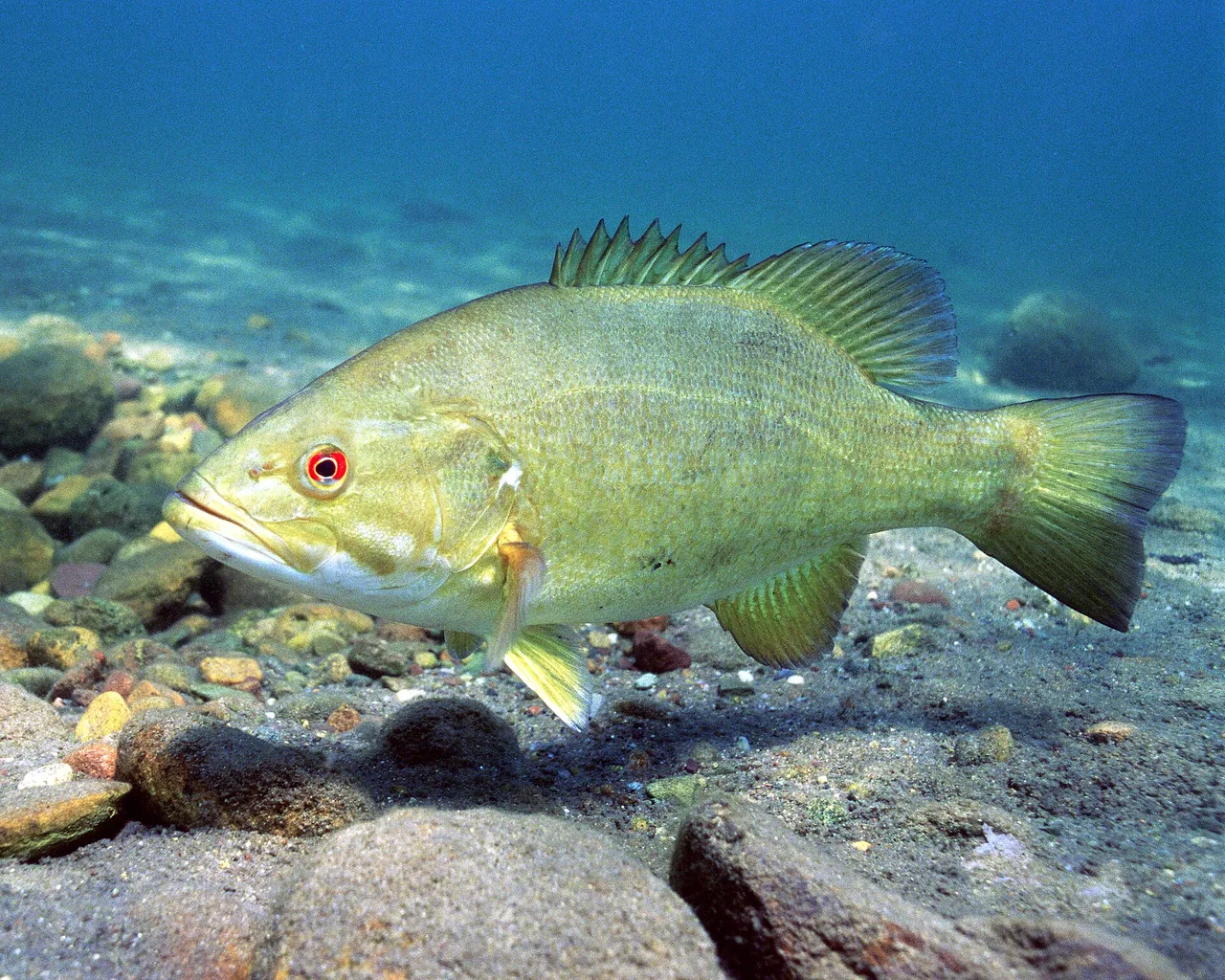
How this was identified, and who took it
Identified by: Red iris, upper jaw ending level with the rear edge of the eye rather than past it, and a dorsal fin only shallowly notched — the three characters separating it from largemouth bass.Eric Engbretson, U.S. Fish and Wildlife Service, Public domain, via Wikimedia Commons — source, licenceWhat is known about how it feeds
Crayfish dominate the smallmouth bass diet across most of its range, and the association is close enough that smallmouth habitat selection is largely crayfish habitat selection.
The verified relationship — freshwater crayfish at group level — is the one that matters most by weight in adult fish, and it explains why the species is found over rock, rubble and gravel rather than in the weed and timber a largemouth prefers. The two species overlap constantly and are doing different things: one is hunting a crustacean that lives under stones, the other is engulfing whatever comes past a weed edge.
Fish, aquatic insects and terrestrial insects taken at the surface make up the rest, and young smallmouth take plankton and insect larvae before the shift.
The feeding mechanism is suction, as in other black basses, but the crayfish emphasis means a great deal of the feeding involves picking prey off and out of the substrate rather than intercepting it in open water.
Temperature governs activity as it does in all the black basses, and smallmouth are more cold-tolerant than largemouth, which is part of why they occupy the cooler, faster, rockier waters they do.
The species is recorded as cannibalistic, which is normal in the family and is a population control rather than an anomaly.
The food
Prey with a verified dietary link to this fish. Each entry carries its own evidence, and each is written at the precision the source actually used: a named species where the source named one, a group or food category where it said “polychaetes”, “crustaceans” or “detritus” and meant it. That is why this list is shorter than the animal’s real diet rather than longer.
- Freshwater crayfish as prey — a group rather than a species: the evidence names the group
Crayfish are the single most important food of adult smallmouth bass by weight in most of their range, and smallmouth habitat choice is largely crayfish habitat choice.
Food with no page of its own here yet
These are real components of the diet, listed as plain text because FishingHQ has no page for them yet. Inventing pages to make the list look fuller would be the fabrication this whole approach exists to prevent.
- minnows and shiners
- sculpins
- aquatic insect larvae
- terrestrial insects
- juvenile smallmouth (cannibalism)
What anglers do with this
Everything below is interpretation, not finding. It is what experienced anglers conclude from the biology above, and the reasoning is usually sound and almost never tested. It is separated from the biology deliberately.
The crayfish emphasis is the reasoning behind presentations that move along and among rock rather than through open water, and it is one of the more securely grounded conventions in North American freshwater angling — the connection from diet to habitat to presentation is short and each link is documented.
The contrast with largemouth bass converts into a location decision on waters that hold both: rock and current for one, cover and slack water for the other. That is practitioner reasoning from documented habitat associations.
The surface-feeding component on terrestrial insects is used to explain the effectiveness of surface presentations in summer, which is inference from the recorded diet.
What this does not establish
One group-level relationship for a diet that also includes a substantial fish component not represented here. Composition varies between rivers and lakes and with fish size, and the crayfish emphasis is strongest in adults. Nothing here establishes proportions.
Where this connects
These are the baits, lures, methods and explainers FishingHQ already joins to this fish — which is why the list is sometimes short. They are not chosen for this page, and a link here means an evidenced relationship exists, not that it follows from the diet.
Lures recorded for this species
Methods used for it
Where it lives
The science behind the feeding
This page covers feeding. The Smallmouth bass record covers identification, lifecycle, seasonal behaviour, handling and the sources behind all of it.
Reviewed 2026-08-12.