Spotted bass
Fish · Last reviewed 2026-08-10
The third black bass — intermediate between largemouth and smallmouth in habitat and appearance, and identified by rows of spots below the lateral line and a tooth patch on the tongue.
Safety: biosecurity and disease transfer — can cause serious injury or death. 5 more points apply here.
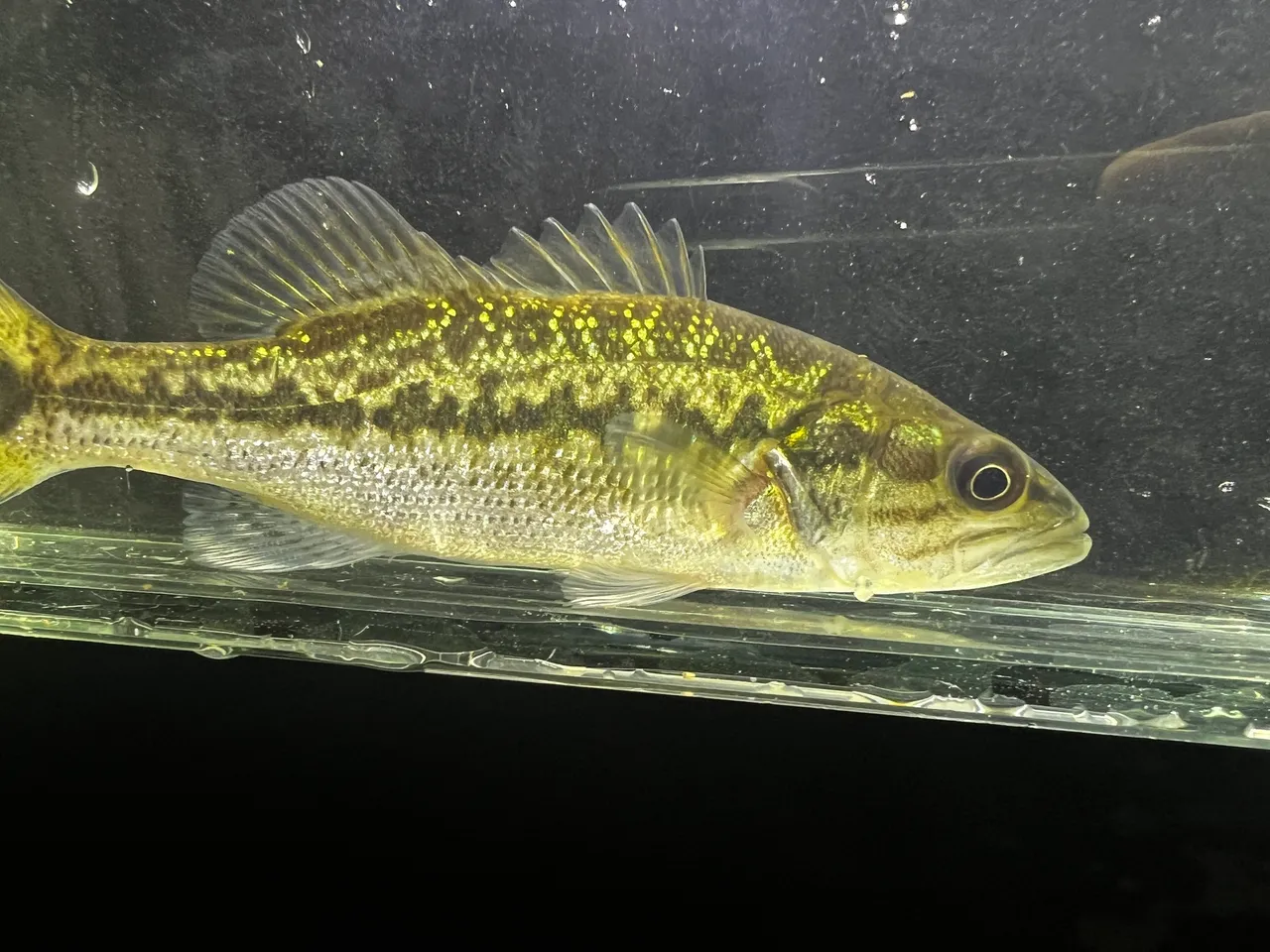
How this was identified, and who took it
Identified by: Rows of small dark spots below the lateral line forming longitudinal streaks, upper jaw terminating at approximately the posterior margin of the eye, and a broad connection between the spiny and soft dorsal fins — the three characters separating Micropterus punctulatus from M. salmoides and M. dolomieu. Four agreeing identifications on the source, none disagreeing.Nick Tobler (Cowturtle) — CC BY, via iNaturalist — source, licenceCatching Spotted bass
Everything here on fishing for it. Each entry opens the page behind it.
The spotted bass is the black bass that most anglers misidentify, because it sits between the other two in almost every respect: more tolerant of current than a largemouth, more tolerant of warm turbid water than a smallmouth, and intermediate in appearance.
Two characters separate it reliably. First, the rows of dark spots below the lateral line, forming distinct horizontal lines along the lower flank — the feature the name refers to and one neither of the other black basses shows. Second, and definitively, a small rough patch of teeth on the tongue, which largemouth and smallmouth lack. That patch requires the fish in hand but it is unambiguous.
The jaw test that separates largemouth from smallmouth places spotted bass with the smallmouth: the upper jaw does not extend past the rear of the eye. The dorsal fin is shallowly notched, again like a smallmouth.
Ecologically it favours the middle ground — rivers with some current, reservoir points and rocky banks — and it schools more readily than either relative, which is a genuine behavioural difference and means that finding one often means finding several. It has also been widely introduced within North America, where it hybridises with and displaces native black bass in several drainages.
Identification
- Scientific name
- Micropterus punctulatus
- Family
- Centrarchidae
- Water
- Freshwater
- Conservation status
- Least Concern
- Regions
- North America
- Rows of dark spots below the lateral line forming distinct horizontal lines along the lower flank — the character the name refers to and unique among the black basses.
- A small rough patch of teeth on the tongue, present in this species and absent in largemouth and smallmouth. Definitive but requires the fish in hand.
- Upper jaw not extending past the rear edge of the eye, as in smallmouth.
- Dorsal fin shallowly notched, appearing continuous, again as in smallmouth.
- A dark lateral band broken into blotches, less continuous than a largemouth's and more so than a smallmouth's barring.
Size
- Typical
- 300–800 g (10 oz–1.8 lb)
- Large
- 1.2–2 kg (2.6–4.4 lb)
Exceptional: Over 3 kg (6.6 lb); maximum published weight 4.7 kg
A gravel nest in current, and hybridisation as a conservation problem
Spotted bass spawn like other black bass, and the interesting part is what happens between species rather than within one.
THE MALE BUILDS AND GUARDS A NEST, fanning a depression in gravel or coarse substrate, usually in slightly deeper water and more current than largemouth choose. Spawning is triggered by rising spring water temperature.
HE TENDS THE EGGS AND GUARDS THE FRY as other black bass do, and nest abandonment leads to rapid predation of the brood.
SPOTTED BASS SPAWN SLIGHTLY LATER AND DEEPER THAN LARGEMOUTH in waters where both occur, which is part of how the two coexist.
HYBRIDISATION IS THE REAL STORY. Where spotted bass have been introduced outside their native range they hybridise readily with native black bass — notably with redeye and shoal bass in southeastern rivers — producing fertile offspring and progressively swamping the native genome. Several endemic black bass species are threatened principally by this mechanism rather than by fishing.
WHICH MAKES INTRODUCED SPOTTED BASS A CONSERVATION PROBLEM RATHER THAN A BONUS FISHERY in those systems, and it is why some management agencies actively discourage their spread and encourage their removal.
MATURITY IS AT A FEW YEARS and the species is comparatively short-lived and slow-growing, so trophy spotted bass are old fish.
Backed by research — why, and the sources (2)
Supported by peer-reviewed research or fisheries science. The sources are listed and can be checked.
- FishBase: a global information system on fishes — Froese, R. and D. Pauly, eds. — FishBase Consortium (Scientific institute)Relied on for: Distribution, habitat association, depth range, size, reproduction and life-history parameters recorded for the species.States this directlyPassage read and verified
- The IUCN Red List of Threatened Species — International Union for Conservation of Nature (Conservation authority)Relied on for: Assessment and range account for the species, including the habitats it depends on, its life history and the pressures acting on it.States this directlyCitation checked — the work exists and is described correctly
A current-loving bass that stays active when largemouth do not
Spotted bass seasonality differs from largemouth bass in ways that matter to anybody fishing water holding both.
THEY TOLERATE COLD BETTER THAN LARGEMOUTH and remain active and catchable in water temperatures at which largemouth become lethargic. In many reservoirs the winter black bass fishery is effectively a spotted bass fishery.
THEY GO DEEPER, and they go deeper earlier. Spotted bass suspend over deep structure and open water more readily than largemouth, and in summer and winter they are frequently found well below the depths a largemouth angler would search.
CURRENT IS THEIR PREFERENCE YEAR-ROUND. In rivers and in reservoirs with flow they hold on current-swept structure — points, bluff ends, channel edges — rather than in slack backwaters.
SPRING BRINGS THEM SHALLOW TO SPAWN, slightly later and slightly deeper than largemouth in the same water.
SUMMER SEES THEM SUSPEND AND FOLLOW BAIT, frequently in open water over deep structure, chasing shad.
AUTUMN CONCENTRATES THEM ON BAIT as it does most predators.
AND THE PRACTICAL POINT IS THE SPECIES CONFUSION. An angler fishing largemouth patterns in a mixed water in cold conditions will underperform, and recognising which bass a water actually holds is the first step in reading its season.
Backed by research — why, and the sources (2)
Supported by peer-reviewed research or fisheries science. The sources are listed and can be checked.
- FishBase: a global information system on fishes — Froese, R. and D. Pauly, eds. — FishBase Consortium (Scientific institute)Relied on for: Distribution, habitat association, depth range, size, reproduction and life-history parameters recorded for the species.States this directlyPassage read and verified
- The IUCN Red List of Threatened Species — International Union for Conservation of Nature (Conservation authority)Relied on for: Assessment and range account for the species, including the habitats it depends on, its life history and the pressures acting on it.States this directlyCitation checked — the work exists and is described correctly
Hybridisation, and why 'put it back' is not always the right answer
Spotted bass are handled exactly like the other black basses — the same solid bony jaw, the same lip grip, the same rule that the fish either hangs vertically or has a hand under its belly, and the same sharp dorsal met by the supporting hand. What is genuinely different about this species is the question of whether it should be returned at all.
THE PROBLEM IS HYBRIDISATION. Where spotted bass have been introduced outside their native range they interbreed with local black basses, and in several drainages the outcome has been the progressive genetic swamping of endemic species — most conspicuously in parts of the south-eastern United States, where distinctive local bass species occupy single river systems and have been substantially hybridised out by introduced spotted bass.
That is a different kind of harm from ordinary predation or competition. A predator can be removed and the prey population recovers. A genome that has been merged with another cannot be separated again, and an endemic species that exists in one river and nowhere else does not come back.
WHICH IS WHY 'RETURN EVERYTHING' IS NOT THE DEFAULT HERE. In a number of drainages the fisheries agency's position is explicitly that spotted bass should be removed rather than returned, sometimes with no bag limit and sometimes with active encouragement — and that position sits alongside strict protection for the native bass in the same water, which makes correct identification part of the handling decision rather than a matter of interest.
SO THE PRACTICAL SEQUENCE IS: know which water you are on, know what the agency's position is for that water, and be able to tell a spotted bass from the native species it resembles before deciding what happens to the fish in your hands. In its native range it is an ordinary and valued sport fish handled like any other black bass.
And whatever the decision, the handling until it is made is the same: wet hands, support the body, do not lever the jaw sideways, and do not leave the fish on a bank while working it out.
Official guidance — why, and the sources (2)
Stated by a fisheries authority, scientific institute or recognised angling body. Authoritative, but summarising rather than demonstrating.
- Check Clean Dry — biosecurity guidance for water users — GB Non-native Species Secretariat (Conservation authority)Relied on for: Regulatory approach to high-risk invasive freshwater fish, including prohibitions on live possession, on return to the water and on movement between waters.States this directlyPassage read and verified
- JNCC species and habitat conservation advice — Joint Nature Conservation Committee (Conservation authority)Relied on for: Conservation advice on native species and the impact of introduced ones.Background and mechanism onlyCitation checked — the work exists and is described correctly
Lifecycle and reproduction
Matures at two to three years and lives to around ten. Spawns in spring on gravel in nests swept by the male, who guards eggs and fry in the same pattern as the other black basses. Growth is intermediate between largemouth and smallmouth in most waters. Schools more readily than either relative, which is a real behavioural difference rather than a local observation.
Nest spawning in spring on gravel, with prolonged male parental care. Hybridisation with other black bass occurs where ranges overlap and is a documented conservation issue in several drainages, particularly where spotted bass have been introduced into waters holding endemic Micropterus species.
Feeding and senses
Feeds on crayfish, fish and aquatic insects, intermediate between the crayfish emphasis of smallmouth and the fish emphasis of largemouth. Feeds actively in current, which is one of the practical differences from largemouth: spotted bass hold in and feed from moving water in a way largemouth generally do not.
Sight-dominant in the clear to moderately stained water it prefers, with the lateral line supporting in current and turbidity. The schooling habit means that a lure worked through a group frequently produces multiple follows, which is a useful indicator of what has been found.
Through the year
Temperature-driven, moving shallow to spawn in spring, holding on points, rock and current seams through summer, feeding heavily in autumn and going deep and slow in cold water. Its greater tolerance of current means it holds in places where largemouth would not, which is the most useful practical distinction through the year.
Distribution
North America: native to the Mississippi River basin and Gulf drainages from Texas to Florida, and widely introduced elsewhere within the continent, where it has hybridised with and in places displaced native black bass species.
This is a biological range — where the species occurs, not a prediction that you will catch one. To browse the fishing geography FishingHQ holds, start at fishing places.
Why anglers care
A significant black bass fishery in the southern and central United States, taken on the same soft plastics, crankbaits, jigs and topwater used for its relatives, and frequently caught alongside them. Its schooling habit and current tolerance make it a distinct proposition despite the tackle overlap.
Handling and returning
Lipped like the other black basses with the body supported and the jaw not levered. Wet hands. The dorsal spines are sharp. Where the species is introduced and hybridising with native black bass, whether a fish should be returned is a local question rather than a default, and in several drainages it is actively not.
Going further
- What does spotted bass eat? — feeding biology, kept separate from what anglers infer from it.
- Spotted bass vs Smallmouth bass — how to tell them apart.
Safety
Biosecurity and disease transfer — Can cause serious injury or death
Spotted bass introduced outside their native range hybridise with and displace native black bass species, including endemic forms with restricted ranges.
What reduces it: Never move live fish or water between waters. Where the species is non-native, establish the local requirement rather than assuming a fish should be returned.
Injury while handling fish — Minor injury
Sharp dorsal spines and abrasive jaw teeth.
What reduces it: Wet hands before handling and lip the fish with the body supported.
Precautions that always apply here
- Wet your hands before touching a fish. Dry hands strip the protective mucus layer that keeps infection out.
- Support the fish's weight along its body, keep it out of the water for as short a time as possible, and hold it over something soft.
- Check, clean and dry your kit between different waters — the published guidance is 48 hours’ drying, in sunlight where possible, because a number of invasive species survive over two weeks in damp conditions. Nets, boots and wet mats move invasive species and disease more effectively than anything else anglers do.
- Never move live fish, live bait or water from one water to another.
Check the rules before you fish
Fishing laws, bylaws, access rules, seasons, bait restrictions and permitted methods vary by location and can change. Check the current rules from the relevant authority and the water you intend to fish before fishing.
Check with:
- Current national or regional law for where you are fishing
- Current local bylaws
- The relevant fisheries authority
- The landowner, club or fishery whose water it is
- Any restrictions specific to the species or the method you intend to use
Where to go next
Understanding this fish
Told apart from
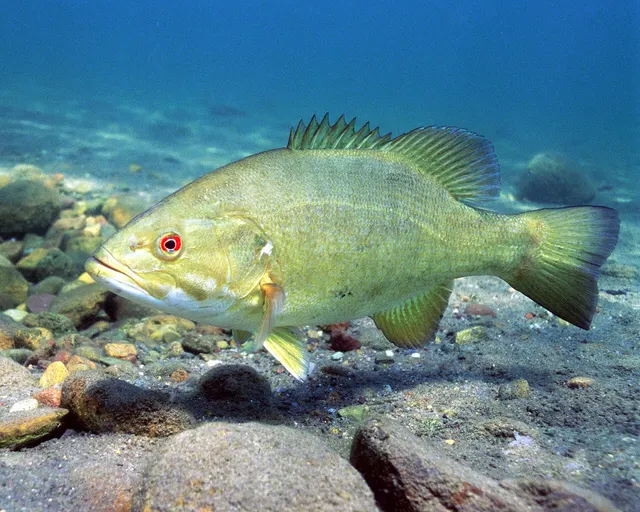 Smallmouth bassThe harder half of the same problem, and the one that catches out anglers who have learned the jaw rule. Neither has a jaw extending past the eye. A smallmouth is bronze with vertical bars and red eyes; a spotted bass is green with a lateral blotch line and the tongue tooth patch. Habitat helps and does not settle it, because the two overlap in exactly the current-swept rocky rivers both prefer.
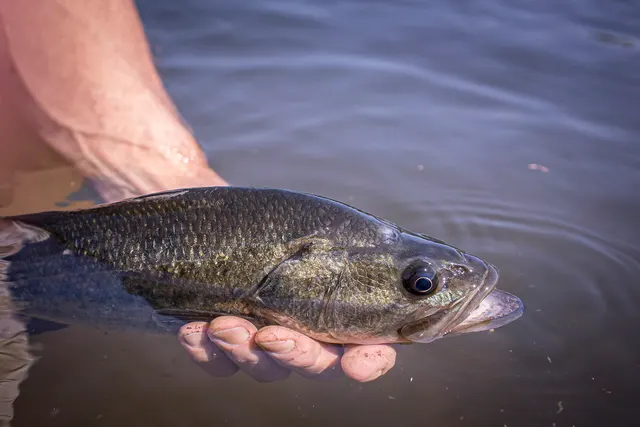 Largemouth bassThe black bass confusion with the most consequence, because bag and size limits frequently differ between them. The jaw is the field character: a largemouth's upper jaw extends BEHIND the eye, a spotted bass's does not. A spotted bass also carries a rough tooth patch on the tongue and rows of small dark spots below the lateral line that give it its name.
More fish
Not related to this page — just the rest of the section. There is little else joined to this subject yet, and a short page should still lead somewhere.
Sources and evidence
- FishBase: a global information system on fishes — Froese, R. and D. Pauly, eds. — FishBase Consortium (Scientific institute)Relied on for: Scientific name, family placement in the Centrarchidae, a maximum length of 63.5 cm TL, a maximum published weight of 4.7 kg, a maximum reported age of 7 years.States this directlyPassage read and verified
- FishBase: a global information system on fishes — Froese, R. and D. Pauly, eds. — FishBase Consortium (Scientific institute)Relied on for: Environment, climate zone and depth range as recorded: Freshwater; demersal. Subtropical; 40°N - 29°NStates this directlyPassage read and verified
- FishBase: a global information system on fishes — Froese, R. and D. Pauly, eds. — FishBase Consortium (Scientific institute)Relied on for: The IUCN Red List category for Micropterus punctulatus — Least Concern, assessed 01 March 2012 — as republished by FishBase, the Red List itself being unreachable during review.States this directlyPassage read and verified
- Check Clean Dry — biosecurity guidance for water users — GB Non-native Species Secretariat (Conservation authority)Relied on for: The framework by which introduced fish are assessed and managed, including hybridisation with native congeners as a recognised harm.FishingHQ's interpretation of what it saysPassage read and verified
Why the 5 connections on this page are here, and the sources
How it is caught
What experienced anglers do — 1 connection
Widely and independently recommended by experienced anglers and specialist sources. This is real angling knowledge, not proof: controlled evidence for it is limited, and FishingHQ records it as convention rather than as a demonstrated effect.
Drop shotting
Established angling practice for this species, recorded as convention. The note states the property of the animal or its water that makes the method the answer.
- IGFA International Angling Rules and World Record Requirements — International Game Fish Association (Angling or fisheries organisation)Relied on for: Recognition of the species as an established sport fish and the angling methods and tackle classes conventionally used for it.States this directlyPassage read and verified
- General angling website restatements of established technique — Various (Credible secondary source)Relied on for: Widely restated practice connecting this species and method.Background and mechanism onlyCitation checked — the work exists and is described correctly
Gear for this fish
What experienced anglers do — 1 connection
Widely and independently recommended by experienced anglers and specialist sources. This is real angling knowledge, not proof: controlled evidence for it is limited, and FishingHQ records it as convention rather than as a demonstrated effect.
Soft plastics
A practitioner claim about which lure family answers this species' feeding or holding behaviour.
- General angling website restatements of established technique — Various (Credible secondary source)Relied on for: Widely restated North American lure practice for this species.Background and mechanism onlyCitation checked — the work exists and is described correctly
- IGFA International Angling Rules and World Record Requirements — International Game Fish Association (Angling or fisheries organisation)Relied on for: Recognition of the species as an established sport fish taken on artificial lures, and the tackle conventions used for it.States this directlyPassage read and verified
Understanding this fish
Backed by research — 1 connection
Supported by peer-reviewed research or fisheries science. The sources are listed and can be checked.
Freshwater crayfish as prey
Recorded diet evidence identifies freshwater crayfish as a food item of this predator at group level rather than to species. The edge points at the taxon record for that reason, and encoding it as a species-level claim would assert something the source does not.
- FishBase: a global information system on fishes — Froese, R. and D. Pauly, eds. — FishBase Consortium (Scientific institute)Relied on for: Food items recorded for this predator, given as freshwater crayfish.States this directlyPassage read and verified
- FAO Species Identification Guides for Fishery Purposes and the FAO Species Catalogues — Food and Agriculture Organization of the United Nations (Scientific institute)Relied on for: Species account describing this predator's diet, recorded at the level of freshwater crayfish.Background and mechanism onlyCitation checked — the work exists and is described correctly
Told apart from
Backed by research — 2 connections
Supported by peer-reviewed research or fisheries science. The sources are listed and can be checked.
Smallmouth bass
An identification comparison naming both binomials, addressing a three-way confusion among the black basses.
- FishBase: a global information system on fishes — Froese, R. and D. Pauly, eds. — FishBase Consortium (Scientific institute)Relied on for: That Micropterus punctulatus and Micropterus dolomieu are congeners in the genus Micropterus with overlapping ranges in the central United States.States this directlyPassage read and verified
An identification link between two species readers genuinely mistake for one another, resting on published morphological characters rather than on angling lore, and naming the character that separates them.
- FishBase: a global information system on fishes — Froese, R. and D. Pauly, eds. — FishBase Consortium (Scientific institute)Relied on for: Morphological description, meristic counts, family placement, distribution and environment of the species named.States this directlyPassage read and verified
- FAO Species Identification Guides for Fishery Purposes and the FAO Species Catalogues — Food and Agriculture Organization of the United Nations (Scientific institute)Relied on for: Identification characters and distribution for inland and coastal fishes, from regional identification guides prepared for fishery purposes.States this directlyCitation checked — the work exists and is described correctly
Largemouth bass
An identification link between two species readers genuinely mistake for one another, resting on published morphological characters rather than on angling lore, and naming the character that separates them.
- FishBase: a global information system on fishes — Froese, R. and D. Pauly, eds. — FishBase Consortium (Scientific institute)Relied on for: Morphological description, meristic counts, family placement, distribution and environment of the species named.States this directlyPassage read and verified
- FAO Species Identification Guides for Fishery Purposes and the FAO Species Catalogues — Food and Agriculture Organization of the United Nations (Scientific institute)Relied on for: Identification characters and distribution for inland and coastal fishes, from regional identification guides prepared for fishery purposes.States this directlyCitation checked — the work exists and is described correctly
How FishingHQ labels evidence is explained in the evidence policy.