How to identify spotted bass
Micropterus punctulatus · Centrarchidae
The characters that identify spotted bass, ranked by how far each one can be trusted on its own.
Safety: biosecurity and disease transfer — can cause serious injury or death. One more point applies here.
How this was identified, and who took it
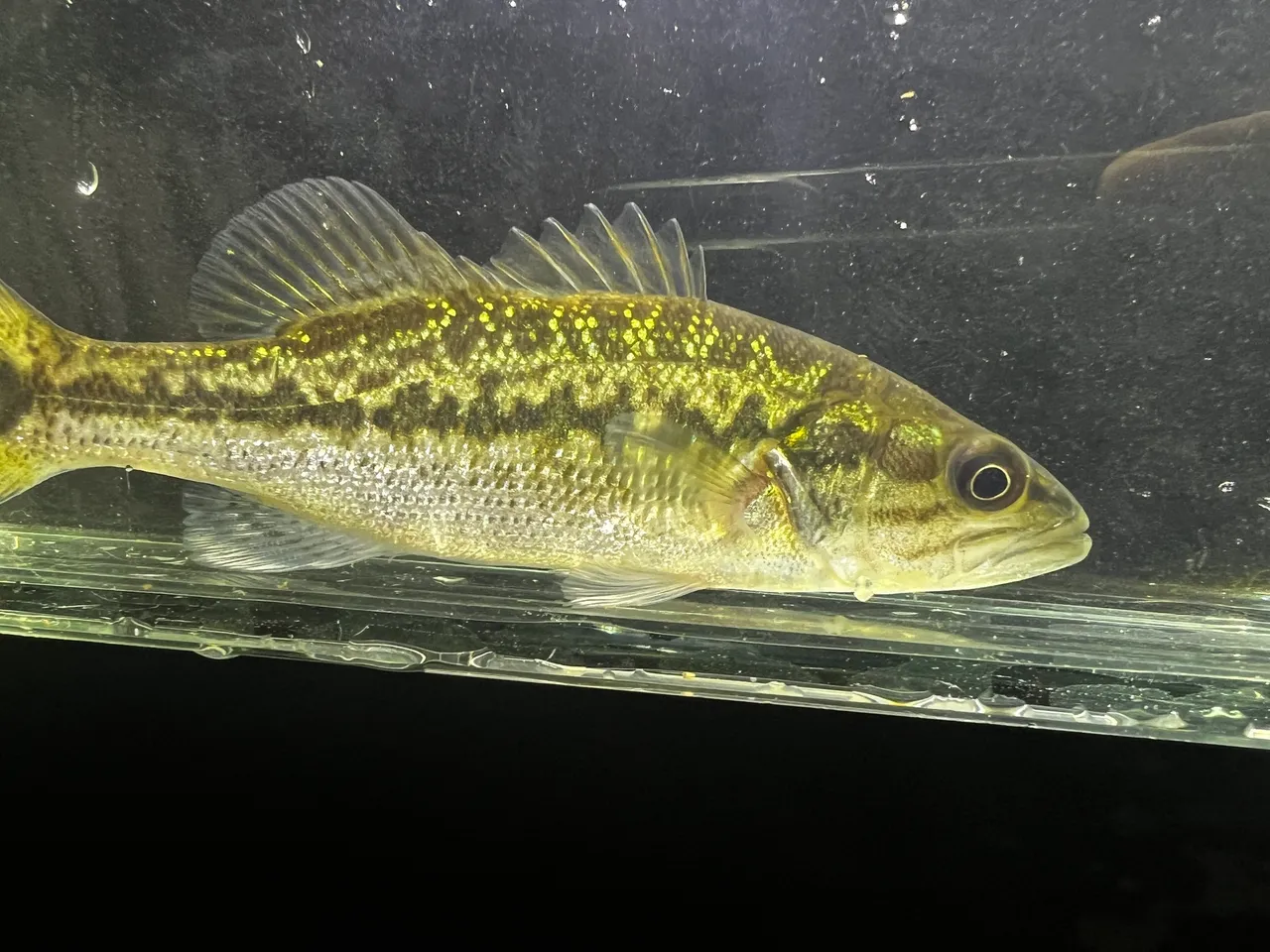
Identified by: Rows of small dark spots below the lateral line forming longitudinal streaks, upper jaw terminating at approximately the posterior margin of the eye, and a broad connection between the spiny and soft dorsal fins — the three characters separating Micropterus punctulatus from M. salmoides and M. dolomieu. Four agreeing identifications on the source, none disagreeing.Nick Tobler (Cowturtle) — CC BY, via iNaturalist — source, licenceAbout the image above: The photograph beside this page shows a captive fish in a photo tank rather than a wild one, and the tail is outside the frame. The rows of marks below the lateral line and the jaw are both clear, but the picture cannot show the shape of the tail or the fish's proportions along its whole length.
Look at this first
Run your eye along the belly side of the lateral line, below the dark band rather than on it. The small dark marks there are arranged in horizontal rows that read as broken lines running the length of the lower flank, and no other black bass carries them. That, and where the upper jaw stops, are the two things worth checking.
Diagnostic — settles it on its own
Each of these settles the identification on its own. If one is clear, you have your answer.
Rows of small dark marks below the lateral line
Below the level of the lateral line, on the lower half of the flank, there are rows of small dark marks lined up horizontally so that they read as a series of interrupted stripes rather than as random speckling. This is the marking the common name refers to and it is not carried by the largemouth or the smallmouth. It is the character to check first, and on a fish in reasonable condition it settles the identification against both of them.
A rough patch on the tongue
Open the mouth and draw a fingertip across the middle of the tongue. On this species there is a small oval patch of fine teeth there that feels like sandpaper; on the largemouth and the smallmouth the tongue is smooth. It is entirely reliable and it is available only with the fish in hand, which is why it sits second on this page rather than first: it cannot be checked from a photograph at all.
Supporting — use with other characters
Real characters that are not conclusive by themselves. Use two or three together.
An upper jaw stopping level with the back of the eye
With the mouth closed, follow the rear corner of the upper jaw and see where it ends relative to the eye. On this fish it finishes at about the back edge of the eye. On a largemouth it carries on well past it, which is the quickest separation of the two and works from a side-on photograph. It does not separate this species from the smallmouth, which is built the same way, so use it to eliminate the largemouth and then go back to the flank markings.
A dorsal fin only shallowly notched
Look at the dip between the spiny front section of the dorsal fin and the soft rear section. Here it is shallow, so the fin reads as a single continuous structure. On a largemouth the notch runs so deep that the two parts look almost separate. As with the jaw, this eliminates the largemouth and leaves the smallmouth, which shares the shallow notch.
Size, and how modest it is
Typical fish run 300 to 800 g, a large one is 1.2 to 2 kg, and anything over 3 kg is exceptional against a maximum published weight of 4.7 kg. This is a smaller fish than the largemouth it shares water with, and a very large black bass is more likely to be a largemouth or, in parts of the southeast, an Alabama bass. Size is weak evidence and is worth noting mainly because it makes an outsized claim worth re-checking.
Where it is native, and where it has been put
It is native to the Mississippi basin and the Gulf drainages from Texas to Florida, and has been introduced widely elsewhere in North America. The introductions matter to identification rather than only to conservation: where this fish has been moved into water holding other black basses it hybridises with them, so a reader in an introduced range is more likely to meet an intermediate fish than a reader inside the native one.
Suggestive only — varies with condition
Hints only. These vary with condition, season, water and how long the fish has been out of it, and a fish that contradicts them is still the same species.
A lateral band broken into blotches
The dark stripe along the middle of the flank is broken into a chain of separate blotches — less continuous than the largemouth's unbroken band and more organised than the smallmouth's vertical barring. It is a matter of degree between three species that all vary individually and with water clarity, so it is genuinely suggestive and nothing more. Never let it override the rows of marks below the lateral line.
Sitting in current that a largemouth would leave
Through the year this fish holds on points, rock and current seams, and it tolerates moving water better than the largemouth does. Finding a black bass holding station in a current seam is a genuine hint about which of the three it is. It is circumstantial and it belongs at the bottom of the page, because smallmouth do exactly the same thing and the two overlap widely.
What it gets confused with
- Largemouth bass, separated by the jaw reaching well past the eye and by the deeply notched dorsal fin.
- Smallmouth bass, which shares the jaw and dorsal characters and lacks the rows of marks below the lateral line.
- Alabama bass, split from this species relatively recently and not reliably separable by eye across much of the southeast.
- Redeye and shoal bass and the other southeastern black basses, several of which are local, similar and genuinely difficult.
- Hybrids between any of the above, which are common wherever black basses have been introduced.
Side by side: Spotted bass vs Smallmouth bass.
Where this stops working
Hybridisation is the real limit and it is not a marginal case. Where this species has been introduced into waters holding other black basses it interbreeds with them freely, and in several drainages that is a documented conservation problem involving endemic Micropterus species; the resulting fish are intermediate in the flank markings, the jaw and the dorsal notch alike. The Alabama bass was treated as a form of this species until recently and is still not separable from it by eye over much of the southeast. Small juveniles of all the black basses are harder than the adults and the flank markings are least developed at exactly the size where a reader most wants them. Finally, the tongue patch — the one character that is genuinely conclusive — cannot be checked from any photograph, so a picture-based identification of this species is always weaker than an in-hand one.
The full record
This page covers identification only. The Spotted bass record covers behaviour, lifecycle, distribution, handling and the sources behind all of it.
Reviewed 2026-08-17.
More about this fish
Telling it apart is one question. Here are the others.
How it is caught
Why the 1 connections on this page are here, and the sources
How it is caught
What experienced anglers do — 1 connection
Widely and independently recommended by experienced anglers and specialist sources. This is real angling knowledge, not proof: controlled evidence for it is limited, and FishingHQ records it as convention rather than as a demonstrated effect.
Drop shotting
Established angling practice for this species, recorded as convention. The note states the property of the animal or its water that makes the method the answer.
- IGFA International Angling Rules and World Record Requirements — International Game Fish Association (Angling or fisheries organisation)Relied on for: Recognition of the species as an established sport fish and the angling methods and tackle classes conventionally used for it.States this directlyPassage read and verified
- General angling website restatements of established technique — Various (Credible secondary source)Relied on for: Widely restated practice connecting this species and method.Background and mechanism onlyCitation checked — the work exists and is described correctly
Safety
Biosecurity and disease transfer — Can cause serious injury or death
Spotted bass introduced outside their native range hybridise with and displace native black bass species, including endemic forms with restricted ranges.
What reduces it: Never move live fish or water between waters. Where the species is non-native, establish the local requirement rather than assuming a fish should be returned.
Injury while handling fish — Minor injury
Sharp dorsal spines and abrasive jaw teeth.
What reduces it: Wet hands before handling and lip the fish with the body supported.