Golden mahseer
Fish · Last reviewed 2026-08-10
A huge Himalayan river carp reaching 275 cm, assessed as Endangered, and the fish around which the whole idea of Indian sport fishing was built.
Safety: moving water and currents — can cause serious injury or death. 6 more points apply here.
How this was identified, and who took it
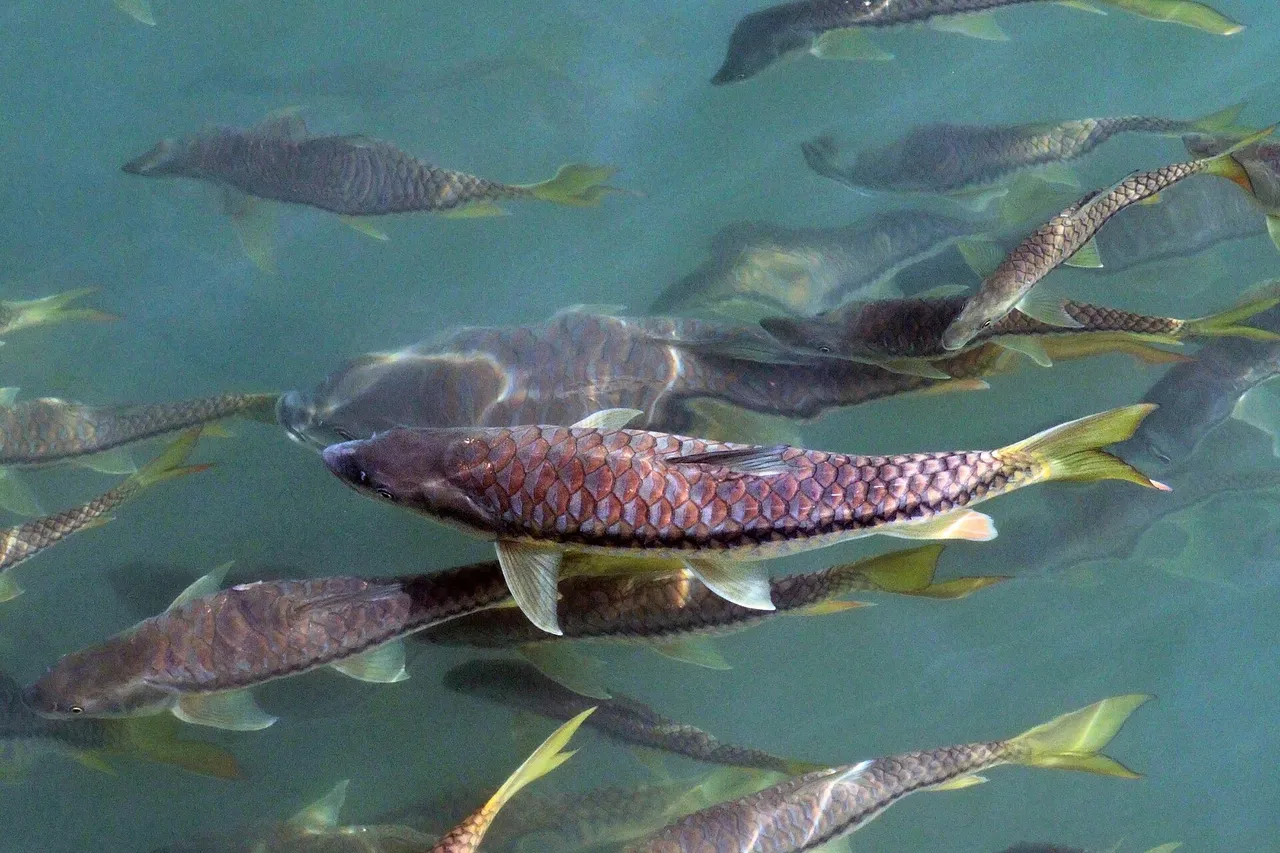
Identified by: A wild shoal in clear river water with one fish in near-full lateral view. The enormous scales that define a mahseer are unmistakable, along with the thick lips, golden-olive flank and yellow-tinged forked tail. All fish in frame are the same species.Charles J. Sharp — CC BY-SA 4.0, via Wikimedia Commons — source, licence_Babai_River.jpg)
Catching Golden mahseer
Everything here on fishing for it. Each entry opens the page behind it.
- Ground
The golden mahseer is a cyprinid — a carp relative — that reaches 275 centimetres and 54 kilograms in fast Himalayan rivers. That combination is startling enough on its own, and it explains why the fish acquired the reputation it did among nineteenth and twentieth-century anglers, for whom it was the freshwater equivalent of a salmon and considerably larger.
It lives in rapid streams with rocky bottoms, in riverine pools and in lakes, and it is potamodromous: it migrates from the lower to the middle reaches of rivers to spawn during low-flood phases, with fry remaining among stones at the stream margins. Like the golden dorado, its life history depends on rivers remaining connected and flowing.
It is assessed as **Endangered**, and FishBase records the reason plainly: overharvesting and habitat degradation, with fish exceeding thirty centimetres and five kilograms now rarely caught. A species that reaches 275 centimetres in which a five-kilogram fish has become uncommon is a species whose size structure has collapsed, and that is a more informative statement about its condition than any category.
FishingHQ includes it because it is genuinely important to South Asian angling and because a guide that only covers fish which are doing well is not describing the world.
How it is caught
- LedgeringStatic bottom baits in deep pools take mahseer holding out of the main current, and this is the traditional method of the Indian river fishery.
- SpinningHeavy spoons swung across fast Himalayan currents are the classic mahseer approach, and the weight is a response to the flow rather than to the fish.
Identification
- Scientific name
- Tor putitora
- Family
- Cyprinidae
- Water
- Freshwater
- Conservation status
- Endangered
- Regions
- South Asia
- Large cyprinid with very large, distinctly outlined scales — the character that gives mahseer their appearance of being armoured.
- Golden to brassy flanks with a darker back; fins often orange or reddish.
- Thick fleshy lips with two pairs of barbels, the mouth inferior and adapted to feeding off the bottom in current.
- Deeply forked tail and a powerful, streamlined body built for fast water.
- Several Tor species overlap across South Asia and are genuinely difficult to separate; scale count, lip structure and barbel proportion distinguish them rather than colour or size.
Size
- Typical
- 1–5 kg (2–11 lb)
- Large
- 10–20 kg (22–44 lb)
Exceptional: Over 30 kg (66 lb); maximum published weight 54 kg
Running upstream on the monsoon rise, to gravel in fast water
Golden mahseer spawning is a flood-triggered upstream migration, and it is the reason barriers matter so much to this species.
RISING WATER IS THE TRIGGER. Mahseer move upstream to spawn as rivers rise with the monsoon, and the cue is the rise itself rather than a date — so an early, late or weak monsoon moves or reduces the whole reproductive event.
THEY SPAWN IN FAST, SHALLOW, GRAVELLY REACHES, frequently in tributaries and upper reaches rather than in the main channel, where the substrate is clean and oxygenated.
MIGRATION DISTANCES ARE SUBSTANTIAL, and fish move from lower-river and reservoir feeding areas into headwater reaches to reproduce. A dam, a weir or a dewatered reach in between removes the population's ability to spawn regardless of how good either end is.
SPAWNING IS PROTRACTED AND MAY OCCUR IN SEVERAL BOUTS across the monsoon period rather than in a single event.
EGGS ARE DEPOSITED IN GRAVEL and depend on interstitial flow, so sedimentation — from road building, deforestation and sand and boulder mining — suffocates them. Sand mining in spawning reaches is a documented and serious pressure.
MATURITY IS LATE AND GROWTH IS SLOW, so populations recover slowly from over-exploitation.
AND THE CONCENTRATION DURING THE RUN IS THE VULNERABILITY. Migrating fish are predictable and interceptable, which is precisely when they most need protection, and it is the period the guarded-reach conservation arrangements on several rivers exist to cover.
Backed by research — why, and the sources (2)
Supported by peer-reviewed research or fisheries science. The sources are listed and can be checked.
- FishBase: a global information system on fishes — Froese, R. and D. Pauly, eds. — FishBase Consortium (Scientific institute)Relied on for: Distribution, habitat association, depth range, size, reproduction and life-history parameters recorded for the species.States this directlyPassage read and verified
- The IUCN Red List of Threatened Species — International Union for Conservation of Nature (Conservation authority)Relied on for: Assessment and range account for the species, including the habitats it depends on, its life history and the pressures acting on it.States this directlyCitation checked — the work exists and is described correctly
Handling a large fish in fast water, where release is the harder half
The handling difficulty with mahseer is not the fish's armament — there is none worth naming — but the water it is in.
A large mahseer is played in fast Himalayan current, and the release is where it goes wrong. A fish let go tired in heavy flow is swept, cannot hold station, and may not recover. Reviving it properly means holding it head-into the current in slower water at the margin until it is actively pushing against the hand, which takes longer than most anglers expect and cannot be hurried.
Handling itself is ordinary: support horizontally, wet hands, keep the fish in the water. The scales are hard and the fins strong, so the fish will scrape a forearm, but nothing here is dangerous to a person.
WHAT MAKES THIS SECTION DIFFERENT IS THE CONSERVATION POSITION. Tor putitora is assessed as Endangered. In a species with that status, catch-and-release handling technique is doing genuine conservation work rather than being a courtesy extended to the fish — and the corollary is honest too: declining to fish for them in depleted waters is a defensible position rather than an excessive one.
The angler's own safety belongs here as well. Wading fast rocky rivers that rise quickly with rain falling somewhere else is the largest hazard in this fishery, and it is not the fish.
Official guidance — why, and the sources (2)
Stated by a fisheries authority, scientific institute or recognised angling body. Authoritative, but summarising rather than demonstrating.
- The IUCN Red List of Threatened Species — International Union for Conservation of Nature (Conservation authority)Relied on for: Conservation assessment for Tor putitora.States this directlyCitation checked — the work exists and is described correctly
- Understanding the Complexity of Catch-and-Release in Recreational Fishing — Reviews in Fisheries Science 15:75–167, 2007 (Scientific literature)Relied on for: Recovery and revival as determinants of post-release survival, and the effect of exhaustion.States this directlyCitation checked — the work exists and is described correctly
A monsoon fish: spawning on the flood and fishing in the clear water either side of it
Mahseer seasonality is entirely subordinate to the monsoon, and describing it any other way produces nonsense.
THE MONSOON IS THE YEAR. Himalayan and peninsular river systems run through an annual cycle of pre-monsoon low clear water, a monsoon period of enormous, turbid, dangerous flow, and a long post-monsoon recession into clear, stable winter conditions. Everything about mahseer biology and everything about fishing for them sits somewhere in that cycle.
SPAWNING IS TIED TO THE MONSOON RISE. Mahseer undertake upstream migrations associated with rising water and spawn during and around the monsoon period, moving into tributaries and upper reaches to reach suitable gravel. The flood is both the cue and the means: it opens passage to habitat that is inaccessible in low water. That migratory requirement is why barriers on these rivers are so damaging to the species — a dam does not merely block a river, it removes a reproductive event.
THE MONSOON ITSELF IS NOT A FISHING SEASON. Rivers in full monsoon flow are turbid, enormous and hazardous, and the fish are dispersed and migrating. Many jurisdictions operate closed seasons around this period, and where they do, the reasons include both the spawning migration and the simple impossibility of the conditions. What any current closure is remains a matter for the competent authority.
THE PRODUCTIVE PERIODS ARE THE SHOULDERS. Post-monsoon, as the river drops and clears through autumn and into winter, fish settle into pools, runs and confluences and become findable in water that can actually be fished. Pre-monsoon, in the low warm water before the rains, fish concentrate in remaining deep water and feed, though warm low water brings its own handling problems for a large fish.
TEMPERATURE MODULATES ACTIVITY WITHIN THAT. Mahseer are less active in the coldest part of the winter in the high-altitude parts of the range, and most active in the warmer transitional periods.
AND THE CONSERVATION POSITION SITS OVER EVERYTHING. Several mahseer species are assessed as threatened, populations have declined substantially through habitat fragmentation, flow alteration and illegal fishing, and much of the surviving recreational fishery operates on a strict catch-and-release basis under local arrangements. Whether fishing is permitted at all on any particular water is a local question with a local answer.
Backed by research — why, and the sources (2)
Supported by peer-reviewed research or fisheries science. The sources are listed and can be checked.
- FishBase: a global information system on fishes — Froese, R. and D. Pauly, eds. — FishBase Consortium (Scientific institute)Relied on for: Spawning season, migratory behaviour, temperature preference and seasonal distribution recorded for the species.States this directlyPassage read and verified
- The IUCN Red List of Threatened Species — International Union for Conservation of Nature (Conservation authority)Relied on for: Assessment and life-history account, including reproductive timing and the seasonal pressures on the population.Background and mechanism onlyCitation checked — the work exists and is described correctly
Lifecycle and reproduction
Potamodromous, migrating from the lower to the middle reaches of streams and rivers to spawn during low-flood phases, with fry remaining in marginal stream areas among stones. Slow-growing and long-lived. The migration requirement makes the species acutely vulnerable to dams and barrages, and the size structure of remaining populations indicates sustained removal of the largest and oldest fish.
Spawns after an upstream migration during low-flood periods, with fry sheltering among marginal stones. Because both the migration and the specific flow conditions are required, populations fail where rivers are impounded or where flow regimes are altered — a failure that occurs regardless of how carefully the adult fishery is managed.
Feeding and senses
Omnivorous. Adults take fish, zooplankton, dipteran larvae and plant matter; juveniles subsist on plankton and fingerlings feed mainly on algae. That breadth is unusual for a fish this size and is a genuine cyprinid characteristic — the mahseer is a carp that got very large rather than a predator that got large.
Adapted to fast, often turbid mountain rivers. Barbels and taste carry a great deal of the load in finding food on and near the bottom, which is why bait fishing has historically dominated and why lure and fly fishing for the species is a comparatively recent development.
Through the year
Organised around the monsoon and the flood cycle rather than a temperate four-season year. Spawning migrations follow low-flood phases; the monsoon itself makes most rivers unfishable; and the productive angling periods sit either side of it. This is a case where describing the year by month would be actively misleading, since the monsoon's timing is what governs everything.
Distribution
Asia: Afghanistan, Pakistan, India, Nepal, Bangladesh, Bhutan and Myanmar. Inhabits streams, riverine pools and lakes, and is found in rapid streams with rocky bottoms.
This is a biological range — where the species occurs, not a prediction that you will catch one. To browse the fishing geography FishingHQ holds, start at fishing places.
Why anglers care
Historically the defining sport fish of South Asian angling and the subject of a substantial literature. Fished with bait, and increasingly with lures and fly. Today a significant catch-and-release fishery in parts of India and Nepal, where angling-led conservation and community river protection have become one of the more effective mechanisms for its survival — which makes recreational fishing part of the argument for the species rather than only a pressure on it.
Handling and returning
A large, powerful fish in fast water. Handle in the water, support horizontally, and revive fully in the current before release — a mahseer released tired in fast water will be swept and may not recover. Given the Endangered assessment, this is a species where catch-and-release handling technique is doing real conservation work rather than being a courtesy, and where choosing not to fish for it in depleted waters is a defensible position.
Going further
- What does golden mahseer eat? — feeding biology, kept separate from what anglers infer from it.
Safety
Moving water and currents — Can cause serious injury or death
This is fishing in fast Himalayan rivers with rocky beds, strong flow and rapidly changing levels. Wading is genuinely dangerous and rivers rise fast with rainfall in the catchment rather than overhead.
What reduces it: Do not wade fast rocky water alone. Use a wading staff, check the forecast for the catchment, and be willing to walk round rather than cross. Wear a buoyancy aid where flow is significant.
Injury while handling fish — Minor injury
A large, heavy, powerful fish with hard scales and strong fins, handled in current.
What reduces it: Support the body horizontally with wet hands and work in the water rather than lifting the fish out.
Precautions that always apply here
- Do not wade alone. Judge depth and flow from the bank first, and turn back sooner than feels necessary.
- Wear a buoyancy aid or lifejacket. Cold water incapacitates strong swimmers within a minute, long before swimming ability matters.
- Support the fish's weight along its body, keep it out of the water for as short a time as possible, and hold it over something soft.
- Wet your hands before touching a fish. Dry hands strip the protective mucus layer that keeps infection out.
- Tell somebody where you are going and when you expect to be back.
Check the rules before you fish
Fishing laws, bylaws, access rules, seasons, bait restrictions and permitted methods vary by location and can change. Check the current rules from the relevant authority and the water you intend to fish before fishing.
Check with:
- Current national or regional law for where you are fishing
- Current local bylaws
- The relevant fisheries authority
- The landowner, club or fishery whose water it is
- Any restrictions specific to the species or the method you intend to use
Where to go next
Similar and related fish
Where it lives
Where you will find it
Understanding this fish
Told apart from
Environment and conservation
Sources and evidence
- FishBase: a global information system on fishes — Froese, R. and D. Pauly, eds. — FishBase Consortium (Scientific institute)Relied on for: Scientific name, family placement in the Cyprinidae, maximum length of 275 cm and maximum published weight of 54 kg, distribution across Afghanistan, Pakistan, India, Nepal, Bangladesh, Bhutan and Myanmar, habitat in streams, riverine pools and lakes including rapid streams with rocky bottoms.States this directlyPassage read and verified
- FishBase: a global information system on fishes — Froese, R. and D. Pauly, eds. — FishBase Consortium (Scientific institute)Relied on for: The IUCN Red List category for Tor putitora — Endangered, assessed 5 August 2018 — as republished by FishBase.States this directlyPassage read and verified
Why the 9 connections on this page are here, and the sources
Similar and related fish
Backed by research — 1 connection
Supported by peer-reviewed research or fisheries science. The sources are listed and can be checked.
Deccan mahseer
An identification comparison naming both binomials: Tor khudree and Tor putitora.
- FishBase: a global information system on fishes — Froese, R. and D. Pauly, eds. — FishBase Consortium (Scientific institute)Relied on for: Morphological and distributional data for Tor khudree and for Tor putitora.States this directlyPassage read and verified
- The IUCN Red List of Threatened Species — International Union for Conservation of Nature (Conservation authority)Relied on for: Separate assessments treating Tor khudree and Tor putitora as distinct species.States this directlyCitation checked — the work exists and is described correctly
How it is caught
What experienced anglers do — 2 connections
Widely and independently recommended by experienced anglers and specialist sources. This is real angling knowledge, not proof: controlled evidence for it is limited, and FishingHQ records it as convention rather than as a demonstrated effect.
Ledgering
Established angling practice for this species, recorded as convention. The note states the property of the animal or its water that makes the method the answer.
- IGFA International Angling Rules and World Record Requirements — International Game Fish Association (Angling or fisheries organisation)Relied on for: Recognition of the species as an established sport fish and the angling methods and tackle classes conventionally used for it.States this directlyPassage read and verified
- General angling website restatements of established technique — Various (Credible secondary source)Relied on for: Widely restated practice connecting this species and method.Background and mechanism onlyCitation checked — the work exists and is described correctly
Spinning
Established angling practice for this species, recorded as convention. The note states the property of the animal or its water that makes the method the answer.
- IGFA International Angling Rules and World Record Requirements — International Game Fish Association (Angling or fisheries organisation)Relied on for: Recognition of the species as an established sport fish and the angling methods and tackle classes conventionally used for it.States this directlyPassage read and verified
- General angling website restatements of established technique — Various (Credible secondary source)Relied on for: Widely restated practice connecting this species and method.Background and mechanism onlyCitation checked — the work exists and is described correctly
Gear for this fish
What experienced anglers do — 1 connection
Widely and independently recommended by experienced anglers and specialist sources. This is real angling knowledge, not proof: controlled evidence for it is limited, and FishingHQ records it as convention rather than as a demonstrated effect.
Spoons
A practitioner claim about which lure family answers this species' feeding or holding behaviour.
- IGFA International Angling Rules and World Record Requirements — International Game Fish Association (Angling or fisheries organisation)Relied on for: Recognition of the species as an established sport fish taken on artificial lures, and the line and tackle classes used for it.States this directlyPassage read and verified
- General angling website restatements of established technique — Various (Credible secondary source)Relied on for: Widely restated lure practice for this species.Background and mechanism onlyCitation checked — the work exists and is described correctly
Where it lives
Backed by research — 1 connection
Supported by peer-reviewed research or fisheries science. The sources are listed and can be checked.
Lowland rivers
A habitat and life-history claim held to a scientific standard.
- FishBase: a global information system on fishes — Froese, R. and D. Pauly, eds. — FishBase Consortium (Scientific institute)Relied on for: That Tor putitora inhabits streams, riverine pools and lakes including rapid streams with rocky bottoms, and is potamodromous, migrating from lower to middle reaches for spawning during low-flood phases.States this directlyPassage read and verified
Where you will find it
Backed by research — 1 connection
Supported by peer-reviewed research or fisheries science. The sources are listed and can be checked.
The Himalayan mahseer rivers
A distribution association between an animal and a kind of water, rather than a claim about any named mark.
- The IUCN Red List of Threatened Species — International Union for Conservation of Nature (Conservation authority)Relied on for: Assessment and habitat account for the species, including the river or lake system it occupies and the pressures acting on it.States this directlyCitation checked — the work exists and is described correctly
- FishBase: a global information system on fishes — Froese, R. and D. Pauly, eds. — FishBase Consortium (Scientific institute)Relied on for: Distribution, habitat association, size and life history recorded for the species in the system concerned.States this directlyPassage read and verified
Understanding this fish
Backed by research — 1 connection
Supported by peer-reviewed research or fisheries science. The sources are listed and can be checked.
Aquatic insect larvae as prey
Recorded diet evidence identifies aquatic insect larvae as a food item of this predator at group level rather than to species. The edge points at the taxon record for that reason, and encoding it as a species-level claim would assert something the source does not.
- FishBase: a global information system on fishes — Froese, R. and D. Pauly, eds. — FishBase Consortium (Scientific institute)Relied on for: Food items recorded for this predator, given as aquatic insect larvae.States this directlyPassage read and verified
- FAO Species Identification Guides for Fishery Purposes and the FAO Species Catalogues — Food and Agriculture Organization of the United Nations (Scientific institute)Relied on for: Species account describing this predator's diet, recorded at the level of aquatic insect larvae.Background and mechanism onlyCitation checked — the work exists and is described correctly
Told apart from
Backed by research — 1 connection
Supported by peer-reviewed research or fisheries science. The sources are listed and can be checked.
Barbel
A comparison resting on shared family and shared feeding morphology, naming both binomials.
- FishBase: a global information system on fishes — Froese, R. and D. Pauly, eds. — FishBase Consortium (Scientific institute)Relied on for: That Tor putitora is a Cyprinidae of streams, riverine pools and lakes with an omnivorous diet including plant matter and invertebrates.States this directlyPassage read and verified
- Freshwater Fishes of the British Isles — HarperCollins (New Naturalist 75), 1992 (Reference work)Relied on for: The morphology and bottom-oriented feeding of Barbus barbus in European rivers, including its barbels and inferior mouth.States this directlyCitation checked — the work exists and is described correctly
Environment and conservation
Backed by research — 1 connection
Supported by peer-reviewed research or fisheries science. The sources are listed and can be checked.
Fish stocks and sustainability
A conservation claim resting on a republished assessment and on the source's own statement about the fishery's condition.
- FishBase: a global information system on fishes — Froese, R. and D. Pauly, eds. — FishBase Consortium (Scientific institute)Relied on for: The IUCN Red List category for Tor putitora — Endangered, assessed 5 August 2018 — as republished by FishBase, together with the statement that the species faces serious threats from overharvesting and habitat degradation with specimens exceeding 30 cm and 5 kg rarely caught.States this directlyPassage read and verified
How FishingHQ labels evidence is explained in the evidence policy.