What does golden mahseer eat?
What is established about how golden mahseer feeds, kept separate from what anglers infer from it.
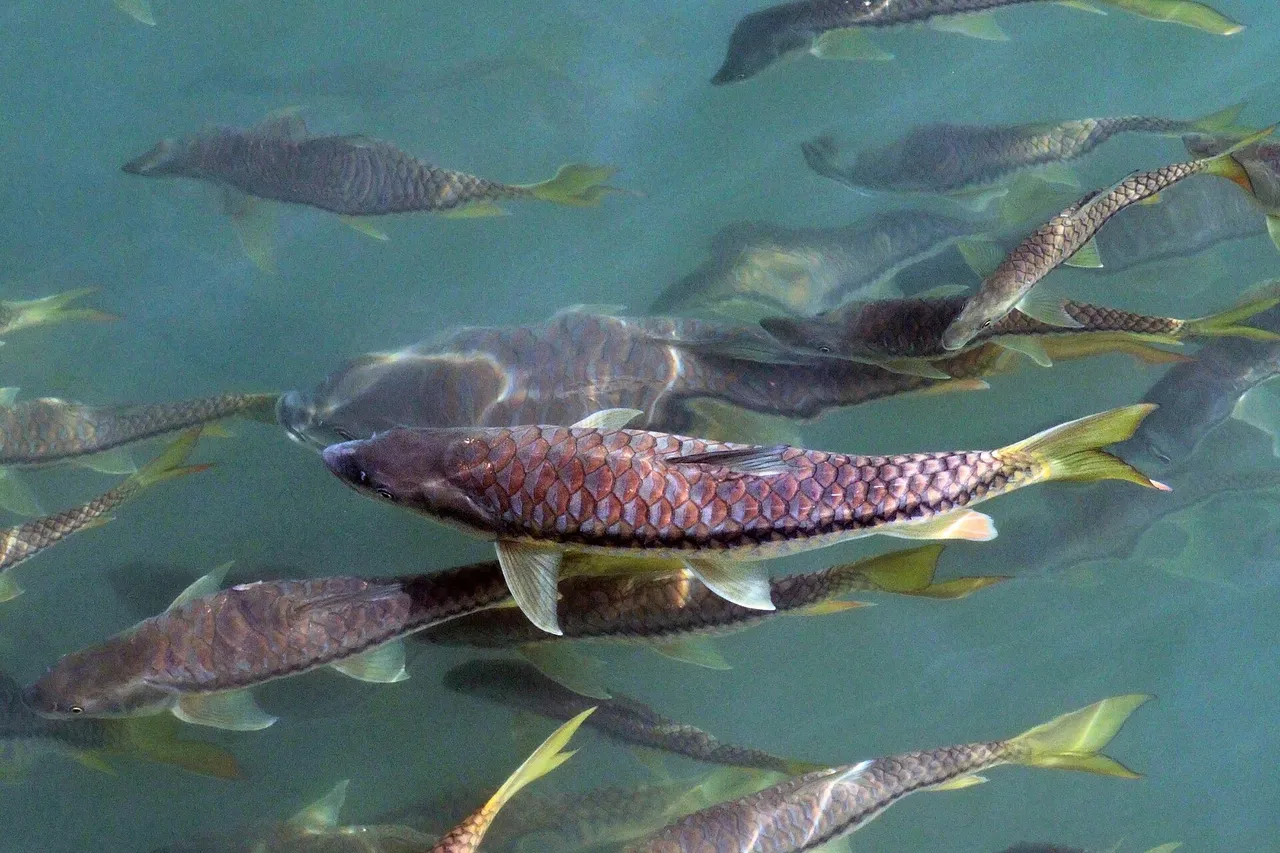
How this was identified, and who took it
Identified by: A wild shoal in clear river water with one fish in near-full lateral view. The enormous scales that define a mahseer are unmistakable, along with the thick lips, golden-olive flank and yellow-tinged forked tail. All fish in frame are the same species.Charles J. Sharp — CC BY-SA 4.0, via Wikimedia Commons — source, licenceWhat is known about how it feeds
The golden mahseer is a very large cyprinid, and cyprinids are omnivores — which produces a fish of considerable size with a diet nothing like that of a predator of the same length.
Adults take fish, zooplankton, dipteran larvae and plant matter. Juveniles subsist on plankton, and fingerlings feed mainly on algae. The verified relationship is aquatic insect larvae at group level, and it describes the invertebrate component that runs through most of the fish's life.
That breadth is genuinely unusual for a fish this size and it is a family characteristic rather than an individual quirk. A mahseer is a carp that grew large in a fast river, and it eats accordingly.
The habitat is the other defining fact. Mahseer occupy cold, fast, boulder-strewn Himalayan and sub-Himalayan rivers, holding in pools and pockets behind structure in heavy flow, and feeding on what the current delivers.
They are strongly migratory, moving upstream to spawn with the monsoon flows, and that migration is where the conservation problem sits: dams, water abstraction and mining of river gravel have blocked or destroyed spawning habitat across much of the range, and the species is now seriously depleted.
The fish is long-lived and slow-growing, so recovery from depletion is correspondingly slow.
The food
Prey with a verified dietary link to this fish. Each entry carries its own evidence, and each is written at the precision the source actually used: a named species where the source named one, a group or food category where it said “polychaetes”, “crustaceans” or “detritus” and meant it. That is why this list is shorter than the animal’s real diet rather than longer.
- Aquatic insect larvae as prey — a group rather than a species: the evidence names the group
Mahseer are omnivores taking insect larvae, molluscs and plant material, with fish prey becoming significant only in large individuals.
Food with no page of its own here yet
These are real components of the diet, listed as plain text because FishingHQ has no page for them yet. Inventing pages to make the list look fuller would be the fabrication this whole approach exists to prevent.
- small fish
- algae and plant material
- zooplankton, in juveniles
- molluscs
- fruit and seeds falling into the river
What anglers do with this
Everything below is interpretation, not finding. It is what experienced anglers conclude from the biology above, and the reasoning is usually sound and almost never tested. It is separated from the biology deliberately.
The omnivory means that both invertebrate-directed and fish-directed approaches work, and anglers use both — which is unusual and follows directly from the breadth of the diet.
The association with pockets and pools in heavy flow is the location method, and it follows from where a fish holding in a fast river can feed economically.
The conservation position dominates the fishery. Mahseer angling in most of the range is catch-and-release, several populations are protected, and a number of the surviving fisheries exist because angling interests funded their protection. What applies is a question for the relevant authority.
What this does not establish
One group-level relationship for a genuine omnivore whose plant, plankton and fish components are unrepresented. Composition varies enormously with fish size and with the river. The taxonomy of the mahseers is unsettled and some records may not refer to this species. Nothing establishes proportions.
Where this connects
These are the baits, lures, methods and explainers FishingHQ already joins to this fish — which is why the list is sometimes short. They are not chosen for this page, and a link here means an evidenced relationship exists, not that it follows from the diet.
Lures recorded for this species
Where it lives
This page covers feeding. The Golden mahseer record covers identification, lifecycle, seasonal behaviour, handling and the sources behind all of it.
Reviewed 2026-08-12.