The Himalayan mahseer rivers
Fishing regions · Last reviewed 2026-08-14
Snow-fed rivers falling off the Himalaya into the Gangetic plain, holding a migratory carp that reaches enormous size and became the subject of one of angling's oldest conservation arguments.
Safety: moving water and currents — can cause serious injury or death. 2 more points apply here.
Being listed here is not permission to fish. What that meansClose
Access, fishing rights, seasons, licences, local bylaws and permitted methods vary and can change. Check current access, permission, local regulations, closures and restrictions before you travel or fish. FishingHQ describes what the ground is and names who holds the answer; it does not hold the answer itself.
Find the authority for a jurisdiction · What FishingHQ does and does not cover
This is a system record because the rivers, the gradient, the snowmelt and the fish are a single explanation, and no jurisdiction along them contains the whole of it.
THE RIVERS FALL A VERY LONG WAY IN A SHORT DISTANCE. Fed by snowmelt and by monsoon rain, the rivers of the Himalayan foothills drop from high mountain to plain across a comparatively narrow band, producing cold, fast, boulder-strewn water with deep pools, rapids and long glides — a habitat closer to a very large Alpine river than to anything in lowland Asia.
THE HYDROGRAPH HAS TWO PEAKS AND THEY DO DIFFERENT THINGS. Spring snowmelt raises and cools the rivers; the summer monsoon raises them enormously and turns them brown and unfishable. Between and after those events the rivers clear and drop, and that is when they are fished.
MAHSEER ARE THE REASON THE SYSTEM HAS A REPUTATION. Large migratory cyprinids of the genus Tor and its relatives, they move upstream to spawn on rising water, feed in fast oxygenated reaches, reach very large sizes, and fight in heavy current in a way that made them the classic catch of colonial-era angling literature. Golden mahseer and deccan mahseer are both held on FishingHQ.
GOONCH AND OTHER LARGE CATFISH SHARE THE DEEP POOLS, holding on the bottom in heavy water and reaching sizes that put them among the largest freshwater fish in Asia.
AND THE CONSERVATION STORY IS THE MODERN ONE. Dams, water abstraction, sand mining, destructive fishing and habitat fragmentation have reduced mahseer populations substantially, and several species are threatened. The angling response — catch-and-release fisheries funding local guarding of river reaches — is one of the better documented examples anywhere of sport fishing being used as a conservation instrument, and it is contested rather than settled.
What fishing here is like
Fast, cold, boulder-bedded rivers falling from the Himalaya into the plains, with deep pools, rapids and long glides, running high and unfishable through the monsoon and clear in the cool months. The fishery is defined by large migratory cyprinids — the mahseer — and by the very large catfish that share the pools. Angling here is a wading and rock-hopping pursuit in heavy water, historically prestigious, currently small and conservation-oriented, and coexisting with a local subsistence fishery under real pressure.
What dominates
Lure and spinning fishing with heavy metal spoons and plugs in fast water, which is the classic mahseer approach. Bait fishing with dough, ragi paste and natural baits in pools and glides. Fly fishing, increasingly practised for mahseer and for the introduced and native trout of the higher tributaries. Deadbaiting and heavy static bait fishing for the large catfish of the deep pools. Local subsistence fishing with nets, traps and lines. Trout fishing in the cold headwaters, largely a colonial-era introduction, on quite different water from the mahseer reaches.
The water available
Steep snow-fed headwaters and cold tributaries; a middle zone of boulder-bedded rivers with pool-rapid sequences, deep holding pools below rapids, and long shallow glides; confluences where a cold clear tributary meets a larger turbid river, which are among the most important features in the system; braided reaches on the emerging plain with shifting gravel; and reservoirs impounded on several of the rivers, which now hold their own mahseer populations under quite different conditions from a river.
How the rules are structured
Inland fisheries in this region are a state or provincial responsibility, so licensing, closed seasons and permitted methods are set by the state fisheries department rather than nationally, and differ between the states the rivers cross. Substantial lengths of the best-known mahseer water lie inside national parks, tiger reserves and wildlife sanctuaries, where the governing authority is the forest or wildlife department and where the rules are conservation rules rather than fisheries rules — access, permits and whether angling is allowed at all are decided there. Several mahseer species carry conservation listing, and the taking of some is restricted. Elsewhere, angling on particular reaches is frequently managed by a community-based or lodge-based arrangement in which local people are employed to guard the water in exchange for the revenue, and the permission to fish comes from that arrangement rather than from a public right. Destructive fishing, including the use of explosives and poisons, is prohibited and remains an enforcement problem. FishingHQ does not state what any current rule is.
Who to ask
- The fisheries department of the state or province concerned, for inland fishing licences, seasons and permitted methods.
- The forest or wildlife department managing the national park, tiger reserve or sanctuary, where the river runs inside a protected area and where its rules take precedence.
- The community-based conservation or angling association managing a particular reach, which is frequently the body that grants access.
- The national environment or wildlife authority, for species protection listings and for the treatment of threatened fishes.
- The dam or irrigation authority controlling releases on a regulated river, whose operating pattern determines the flow an angler will meet.
Words you will meet
- Mahseer
- A group of large migratory cyprinids of the genus Tor and its relatives. The name covers several species whose taxonomy has been revised repeatedly, so a historical record of a mahseer catch may not identify the fish a modern list would.
- Goonch
- A very large bottom-dwelling catfish of the deep pools, adapted to hold station on the bed in heavy current. It shares the mahseer water and is the other large fish of the system.
- Ragi
- Finger millet, made into a paste and used as the traditional mahseer bait. Its use is well documented in the angling literature of the region and is still practised where bait fishing is permitted.
- Confluence
- The junction of a clear cold tributary with a larger river. These are the key features of the system: they concentrate fish, they mark the change from turbid to clear water, and much of the fishing history of these rivers happened at them.
- Catch-and-release conservation fishery
- An arrangement in which angling revenue funds local guarding of a river reach against netting, dynamiting and poisoning. Established on several Indian rivers and one of the better-documented cases of angling used deliberately as a conservation instrument.
Conditions and hazards
These are powerful mountain rivers and wading them is the principal hazard: boulder beds are unstable and slippery, the current is strong enough to sweep a standing person off their feet in less depth than expected, and a fall in fast water among boulders carries an entrainment as well as a drowning risk. Levels change quickly with rain upstream and with dam releases on regulated rivers, and a rise can arrive under a clear sky. The monsoon makes the rivers dangerous rather than merely unfishable. Terrain is steep and remote, medical help can be hours away, and roads are subject to landslides. A great deal of the best-known water lies inside protected areas holding tigers, leopards, elephants and bears, and the risk from large animals is real, particularly at dawn and dusk and on paths between camp and river. Heat in the foothills is severe in the pre-monsoon months, and altitude affects the higher tributaries.
Gradient, snowmelt and monsoon: why these rivers behave as they do
The physical setting explains both the fish and the fishing, and it is unlike anything on FishingHQ's European or North American freshwater records.
THE FALL IS EXTREME AND CONCENTRATED. These rivers descend from high mountain to plain over a comparatively short horizontal distance, so gradient is high, energy is high, and the bed is boulder and cobble rather than gravel or silt. The resulting form is a pool-rapid sequence: fast broken water dropping into deep holding pools, separated by glides.
THE WATER IS COLD AND WELL OXYGENATED because it is largely snow and glacier melt in its upper reaches, which is why a fish that would be a warm-water cyprinid elsewhere behaves here like a fast-water species.
THE HYDROGRAPH HAS TWO DISTINCT RISES. Spring snowmelt lifts and cools the rivers gradually. The summer monsoon lifts them enormously and abruptly, filling them with sediment, moving the bed, and putting them out of use entirely for months. The two events are ecologically different: one is a temperature and flow cue, the other is a scouring flood.
CONFLUENCES ARE THE KEY FEATURE. Where a clear cold tributary joins a larger, warmer, more turbid river, there is a boundary in temperature, clarity and oxygen that concentrates fish, and a scour hole that gives them depth. Much of the fishing on these systems has always happened at confluences, and the historical angling literature is full of them.
DEEP POOLS BELOW RAPIDS ARE THE OTHER KEY FEATURE, and they are what carries fish through the low-water months. The same logic as the Mekong's dry-season refuges applies at a smaller scale: the pool is the bottleneck.
AND DAMS HAVE CHANGED THE PATTERN ON MANY RIVERS. Impoundment converts a section of river to a reservoir, changes the temperature and timing of downstream flow, and blocks migration. Several of these rivers now have mahseer populations living in reservoirs, which is a different animal ecologically from a river fish even where it is the same species.
Backed by research — why, and the sources (2)
Supported by peer-reviewed research or fisheries science. The sources are listed and can be checked.
- The IUCN Red List of Threatened Species — International Union for Conservation of Nature (Conservation authority)Relied on for: Assessment and habitat accounts for the migratory river cyprinids of the region, their spawning requirements and the pressures acting on them.States this directlyCitation checked — the work exists and is described correctly
- FishBase: a global information system on fishes — Froese, R. and D. Pauly, eds. — FishBase Consortium (Scientific institute)Relied on for: Distribution, habitat association, size and life history recorded for the species of the system.States this directlyPassage read and verified
Mahseer, goonch and the taxonomy that keeps moving
The species story here has an unusual complication that any honest record has to state: nobody is entirely sure how many mahseer there are.
MAHSEER IS A GROUP RATHER THAN A SPECIES. The name covers several large cyprinids of the genus Tor and related genera across South and South-East Asia. Their taxonomy has been revised repeatedly, several historically recognised names have been reassigned, and the identity of some famous historical fish is genuinely uncertain. A reader should treat 'mahseer' as a functional group and check which species is meant.
GOLDEN MAHSEER IS THE HIMALAYAN ONE. A migratory cyprinid of the foothill rivers, moving upstream on rising water to spawn, feeding in fast oxygenated reaches, growing large and long-lived. Deccan mahseer occupies the peninsular rivers to the south and is a separate story on separate water.
THEY ARE MIGRATORY, AND THAT IS THE VULNERABILITY. Movement between feeding, holding and spawning habitat over substantial distances means that a barrier anywhere in the system affects the whole population, and that fish are predictable and interceptable when they run.
GOONCH SHARES THE DEEP POOLS. A very large bottom-dwelling catfish adapted to hold station on the bed in heavy current, with a flattened head and enormous pectoral fins for exactly that purpose. It reaches sizes that place it among Asia's largest freshwater fish and it is taken on heavy static baits.
SNOW TROUT AND HILL-STREAM CYPRINIDS FILL THE COLDER UPPER REACHES, and introduced brown and rainbow trout occupy some of the highest tributaries as a legacy of colonial-era stocking — a different fishery on different water from the mahseer reaches, and one with its own conservation questions about native species.
AND SEVERAL OF THESE FISH ARE THREATENED. Habitat fragmentation, abstraction, sand mining, pollution and destructive fishing have reduced populations substantially, and conservation listing reflects that. A record of this system that presented it as an intact fishery would be describing the nineteenth century rather than the present.
Backed by research — why, and the sources (2)
Supported by peer-reviewed research or fisheries science. The sources are listed and can be checked.
- The IUCN Red List of Threatened Species — International Union for Conservation of Nature (Conservation authority)Relied on for: Assessment and habitat accounts for the migratory river cyprinids of the region, their spawning requirements and the pressures acting on them.States this directlyCitation checked — the work exists and is described correctly
- FishBase: a global information system on fishes — Froese, R. and D. Pauly, eds. — FishBase Consortium (Scientific institute)Relied on for: Distribution, habitat association, size and life history recorded for the species of the system.States this directlyPassage read and verified
Heavy spoons in fast water, and the other ways these rivers are fished
Mahseer angling is a distinctive discipline and it is shaped entirely by the water it is done in.
SPINNING WITH HEAVY METAL IS THE CLASSIC APPROACH. A substantial spoon or plug cast across and swung through fast water, fished deep enough to work in current that would lift anything lighter, is the technique the sport is built on. The tackle is heavy by freshwater standards because the fish are strong, the current is strong, and the ground is boulder.
BAIT FISHING WITH RAGI PASTE IS THE OLDER METHOD and is well documented in the angling literature of the region. A paste of finger millet fished in a pool or the tail of a glide, on strong tackle, catches large mahseer, and where bait fishing is permitted it remains effective.
FLY FISHING HAS GROWN and is now a serious approach for mahseer as well as for the trout of the higher tributaries. It demands heavy lines, big flies and an ability to fish them deep in current.
DEADBAITING AND HEAVY STATIC FISHING TAKE THE CATFISH, worked into the deep pools where goonch hold on the bed.
THE PHYSICAL FORM OF THE FISHING IS ROCK-HOPPING AND WADING. There is very little bank fishing in the European sense: the angler moves along a boulder bed, wades where the current allows, and fights fish that run downstream into rapids. It is demanding and it is where most of the risk lies.
THE LOCAL SUBSISTENCE FISHERY USES NETS, TRAPS AND LINES and is a different activity on the same water. Where destructive methods have been used — explosives and poisons in particular — the damage is severe and indiscriminate, and it is precisely what the guarded-reach conservation arrangements exist to stop.
AND RESERVOIR FISHING IS NOW A REAL BRANCH OF THE SPORT on impounded rivers, with boats, different tackle and a different fish behaviour. It is not a substitute for river fishing and should not be described as one.
What experienced anglers do — why, and the sources (2)
Widely and independently recommended by experienced anglers and specialist sources. This is real angling knowledge, not proof: controlled evidence for it is limited, and FishingHQ records it as convention rather than as a demonstrated effect.
- FAO fishing gear types and fishing technology information — Food and Agriculture Organization of the United Nations (Scientific institute)Relied on for: Descriptions of fishing gear types and their operation, including the small-scale and pole-and-line gears used in the region.States this directlyCitation checked — the work exists and is described correctly
- IGFA International Angling Rules and World Record Requirements — International Game Fish Association (Angling or fisheries organisation)Relied on for: International recreational angling practice, tackle categories and the conventions applied to recognised catches.Background and mechanism onlyPassage read and verified
Two windows a year, and the flood that closes everything between them
The fishing year on these rivers is short, and it is defined by what the water is doing rather than by temperature.
THE MONSOON CLOSES THE RIVERS. For months the rivers run very high, brown and dangerous. Fishing is impossible and being near the water is unwise. This is also the period in which the major spawning migration occurs, cued by rising water, so a closed season over the monsoon is both a safety and a biological measure wherever it is applied.
THE POST-MONSOON WINDOW IS THE FIRST FISHING PERIOD. As the rains end, levels fall and the rivers clear from the top down. Fish are dispersed and feeding, water is still warm, and the fishing improves as clarity returns. This is the more productive of the two windows on many rivers.
WINTER IS COLD AND CLEAR AND SLOW. Snowmelt has stopped, levels are at their lowest, and the water is very clear. Fish concentrate in the deeper pools, feeding is reduced, and the fishing becomes a stalking exercise in low water rather than a covering exercise in fast water.
THE PRE-MONSOON WINDOW IS THE SECOND FISHING PERIOD AND THE HOTTEST. Spring snowmelt begins to lift and cool the rivers, fish become active again, and there is a period of good fishing before the monsoon arrives. Air temperature in the foothills in this period is severe.
THE SPAWNING MIGRATION IS THE BIOLOGICAL EVENT THAT MATTERS. Mahseer move upstream on rising water, which means the migration is cued by the monsoon rather than by a date, and a late or weak monsoon moves or reduces it. Fish are concentrated and predictable when they run, which is exactly when they need protecting.
AND ON REGULATED RIVERS THE DAM SETS THE SEASON. Where flow is controlled by releases, the effective hydrograph is an operational decision rather than a natural one, and the fishing follows the release pattern rather than the weather.
Backed by research — why, and the sources (2)
Supported by peer-reviewed research or fisheries science. The sources are listed and can be checked.
- The IUCN Red List of Threatened Species — International Union for Conservation of Nature (Conservation authority)Relied on for: Assessment and habitat accounts for the migratory river cyprinids of the region, their spawning requirements and the pressures acting on them.States this directlyCitation checked — the work exists and is described correctly
- FishBase: a global information system on fishes — Froese, R. and D. Pauly, eds. — FishBase Consortium (Scientific institute)Relied on for: Distribution, habitat association, size and life history recorded for the species of the system.States this directlyPassage read and verified
State fisheries law, park rules, and a permission that usually comes from a village
Access to these rivers is governed by an unusual stack of authorities, and knowing which one applies is more useful than knowing any individual rule.
INLAND FISHERIES ARE A STATE SUBJECT. Licences, closed seasons and permitted methods are set by the state or provincial fisheries department, and the rivers cross state boundaries, so the framework changes along a single river.
MUCH OF THE PRINCIPAL WATER LIES INSIDE A PROTECTED AREA, AND THEN THE PARK RULES GOVERN. National parks, tiger reserves and wildlife sanctuaries cover substantial lengths of the famous mahseer rivers. Inside them, the forest or wildlife department decides whether angling happens at all, on what terms, and where a person may go — and these are conservation rules rather than fisheries rules, made for reasons that have nothing to do with fish.
SPECIES PROTECTION APPLIES INDEPENDENTLY. Several mahseer species carry conservation listing, and the treatment of threatened fishes is set nationally rather than by state fisheries rules.
AND ON UNPROTECTED WATER, PERMISSION IS FREQUENTLY A LOCAL ARRANGEMENT. On a number of reaches, angling is managed by a community-based conservation association or by a lodge working with one, under which local people are employed to guard the river against netting, dynamiting and poisoning, funded by angling revenue. Permission to fish comes from that arrangement. This is a genuine institution rather than an informal courtesy, and it is the reason those reaches still hold fish.
DESTRUCTIVE FISHING IS PROHIBITED AND STILL HAPPENS. Explosives and poisons kill everything in a pool including the year classes a fishery depends on, and stopping them is the practical purpose of most guarding arrangements.
DAM AND ABSTRACTION DECISIONS SIT OUTSIDE THE FISHERIES SYSTEM ENTIRELY, and they are the largest single influence on these rivers. That is a structural point worth stating: the authority with the most effect on the fishery is frequently not a fisheries authority.
FISHINGHQ DOES NOT STATE WHAT ANY OF THIS CURRENTLY PERMITS. On rivers where access depends on a park decision or a village arrangement, that is not a thing a reference work can hold.
Official guidance — why, and the sources (2)
Stated by a fisheries authority, scientific institute or recognised angling body. Authoritative, but summarising rather than demonstrating.
- Good Fish Guide — Marine Conservation Society (Conservation authority)Relied on for: Assessment of fisheries and the management measures applied to them, including gear selectivity and spatial protection.States this directlyCitation checked — the work exists and is described correctly
- Code of Conduct for Responsible Fisheries — Food and Agriculture Organization of the United Nations, Rome, 1995 (Standards body)Relied on for: Principles for responsible fisheries management, precaution, gear selectivity and the treatment of small-scale and shared stocks.States this directlyCitation checked — the work exists and is described correctly
Mahseer, ragi and a vocabulary inherited from two directions
The words used on these rivers come from local languages and from a century of angling literature, and the two do not always agree.
MAHSEER IS THE CENTRAL WORD AND IT IS IMPRECISE BY NATURE. It names a group rather than a species, its application has shifted as the taxonomy has been revised, and historical records using it cannot always be matched to a modern species. Anyone reading old accounts should treat the identifications with caution, which is a genuinely useful thing to know rather than a pedantic one.
GOONCH NAMES THE LARGE CATFISH OF THE POOLS and is the standard name in both local and angling use.
RAGI IS FINGER MILLET, and its use as a mahseer bait paste is specific enough that the word functions as a fishing term rather than a crop name in this context.
CONFLUENCE IS A PLAIN ENGLISH WORD DOING TECHNICAL WORK HERE. On these rivers it names the single most important feature type — the meeting of a clear cold tributary with a larger river — and the angling literature of the region treats confluences as the fundamental unit of the fishery.
THE COLONIAL ANGLING LITERATURE SUPPLIED A GREAT DEAL OF THE ENGLISH VOCABULARY, and it should be read with its context visible. It is a genuine and detailed record of the rivers as they were, and it is also the literature of an imperial sporting culture. Both facts are true and FishingHQ holds them together rather than choosing one.
AND THE LOCAL NAMES VARY BY LANGUAGE AND BY VALLEY. The rivers cross several linguistic regions, and fish names, pool names and gear names change with them. FishingHQ records the terms that are stable in the published record and does not manufacture a single vocabulary for a system that has several.
What experienced anglers do — why, and the sources (2)
Widely and independently recommended by experienced anglers and specialist sources. This is real angling knowledge, not proof: controlled evidence for it is limited, and FishingHQ records it as convention rather than as a demonstrated effect.
- FAO fishing gear types and fishing technology information — Food and Agriculture Organization of the United Nations (Scientific institute)Relied on for: Descriptions of fishing gear types and their operation, including the small-scale and pole-and-line gears used in the region.States this directlyCitation checked — the work exists and is described correctly
- IGFA International Angling Rules and World Record Requirements — International Game Fish Association (Angling or fisheries organisation)Relied on for: International recreational angling practice, tackle categories and the conventions applied to recognised catches.Background and mechanism onlyPassage read and verified
The Victorian fishery, the collapse, and the guarded reach
These rivers have one of the longest continuous angling records outside Europe, and the arc of it is worth setting out plainly.
THE COLONIAL-ERA FISHERY PRODUCED A LARGE LITERATURE. From the nineteenth century onwards, British anglers in India fished the mahseer rivers and wrote extensively about them, producing detailed accounts of tackle, methods, rivers and catches. That literature is the reason mahseer became internationally known and it remains a substantial historical record of the rivers before modern pressures.
IT WAS ALSO THE LITERATURE OF AN IMPERIAL SPORTING CULTURE, written by and for a colonial administrative class, and the fishing it describes was practised alongside a local subsistence fishery it largely did not discuss. FishingHQ records both the value of the record and the circumstances of its production.
THE TWENTIETH CENTURY BROUGHT THE PRESSURES. Dam construction fragmented migration routes and converted river reaches to reservoirs; abstraction reduced flows; sand and boulder mining removed spawning and holding habitat; pollution affected the lower reaches; and destructive fishing with explosives and poisons removed whole pools. Mahseer populations declined substantially and several species are now assessed as threatened.
THE CONSERVATION ANGLING MODEL EMERGED IN RESPONSE. From the later twentieth century, angling associations and lodges on several rivers began paying local people to guard reaches against destructive fishing, funded by strictly catch-and-release angling. Where it has been sustained, the recovery of fish stocks on guarded reaches is documented, and the model has been influential well beyond India.
IT IS ALSO CONTESTED, AND HONESTLY SO. Critics point out that it makes access to a public resource conditional on a commercial fishery, that the benefit is concentrated where anglers want to fish, and that it does nothing about dams, abstraction or mining. Supporters point out that it works on the reaches where it operates and that nothing else has. Both positions are reasonable and this page does not pretend the question is settled.
AND TROUT ARE THE OTHER COLONIAL LEGACY. Brown and rainbow trout stocked into the high tributaries in the same era support a small fishery today and raise their own questions about introduced species in native hill-stream systems.
Official guidance — why, and the sources (2)
Stated by a fisheries authority, scientific institute or recognised angling body. Authoritative, but summarising rather than demonstrating.
- Good Fish Guide — Marine Conservation Society (Conservation authority)Relied on for: Assessment of fisheries and the management measures applied to them, including gear selectivity and spatial protection.States this directlyCitation checked — the work exists and is described correctly
- Code of Conduct for Responsible Fisheries — Food and Agriculture Organization of the United Nations, Rome, 1995 (Standards body)Relied on for: Principles for responsible fisheries management, precaution, gear selectivity and the treatment of small-scale and shared stocks.States this directlyCitation checked — the work exists and is described correctly
A prestige fishery in somebody else's valley
The culture around these rivers involves several groups whose interests do not align neatly, and describing it honestly means saying so.
THE INTERNATIONAL SPORT FISHERY IS SMALL, EXPENSIVE AND RELEASE-ONLY. Anglers travel a long way for a fish with a large reputation, fish hard water for few takes, and return everything. The catch-and-release ethic in this fishery is unusually strict and is a condition of most access arrangements rather than a preference.
THE LOCAL FISHERY IS FOOD AND INCOME. People living along these rivers have fished them for generations with nets, traps and lines. Where guarding arrangements operate, some of those same people are employed to protect the reach, which converts a conflict into a livelihood — and that conversion is the whole design of the model.
THE TENSION IS REAL AND SHOULD NOT BE SMOOTHED OVER. A conservation fishery funded by visiting anglers restricts local access to a public resource in exchange for money and employment. Whether that is a fair bargain is a live question with reasonable views on both sides, and the answer differs between rivers depending on how the arrangement was made and who benefits.
THE HANDLING STANDARD IS EXCEPTIONALLY DEMANDING AND IS PART OF THE CULTURE. A large mahseer fought in heavy warm water in summer, landed on a boulder bank, is a fish at real risk. Practice in this fishery — keeping fish in water, supporting them properly, minimising fight time and air exposure, reviving in current — is more rigorous than in most sport fisheries, and it is rigorous because it has to be.
THE SETTING IS PART OF THE EXPERIENCE AND PART OF THE HAZARD. Much of this fishing happens inside or beside protected forest holding tigers, leopards, elephants and bears. Camp discipline, guides and local knowledge are safety infrastructure rather than atmosphere.
AND FISHINGHQ DOES NOT SPEAK FOR THE COMMUNITIES ALONG THESE RIVERS. What is recorded is what the public record supports about how the fishery and its conservation arrangements work.
Official guidance — why, and the sources (2)
Stated by a fisheries authority, scientific institute or recognised angling body. Authoritative, but summarising rather than demonstrating.
- Good Fish Guide — Marine Conservation Society (Conservation authority)Relied on for: Assessment of fisheries and the management measures applied to them, including gear selectivity and spatial protection.States this directlyCitation checked — the work exists and is described correctly
- Code of Conduct for Responsible Fisheries — Food and Agriculture Organization of the United Nations, Rome, 1995 (Standards body)Relied on for: Principles for responsible fisheries management, precaution, gear selectivity and the treatment of small-scale and shared stocks.States this directlyCitation checked — the work exists and is described correctly
A rise under a clear sky, and a path that is somebody else's territory
These rivers concentrate three hazards that each behave differently from their equivalents elsewhere, and in each case the difference is about warning: the river gives none, the animals give little, and the terrain gives none once something has gone wrong.
THE RIVER RISES FROM WEATHER YOU CANNOT SEE, AND SOMETIMES FROM NO WEATHER AT ALL. These are mountain catchments: rain that fell hours ago high in the hills arrives here under a clear sky. On regulated rivers there is a second and sharper mechanism — a dam release, which is a decision rather than a weather event, and which can raise a river fast with no natural signal preceding it. Somebody standing in the water reading the sky is reading the wrong instrument in both cases.
SO THE SIGNALS TO ACT ON ARE IN THE WATER RATHER THAN OVERHEAD. Colouring, a lifting level against a fixed mark on the bank, debris appearing in the flow. Each of those means the same thing and none of them improves. Get out at the first one, not the second.
WADING IS THE PRINCIPAL HAZARD AND THE BED IS THE REASON. These are boulder-bedded rivers: the stones are large, rounded, unstable and slippery, and the gaps between them will take a foot. Current strong enough to sweep a standing person off their feet arrives at less depth than expected, and a fall in fast water among large boulders carries a risk of the foot or leg being trapped — which converts a swim into a pin, and a pin in moving water is the mechanism behind most river fatalities of this kind. Foot entrapment is why the standing instruction in fast water is to get on your back with feet downstream and at the surface rather than to try to stand up.
THE ANIMALS ARE A PATH PROBLEM RATHER THAN A WATER PROBLEM. Much of the best-known mahseer water lies inside or beside forest holding tigers, leopards, elephants and sloth bears, and encounters happen on the paths between camp and river at dawn and dusk — which are also the best fishing hours, so the conflict is structural. Go with people who know the ground, do not walk those paths alone in the dark, and take camp and food discipline seriously.
AND THE TERRAIN SETS THE PRICE OF EVERYTHING: steep ground, patchy coverage, roads subject to landslides, and definitive medical care many hours away.
SEASON AND ALTITUDE ADD THE LAST TWO. The monsoon does not merely make these rivers unfishable, it makes them dangerous, and its shoulder is when people misjudge. Pre-monsoon foothill heat is a hazard in its own right, and the higher tributaries are high enough for altitude to matter.
WHAT ACTUALLY HELPS. Wade with a staff and a fastened wading belt, wade with the current rather than against it, and do not wade above heavy water. Check whether the river is regulated and what the release pattern is. Fish with a guide who knows both the water and the forest. Tell somebody the beat and the return time. And treat a rising or colouring river as the end of the session rather than the start of the good part.
Official guidance — why, and the sources (3)
Stated by a fisheries authority, scientific institute or recognised angling body. Authoritative, but summarising rather than demonstrating.
- RNLI water safety guidance: cold water shock and Float to Live — Royal National Lifeboat Institution (Water-safety or diver-training authority)Relied on for: Cold water shock and the immersion response, and water-safety guidance for shore anglers and small-craft users.States this directlyPassage read and verified
- General angling website restatements of established technique — Various (Credible secondary source)Relied on for: Widely restated descriptions of regional angling practice and of the conditions under which it is undertaken, recorded as practitioner consensus rather than as scholarship.Background and mechanism onlyCitation checked — the work exists and is described correctly
- Code of Conduct for Responsible Fisheries — Food and Agriculture Organization of the United Nations, Rome, 1995 (Standards body)Relied on for: That responsible fishing includes the safety of fishers, and the international framework within which national fisheries authorities set and revise measures.Background and mechanism onlyCitation checked — the work exists and is described correctly
Some of what lives here
Fish recorded here that FishingHQ holds a reviewed photograph of. It is not a complete list of what The Himalayan mahseer rivers holds, and it is not a prediction that you will catch any of them — it is a way in to the ones we can show you.
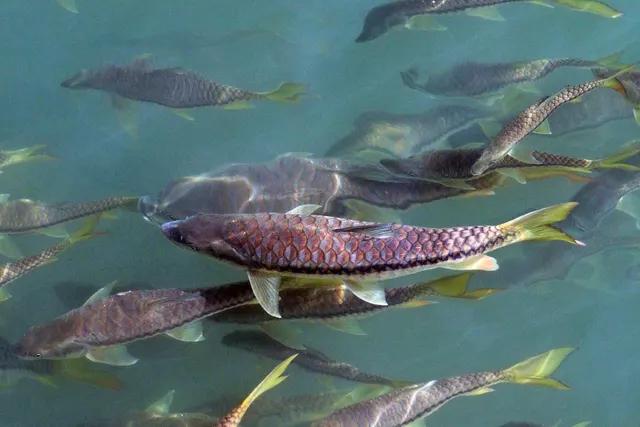 Golden mahseerA huge Himalayan river carp reaching 275 cm, assessed as Endangered, and the fish around which the whole idea of Indian sport fishing was built.
Charles J. Sharp — CC BY-SA 4.0, via Wikimedia Commons
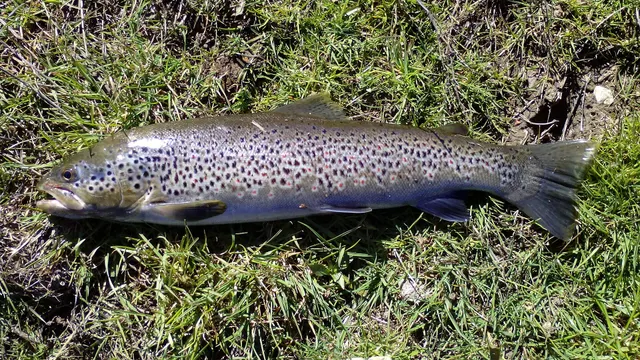 Brown troutA single, extraordinarily plastic species that appears as a tiny hill-stream fish, a deep-bodied loch trout and a silver sea-run migrant — all the same animal.
Robermix, CC0, via Wikimedia Commons
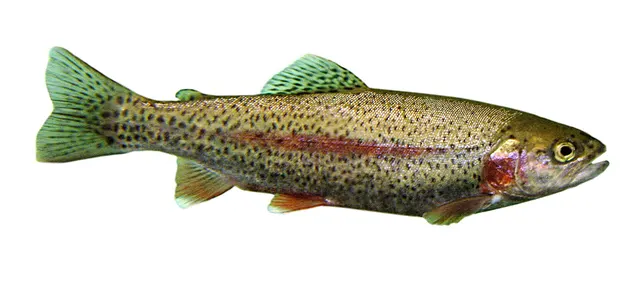 Rainbow troutThe most widely introduced sport fish on Earth — a Pacific salmonid now stocked on every continent except Antarctica, and the same species as the steelhead.
Jonathunder — CC BY-SA 3.0, via Wikimedia Commons
Safety
Moving water and currents — Can cause serious injury or death
These are powerful boulder-bedded mountain rivers. Current strong enough to sweep a standing person off their feet arrives at less depth than expected, the bed is unstable and slippery, and a fall in fast water among large boulders carries a risk of entrapment as well as drowning. Levels can rise quickly from rain upstream or from a dam release under a clear sky.
What reduces it: Wade with a staff and studded boots, cross facing upstream and never above a rapid, do not wade alone, and treat any rise in level or colour as a signal to get out. On regulated rivers, find out the release pattern before wading.
Worse when:
- During and immediately after the monsoon, when levels and debris load are highest.
- On regulated rivers, where a release can raise the level with no local weather warning.
- In low light, when reading the bed and the current is hardest.
Species that bite — Can cause serious injury or death
Much of the well-known mahseer water lies inside or beside forest holding tigers, leopards, elephants and sloth bears. Encounters happen on paths between camp and river and at the water's edge, and dawn and dusk — the best fishing times — are also the times of highest animal activity.
What reduces it: Fish with local guides who know the ground, move in groups, avoid predictable routines at the same place and time, keep to established paths, and follow camp discipline about food and light. Treat local advice about which stretches are avoided as knowledge.
Fishing alone — Can cause serious injury or death
The terrain is steep and remote, mobile coverage is patchy, roads are subject to landslides, and definitive medical care can be many hours away. An injury that would be minor near a town is serious here.
What reduces it: Do not fish alone, agree a return time with somebody who will act on it, carry a first-aid kit and a means of signalling that does not depend on a mobile network, and plan on the assumption that evacuation will be slow.
Further safety reading
- Cold water shock and immersion — Snow-fed water is cold enough year-round that immersion incapacitates quickly, and the rivers are at their coldest when the fishing is at its clearest.
- Fishing alone — Steep remote terrain, patchy communications and landslide-prone roads mean an injury that would be minor near a town is serious here.
- Wading safely — Powerful boulder-bedded mountain rivers sweep a standing person off their feet at less depth than expected, and a fall among large boulders in fast water carries an entrapment risk.
Check the rules before you fish
Fishing laws, bylaws, access rules, seasons, bait restrictions and permitted methods vary by location and can change. Check the current rules from the relevant authority and the water you intend to fish before fishing.
Check with:
- Current national or regional law for where you are fishing
- Current local bylaws
- The relevant fisheries authority
- The landowner, club or fishery whose water it is
- Any restrictions specific to the species or the method you intend to use
Where to go next
What swims here
- Brown troutIntroduced into the cold headwaters during the colonial period and now self-sustaining in some high tributaries, on quite different water from the mahseer reaches.
- Golden mahseerThe migratory cyprinid the system is named for, running upstream on rising water to spawn and feeding in the fast oxygenated reaches.
- GoonchShares the deep pools with the mahseer, holding station on the bed in heavy current with a flattened head and enormous pectoral fins.
- Rainbow troutStocked into the same cold upper tributaries as brown trout and persisting in several of them.
How people fish here
- Fly fishingFly fishing for mahseer with heavy lines and large flies, and for the trout of the higher tributaries, is now a serious branch of the fishery.
- Lure fishingHeavy metal spoons and plugs swung through fast boulder-bedded water is the classic mahseer approach and the technique the sport was built on.
Rules and access
- Close seasonsClosure over the monsoon spawning migration is both a biological and a safety measure on rivers that are unfishable and dangerous in that period.
- Licences and permissionInland fishing is a state responsibility, much of the principal water lies inside protected areas where the forest authority decides access, and elsewhere permission comes from a community or lodge arrangement.
Environment and conservation
History and culture
Sources and evidence
- The IUCN Red List of Threatened Species — International Union for Conservation of Nature (Conservation authority)Relied on for: Assessment and habitat accounts for the migratory river cyprinids of the region, their spawning requirements and the pressures acting on them.States this directlyCitation checked — the work exists and is described correctly
- FishBase: a global information system on fishes — Froese, R. and D. Pauly, eds. — FishBase Consortium (Scientific institute)Relied on for: Distribution, habitat association, size and life history recorded for the species of the system.States this directlyPassage read and verified
- Good Fish Guide — Marine Conservation Society (Conservation authority)Relied on for: Assessment of fisheries and the management measures applied to them, including gear selectivity and spatial protection.States this directlyCitation checked — the work exists and is described correctly
- Code of Conduct for Responsible Fisheries — Food and Agriculture Organization of the United Nations, Rome, 1995 (Standards body)Relied on for: Principles for responsible fisheries management, precaution, gear selectivity and the treatment of small-scale and shared stocks.States this directlyCitation checked — the work exists and is described correctly
Why the 13 connections on this page are here, and the sources
What swims here
Backed by research — 4 connections
Supported by peer-reviewed research or fisheries science. The sources are listed and can be checked.
Brown trout
A distribution association between an animal and a kind of water, rather than a claim about any named mark.
- The IUCN Red List of Threatened Species — International Union for Conservation of Nature (Conservation authority)Relied on for: Assessment and habitat account for the species, including the river or lake system it occupies and the pressures acting on it.States this directlyCitation checked — the work exists and is described correctly
- FishBase: a global information system on fishes — Froese, R. and D. Pauly, eds. — FishBase Consortium (Scientific institute)Relied on for: Distribution, habitat association, size and life history recorded for the species in the system concerned.States this directlyPassage read and verified
Golden mahseer
A distribution association between an animal and a kind of water, rather than a claim about any named mark.
- The IUCN Red List of Threatened Species — International Union for Conservation of Nature (Conservation authority)Relied on for: Assessment and habitat account for the species, including the river or lake system it occupies and the pressures acting on it.States this directlyCitation checked — the work exists and is described correctly
- FishBase: a global information system on fishes — Froese, R. and D. Pauly, eds. — FishBase Consortium (Scientific institute)Relied on for: Distribution, habitat association, size and life history recorded for the species in the system concerned.States this directlyPassage read and verified
Goonch
A distribution association between an animal and a kind of water, rather than a claim about any named mark.
- The IUCN Red List of Threatened Species — International Union for Conservation of Nature (Conservation authority)Relied on for: Assessment and habitat account for the species, including the river or lake system it occupies and the pressures acting on it.States this directlyCitation checked — the work exists and is described correctly
- FishBase: a global information system on fishes — Froese, R. and D. Pauly, eds. — FishBase Consortium (Scientific institute)Relied on for: Distribution, habitat association, size and life history recorded for the species in the system concerned.States this directlyPassage read and verified
Rainbow trout
A distribution association between an animal and a kind of water, rather than a claim about any named mark.
- The IUCN Red List of Threatened Species — International Union for Conservation of Nature (Conservation authority)Relied on for: Assessment and habitat account for the species, including the river or lake system it occupies and the pressures acting on it.States this directlyCitation checked — the work exists and is described correctly
- FishBase: a global information system on fishes — Froese, R. and D. Pauly, eds. — FishBase Consortium (Scientific institute)Relied on for: Distribution, habitat association, size and life history recorded for the species in the system concerned.States this directlyPassage read and verified
How people fish here
What experienced anglers do — 2 connections
Widely and independently recommended by experienced anglers and specialist sources. This is real angling knowledge, not proof: controlled evidence for it is limited, and FishingHQ records it as convention rather than as a demonstrated effect.
Fly fishing
A discipline that is characteristic of the place rather than merely possible there, joined so a reader can move between the place and the practice.
- General angling website restatements of established technique — Various (Credible secondary source)Relied on for: Widely restated practice associating this discipline with this place, recorded as practitioner consensus rather than as tested fact.Background and mechanism onlyCitation checked — the work exists and is described correctly
- Fishers' Craft and Lettered Art: Tracts on Fishing from the End of the Middle Ages — University of Toronto Press, 1997 (Scientific literature)Relied on for: That fishing traditions develop around the water and fish available to them, and the historical method of reading such traditions.States this directlyCitation checked — the work exists and is described correctly
Lure fishing
A discipline that is characteristic of the place rather than merely possible there, joined so a reader can move between the place and the practice.
- General angling website restatements of established technique — Various (Credible secondary source)Relied on for: Widely restated practice associating this discipline with this place, recorded as practitioner consensus rather than as tested fact.Background and mechanism onlyCitation checked — the work exists and is described correctly
- Fishers' Craft and Lettered Art: Tracts on Fishing from the End of the Middle Ages — University of Toronto Press, 1997 (Scientific literature)Relied on for: That fishing traditions develop around the water and fish available to them, and the historical method of reading such traditions.States this directlyCitation checked — the work exists and is described correctly
Safety reading
Official guidance — 3 connections
Stated by a fisheries authority, scientific institute or recognised angling body. Authoritative, but summarising rather than demonstrating.
Cold water shock and immersion
A place is joined to the safety topic that explains a hazard genuinely characteristic of it, so the mechanism is reachable rather than restated as a weak warning.
- RNLI water safety guidance: cold water shock and Float to Live — Royal National Lifeboat Institution (Water-safety or diver-training authority)Relied on for: Cold water shock and the immersion response, shore angling hazards, small-craft guidance and the circumstances in which water users are most often killed.States this directlyPassage read and verified
- RoSPA water safety information and UK accidental drowning statistics — Royal Society for the Prevention of Accidents (Water-safety or diver-training authority)Relied on for: Accidental drowning statistics and the circumstances in which recreational water users are most often killed.Background and mechanism onlyPassage read and verified
Fishing alone
A place is joined to the safety topic that explains a hazard genuinely characteristic of it, so the mechanism is reachable rather than restated as a weak warning.
- RNLI water safety guidance: cold water shock and Float to Live — Royal National Lifeboat Institution (Water-safety or diver-training authority)Relied on for: Cold water shock and the immersion response, shore angling hazards, small-craft guidance and the circumstances in which water users are most often killed.States this directlyPassage read and verified
- RoSPA water safety information and UK accidental drowning statistics — Royal Society for the Prevention of Accidents (Water-safety or diver-training authority)Relied on for: Accidental drowning statistics and the circumstances in which recreational water users are most often killed.Background and mechanism onlyPassage read and verified
Wading safely
A place is joined to the safety topic that explains a hazard genuinely characteristic of it, so the mechanism is reachable rather than restated as a weak warning.
- RNLI water safety guidance: cold water shock and Float to Live — Royal National Lifeboat Institution (Water-safety or diver-training authority)Relied on for: Cold water shock and the immersion response, shore angling hazards, small-craft guidance and the circumstances in which water users are most often killed.States this directlyPassage read and verified
- RoSPA water safety information and UK accidental drowning statistics — Royal Society for the Prevention of Accidents (Water-safety or diver-training authority)Relied on for: Accidental drowning statistics and the circumstances in which recreational water users are most often killed.Background and mechanism onlyPassage read and verified
Rules and access
Official guidance — 2 connections
Stated by a fisheries authority, scientific institute or recognised angling body. Authoritative, but summarising rather than demonstrating.
Close seasons
A place joined to the regulatory concept whose structure it illustrates. The edge asserts that the concept applies here, never what any current rule says.
- Code of Conduct for Responsible Fisheries — Food and Agriculture Organization of the United Nations, Rome, 1995 (Standards body)Relied on for: Principles for the management of fisheries, including licensing, closed seasons, size limits and the treatment of small-scale and shared stocks.States this directlyCitation checked — the work exists and is described correctly
- Good Fish Guide — Marine Conservation Society (Conservation authority)Relied on for: Assessment of fisheries and the management measures applied to them, including the instruments used and their purpose.Background and mechanism onlyCitation checked — the work exists and is described correctly
Licences and permission
A place joined to the regulatory concept whose structure it illustrates. The edge asserts that the concept applies here, never what any current rule says.
- Code of Conduct for Responsible Fisheries — Food and Agriculture Organization of the United Nations, Rome, 1995 (Standards body)Relied on for: Principles for the management of fisheries, including licensing, closed seasons, size limits and the treatment of small-scale and shared stocks.States this directlyCitation checked — the work exists and is described correctly
- Good Fish Guide — Marine Conservation Society (Conservation authority)Relied on for: Assessment of fisheries and the management measures applied to them, including the instruments used and their purpose.Background and mechanism onlyCitation checked — the work exists and is described correctly
Environment and conservation
Backed by research — 1 connection
Supported by peer-reviewed research or fisheries science. The sources are listed and can be checked.
Fish stocks and sustainability
An environmental pressure that is specific to this place rather than general to fishing, joined so the issue is anchored to a real example.
- The IUCN Red List of Threatened Species — International Union for Conservation of Nature (Conservation authority)Relied on for: Assessment of the species and habitats affected, and the pressures acting on them, including habitat change and exploitation.States this directlyCitation checked — the work exists and is described correctly
- Code of Conduct for Responsible Fisheries — Food and Agriculture Organization of the United Nations, Rome, 1995 (Standards body)Relied on for: Principles for responsible fisheries management, precaution, gear selectivity and the treatment of shared and small-scale fisheries.Background and mechanism onlyCitation checked — the work exists and is described correctly
History and culture
Official guidance — 1 connection
Stated by a fisheries authority, scientific institute or recognised angling body. Authoritative, but summarising rather than demonstrating.
Angling literature and the written tradition
A place joined to the documented fishing tradition it belongs to, so the history has a real setting and the place has a real past.
- Fishers' Craft and Lettered Art: Tracts on Fishing from the End of the Middle Ages — University of Toronto Press, 1997 (Scientific literature)Relied on for: The historical development of fishing practice and its transmission, and the method of reading a fishing tradition from its documentary record.States this directlyCitation checked — the work exists and is described correctly
- Words of the Lagoon: Fishing and Marine Lore in the Palau District of Micronesia — University of California Press, Berkeley, 1981 (Reference work)Relied on for: Documented traditional marine knowledge and fishing practice, and the social organisation of fishing rights and closures.Background and mechanism onlyCitation checked — the work exists and is described correctly
How FishingHQ labels evidence is explained in the evidence policy.