Smallmouth yellowfish
Fish · Last reviewed 2026-08-10
A golden grazing cyprinid of southern African rivers, fished on nymphs in fast shallow water and often called Africa's answer to the bonefish.
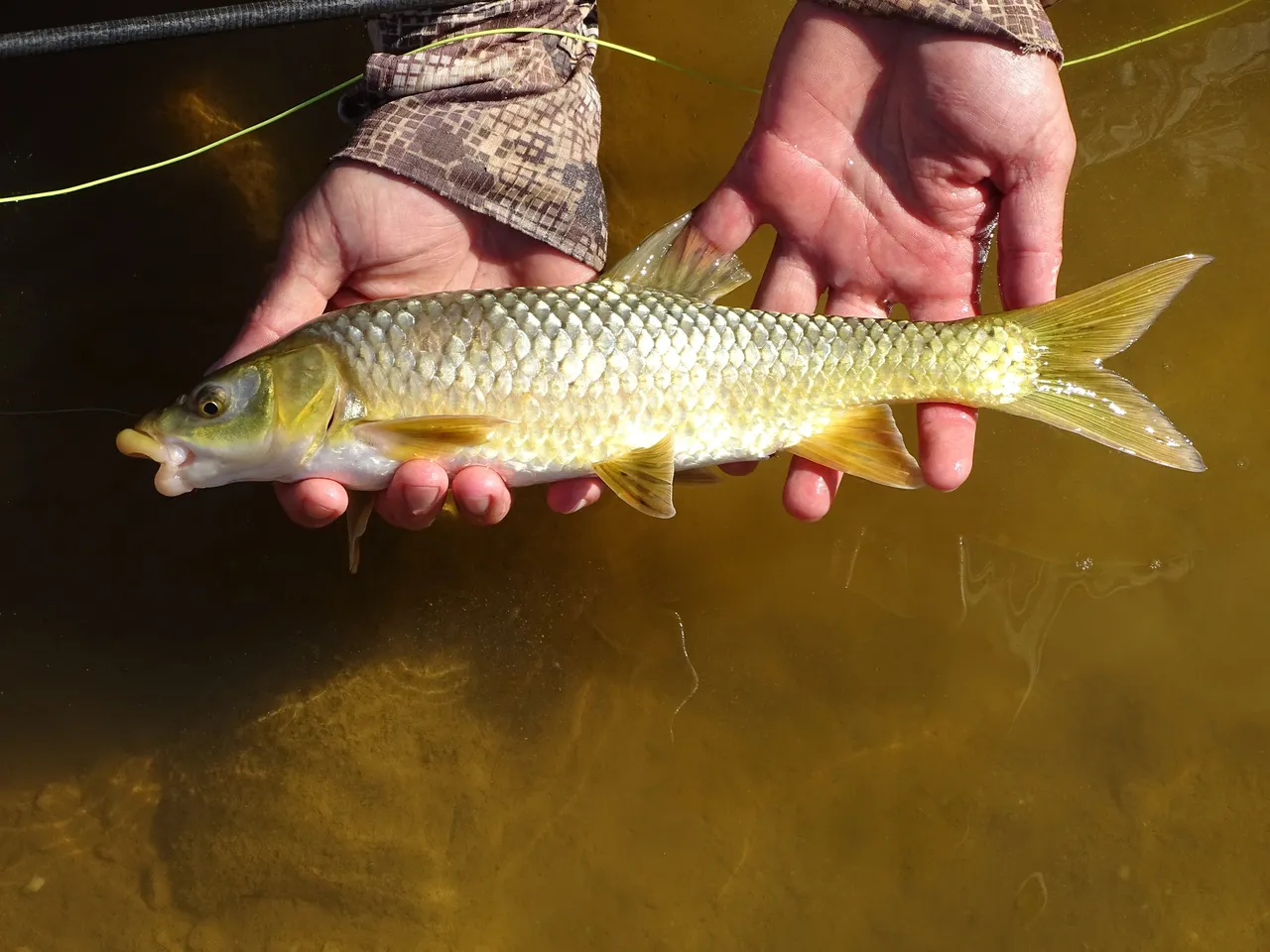
How this was identified, and who took it
Identified by: The record's separating character is unambiguous: the mouth is small and clearly SUBTERMINAL, set well back beneath a blunt rounded snout with thick pale lips, which is the inverse of the large terminal mouth of the largemouth yellowfish. Large scales, golden-olive flank, olive-yellow fins, whole fish in frame in full lateral.Shaun Swanepoel — CC BY, via iNaturalist — source, licenceCatching Smallmouth yellowfish
Everything here on fishing for it. Each entry opens the page behind it.
- Ground
Smallmouth yellowfish is the workhorse of South African fly fishing: a golden-bronze cyprinid of the Orange and Vaal systems that feeds on invertebrates among rocks and gravel in fast, shallow, sunlit water.
It is fished in a style closer to saltwater flats fishing than to trout fishing — anglers wade wide shallow riffles and cast nymphs to visible fish, which is why the comparison to bonefish is made so often and why it has become a destination fishery.
The small subterminal mouth is the identification and the explanation: it grazes and grubs rather than hunting, which is why it is caught on nymphs rather than streamers, and why it coexists with the predatory largemouth yellowfish in the same rivers.
How it is caught
Gear for this fish
Identification
- Scientific name
- Labeobarbus aeneus
- Family
- Cyprinidae
- Water
- Freshwater
- Conservation status
- Least Concern
- Regions
- East & Southern Africa
- A small subterminal mouth set beneath a rounded snout, for grubbing among stones — not the large terminal mouth of the largemouth yellowfish.
- Golden-bronze to olive flanks with large scales and orange-tinged lower fins.
- Deeper-bodied and less streamlined than the largemouth yellowfish.
- Two pairs of barbels, and a forked tail.
Size
- Typical
- 1–3 kg (2.2–6.6 lb)
- Large
- 4–7 kg (8.8–15 lb)
Exceptional: FishBase records a maximum of 50 cm and 7.8 kg
Fast, clear, rocky river: a yellowfish that needs current
Smallmouth yellowfish occupy the faster, clearer, rockier reaches of the Orange and Vaal systems, and the contrast with their largemouth relative is the useful frame.
CURRENT AND ROCK ARE THE REQUIREMENT. Smallmouth yellowfish hold in riffles, runs, rapids and the pocket water among boulders, feeding on invertebrates dislodged by the flow. They are a fast-water fish in a way largemouth yellowfish are not.
WELL-OXYGENATED WATER FOLLOWS FROM THAT, and they are less tolerant of stagnant, silted or deoxygenated conditions than many African cyprinids.
THEY FEED ON INVERTEBRATES — nymphs, larvae, crustaceans and molluscs — taken from the bed and from the drift, which is why they respond to fly fishing and why the fishery for them developed as a nymph and dry fly one.
JUVENILES USE SHALLOWER MARGINAL AND SLACKER WATER, moving into the faster reaches as they grow.
THEY SHOAL, particularly as smaller fish, and larger individuals become more solitary and hold in defined lies.
SILTATION AND FLOW REGULATION ARE THE PRESSURES. Sedimentation smothers the invertebrate community and the clean substrate the fish depend on, and dams and abstraction alter the flow regime that maintains both.
AND THE FISHERY'S HISTORY IS PART OF THE HABITAT STORY. A species long dismissed as coarse and now the basis of a serious fly fishery with a conservation ethic attached is one of the more encouraging developments in African angling, and it has brought attention to the river habitat itself.
Backed by research — why, and the sources (2)
Supported by peer-reviewed research or fisheries science. The sources are listed and can be checked.
- FishBase: a global information system on fishes — Froese, R. and D. Pauly, eds. — FishBase Consortium (Scientific institute)Relied on for: Distribution, habitat association, depth range, size, reproduction and life-history parameters recorded for the species.States this directlyPassage read and verified
- The IUCN Red List of Threatened Species — International Union for Conservation of Nature (Conservation authority)Relied on for: Assessment and range account for the species, including the habitats it depends on, its life history and the pressures acting on it.States this directlyCitation checked — the work exists and is described correctly
Lifecycle and reproduction
Moderately long-lived and slower-growing than many cyprinids, maturing after several years. Populations are affected by siltation, abstraction and water quality in a heavily used river system.
Migrates upstream to spawn over gravel and cobble runs in early summer on rising water, scattering eggs with no parental care.
Feeding and senses
Grazes and grubs among stones for aquatic invertebrates, larvae and algae, feeding on and close to the bottom in fast shallow water.
Feeds by close-range sight and touch over stony substrate in clear water, which is why small imitative nymphs fished on the bottom are so effective.
Through the year
Spawning runs in early summer; strongest feeding through the warm months in shallow riffles, moving to deeper water in cold conditions.
Distribution
Africa: originally endemic to the Orange-Vaal River system, South Africa. Has been introduced into the Gouritz River, South Cape and the Olifants River, Limpopo River system where it is now established
This is a biological range — where the species occurs, not a prediction that you will catch one. To browse the fishing geography FishingHQ holds, start at fishing places.
Why anglers care
The backbone of South African river fly fishing, taken on small weighted nymphs fished in fast shallow water, and increasingly on light lure tackle. Its significance is that it supports an accessible, wadeable, sight-based river fishery of genuine international standing, and it has driven substantial conservation attention to the Orange–Vaal system.
Handling and returning
Wet hands, a soft net and minimal air exposure. Return fish facing into current and support them until they swim off. Summer water temperatures in these rivers can be high, so fights should be kept short.
Where to go next
Similar and related fish
Where it lives
Where you will find it
More fish
Not related to this page — just the rest of the section. There is little else joined to this subject yet, and a short page should still lead somewhere.
Sources and evidence
- FishBase: a global information system on fishes — Froese, R. and D. Pauly, eds. — FishBase Consortium (Scientific institute)Relied on for: Family, maximum size, depth and environment, distribution and the IUCN assessment for Labeobarbus aeneus.States this directlyPassage read and verified
- The IUCN Red List of Threatened Species — International Union for Conservation of Nature (Conservation authority)Relied on for: The Least Concern assessment for Labeobarbus aeneus, assessed 01 September 2017.States this directlyCitation checked — the work exists and is described correctly
Why the 5 connections on this page are here, and the sources
Similar and related fish
Backed by research — 1 connection
Supported by peer-reviewed research or fisheries science. The sources are listed and can be checked.
Largemouth yellowfish
An identification comparison naming both binomials: Labeobarbus kimberleyensis and Labeobarbus aeneus.
- FishBase: a global information system on fishes — Froese, R. and D. Pauly, eds. — FishBase Consortium (Scientific institute)Relied on for: Morphological and distributional data for Labeobarbus kimberleyensis and for Labeobarbus aeneus.States this directlyPassage read and verified
- The IUCN Red List of Threatened Species — International Union for Conservation of Nature (Conservation authority)Relied on for: Separate assessments treating Labeobarbus kimberleyensis and Labeobarbus aeneus as distinct species.States this directlyCitation checked — the work exists and is described correctly
How it is caught
What experienced anglers do — 1 connection
Widely and independently recommended by experienced anglers and specialist sources. This is real angling knowledge, not proof: controlled evidence for it is limited, and FishingHQ records it as convention rather than as a demonstrated effect.
Nymphing
A practitioner claim about how Labeobarbus aeneus is commonly fished, following from where and how it feeds.
- General angling website restatements of established technique — Various (Credible secondary source)Relied on for: Widely restated practitioner accounts of fishing for smallmouth yellowfish.Citation checked — the work exists and is described correctly
- Sea Angler — Bauer Media (Specialist angling publication)Relied on for: Practitioner treatment of the methods used for smallmouth yellowfish and comparable species.Citation checked — the work exists and is described correctly
Gear for this fish
What experienced anglers do — 1 connection
Widely and independently recommended by experienced anglers and specialist sources. This is real angling knowledge, not proof: controlled evidence for it is limited, and FishingHQ records it as convention rather than as a demonstrated effect.
Nymphs
A practitioner claim about tackle commonly used for Labeobarbus aeneus.
- General angling website restatements of established technique — Various (Credible secondary source)Relied on for: Widely restated practitioner accounts of this presentation for smallmouth yellowfish.Citation checked — the work exists and is described correctly
- Angling Times — Bauer Media (Specialist angling publication)Relied on for: Practitioner treatment of comparable presentations for the species group.Citation checked — the work exists and is described correctly
Where it lives
Backed by research — 1 connection
Supported by peer-reviewed research or fisheries science. The sources are listed and can be checked.
Lowland rivers
A habitat association for Labeobarbus aeneus taken from the environment and distribution data on its FishBase summary.
- FishBase: a global information system on fishes — Froese, R. and D. Pauly, eds. — FishBase Consortium (Scientific institute)Relied on for: The environment, depth range and habitat description recorded for Labeobarbus aeneus.States this directlyPassage read and verified
Where you will find it
Backed by research — 1 connection
Supported by peer-reviewed research or fisheries science. The sources are listed and can be checked.
South Africa
A distribution association between an animal and a kind of water, rather than a claim about any named mark.
- FishBase: a global information system on fishes — Froese, R. and D. Pauly, eds. — FishBase Consortium (Scientific institute)Relied on for: Distribution, habitat association and depth range recorded for the species, including its occurrence in the water body concerned.States this directlyPassage read and verified
- The IUCN Red List of Threatened Species — International Union for Conservation of Nature (Conservation authority)Relied on for: Assessment and range account for the species, including the systems and coasts it occupies.Background and mechanism onlyCitation checked — the work exists and is described correctly
How FishingHQ labels evidence is explained in the evidence policy.