How to identify smallmouth yellowfish
Labeobarbus aeneus · Cyprinidae
The characters that identify smallmouth yellowfish, ranked by how far each one can be trusted on its own.
How this was identified, and who took it
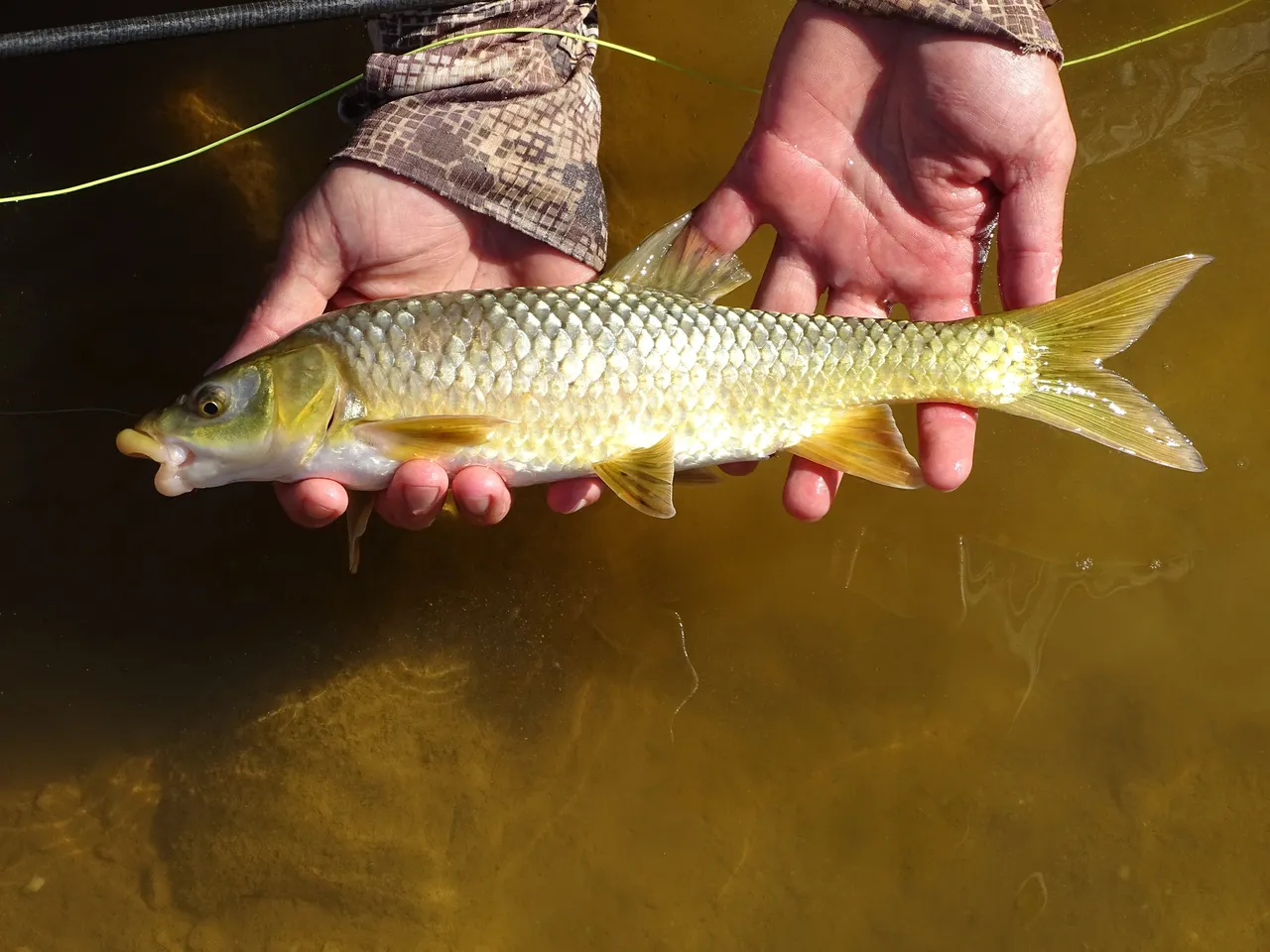
Identified by: The record's separating character is unambiguous: the mouth is small and clearly SUBTERMINAL, set well back beneath a blunt rounded snout with thick pale lips, which is the inverse of the large terminal mouth of the largemouth yellowfish. Large scales, golden-olive flank, olive-yellow fins, whole fish in frame in full lateral.Shaun Swanepoel — CC BY, via iNaturalist — source, licenceLook at this first
Turn the fish so you are looking at the underside of the head. On a smallmouth yellowfish the mouth is small and set back beneath a rounded snout, pointing downwards at the stones it feeds off. On a largemouth yellowfish it is big and at the front of the head, reaching back under the eye. That is the whole separation and it is what both names describe.
Diagnostic — settles it on its own
Each of these settles the identification on its own. If one is clear, you have your answer.
A small mouth set beneath a rounded snout
The snout is blunt and projects forward, and the mouth opens under it rather than at its tip, with thickened pale lips for grubbing among gravel and cobble. Compare against the eye: the gape of a smallmouth ends well forward of it. On a largemouth yellowfish the jaw articulation runs back to beneath the eye and the mouth is obviously large. Because this is a structural relationship between mouth and eye it does not change with condition.
Supporting — use with other characters
Real characters that are not conclusive by themselves. Use two or three together.
A deeper, less streamlined body than a largemouth
Smallmouth yellowfish is a stockier fish for its length: deeper through the shoulder and blunter overall. A largemouth is built like a predator, longer and more torpedo-shaped, which fits a fish that eats other fish rather than invertebrates off stones. It is a real difference, it needs the two side by side to be confident about, and it supports the mouth rather than replacing it.
Two pairs of barbels
Both yellowfish carry barbels, so this places the fish in Labeobarbus rather than naming the species. It matters because it removes the mudfish and the various Labeo of the same rivers, which are the other large cyprinids a visiting angler will meet.
Suggestive only — varies with condition
Hints only. These vary with condition, season, water and how long the fish has been out of it, and a fish that contradicts them is still the same species.
Golden-bronze to olive flanks with large scales and orange lower fins
The flank is warm gold to olive with big scales, and the pelvic and anal fins carry an orange tinge in a fish in condition. The colour is what gives the group its name and it is shared by both species, so it is useful for recognising a yellowfish and useless for choosing between them.
What it gets confused with
- Largemouth yellowfish, the only confusion that matters; the mouth size and its position relative to the eye separate them and the colour does not.
- Clanwilliam yellowfish and the other regional Labeobarbus of southern Africa, several of which also have subterminal mouths and which a mouth-position character will not resolve.
- Moggel and the mudfish Labeo species of the same rivers, which are separated by the barbels and by the shape of the lip.
- Common carp, widely introduced into the same systems, which is deeper still, has four barbels of very different proportions and a long-based dorsal fin.
Where this stops working
Southern African yellowfish taxonomy is unsettled and several regional forms are treated as species by some authorities and as populations by others. Outside the native Orange–Vaal system the species has been widely translocated, so a yellowfish in a Western Cape river may be an introduced smallmouth, a native Clanwilliam yellowfish or something intermediate, and all three share the subterminal mouth this page leads on. Yellowfish also hybridise where translocated populations meet native ones. Several of these fish are of conservation concern and some populations are protected; the handling and the permissions are questions for the provincial conservation authority and the water's manager, not for a field character.
The full record
This page covers identification only. The Smallmouth yellowfish record covers behaviour, lifecycle, distribution, handling and the sources behind all of it.
Reviewed 2026-08-16.
More about this fish
Telling it apart is one question. Here are the others.
Similar and related fish
How it is caught
Where it lives
Where you will find it
Why the 4 connections on this page are here, and the sources
Similar and related fish
Backed by research — 1 connection
Supported by peer-reviewed research or fisheries science. The sources are listed and can be checked.
Largemouth yellowfish
An identification comparison naming both binomials: Labeobarbus kimberleyensis and Labeobarbus aeneus.
- FishBase: a global information system on fishes — Froese, R. and D. Pauly, eds. — FishBase Consortium (Scientific institute)Relied on for: Morphological and distributional data for Labeobarbus kimberleyensis and for Labeobarbus aeneus.States this directlyPassage read and verified
- The IUCN Red List of Threatened Species — International Union for Conservation of Nature (Conservation authority)Relied on for: Separate assessments treating Labeobarbus kimberleyensis and Labeobarbus aeneus as distinct species.States this directlyCitation checked — the work exists and is described correctly
How it is caught
What experienced anglers do — 1 connection
Widely and independently recommended by experienced anglers and specialist sources. This is real angling knowledge, not proof: controlled evidence for it is limited, and FishingHQ records it as convention rather than as a demonstrated effect.
Nymphing
A practitioner claim about how Labeobarbus aeneus is commonly fished, following from where and how it feeds.
- General angling website restatements of established technique — Various (Credible secondary source)Relied on for: Widely restated practitioner accounts of fishing for smallmouth yellowfish.Citation checked — the work exists and is described correctly
- Sea Angler — Bauer Media (Specialist angling publication)Relied on for: Practitioner treatment of the methods used for smallmouth yellowfish and comparable species.Citation checked — the work exists and is described correctly
Where it lives
Backed by research — 1 connection
Supported by peer-reviewed research or fisheries science. The sources are listed and can be checked.
Lowland rivers
A habitat association for Labeobarbus aeneus taken from the environment and distribution data on its FishBase summary.
- FishBase: a global information system on fishes — Froese, R. and D. Pauly, eds. — FishBase Consortium (Scientific institute)Relied on for: The environment, depth range and habitat description recorded for Labeobarbus aeneus.States this directlyPassage read and verified
Where you will find it
Backed by research — 1 connection
Supported by peer-reviewed research or fisheries science. The sources are listed and can be checked.
South Africa
A distribution association between an animal and a kind of water, rather than a claim about any named mark.
- FishBase: a global information system on fishes — Froese, R. and D. Pauly, eds. — FishBase Consortium (Scientific institute)Relied on for: Distribution, habitat association and depth range recorded for the species, including its occurrence in the water body concerned.States this directlyPassage read and verified
- The IUCN Red List of Threatened Species — International Union for Conservation of Nature (Conservation authority)Relied on for: Assessment and range account for the species, including the systems and coasts it occupies.Background and mechanism onlyCitation checked — the work exists and is described correctly