Lake sturgeon
Fish · Last reviewed 2026-08-10
An ancient armoured Great Lakes and Mississippi basin fish that may take twenty years to first spawn and then spawns only every few years.
Safety: injury while handling fish — minor injury.
How this was identified, and who took it
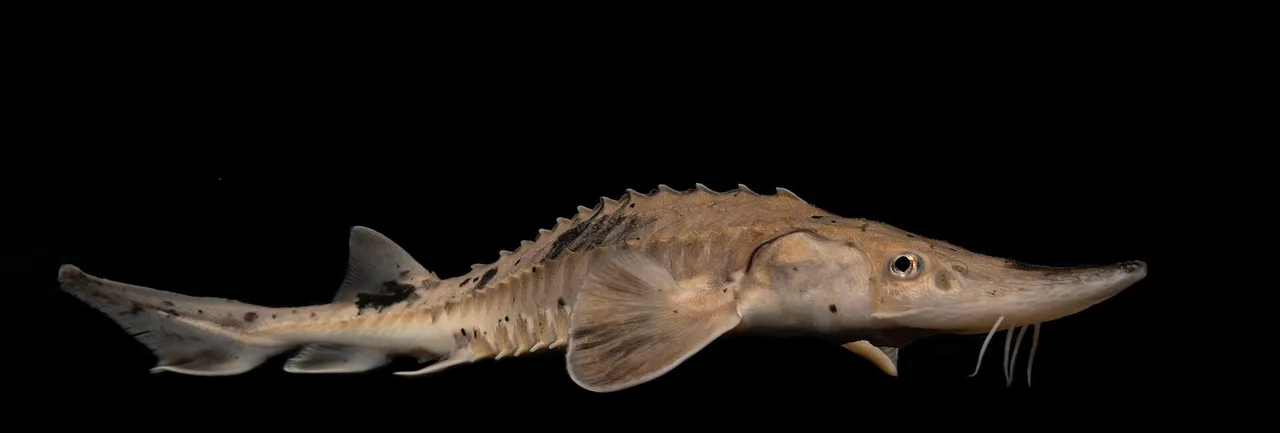
Identified by: A hatchery studio photograph against black in which every character the page names is resolved: rows of bony scutes along the back and flank in place of scales, four barbels standing clear in front of a protrusible tube-like mouth set beneath a pointed snout, and a heterocercal shark-like tail with a much longer upper lobe. Photographed by USFWS staff at a named federal hatchery, so the identity has an institutional basis as well as a visual one.Sam Stukel, USFWS — public domain, via Wikimedia Commons — source, licence
Catching Lake sturgeon
Everything here on fishing for it. Each entry opens the page behind it.
Lake sturgeon is the freshwater sturgeon of the Great Lakes, Mississippi and Hudson Bay drainages — an armoured, barbelled, bottom-feeding fish that grows large and lives for many decades.
Its reproductive schedule is the essential fact. Females may not spawn until around twenty years of age and then spawn only once every four or five years. A population's annual reproductive output is therefore a small fraction of its adult numbers, and the species cannot absorb sustained removal of adults.
It was fished commercially to near-collapse in the nineteenth and twentieth centuries and has been recovering slowly under protection since. Where angling is permitted it is tightly regulated and largely release-based.
How it is caught
Identification
- Scientific name
- Acipenser fulvescens
- Family
- Acipenseridae
- Water
- Freshwater
- Conservation status
- Endangered
- Regions
- North America
- Five rows of bony scutes along the body instead of scales — one dorsal, two lateral, two ventral.
- A protrusible tube-like mouth beneath the snout with four barbels in front of it.
- Shark-like tail with a much longer upper lobe, and a pointed snout that blunts with age.
- Olive-brown to grey body, with scutes more prominent and sharper in young fish.
Size
- Typical
- Most rod-caught fish 5–25 kg (11–55 lb)
- Large
- 35–70 kg (77–155 lb)
Exceptional: FishBase records a maximum of 274 cm and 125 kg
A century-old fish, handled in shallow water, in the winter
Everything in the white sturgeon account about support and scutes applies, and lake sturgeon add a set of circumstances of their own.
THE FISHERY IS OFTEN A COLD ONE. Lake sturgeon are frequently fished in rivers in cold conditions, sometimes through ice, which changes the practical problem: cold hands handling a heavy fish, cold air, and a fish that must not be laid on ice, snow or a frozen surface. Freezing damage to a fish's tissue happens fast and is invisible.
SUPPORT ALONG THE LENGTH, IN THE WATER. The body is long and heavy and there is no way to hold a large one clear of the water without loading tissue that has never carried the weight. Where the fishery permits handling at all, it is done in the shallows with the fish supported at two or three points.
THE SCUTES CUT and are sharpest on younger fish, which are also the ones handled most often.
THE MOUTH IS HARMLESS — a toothless protrusible tube.
AND THE DEMOGRAPHY IS EXTREME even by sturgeon standards. Lake sturgeon mature very late, spawn intermittently rather than annually, and individuals live for many decades. Populations depleted a century ago have still not recovered, and the species is protected or tightly restricted through most of its range. A single large fish is a substantial fraction of a local population's reproductive output, and the handling standard should be set by that rather than by how robust the animal looks.
Official guidance — why, and the sources (1)
Stated by a fisheries authority, scientific institute or recognised angling body. Authoritative, but summarising rather than demonstrating.
- The IUCN Red List of Threatened Species — International Union for Conservation of Nature (Conservation authority)Relied on for: Conservation status, late maturity and intermittent spawning in lake sturgeon, and the slow recovery of depleted populations.States this directlyCitation checked — the work exists and is described correctly
Lifecycle and reproduction
Extremely long-lived, with individuals documented past a century. Females mature at around twenty years and then spawn only every four to five years, so recruitment is very slow and every mature adult is disproportionately valuable.
Spawns in spring in fast, rocky river reaches, broadcasting adhesive eggs. Intermittent spawning combined with late maturity means dams blocking access to spawning rock remove reproduction entirely from affected reaches.
Feeding and senses
A bottom feeder that locates invertebrates, molluscs and small fish with its barbels and vacuums them up with a protrusible tube mouth.
Locates food by smell, touch through the barbels, and electroreception through ampullae on the snout. Vision plays little part in feeding.
Through the year
Moves upriver to spawn in spring where access allows, and disperses to deeper lake and river habitat afterwards. Feeds through cold water.
Distribution
North America: St. Lawrence-Great Lakes, Hudson Bay, and Mississippi River basins
This is a biological range — where the species occurs, not a prediction that you will catch one. To browse the fishing geography FishingHQ holds, start at fishing places.
Why anglers care
Fished under strict regulation in parts of the Great Lakes and Mississippi basins, generally with tightly limited seasons, tags and largely mandatory release, and by spearing under separate rules in some jurisdictions. Its significance is as a living relic and a recovery case study. FishingHQ does not state what any rule is; lake sturgeon rules are highly specific by water and change.
Handling and returning
Keep the fish in the water and never lift a large sturgeon vertically or drag it ashore — its body is not built to support its own weight in air. Support horizontally with two hands if it must be handled, avoid the gills, take care with the sharp scutes, and release facing into current.
Safety
Injury while handling fish — Minor injury
The scute rows are sharp-edged, particularly in younger fish, and cut hands and forearms during handling.
What reduces it: Wear gloves, support the fish along the smooth areas of the body, and avoid dragging hands along the flanks.
Where to go next
Similar and related fish
Where it lives
Where you will find it
Understanding this fish
Sources and evidence
- FishBase: a global information system on fishes — Froese, R. and D. Pauly, eds. — FishBase Consortium (Scientific institute)Relied on for: Family, maximum size, depth and environment, distribution and the IUCN assessment for Acipenser fulvescens.States this directlyPassage read and verified
- The IUCN Red List of Threatened Species — International Union for Conservation of Nature (Conservation authority)Relied on for: The Endangered assessment for Acipenser fulvescens, assessed 14 September 2019.States this directlyCitation checked — the work exists and is described correctly
Why the 6 connections on this page are here, and the sources
Similar and related fish
Backed by research — 1 connection
Supported by peer-reviewed research or fisheries science. The sources are listed and can be checked.
White sturgeon
An identification comparison naming both binomials: Acipenser fulvescens and Acipenser transmontanus.
- FishBase: a global information system on fishes — Froese, R. and D. Pauly, eds. — FishBase Consortium (Scientific institute)Relied on for: Morphological and distributional data for Acipenser fulvescens and for Acipenser transmontanus.States this directlyPassage read and verified
- The IUCN Red List of Threatened Species — International Union for Conservation of Nature (Conservation authority)Relied on for: Separate assessments treating Acipenser fulvescens and Acipenser transmontanus as distinct species.States this directlyCitation checked — the work exists and is described correctly
How it is caught
What experienced anglers do — 1 connection
Widely and independently recommended by experienced anglers and specialist sources. This is real angling knowledge, not proof: controlled evidence for it is limited, and FishingHQ records it as convention rather than as a demonstrated effect.
Ledgering
A practitioner claim about how Acipenser fulvescens is commonly fished, following from where and how it feeds.
- General angling website restatements of established technique — Various (Credible secondary source)Relied on for: Widely restated practitioner accounts of fishing for lake sturgeon.Citation checked — the work exists and is described correctly
- Sea Angler — Bauer Media (Specialist angling publication)Relied on for: Practitioner treatment of the methods used for lake sturgeon and comparable species.Citation checked — the work exists and is described correctly
Where it lives
Backed by research — 2 connections
Supported by peer-reviewed research or fisheries science. The sources are listed and can be checked.
Lowland rivers
A habitat association for Acipenser fulvescens taken from the environment and distribution data on its FishBase summary.
- FishBase: a global information system on fishes — Froese, R. and D. Pauly, eds. — FishBase Consortium (Scientific institute)Relied on for: The environment, depth range and habitat description recorded for Acipenser fulvescens.States this directlyPassage read and verified
Lowland stillwaters
A habitat association for Acipenser fulvescens taken from the environment and distribution data on its FishBase summary.
- FishBase: a global information system on fishes — Froese, R. and D. Pauly, eds. — FishBase Consortium (Scientific institute)Relied on for: The environment, depth range and habitat description recorded for Acipenser fulvescens.States this directlyPassage read and verified
Where you will find it
Backed by research — 1 connection
Supported by peer-reviewed research or fisheries science. The sources are listed and can be checked.
The Great Lakes
Occurrence of the species in this system or along this coast: a statement about the animal's distribution, not a venue recommendation.
- FishBase: a global information system on fishes — Froese, R. and D. Pauly, eds. — FishBase Consortium (Scientific institute)Relied on for: Distribution, salinity tolerance and habitat association recorded for the species, including its occurrence in this system.States this directlyPassage read and verified
- The IUCN Red List of Threatened Species — International Union for Conservation of Nature (Conservation authority)Relied on for: Assessment and range description for the species, including the waters in which it occurs.Background and mechanism onlyCitation checked — the work exists and is described correctly
Understanding this fish
Backed by research — 1 connection
Supported by peer-reviewed research or fisheries science. The sources are listed and can be checked.
Fish growth, age and what a big fish represents
A species joined to the mechanism it is a worked example of, written only where the species demonstrates the mechanism unusually clearly rather than where it is merely subject to it.
- FishBase: a global information system on fishes — Froese, R. and D. Pauly, eds. — FishBase Consortium (Scientific institute)Relied on for: Recorded environment, respiration, oxygen tolerance, feeding biology, growth, longevity and distribution of the species named.States this directlyPassage read and verified
- The IUCN Red List of Threatened Species — International Union for Conservation of Nature (Conservation authority)Relied on for: Conservation assessment, recorded threats and population trend of the species named.States this directlyCitation checked — the work exists and is described correctly
How FishingHQ labels evidence is explained in the evidence policy.