How to identify lake sturgeon
Acipenser fulvescens · Acipenseridae
The characters that identify lake sturgeon, ranked by how far each one can be trusted on its own.
Safety: injury while handling fish — minor injury.
How this was identified, and who took it
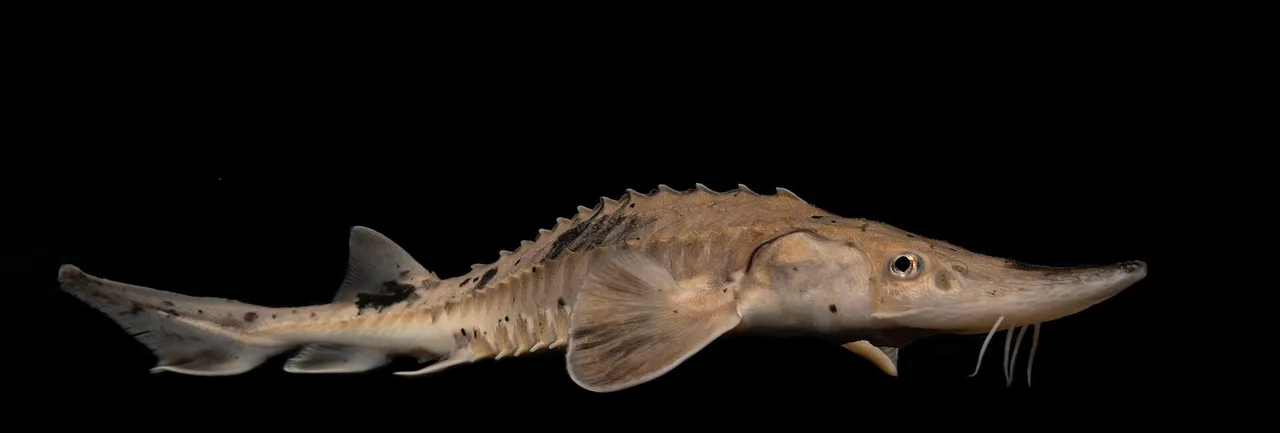
Identified by: A hatchery studio photograph against black in which every character the page names is resolved: rows of bony scutes along the back and flank in place of scales, four barbels standing clear in front of a protrusible tube-like mouth set beneath a pointed snout, and a heterocercal shark-like tail with a much longer upper lobe. Photographed by USFWS staff at a named federal hatchery, so the identity has an institutional basis as well as a visual one.Sam Stukel, USFWS — public domain, via Wikimedia Commons — source, licenceAbout the image above: The photograph shows a hatchery-reared young fish, in which the scutes are sharpest and the snout most pointed. An old lake sturgeon has worn, much less prominent scutes and a blunter snout.
Look at this first
Nothing else in fresh water looks remotely like this. Five rows of bony plates run the length of the body in place of scales, four barbels hang in front of a tube-like mouth on the underside of the snout, and the tail is shark-like with a much longer upper lobe. The question is which sturgeon, not whether it is one.
Diagnostic — settles it on its own
Each of these settles the identification on its own. If one is clear, you have your answer.
Five rows of bony scutes
One row along the back, one along each flank and one along each side of the belly. Count them: five is the arrangement across the sturgeons and it immediately separates the whole family from every scaled fish. The plates are sharp in young fish and worn smoother in old ones.
Four barbels ahead of a protrusible ventral mouth
The mouth sits underneath the snout and extends downwards as a tube when the fish feeds. In front of it four barbels hang in a row. Their POSITION is what separates sturgeon species: in lake sturgeon they sit closer to the tip of the snout than to the mouth, where in several other North American sturgeons they sit closer to the mouth.
Supporting — use with other characters
Real characters that are not conclusive by themselves. Use two or three together.
Heterocercal tail
The upper lobe of the tail is much longer than the lower, as in a shark, because the backbone continues into it. Along with the scutes it is the shape that makes a sturgeon recognisable at a distance in clear water.
A snout that blunts with age
Young lake sturgeon have a sharply pointed snout that becomes shorter and blunter as the fish grows. This is worth knowing because photographs of young hatchery fish are far more common than photographs of old ones, and the two look meaningfully different.
What it gets confused with
- Shovelnose sturgeon, which shares the Mississippi basin and has a broad flattened shovel-shaped snout and a long filamentous upper tail lobe.
- Pallid and shortnose sturgeon, both protected and both separated on barbel position and snout shape rather than on general appearance.
- Paddlefish, sometimes lumped in by beginners — it has an enormous flat paddle snout, smooth skin and no scutes at all.
Where this stops working
The family is unmistakable and the species within it are not. Barbel position relative to the snout tip and the mouth is the standard character, and it needs a fish held still and looked at from below rather than glanced at in a net. Several North American sturgeons are protected under federal or state law and some are critically endangered; a misidentified fish is not a neutral error, and the correct response to any uncertainty is to keep the fish in the water, photograph the underside of the snout if it can be done without harm, release it, and check with the responsible fisheries authority. Sturgeon are long-lived and slow-maturing, so the fish in front of you may be older than you are and may not have spawned yet.
The full record
This page covers identification only. The Lake sturgeon record covers behaviour, lifecycle, distribution, handling and the sources behind all of it.
Reviewed 2026-08-15.
More about this fish
Telling it apart is one question. Here are the others.
Similar and related fish
How it is caught
Where it lives
Where you will find it
Why the 5 connections on this page are here, and the sources
Similar and related fish
Backed by research — 1 connection
Supported by peer-reviewed research or fisheries science. The sources are listed and can be checked.
White sturgeon
An identification comparison naming both binomials: Acipenser fulvescens and Acipenser transmontanus.
- FishBase: a global information system on fishes — Froese, R. and D. Pauly, eds. — FishBase Consortium (Scientific institute)Relied on for: Morphological and distributional data for Acipenser fulvescens and for Acipenser transmontanus.States this directlyPassage read and verified
- The IUCN Red List of Threatened Species — International Union for Conservation of Nature (Conservation authority)Relied on for: Separate assessments treating Acipenser fulvescens and Acipenser transmontanus as distinct species.States this directlyCitation checked — the work exists and is described correctly
How it is caught
What experienced anglers do — 1 connection
Widely and independently recommended by experienced anglers and specialist sources. This is real angling knowledge, not proof: controlled evidence for it is limited, and FishingHQ records it as convention rather than as a demonstrated effect.
Ledgering
A practitioner claim about how Acipenser fulvescens is commonly fished, following from where and how it feeds.
- General angling website restatements of established technique — Various (Credible secondary source)Relied on for: Widely restated practitioner accounts of fishing for lake sturgeon.Citation checked — the work exists and is described correctly
- Sea Angler — Bauer Media (Specialist angling publication)Relied on for: Practitioner treatment of the methods used for lake sturgeon and comparable species.Citation checked — the work exists and is described correctly
Where it lives
Backed by research — 2 connections
Supported by peer-reviewed research or fisheries science. The sources are listed and can be checked.
Lowland rivers
A habitat association for Acipenser fulvescens taken from the environment and distribution data on its FishBase summary.
- FishBase: a global information system on fishes — Froese, R. and D. Pauly, eds. — FishBase Consortium (Scientific institute)Relied on for: The environment, depth range and habitat description recorded for Acipenser fulvescens.States this directlyPassage read and verified
Lowland stillwaters
A habitat association for Acipenser fulvescens taken from the environment and distribution data on its FishBase summary.
- FishBase: a global information system on fishes — Froese, R. and D. Pauly, eds. — FishBase Consortium (Scientific institute)Relied on for: The environment, depth range and habitat description recorded for Acipenser fulvescens.States this directlyPassage read and verified
Where you will find it
Backed by research — 1 connection
Supported by peer-reviewed research or fisheries science. The sources are listed and can be checked.
The Great Lakes
Occurrence of the species in this system or along this coast: a statement about the animal's distribution, not a venue recommendation.
- FishBase: a global information system on fishes — Froese, R. and D. Pauly, eds. — FishBase Consortium (Scientific institute)Relied on for: Distribution, salinity tolerance and habitat association recorded for the species, including its occurrence in this system.States this directlyPassage read and verified
- The IUCN Red List of Threatened Species — International Union for Conservation of Nature (Conservation authority)Relied on for: Assessment and range description for the species, including the waters in which it occurs.Background and mechanism onlyCitation checked — the work exists and is described correctly
Safety
Injury while handling fish — Minor injury
The scute rows are sharp-edged, particularly in younger fish, and cut hands and forearms during handling.
What reduces it: Wear gloves, support the fish along the smooth areas of the body, and avoid dragging hands along the flanks.