How to identify red emperor
Lutjanus sebae · Lutjanidae
The characters that identify red emperor, ranked by how far each one can be trusted on its own.
Safety: barotrauma and pressure injury — can cause injury needing treatment. One more point applies here.
How this was identified, and who took it
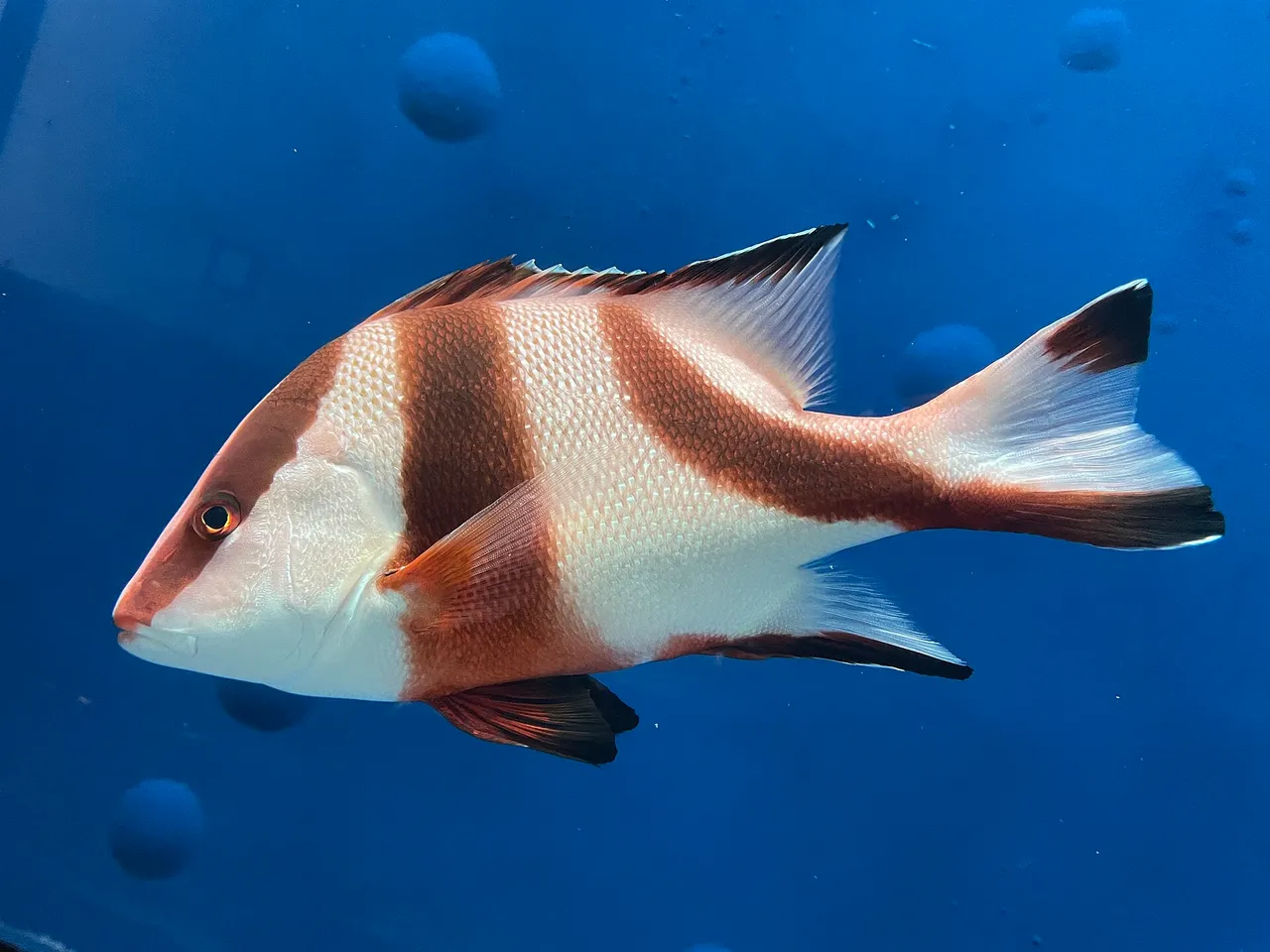
Identified by: Identified on the three-band pattern the page names, all three present and complete: one band through the eye, one running from the dorsal fin down to the pelvic, and one across the caudal wrist continuing onto both lobes of the tail. Deep compressed body with a steep forehead and a slightly forked tail. The bands are a juvenile and sub-adult state; this page says they fade with age and adults become nearly uniform red, which is why the caption says so.Totti — CC BY-SA 4.0, via Wikimedia Commons — source, licenceAbout the image above: The photograph shows a young fish with the three-band pattern at its clearest. Adults fade towards a nearly uniform red with only faint traces of banding, so a plain red fish of the same shape is not a different species.
Look at this first
On a young fish, count the bands. Three broad dark bands cross a red emperor — one down through the eye, one from the dorsal down to the pelvic fin, and one across the tail wrist and onto the tail. On an old fish they are nearly gone and you are working from body shape and the deep even red instead.
Diagnostic — settles it on its own
Each of these settles the identification on its own. If one is clear, you have your answer.
Three broad bands including one across the tail wrist
The third band is the useful one: it crosses the caudal peduncle and continues out onto both lobes of the tail. Several banded reef fish carry bars on the body but not out onto the tail, so the tail band is what makes the pattern specific rather than merely striking.
Supporting — use with other characters
Real characters that are not conclusive by themselves. Use two or three together.
Deep compressed body with a steep forehead
The body is deep for a snapper and strongly flattened side to side, and the profile rises steeply from the snout to the dorsal origin. In a large fish that has lost its banding this becomes the primary character and the fish reads as a heavy, high-shouldered red snapper.
Large canines and a slightly forked tail
Prominent conical teeth stand at the front of both jaws and the tail is only shallowly forked rather than deeply cut. The teeth place it in the snappers; the shallow fork helps separate it from several deeper-bodied emperors with more sharply forked tails.
Suggestive only — varies with condition
Hints only. These vary with condition, season, water and how long the fish has been out of it, and a fish that contradicts them is still the same species.
Uniform deep red in adults
A large red emperor is close to evenly red-pink over the whole body with only ghosts of the banding remaining. It is a striking fish and the colour is not a species-level character, because a great many reef snappers and emperors are red.
What it gets confused with
- Other large red Lutjanus of the same reef, several of which are similar in adult colour — the tail band, where any trace remains, is the separation.
- Emperors of the family Lethrinidae, which share the deep body and reef habitat but have a differently shaped head and no snapper canines.
- Juvenile red emperor of a few hundred grams, whose banding is so bold it is often taken for a different, smaller species altogether.
Side by side: Red emperor vs Mangrove jack.
Where this stops working
This is a species whose identification gets harder as the fish gets bigger, which is the reverse of the usual case: the three-band pattern that makes a young red emperor unmistakable fades until an old fish is a nearly plain red snapper-shaped animal separated from its neighbours by proportion rather than pattern. Red is not a useful character on tropical reef, where a dozen unrelated species share it. Fish brought up from reef depth suffer barotrauma and a descending device should be carried before fishing ground that holds them. Where an unfamiliar large reef fish is to be eaten, local ciguatera advice applies and is specific to the place.
The full record
This page covers identification only. The Red emperor record covers behaviour, lifecycle, distribution, handling and the sources behind all of it.
Reviewed 2026-08-15.
More about this fish
Telling it apart is one question. Here are the others.
Similar and related fish
How it is caught
Where it lives
Where you will find it
- The Coral TriangleOccupies deeper reef and slope ground across the region and is a mainstay of the handline fishery.
- The Great Barrier ReefOccupies deeper reef and hard bottom across the shelf and is among the principal bottom-fishing targets of the system.
- The MaldivesOccupies the deeper outer slope, which drops away very steeply here, and is a target of the traditional night handline fishery.
- The Ryukyu IslandsOccupies deeper reef and slope ground around the islands and is one of the prized food fish of the local fishery.
- The western Indian Ocean coastHolds deeper reef and slope ground and is a mainstay of the artisanal handline fishery.
Why the 10 connections on this page are here, and the sources
Similar and related fish
Backed by research — 1 connection
Supported by peer-reviewed research or fisheries science. The sources are listed and can be checked.
Mangrove jack
An identification comparison naming both binomials: Lutjanus sebae and Lutjanus argentimaculatus.
- FishBase: a global information system on fishes — Froese, R. and D. Pauly, eds. — FishBase Consortium (Scientific institute)Relied on for: Morphological and distributional data for Lutjanus sebae and for Lutjanus argentimaculatus.States this directlyPassage read and verified
- The IUCN Red List of Threatened Species — International Union for Conservation of Nature (Conservation authority)Relied on for: Separate assessments treating Lutjanus sebae and Lutjanus argentimaculatus as distinct species.States this directlyCitation checked — the work exists and is described correctly
How it is caught
What experienced anglers do — 2 connections
Widely and independently recommended by experienced anglers and specialist sources. This is real angling knowledge, not proof: controlled evidence for it is limited, and FishingHQ records it as convention rather than as a demonstrated effect.
Deep-drop fishing
A practitioner claim about how Lutjanus sebae is commonly fished, following from where and how it feeds.
- General angling website restatements of established technique — Various (Credible secondary source)Relied on for: Widely restated practitioner accounts of fishing for red emperor.Citation checked — the work exists and is described correctly
- Sea Angler — Bauer Media (Specialist angling publication)Relied on for: Practitioner treatment of the methods used for red emperor and comparable species.Citation checked — the work exists and is described correctly
Ledgering
A practitioner claim about how Lutjanus sebae is commonly fished, following from where and how it feeds.
- General angling website restatements of established technique — Various (Credible secondary source)Relied on for: Widely restated practitioner accounts of fishing for red emperor.Citation checked — the work exists and is described correctly
- Sea Angler — Bauer Media (Specialist angling publication)Relied on for: Practitioner treatment of the methods used for red emperor and comparable species.Citation checked — the work exists and is described correctly
Where it lives
Backed by research — 2 connections
Supported by peer-reviewed research or fisheries science. The sources are listed and can be checked.
Coral reef
A habitat association for Lutjanus sebae taken from the environment and distribution data on its FishBase summary.
- FishBase: a global information system on fishes — Froese, R. and D. Pauly, eds. — FishBase Consortium (Scientific institute)Relied on for: The environment, depth range and habitat description recorded for Lutjanus sebae.States this directlyPassage read and verified
Inshore ground
A habitat association for Lutjanus sebae taken from the environment and distribution data on its FishBase summary.
- FishBase: a global information system on fishes — Froese, R. and D. Pauly, eds. — FishBase Consortium (Scientific institute)Relied on for: The environment, depth range and habitat description recorded for Lutjanus sebae.States this directlyPassage read and verified
Where you will find it
Backed by research — 5 connections
Supported by peer-reviewed research or fisheries science. The sources are listed and can be checked.
The Coral Triangle
A distribution association between an animal and a kind of water, rather than a claim about any named mark.
- FAO Species Identification Guides for Fishery Purposes and the FAO Species Catalogues — Food and Agriculture Organization of the United Nations (Scientific institute)Relied on for: Distribution, habitat, depth and fishery accounts for the species in the FAO regional identification guides for the ocean area concerned.States this directlyCitation checked — the work exists and is described correctly
- FishBase: a global information system on fishes — Froese, R. and D. Pauly, eds. — FishBase Consortium (Scientific institute)Relied on for: Distribution, habitat association and depth range recorded for the species.States this directlyPassage read and verified
The Great Barrier Reef
A distribution association between an animal and a kind of water, rather than a claim about any named mark.
- FishBase: a global information system on fishes — Froese, R. and D. Pauly, eds. — FishBase Consortium (Scientific institute)Relied on for: Distribution, habitat association and depth range recorded for the species, including its occurrence in the water body concerned.States this directlyPassage read and verified
- The IUCN Red List of Threatened Species — International Union for Conservation of Nature (Conservation authority)Relied on for: Assessment and range account for the species, including the systems and coasts it occupies.Background and mechanism onlyCitation checked — the work exists and is described correctly
The Maldives
A distribution association between an animal and a kind of water, rather than a claim about any named mark.
- FAO Species Identification Guides for Fishery Purposes and the FAO Species Catalogues — Food and Agriculture Organization of the United Nations (Scientific institute)Relied on for: Distribution, habitat, depth and fishery accounts for the species in the FAO regional identification guides for the ocean area concerned.States this directlyCitation checked — the work exists and is described correctly
- FishBase: a global information system on fishes — Froese, R. and D. Pauly, eds. — FishBase Consortium (Scientific institute)Relied on for: Distribution, habitat association and depth range recorded for the species.States this directlyPassage read and verified
The Ryukyu Islands
A distribution association between an animal and a kind of water, rather than a claim about any named mark.
- FAO Species Identification Guides for Fishery Purposes and the FAO Species Catalogues — Food and Agriculture Organization of the United Nations (Scientific institute)Relied on for: Distribution, habitat, depth and fishery accounts for the species in the FAO regional identification guides for the ocean area concerned.States this directlyCitation checked — the work exists and is described correctly
- FishBase: a global information system on fishes — Froese, R. and D. Pauly, eds. — FishBase Consortium (Scientific institute)Relied on for: Distribution, habitat association and depth range recorded for the species.States this directlyPassage read and verified
The western Indian Ocean coast
A distribution association between an animal and a kind of water, rather than a claim about any named mark.
- FAO Species Identification Guides for Fishery Purposes and the FAO Species Catalogues — Food and Agriculture Organization of the United Nations (Scientific institute)Relied on for: Distribution, habitat, depth and fishery accounts for the species in the FAO regional identification guides for the ocean area concerned.States this directlyCitation checked — the work exists and is described correctly
- FishBase: a global information system on fishes — Froese, R. and D. Pauly, eds. — FishBase Consortium (Scientific institute)Relied on for: Distribution, habitat association and depth range recorded for the species.States this directlyPassage read and verified
Safety
Barotrauma and pressure injury is set out at the top of this page, where it cannot be missed.
Injury while handling fish — Minor injury
Large canines, stiff dorsal spines and sharp gill covers all cause injury during handling of a struggling fish.
What reduces it: Grip across the body with the dorsal folded, use long pliers, and keep hands clear of the head.