What salt water does to fly tackle
Explainer · Last reviewed 2026-08-18
A trout reel stores line and a saltwater reel fights fish, which is why the drag is sealed — and why the single habit that decides how long an outfit lasts takes two minutes at the end of a session.
FishingHQ holds a record on saltwater corrosion written for sea tackle in general. Fly tackle has a specific version of the problem, and it is specific because a fly reel is used differently in salt water from the way it is used in fresh.
A TROUT REEL IS LARGELY A LINE STORE. Fish are played on the line held in the hand, the drag does little, and the reel is rarely in the water. Its drag can be a simple exposed mechanism and nothing much is lost.
A SALTWATER FLY REEL IS A FIGHTING TOOL. A fish that runs a hundred metres has to be played off the reel, so the drag does real work under real load — and a drag doing real work is a drag heating, wearing and needing to be smooth and consistent from the first turn. That is why saltwater fly reels are built around sealed drag systems and corrosion-resistant materials, and why they cost what they do.
AND IT GETS IMMERSED IN A WAY A TROUT REEL DOES NOT. Wading, a wave over a rock, spray on a boat — a coastal fly reel is regularly in salt water, which is precisely the condition an exposed drag cannot survive.
THE ELECTROLYTIC PROBLEM IS THE ONE THAT SURPRISES PEOPLE. Where two different metals are in contact and salt water bridges them, one corrodes preferentially and rapidly. A stainless screw in an aluminium frame is the standard case, and it is why a reel can be immaculate on the outside and seized where the screw meets the body. Anodising is a protective layer and a scratch through it is a starting point rather than a blemish.
RODS AND LINES ARE NOT EXEMPT. Salt crystallises in reel seats and in the guides' wrappings, guide inserts crack from impact and then cut line, and salt left on a fly line dries into an abrasive that shortens its life and ruins its handling. A fly line rinsed and wiped after each trip lasts several times as long as one that is not.
THE HABIT THAT DECIDES EVERYTHING TAKES TWO MINUTES. Rinse in cool fresh water — not hot, which drives salt into bearings and seals — with the drag backed off, let everything dry properly before it goes into a case, and wipe the line. That is the whole maintenance regime for most people, and the alternative is replacing a reel every few seasons and blaming the manufacturer.
The rinse, and what actually fails when it is skipped
Corrosion is described everywhere as a maintenance issue and treated as a chore. It is worth being specific about what fails, because the failures are not evenly distributed and one of them is expensive.
THE DRAG IS THE COMPONENT THAT MATTERS AND IT IS THE ONE PEOPLE CANNOT SEE. Salt water reaching a drag stack corrodes the washers and the spindle, and the symptom is a drag that starts up jerkily rather than smoothly — which is precisely the behaviour that breaks a fine tippet at the moment a fish first runs. A sealed drag is sold as a convenience and is really an insurance against this.
RINSING A SEALED REEL IS STILL NECESSARY, and the reason surprises people: the seal keeps salt out of the drag and does nothing for the spool bearings, the handle, the reel foot and the screws. A sealed reel that is never rinsed seizes at the handle instead of at the drag.
THE FLY LINE SUFFERS FROM SAND MORE THAN FROM SALT. Salt dries on a line and dulls the coating; sand embeds in it and abrades the rod rings and the line's own surface every cast. A line fished off a beach and left in a reel with sand on it is being sanded down each session, and the symptom is a line that has stopped shooting.
HOOKS GO FIRST AND CHEAPEST. Saltwater hooks rust in a fly box within days, and a fly with a rusted point is a fly that will not hold. This is the one component where the answer is to throw them away rather than to maintain them.
AND THE RINSE ITSELF IS ROUTINELY DONE WRONG. Blasting a reel with a hose drives salt further into it. The method is a gentle flow or a soak in fresh water, at the temperature the sea was rather than hot, with the reel then dried with the drag backed off. Backing the drag off is the step that gets skipped and it is what stops the washers taking a permanent set.
THE ROD IS MOSTLY FINE AND HAS ONE WEAK POINT. Reel seats corrode, particularly where a metal seat meets a metal reel foot, and a seized reel seat is a rod that cannot be broken down. A wipe and an occasional drop of light lubricant on the threads prevents it entirely.
What experienced anglers do — why, and the sources (4)
Widely and independently recommended by experienced anglers and specialist sources. This is real angling knowledge, not proof: controlled evidence for it is limited, and FishingHQ records it as convention rather than as a demonstrated effect.
- Sea Angler — Bauer Media (Specialist angling publication)Relied on for: British sea angling practice including shore fishing for bass, pollack and mullet, the ground each is found over and the conditions each is fished in.FishingHQ's interpretation of what it saysCitation checked — the work exists and is described correctly
- FAO Species Identification Guides for Fishery Purposes and the FAO Species Catalogues — Food and Agriculture Organization of the United Nations (Scientific institute)Relied on for: Habitat association and feeding biology of coastal and tropical marine species, from regional identification guides prepared for fishery purposes.States this directlyCitation checked — the work exists and is described correctly
- Freshwater Fishing — Macdonald & Jane's, 1975 (Specialist angling publication)Relied on for: Comprehensive angling practice including fly fishing across rivers and stillwaters and the tackle each requires.States this directlyCitation checked — the work exists and is described correctly
- General angling website restatements of established technique — Various (Credible secondary source)Relied on for: Widely restated descriptions of established fly-fishing convention, recorded as practitioner consensus rather than as scholarship.Background and mechanism onlyCitation checked — the work exists and is described correctly
Where to go next
Fish this applies to
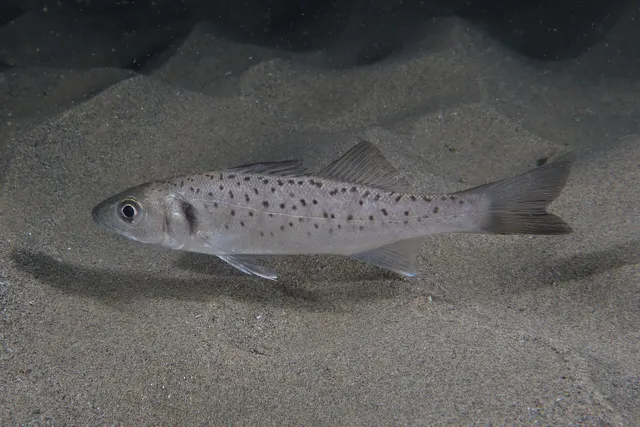 European sea bassThe temperate reminder that the corrosion problem is not tropical. A reel used in British surf and rinsed carelessly fails within a season, and the salt reaches the parts of a fly reel — the drag stack and the spindle — that a spinning reel keeps enclosed.
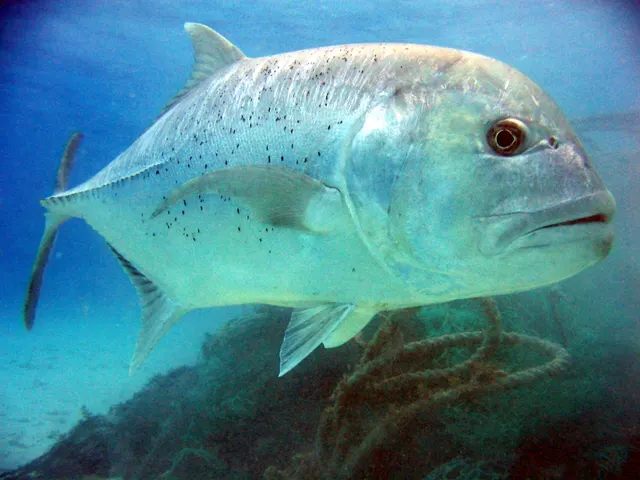 Giant trevallyThe fish that justifies the whole specification. Sealed drags, corrosion-resistant materials, heavy fast-taper lines and backing measured in hundreds of metres are not refinements here; they are what survives one fish.
Where it matters
Gear this affects
Sources and evidence
- Trout & Salmon — Bauer Media (Specialist angling publication)Relied on for: Long-running published description of British game angling practice, including casting, line choice, leader construction and the move from fresh water to salt.FishingHQ's interpretation of what it saysCitation checked — the work exists and is described correctly
- Still Water Fly-Fishing — Andre Deutsch, 1952 (Specialist angling publication)Relied on for: Stillwater fly practice including line handling, retrieve, leader construction and the reasoning behind each.States this directlyCitation checked — the work exists and is described correctly
- Sea Angler — Bauer Media (Specialist angling publication)Relied on for: Long-running published description of British sea angling practice by ground type, including the species and conditions coastal fly fishing addresses.FishingHQ's interpretation of what it saysCitation checked — the work exists and is described correctly
- General angling website restatements of established technique — Various (Credible secondary source)Relied on for: Widely restated descriptions of coastal fly fishing practice and equipment convention, recorded as practitioner consensus rather than as scholarship.Background and mechanism onlyCitation checked — the work exists and is described correctly
Why the 4 connections on this page are here, and the sources
Fish this applies to
What experienced anglers do — 2 connections
Widely and independently recommended by experienced anglers and specialist sources. This is real angling knowledge, not proof: controlled evidence for it is limited, and FishingHQ records it as convention rather than as a demonstrated effect.
European sea bass
A fish or a water joined to the fly-fishing mechanism it is a worked example of, written only where the subject's own behaviour or physical character is what this page explains. The direction is the one FishingHQ writes this kind of connection in, and the one it already uses 176 times, and it is also the semantically correct one: the mechanism explains the fish, not the reverse.
- Sea Angler — Bauer Media (Specialist angling publication)Relied on for: British sea angling practice including shore fishing for bass, pollack and mullet, the ground each is found over and the presentation each takes.FishingHQ's interpretation of what it saysCitation checked — the work exists and is described correctly
- FAO Species Identification Guides for Fishery Purposes and the FAO Species Catalogues — Food and Agriculture Organization of the United Nations (Scientific institute)Relied on for: Distribution, habitat and feeding biology of coastal and tropical marine species, from regional identification guides prepared for fishery purposes.States this directlyCitation checked — the work exists and is described correctly
- Freshwater Fishes of the British Isles — HarperCollins (New Naturalist 75), 1992 (Reference work)Relied on for: Life history, feeding biology, habitat requirement and seasonal behaviour of the freshwater fishes of the British Isles.States this directlyCitation checked — the work exists and is described correctly
- FishBase: a global information system on fishes — Froese, R. and D. Pauly, eds. — FishBase Consortium (Scientific institute)Relied on for: Recorded environment, depth range, feeding biology and distribution of the species named.States this directlyPassage read and verified
Giant trevally
A fish or a water joined to the fly-fishing mechanism it is a worked example of, written only where the subject's own behaviour or physical character is what this page explains. The direction is the one FishingHQ writes this kind of connection in, and the one it already uses 176 times, and it is also the semantically correct one: the mechanism explains the fish, not the reverse.
- FAO Species Identification Guides for Fishery Purposes and the FAO Species Catalogues — Food and Agriculture Organization of the United Nations (Scientific institute)Relied on for: Distribution, habitat association and feeding biology of tropical inshore and reef species, from regional identification guides prepared for fishery purposes.States this directlyCitation checked — the work exists and is described correctly
- FishBase: a global information system on fishes — Froese, R. and D. Pauly, eds. — FishBase Consortium (Scientific institute)Relied on for: Recorded environment, depth range, feeding biology and distribution of the tropical species named.States this directlyPassage read and verified
Where it matters
What experienced anglers do — 1 connection
Widely and independently recommended by experienced anglers and specialist sources. This is real angling knowledge, not proof: controlled evidence for it is limited, and FishingHQ records it as convention rather than as a demonstrated effect.
Saltwater fly fishing
A link from a practice or a piece of equipment to the explanation or mechanism it rests on.
- Trout & Salmon — Bauer Media (Specialist angling publication)Relied on for: Long-running published description of British game angling practice, including casting, line choice and the move from fresh water to salt.FishingHQ's interpretation of what it saysCitation checked — the work exists and is described correctly
- Still Water Fly-Fishing — Andre Deutsch, 1952 (Specialist angling publication)Relied on for: Stillwater fly practice including line handling, retrieve, leader construction and the reasoning behind each.States this directlyCitation checked — the work exists and is described correctly
Gear this affects
What experienced anglers do — 1 connection
Widely and independently recommended by experienced anglers and specialist sources. This is real angling knowledge, not proof: controlled evidence for it is limited, and FishingHQ records it as convention rather than as a demonstrated effect.
Fly reels
A link from a practice or a piece of equipment to the explanation or mechanism it rests on.
- Trout & Salmon — Bauer Media (Specialist angling publication)Relied on for: Long-running published description of British game angling practice, including casting, line choice and the move from fresh water to salt.FishingHQ's interpretation of what it saysCitation checked — the work exists and is described correctly
- Still Water Fly-Fishing — Andre Deutsch, 1952 (Specialist angling publication)Relied on for: Stillwater fly practice including line handling, retrieve, leader construction and the reasoning behind each.States this directlyCitation checked — the work exists and is described correctly
How FishingHQ labels evidence is explained in the evidence policy.