What does giant trevally eat?
What is established about how giant trevally feeds, kept separate from what anglers infer from it.
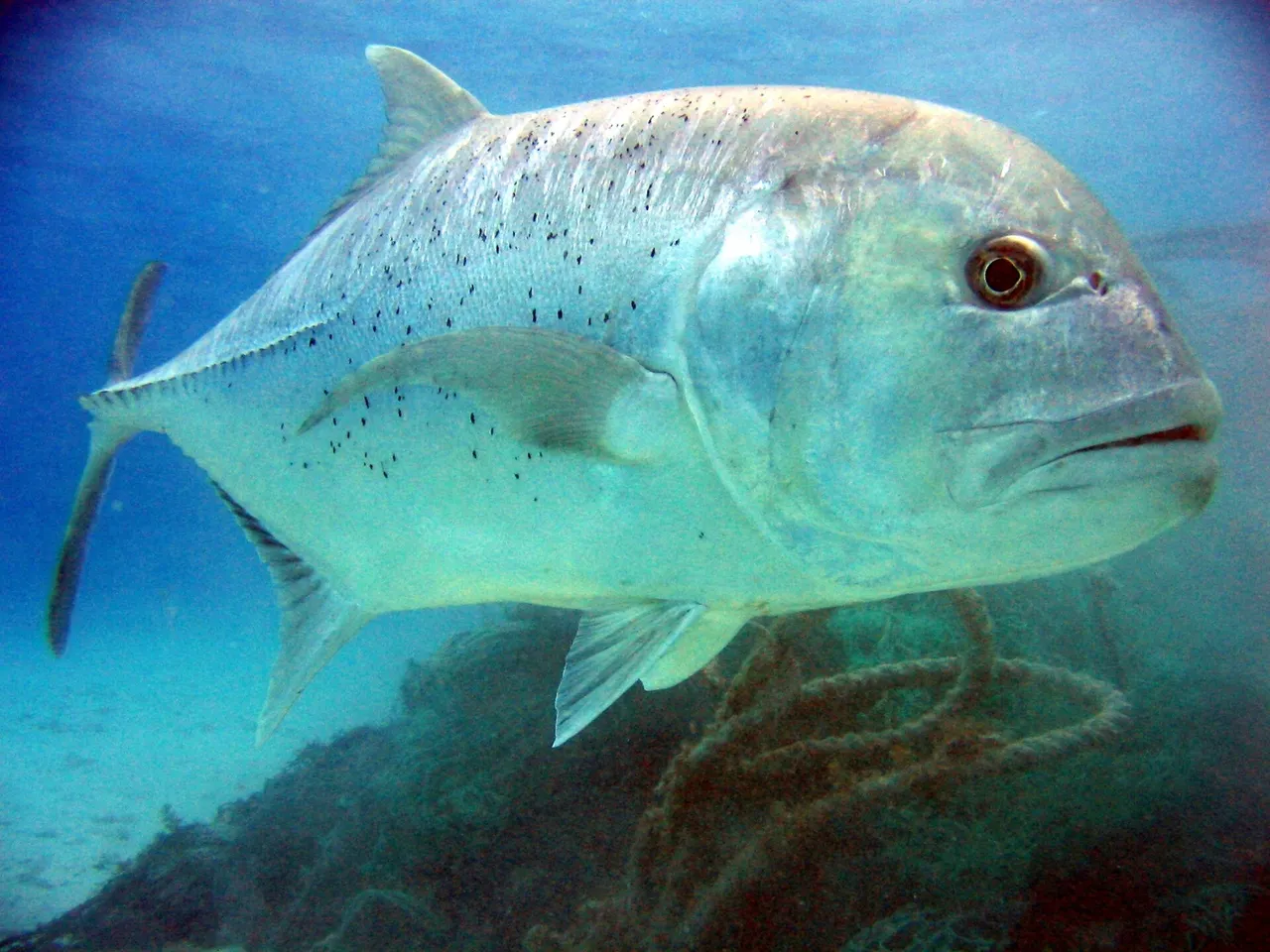
How this was identified, and who took it
Identified by: Near-full lateral view of a large fish. The steep head profile, deep compressed body and the scutes along the straight rear lateral line are the characters that place it in Caranx, and they are clear.Dr. Dwayne Meadows, NOAA/NMFS/OPR — Public domain, via Wikimedia Commons — source, licenceWhat is known about how it feeds
The giant trevally is an apex inshore predator that hunts in the top few metres of water and will attack prey at the surface with a violence that has few parallels.
It takes fish, cephalopods and crustaceans, hunting alone and in groups, and driving prey against reef, structure and the surface. It feeds by day and at night. The two verified relationships are cephalopods and decapod crustaceans, both at group level, and both reflect the broad opportunism of the species rather than a specialisation.
What distinguishes the animal is the willingness to attack large prey and to do so in very shallow water. Giant trevally are recorded taking prey at the edge of dry reef in water barely deep enough to cover them, and they are documented taking birds from the surface — behaviour that is unusual enough to have been filmed and studied.
The hunting is powerful rather than fast in the tuna sense. The body is deep and the musculature is built for acceleration and for sustained pressure in turbulent shallow water rather than for open-ocean speed.
The species is slow-growing and long-lived, and large individuals are old and comparatively few. It is also a resident predator rather than a migratory one, which means a reef's population of large fish can be depleted locally and does not replace itself quickly.
The food
Prey with a verified dietary link to this fish. Each entry carries its own evidence, and each is written at the precision the source actually used: a named species where the source named one, a group or food category where it said “polychaetes”, “crustaceans” or “detritus” and meant it. That is why this list is shorter than the animal’s real diet rather than longer.
- Cephalopods as prey — a group rather than a species: the evidence names the group
Squid and octopus are taken alongside fish and crustaceans, and giant trevally are opportunistic enough that diet composition varies substantially between locations.
- Decapod crustaceans as prey — a group rather than a species: the evidence names the group
Crustaceans are a regular component of the diet, particularly for smaller fish on shallow reef and flats habitat.
Food with no page of its own here yet
These are real components of the diet, listed as plain text because FishingHQ has no page for them yet. Inventing pages to make the list look fuller would be the fabrication this whole approach exists to prevent.
- reef fish of many families
- juvenile trevally
- octopus
- birds at the surface, recorded
- spiny lobsters
What anglers do with this
Everything below is interpretation, not finding. It is what experienced anglers conclude from the biology above, and the reasoning is usually sound and almost never tested. It is separated from the biology deliberately.
The shallow-water surface attack is the basis of the entire popping fishery for this species, and the connection from documented behaviour to presentation is direct.
The opportunism converts into a convention that placement and retrieve matter more than imitation, which follows from a diet with no specialisation in it.
The physical demands of the fishery are a mechanical consequence of the fish rather than a claim: a hooked giant trevally in shallow reef water applies sustained pressure towards structure, and the outcome is decided quickly.
The resident, slow-growing life history is the argument for release that the conservation bodies make, and the depletion of large fish on accessible reefs is documented rather than anecdotal.
What this does not establish
Both relationships are group-level and the fish component of the diet — which is the largest part of it — is not represented by a verified relationship. Composition varies enormously across the Indo-Pacific range and with fish size. Nothing establishes proportions.
Where this connects
These are the baits, lures, methods and explainers FishingHQ already joins to this fish — which is why the list is sometimes short. They are not chosen for this page, and a link here means an evidenced relationship exists, not that it follows from the diet.
Lures recorded for this species
Methods used for it
Where it lives
The science behind the feeding
This page covers feeding. The Giant trevally record covers identification, lifecycle, seasonal behaviour, handling and the sources behind all of it.
Reviewed 2026-08-12.