The double haul, and casting a fly in wind
Explainer · Last reviewed 2026-08-18
The technique that decides whether coastal fly fishing is possible at all in the conditions it is usually done in — and the one that beginners are told about long before they are shown why it works.
Safety: hooks and barbs — can cause serious injury or death.
Coastal fly fishing happens in wind, because a coast is windy and because the wind is frequently what has put the fish where they are. Casting in wind is therefore not an advanced refinement here; it is the entry requirement.
THE PROBLEM, STATED PHYSICALLY. A fly is cast by the line's momentum, and wind takes momentum away. A cast that is adequate on a still lake collapses into a headwind, and the instinctive response — casting harder — makes it worse, because a rod overloaded by effort opens its loop and an open loop presents more surface to the wind.
WHAT ACTUALLY SOLVES IT IS LINE SPEED WITH A TIGHT LOOP. Faster line in a narrower loop carries through wind that would stop a slow wide one. Both are produced by technique rather than by strength, and both can be produced by somebody who is not physically strong at all.
THE HAUL IS HOW LINE SPEED IS GENERATED. The line hand pulls sharply on the line during the casting stroke, accelerating the line relative to the rod tip and loading the rod more deeply than the casting arm alone can. A single haul does this on one stroke; a double haul does it on both the back cast and the forward cast, which compounds the effect. It is the difference between a rod being waved and a rod being loaded.
AND THE SECOND HALF OF THE ANSWER IS TO STOP MAKING FALSE CASTS. Every false cast in wind is another chance to be blown off line, another chance for the fly to reach the caster, and time in which the fish moves. A short heavy head, a haul and two false casts beat a long belly line and six.
THE WIND DIRECTION CHANGES THE PROBLEM RATHER THAN THE ANSWER. A headwind needs line speed and a low forward delivery. A tailwind is easy forwards and hard backwards, which is where back casts collapse. A wind from the casting-arm side is the dangerous one: it blows the fly into the caster, and the standard responses are to cast with the rod tilted across the body, to turn and present with the back cast, or to move.
WHICH IS WHY THIS PAGE IS ALSO A SAFETY RECORD. A hook travelling at speed towards a person's own head, twice per cast, in wind, is the mechanism behind the discipline's characteristic injury. Eye protection is not optional in fly fishing and the wind is the reason.
Wind direction changes the problem, and one direction is dangerous
The double haul is treated as the answer to wind, singular. There are four winds and they pose four different problems, and only one of them is really solved by line speed.
HEADWIND — INTO YOUR FACE. This is the one the haul is for. The line must be driven through moving air, which needs speed and a tight narrow loop, and it also needs a lower forward stroke so the line is delivered under the worst of the wind rather than into it. Casting harder without casting tighter makes it worse, because a wide loop presents more line to the wind.
TAILWIND — AT YOUR BACK. The easiest and the one that produces the worst presentation. The forward cast flies, and the back cast collapses because it is being blown down. The fix is a high back cast and a low forward one, and the trap is that distance comes so easily the leader is never turned over — the fly lands in a heap thirty metres away.
CROSSWIND FROM YOUR NON-CASTING SIDE. Harmless, and it actually helps by carrying the line away from you.
CROSSWIND FROM YOUR CASTING SIDE. THIS IS THE DANGEROUS ONE, and it is where hooks end up in people. The wind blows the line and the fly across the caster's body at head height on every stroke, and a double haul makes the fly arrive faster. The answers are all about moving the line's path away from the body: cast off the opposite shoulder, turn and cast backhanded, tilt the rod so the loop travels out to the side, or move to fish from the other side of the water. Continuing to cast normally with a weighted fly in a right-to-left wind on the right shoulder is how eyes are lost.
AND A HAUL DOES NOT FIX A BAD LOOP. Line speed multiplies whatever the stroke is producing. An angler with a wide loop who learns to haul gets a faster wide loop, which is worse in wind rather than better, and this is the commonest reason the technique disappoints the people who work hardest at it.
EYE PROTECTION IS THE ONE PIECE OF TACKLE THIS PAGE RECOMMENDS WITHOUT QUALIFICATION. Polarised glasses are worn for seeing fish and are worth wearing for this alone.
What experienced anglers do — why, and the sources (4)
Widely and independently recommended by experienced anglers and specialist sources. This is real angling knowledge, not proof: controlled evidence for it is limited, and FishingHQ records it as convention rather than as a demonstrated effect.
- Sea Angler — Bauer Media (Specialist angling publication)Relied on for: British sea angling practice including shore fishing for bass, pollack and mullet, the ground each is found over and the conditions each is fished in.FishingHQ's interpretation of what it saysCitation checked — the work exists and is described correctly
- FAO Species Identification Guides for Fishery Purposes and the FAO Species Catalogues — Food and Agriculture Organization of the United Nations (Scientific institute)Relied on for: Habitat association and feeding biology of coastal and tropical marine species, from regional identification guides prepared for fishery purposes.States this directlyCitation checked — the work exists and is described correctly
- Freshwater Fishing — Macdonald & Jane's, 1975 (Specialist angling publication)Relied on for: Comprehensive angling practice including fly fishing across rivers and stillwaters and the tackle each requires.States this directlyCitation checked — the work exists and is described correctly
- General angling website restatements of established technique — Various (Credible secondary source)Relied on for: Widely restated descriptions of established fly-fishing convention, recorded as practitioner consensus rather than as scholarship.Background and mechanism onlyCitation checked — the work exists and is described correctly
Safety
Hooks and barbs — Can cause serious injury or death
A fly passes the caster's head twice on every cast. A wind from the casting-arm side blows it towards them, and a collapsed back cast can put it into a face, a scalp or an eye at speed. A hook near an eye is a medical emergency with no field remedy.
What reduces it: Wear impact-resistant eye protection whenever a fly rod is in use. With a wind on the casting-arm side, tilt the rod across the body, present with the back cast, or move rather than casting through it. Fewer false casts means fewer opportunities.
Worse when:
- In a crosswind from the casting-arm side, which is the specific case that drives the fly into the caster.
- With heavy, weighted or large saltwater flies, which carry more energy than a trout fly.
Further safety reading
- Coastal fly fishing: the safety problem you bring with you — A fly passes the caster's head twice on every cast, and a crosswind from the casting-arm side drives it towards them — which is the discipline's characteristic injury mechanism.
- Hook injuries — The double haul exists to raise line speed, and it raises the speed of the fly with it. A wind that pushes the loop back towards the caster — which is the wind the haul is used in — is the specific combination that drives a fly into a face or a scalp.
Where to go next
Fish this applies to
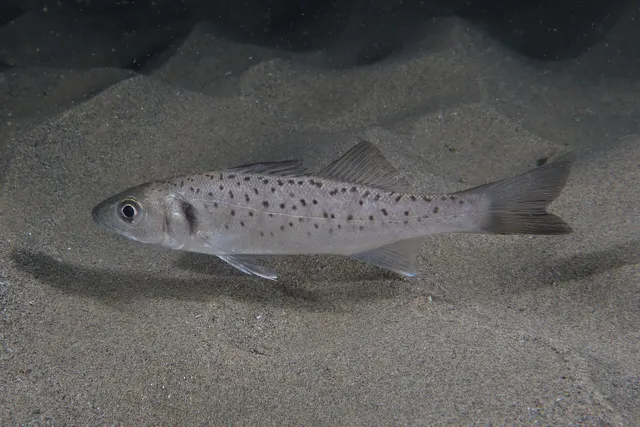 European sea bassThe commonest British reason to learn the cast. Bass fishing happens in wind because bass feed in broken water, and a single-haul caster on an onshore wind is not fishing badly — they are not reaching the water the fish are in at all.
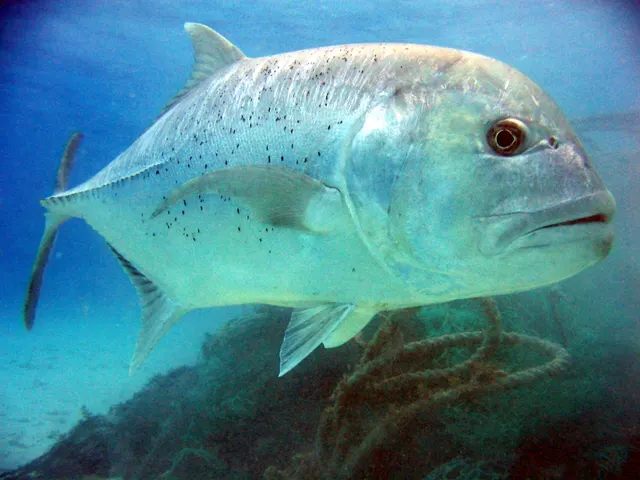 Giant trevallyThe extreme case, and it shows what the cast is really buying. A very large air-resistant fly on a heavy line into a trade wind, with one chance at a fish moving fast, is a line-speed problem before it is anything else.
Where it matters
Gear this affects
Sources and evidence
- Trout & Salmon — Bauer Media (Specialist angling publication)Relied on for: Long-running published description of British game angling practice, including casting, line choice, leader construction and the move from fresh water to salt.FishingHQ's interpretation of what it saysCitation checked — the work exists and is described correctly
- Still Water Fly-Fishing — Andre Deutsch, 1952 (Specialist angling publication)Relied on for: Stillwater fly practice including line handling, retrieve, leader construction and the reasoning behind each.States this directlyCitation checked — the work exists and is described correctly
- RNLI water safety guidance: cold water shock and Float to Live — Royal National Lifeboat Institution (Water-safety or diver-training authority)Relied on for: Cold water shock and the immersion response, tidal cut-off, and water-safety guidance for shore anglers, including those wading.States this directlyPassage read and verified
- RoSPA water safety information and UK accidental drowning statistics — Royal Society for the Prevention of Accidents (Water-safety or diver-training authority)Relied on for: Accident prevention around water, including hook injuries and the circumstances in which they occur.States this directlyPassage read and verified
Why the 7 connections on this page are here, and the sources
Fish this applies to
What experienced anglers do — 2 connections
Widely and independently recommended by experienced anglers and specialist sources. This is real angling knowledge, not proof: controlled evidence for it is limited, and FishingHQ records it as convention rather than as a demonstrated effect.
European sea bass
A fish or a water joined to the fly-fishing mechanism it is a worked example of, written only where the subject's own behaviour or physical character is what this page explains. The direction is the one FishingHQ writes this kind of connection in, and the one it already uses 176 times, and it is also the semantically correct one: the mechanism explains the fish, not the reverse.
- Sea Angler — Bauer Media (Specialist angling publication)Relied on for: British sea angling practice including shore fishing for bass, pollack and mullet, the ground each is found over and the presentation each takes.FishingHQ's interpretation of what it saysCitation checked — the work exists and is described correctly
- FAO Species Identification Guides for Fishery Purposes and the FAO Species Catalogues — Food and Agriculture Organization of the United Nations (Scientific institute)Relied on for: Distribution, habitat and feeding biology of coastal and tropical marine species, from regional identification guides prepared for fishery purposes.States this directlyCitation checked — the work exists and is described correctly
- Freshwater Fishes of the British Isles — HarperCollins (New Naturalist 75), 1992 (Reference work)Relied on for: Life history, feeding biology, habitat requirement and seasonal behaviour of the freshwater fishes of the British Isles.States this directlyCitation checked — the work exists and is described correctly
- FishBase: a global information system on fishes — Froese, R. and D. Pauly, eds. — FishBase Consortium (Scientific institute)Relied on for: Recorded environment, depth range, feeding biology and distribution of the species named.States this directlyPassage read and verified
Giant trevally
A fish or a water joined to the fly-fishing mechanism it is a worked example of, written only where the subject's own behaviour or physical character is what this page explains. The direction is the one FishingHQ writes this kind of connection in, and the one it already uses 176 times, and it is also the semantically correct one: the mechanism explains the fish, not the reverse.
- FAO Species Identification Guides for Fishery Purposes and the FAO Species Catalogues — Food and Agriculture Organization of the United Nations (Scientific institute)Relied on for: Distribution, habitat association and feeding biology of tropical inshore and reef species, from regional identification guides prepared for fishery purposes.States this directlyCitation checked — the work exists and is described correctly
- FishBase: a global information system on fishes — Froese, R. and D. Pauly, eds. — FishBase Consortium (Scientific institute)Relied on for: Recorded environment, depth range, feeding biology and distribution of the tropical species named.States this directlyPassage read and verified
Where it matters
What experienced anglers do — 2 connections
Widely and independently recommended by experienced anglers and specialist sources. This is real angling knowledge, not proof: controlled evidence for it is limited, and FishingHQ records it as convention rather than as a demonstrated effect.
Fly fishing
Which branch of fishing the record sits in.
- Sea Angler — Bauer Media (Specialist angling publication)Relied on for: Long-running published description of British sea angling practice including small-craft, kayak and coastal fly fishing.FishingHQ's interpretation of what it saysCitation checked — the work exists and is described correctly
- General angling website restatements of established technique — Various (Credible secondary source)Relied on for: Widely restated descriptions of kayak and coastal fly practice and equipment convention, recorded as practitioner consensus rather than as scholarship.Background and mechanism onlyCitation checked — the work exists and is described correctly
Saltwater fly fishing
A link from a practice or a piece of equipment to the explanation or mechanism it rests on.
- Trout & Salmon — Bauer Media (Specialist angling publication)Relied on for: Long-running published description of British game angling practice, including casting, line choice and the move from fresh water to salt.FishingHQ's interpretation of what it saysCitation checked — the work exists and is described correctly
- Still Water Fly-Fishing — Andre Deutsch, 1952 (Specialist angling publication)Relied on for: Stillwater fly practice including line handling, retrieve, leader construction and the reasoning behind each.States this directlyCitation checked — the work exists and is described correctly
Gear this affects
What experienced anglers do — 1 connection
Widely and independently recommended by experienced anglers and specialist sources. This is real angling knowledge, not proof: controlled evidence for it is limited, and FishingHQ records it as convention rather than as a demonstrated effect.
Fly rods
A link from a practice or a piece of equipment to the explanation or mechanism it rests on.
- Trout & Salmon — Bauer Media (Specialist angling publication)Relied on for: Long-running published description of British game angling practice, including casting, line choice and the move from fresh water to salt.FishingHQ's interpretation of what it saysCitation checked — the work exists and is described correctly
- Still Water Fly-Fishing — Andre Deutsch, 1952 (Specialist angling publication)Relied on for: Stillwater fly practice including line handling, retrieve, leader construction and the reasoning behind each.States this directlyCitation checked — the work exists and is described correctly
Safety reading
Official guidance — 1 connection
Stated by a fisheries authority, scientific institute or recognised angling body. Authoritative, but summarising rather than demonstrating.
Coastal fly fishing: the safety problem you bring with you
A link from the practice to the substantial safety topic describing the mechanism it creates or addresses.
- RNLI water safety guidance: cold water shock and Float to Live — Royal National Lifeboat Institution (Water-safety or diver-training authority)Relied on for: Cold water shock and the immersion response, small-craft water safety, and the advice to carry a means of calling for help on the person.States this directlyPassage read and verified
- RoSPA water safety information and UK accidental drowning statistics — Royal Society for the Prevention of Accidents (Water-safety or diver-training authority)Relied on for: Accident prevention around water, including entanglement, immersion and the measures that reduce both.States this directlyPassage read and verified
What experienced anglers do — 1 connection
Widely and independently recommended by experienced anglers and specialist sources. This is real angling knowledge, not proof: controlled evidence for it is limited, and FishingHQ records it as convention rather than as a demonstrated effect.
Hook injuries
A fly-fishing technique joined to the harm its own mechanics create, rather than to the general hazards of being near water. Written where the technique itself is the risk factor — a weighted fly accelerating past a head, a wader standing in current, a line manager on a rock platform with a swell running.
- RNLI water safety guidance: cold water shock and Float to Live — Royal National Lifeboat Institution (Water-safety or diver-training authority)Relied on for: Water safety guidance including cold water shock, sudden immersion and the behaviour that reduces both.States this directlyPassage read and verified
- Trout & Salmon — Bauer Media (Specialist angling publication)Relied on for: British game angling practice including wading, river safety and the handling of a weighted fly under load.FishingHQ's interpretation of what it saysCitation checked — the work exists and is described correctly
How FishingHQ labels evidence is explained in the evidence policy.