Permit
Fish · Last reviewed 2026-08-10
A large, deep-bodied jack of tropical flats and wrecks, famously difficult on fly and the third fish of the flats grand slam.
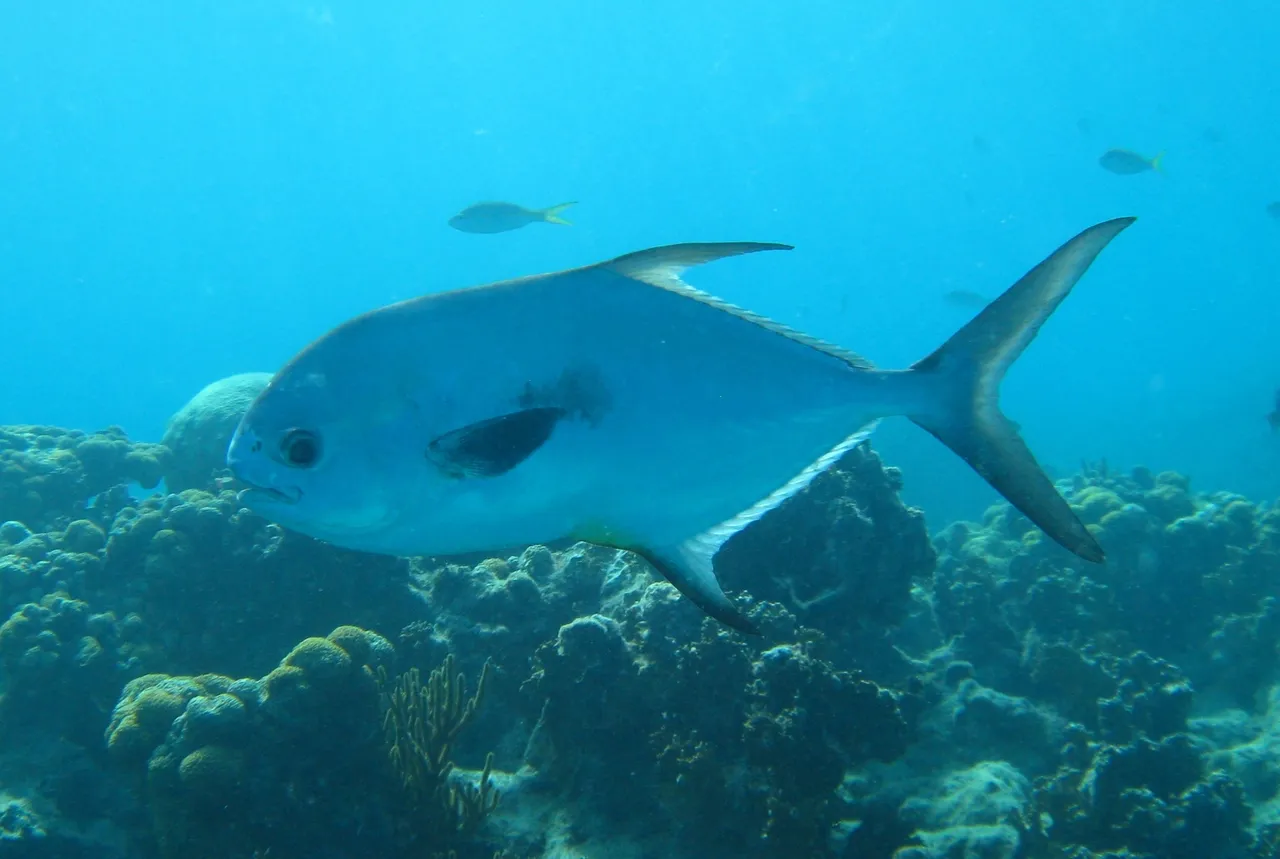
How this was identified, and who took it
Identified by: The long falcate forward lobes on both dorsal and anal fins, on a very deep strongly compressed body with a steep blunt forehead, a dark-margined deeply forked tail and a faint yellow wash on the belly ahead of the anal fin. Four agreeing identifications on the source, none disagreeing.Robert Webster — CC BY-SA, via iNaturalist — source, licenceCatching Permit
Everything here on fishing for it. Each entry opens the page behind it.
- Where
- 2 places FishingHQ documents — strongest claim anywhere: repeatedly reported · From a boat, Fly fishing
Permit occupies a peculiar position in angling: it is neither the largest nor the fastest fish on a tropical flat, and it is comfortably the most difficult. A permit will follow a fly for metres, examine it, and refuse it, and anglers have built a substantial literature around that refusal.
The fish itself is a large deep-bodied jack — a slab of silver with a high forehead, long sickle-shaped dorsal and anal lobes, and often an orange wash before the anal fin. It feeds on crabs and shellfish on shallow flats, tailing in water barely deep enough to cover it, and moves to wrecks and deeper structure as it grows.
With tarpon and bonefish it makes up the flats grand slam, and it is the component that keeps the slam rare.
How it is caught
Where Permit is documented
Places where public sources describe this species as fished, with how it is fished and how strongly the evidence supports it. This is not a range map and it is not a recommendation — it is what has been written down about a fishery rather than a record of any individual catch, and being listed is never permission to fish.
Florida
2 documented places
Bridge
Recorded here
From a boat
Shallow flat
Repeatedly reported
Fly fishing · From a boat
What these strengths mean
- Recorded here
- At least one credible public account of this species being caught here. That is all it means.
- Repeatedly reported
- Several independent public accounts. Enough to say it happens more than once; not enough to call it a fishery.
Identification
- Scientific name
- Trachinotus falcatus
- Family
- Carangidae
- Water
- Saltwater, Brackish
- Conservation status
- Least Concern
- Regions
- North America, Caribbean, Central & South America
- Long sickle-shaped forward lobes on the dorsal and anal fins, far longer than the short lobes of a Florida pompano.
- Very deep, strongly compressed silver body with a steep blunt forehead.
- Often an orange to yellow patch on the belly ahead of the anal fin.
- Deeply forked tail with dark margins, and no scutes along the rear lateral line.
Size
- Typical
- 4–12 kg (8.8–26 lb)
- Large
- 15–20 kg (33–44 lb)
Exceptional: FishBase records a maximum of 122 cm and 36 kg
A flats fish governed by tide and temperature, with an offshore spawning season nobody sees
Permit seasonality operates on two completely different scales — a tidal cycle measured in hours and a spawning cycle measured in months — and the flats angler experiences almost entirely the first.
THE TIDE IS THE SHORT-SCALE SEASON AND IT IS DECISIVE. Permit move onto shallow flats to feed on crabs and shrimp when the tide covers them and off again as it drains. A flat is permit habitat for a few hours of a cycle and empty ground the rest of the time, so 'when' at the daily scale means a state of tide rather than a time of day. Which stage of tide works varies with the particular flat, its depth and its access channels.
TEMPERATURE IS THE SEASONAL SCALE AND PERMIT ARE SENSITIVE TO IT. They are a warm-water fish that leaves shallow flats when water becomes too cool, retreating to deeper channels, basins and offshore structure through cold periods and returning as the shallows warm. In the cooler parts of the range that produces a genuine seasonal absence from the flats; in the warm core, permit are on the flats through most of the year and the season is about consistency rather than presence.
WIND AND LIGHT DECIDE WHETHER A GIVEN DAY WORKS AT ALL. This is a sight fishery, so cloud, chop and low sun make the fish unfindable even when they are present in normal numbers. That is not a seasonal effect but it dominates the experience of one, and a poor week is more often a weather week than a fish week.
SPAWNING TAKES THEM OFF THE FLATS ENTIRELY. Permit aggregate to spawn on offshore reefs, wrecks and structure through the warmer months, and those aggregations are predictable in place and time. That is a different fishery on different ground, and it is the point at which the population is most concentrated and most exposed.
WHICH IS WHY THE SPAWNING AGGREGATIONS ARE A CONSERVATION SUBJECT. Several jurisdictions have introduced measures aimed specifically at protecting permit spawning aggregations. Whether any such measure applies, where and when, is a matter for the competent authority and is not derivable from the biology.
AND JUVENILES USE SURF BEACHES AND SHALLOW BAYS, a habitat and a season entirely separate from the adult flats fishery, which is worth knowing because small permit turn up in places adults never go.
Backed by research — why, and the sources (2)
Supported by peer-reviewed research or fisheries science. The sources are listed and can be checked.
- IGFA International Angling Rules and World Record Requirements — International Game Fish Association (Angling or fisheries organisation)Relied on for: Recognition of the species as a recognised game fish and the seasonal pattern of the recreational fisheries that target it.Background and mechanism onlyPassage read and verified
- FishBase: a global information system on fishes — Froese, R. and D. Pauly, eds. — FishBase Consortium (Scientific institute)Relied on for: Spawning season, temperature preference, migratory behaviour and seasonal distribution for the species.States this directlyPassage read and verified
Lifecycle and reproduction
Long-lived and slow to mature relative to its pompano relatives, with fish recorded past twenty years. Large permit represent decades of growth, which is a substantial part of the argument for releasing them.
Spawns offshore, often around wrecks and deeper structure, in aggregations away from the flats. Juveniles use surf zones and shallow inshore habitat before moving onto flats and structure.
Feeding and senses
Feeds principally on crabs, and also on shellfish and small fish, crushing hard prey with powerful pharyngeal teeth. Tailing fish on a flat are rooting for crabs in sand and turtle grass.
Exceptional close-range vision in shallow clear water, which is precisely why the species is so difficult to deceive: a permit inspects a fly at close quarters in good light and rejects anything that behaves wrongly.
Through the year
Moves between shallow flats and deeper structure with temperature, tide and spawning. Flats fishing depends on tide state as much as on season, since the fish are only accessible when water covers the ground they feed on.
Distribution
Western Atlantic: Massachusetts, USA to southeastern Brazil, including Bahamas and many of the West Indies . Reports from Africa are based on misidentifications, mostly referring to T. teraia
This is a biological range — where the species occurs, not a prediction that you will catch one. To browse the fishing geography FishingHQ holds, start at fishing places.
Why anglers care
Among the most prized fly-fishing targets in the world, and the reason many anglers travel. Fished by sight on shallow flats with crab patterns, and on bait and jigs around wrecks. Practitioner consensus is unusually strong and unusually consistent here: permit refuse more presentations than any comparable species, and success depends on the fly landing correctly relative to a moving fish rather than on the pattern itself. Almost universally released by fly anglers.
Handling and returning
A large, deep-bodied fish that must be supported horizontally with both hands and never held vertically by the tail alone. Keep it in the water where possible, minimise air exposure after a long fight in warm shallow water, and revive it fully — permit fight to exhaustion and are vulnerable to shark predation immediately after release.
Going further
- Permit vs Florida pompano — how to tell them apart.
Where to go next
Similar and related fish
Where it lives
- Coral reefTails on shallow tropical flats rooting for crabs, and holds around wrecks as it grows.
- EstuaryTails on shallow tropical flats rooting for crabs, and holds around wrecks as it grows.
- Seagrass bedsFeeds over turtle grass and mixed seagrass flats, and the crabs it is hunting are animals of exactly that ground.
Where you will find it
- CubaLong-lived, site-attached and aggregating to spawn predictably, which is the life history that collapses fastest under concentrated fishing — and the reason catch-and-release is a management measure here rather than an ethic.
- FloridaOccupies flats, wrecks and reef, and is regarded as the hardest of the flats species to take on a fly — which is a large part of its standing here.
- The Yucatán and Mexican Caribbean coastOver turtle grass and coral rubble, and the species that decides whether a week here is remembered — long-lived, wary, site-attached and the hardest of the flats fish to convert.
Understanding this fish
- Crustacean imitation in saltwater fly fishingThe fish that made crab imitation a serious subject. Permit feed heavily on crabs on the flats, they inspect closely in clear shallow water, and the fly's sink rate and the way it lands and sits matter more than its outline — which is the record's point about behaviour over silhouette.
- Sight fishing and blind searchingThe hardest version of the same problem, and the reason the record separates spotting from catching. Permit are found the same way bonefish are and refuse far more often, which means the skill that locates them is not the skill that converts them.
Sources and evidence
- FishBase: a global information system on fishes — Froese, R. and D. Pauly, eds. — FishBase Consortium (Scientific institute)Relied on for: Family, maximum size, depth and environment, distribution and the IUCN assessment for Trachinotus falcatus.States this directlyPassage read and verified
- The IUCN Red List of Threatened Species — International Union for Conservation of Nature (Conservation authority)Relied on for: The Least Concern assessment for Trachinotus falcatus, assessed 21 August 2012.States this directlyCitation checked — the work exists and is described correctly
Why the 11 connections on this page are here, and the sources
Similar and related fish
Backed by research — 1 connection
Supported by peer-reviewed research or fisheries science. The sources are listed and can be checked.
Florida pompano
An identification comparison naming both binomials: Trachinotus falcatus and Trachinotus carolinus.
- FishBase: a global information system on fishes — Froese, R. and D. Pauly, eds. — FishBase Consortium (Scientific institute)Relied on for: Morphological and distributional data for Trachinotus falcatus and for Trachinotus carolinus.States this directlyPassage read and verified
- The IUCN Red List of Threatened Species — International Union for Conservation of Nature (Conservation authority)Relied on for: Separate assessments treating Trachinotus falcatus and Trachinotus carolinus as distinct species.States this directlyCitation checked — the work exists and is described correctly
How it is caught
What experienced anglers do — 2 connections
Widely and independently recommended by experienced anglers and specialist sources. This is real angling knowledge, not proof: controlled evidence for it is limited, and FishingHQ records it as convention rather than as a demonstrated effect.
Saltwater fly fishing
A practitioner claim about how Trachinotus falcatus is commonly fished, following from where and how it feeds.
- General angling website restatements of established technique — Various (Credible secondary source)Relied on for: Widely restated practitioner accounts of fishing for permit.Citation checked — the work exists and is described correctly
- Sea Angler — Bauer Media (Specialist angling publication)Relied on for: Practitioner treatment of the methods used for permit and comparable species.Citation checked — the work exists and is described correctly
A statement about how a species is fished, which is angling convention rather than biology and is labelled as such.
- Still Water Fly-Fishing — Andre Deutsch, 1952 (Specialist angling publication)Relied on for: Fly-fishing practice from a practitioner tradition: line control, depth management, retrieve and the reading of water.States this directlyCitation checked — the work exists and is described correctly
- Sea Angler — Bauer Media (Specialist angling publication)Relied on for: Contemporary UK sea angling practice as reported by practitioners: ground, tackle, presentation and seasonal timing.States this directlyCitation checked — the work exists and is described correctly
Popping and stickbaiting
A practitioner claim about how Trachinotus falcatus is commonly fished, following from where and how it feeds.
- General angling website restatements of established technique — Various (Credible secondary source)Relied on for: Widely restated practitioner accounts of fishing for permit.Citation checked — the work exists and is described correctly
- Sea Angler — Bauer Media (Specialist angling publication)Relied on for: Practitioner treatment of the methods used for permit and comparable species.Citation checked — the work exists and is described correctly
Where it lives
Backed by research — 3 connections
Supported by peer-reviewed research or fisheries science. The sources are listed and can be checked.
Coral reef
A habitat association for Trachinotus falcatus taken from the environment and distribution data on its FishBase summary.
- FishBase: a global information system on fishes — Froese, R. and D. Pauly, eds. — FishBase Consortium (Scientific institute)Relied on for: The environment, depth range and habitat description recorded for Trachinotus falcatus.States this directlyPassage read and verified
Estuary
A habitat association for Trachinotus falcatus taken from the environment and distribution data on its FishBase summary.
- FishBase: a global information system on fishes — Froese, R. and D. Pauly, eds. — FishBase Consortium (Scientific institute)Relied on for: The environment, depth range and habitat description recorded for Trachinotus falcatus.States this directlyPassage read and verified
Seagrass beds
A habitat association resting on the regional identification and fisheries literature rather than on angling report.
- JNCC species and habitat conservation advice — Joint Nature Conservation Committee (Conservation authority)Relied on for: UK and European habitat classification and the conservation status of seagrass beds, including the species associated with them.States this directlyCitation checked — the work exists and is described correctly
- FAO Species Identification Guides for Fishery Purposes and the FAO Species Catalogues — Food and Agriculture Organization of the United Nations (Scientific institute)Relied on for: Habitat association and distribution of the species concerned.States this directlyCitation checked — the work exists and is described correctly
Where you will find it
Backed by research — 3 connections
Supported by peer-reviewed research or fisheries science. The sources are listed and can be checked.
Cuba
That a species occurs in these waters, drawn from distribution science. It is a statement about where the animal lives and is not a statement that anybody will catch one, still less where.
- The IUCN Red List of Threatened Species — International Union for Conservation of Nature (Conservation authority)Relied on for: Current conservation assessment of the species and systems concerned, with the assessment date.States this directlyCitation checked — the work exists and is described correctly
- Reef Fish Spawning Aggregations: Biology, Research and Management — Springer, Fish & Fisheries Series vol. 35, 2012 (Scientific literature)Relied on for: The exploitation and management of aggregating reef species, and the evidence on which protection is argued.States this directlyCitation checked — the work exists and is described correctly
Florida
A distribution association between an animal and a kind of water, rather than a claim about any named mark.
- NOAA National Ocean Service education on estuaries and the National Estuarine Research Reserve System — National Oceanic and Atmospheric Administration, United States (Government fisheries body)Relied on for: Estuarine, seagrass and coastal habitat function in North American waters, and the nursery role of shallow habitat for the species concerned.Background and mechanism onlyCitation checked — the work exists and is described correctly
- FishBase: a global information system on fishes — Froese, R. and D. Pauly, eds. — FishBase Consortium (Scientific institute)Relied on for: Distribution, habitat association, depth range and life history recorded for the species.States this directlyPassage read and verified
The Yucatán and Mexican Caribbean coast
That a species occurs in these waters, drawn from distribution science. It is a statement about where the animal lives and is not a statement that anybody will catch one, still less where.
- FAO Species Identification Guides for Fishery Purposes and the FAO Species Catalogues — Food and Agriculture Organization of the United Nations (Scientific institute)Relied on for: Identification, distribution and habitat association of the fishes and invertebrates of the tropical region named.States this directlyCitation checked — the work exists and is described correctly
- FishBase: a global information system on fishes — Froese, R. and D. Pauly, eds. — FishBase Consortium (Scientific institute)Relied on for: Recorded distribution, depth range and habitat association of the species named, including its occurrence in the waters concerned.States this directlyPassage read and verified
Understanding this fish
What experienced anglers do — 2 connections
Widely and independently recommended by experienced anglers and specialist sources. This is real angling knowledge, not proof: controlled evidence for it is limited, and FishingHQ records it as convention rather than as a demonstrated effect.
Crustacean imitation in saltwater fly fishing
A fish or a water joined to the fly-fishing mechanism it is a worked example of, written only where the subject's own behaviour or physical character is what this page explains. The direction is the one FishingHQ writes this kind of connection in, and the one it already uses 176 times, and it is also the semantically correct one: the mechanism explains the fish, not the reverse.
- FAO Species Identification Guides for Fishery Purposes and the FAO Species Catalogues — Food and Agriculture Organization of the United Nations (Scientific institute)Relied on for: Distribution, habitat association and feeding biology of tropical inshore and reef species, from regional identification guides prepared for fishery purposes.States this directlyCitation checked — the work exists and is described correctly
- FishBase: a global information system on fishes — Froese, R. and D. Pauly, eds. — FishBase Consortium (Scientific institute)Relied on for: Recorded environment, depth range, feeding biology and distribution of the tropical species named.States this directlyPassage read and verified
Sight fishing and blind searching
A fish or a water joined to the fly-fishing mechanism it is a worked example of, written only where the subject's own behaviour or physical character is what this page explains. The direction is the one FishingHQ writes this kind of connection in, and the one it already uses 176 times, and it is also the semantically correct one: the mechanism explains the fish, not the reverse.
- FAO Species Identification Guides for Fishery Purposes and the FAO Species Catalogues — Food and Agriculture Organization of the United Nations (Scientific institute)Relied on for: Distribution, habitat association and feeding biology of tropical inshore and reef species, from regional identification guides prepared for fishery purposes.States this directlyCitation checked — the work exists and is described correctly
- FishBase: a global information system on fishes — Froese, R. and D. Pauly, eds. — FishBase Consortium (Scientific institute)Relied on for: Recorded environment, depth range, feeding biology and distribution of the tropical species named.States this directlyPassage read and verified
How FishingHQ labels evidence is explained in the evidence policy.