Florida pompano
Fish · Last reviewed 2026-08-10
A small, deep-bodied, hard-fighting jack of sandy surf beaches, feeding on sand fleas in the wash and prized out of proportion to its size.
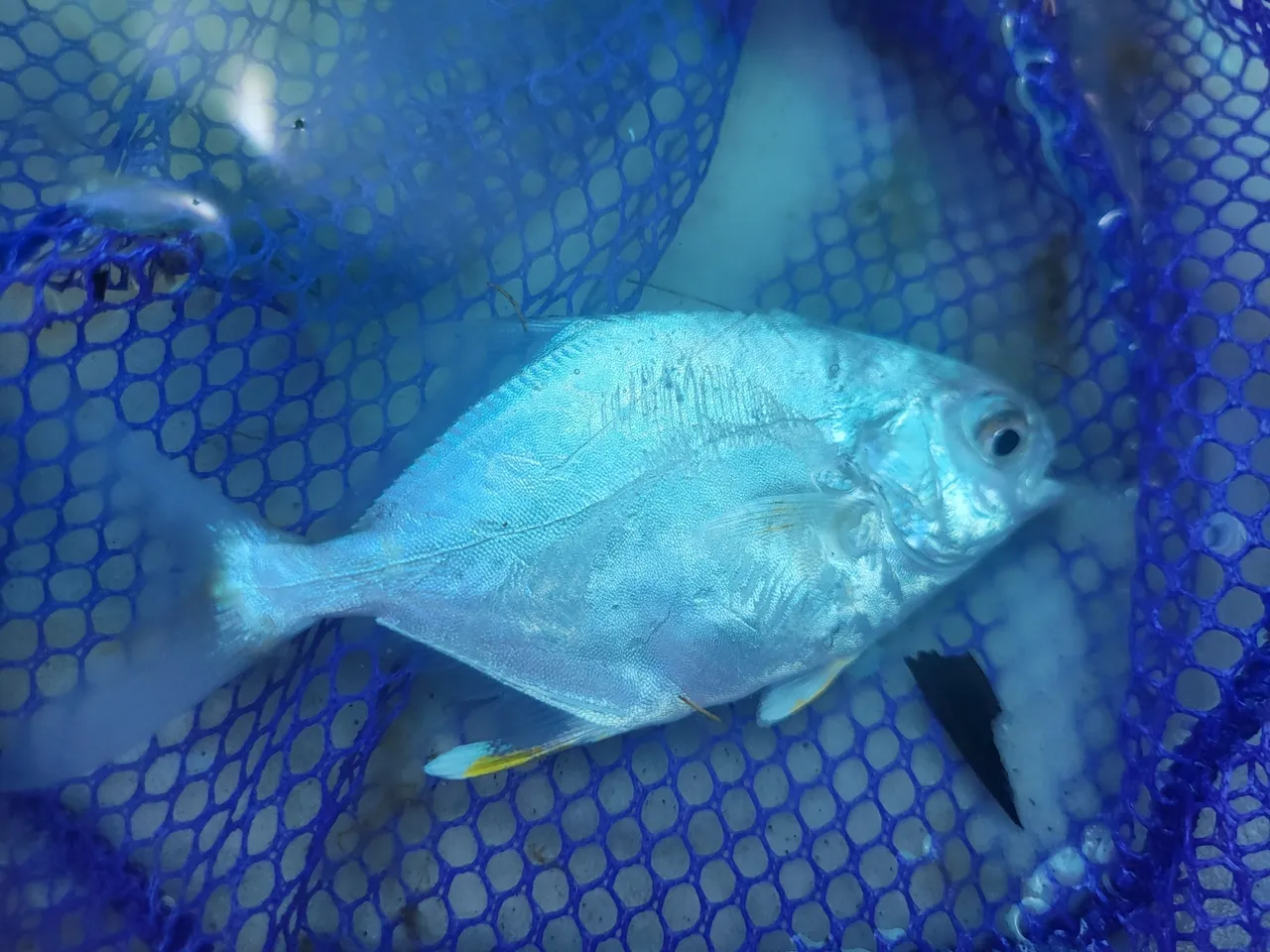
How this was identified, and who took it
Identified by: Short forward lobes on the dorsal and anal fins — the character that distinguishes it from the permit published in this same batch — on a deep strongly compressed body with a blunt rounded head, a small mouth, a deeply forked tail and a smooth rear lateral line carrying no scutes. Yellow persists on the anal and pelvic fins.Brandon McCracken — CC BY, via iNaturalist — source, licenceCatching Florida pompano
Everything here on fishing for it. Each entry opens the page behind it.
- Ground
Florida pompano is a surf fish in the most literal sense: it feeds in the broken water right at the beach, following the wash in and out to take mole crabs and coquina clams exposed by the surge. Anglers fish for it a rod's length beyond the first breaker, not out at sea.
It is a small jack — deep-bodied, blunt-headed, brilliantly silver with a yellow wash on the throat and belly — and it fights far above its weight on light tackle. It is also among the most valuable food fish of the American south-east, which shapes both commercial and recreational interest.
The key to catching it is the sand flea. Pompano feeding is tightly tied to the invertebrates of the swash zone, and matching that is the whole game.
How it is caught
Gear for this fish
Identification
- Scientific name
- Trachinotus carolinus
- Family
- Carangidae
- Water
- Saltwater, Brackish
- Conservation status
- Least Concern
- Regions
- North America, Caribbean
- Deep, strongly compressed body with a blunt rounded head and a small mouth.
- Brilliant silver flanks with a yellow to orange wash on the throat, belly and anal fin.
- Deeply forked tail and no scutes along the rear lateral line, which separates it from the true jacks.
- Dorsal and anal fins with short forward lobes — not the long trailing lobes of a permit.
Size
- Typical
- 0.4–1 kg (1–2.2 lb)
- Large
- 1.4–2.2 kg (3–5 lb)
Exceptional: FishBase records a maximum of 64 cm and 3.8 kg
Lifecycle and reproduction
Fast-growing and short-lived, maturing within a year or two and rarely exceeding four or five years. That life history makes it far more resilient to fishing pressure than the long-lived reef species of the same coast.
Spawns offshore in spring and summer, broadcasting eggs. Juveniles recruit to the surf zone and inshore flats, where they remain through the first part of life.
Feeding and senses
Feeds on mole crabs (sand fleas), small clams, and other invertebrates exposed by wave action in the swash zone, crushing them with heavy pharyngeal teeth. Feeding follows the tide and the wash rather than a fixed location.
Locates prey at very close range in turbulent, sand-laden water where visibility is poor, working the disturbance of the wave zone rather than hunting by long-range sight.
Through the year
Moves along the coast with water temperature, appearing in numbers on given beaches in predictable seasons and vacating when temperatures fall. The runs are the defining event of the fishery.
Distribution
Western Atlantic: Massachusetts, USA through the Gulf of Mexico and scattered localities in the West Indies to Brazil. Also found in Argentina . Absent from clear waters of Bahamas and similar islands
This is a biological range — where the species occurs, not a prediction that you will catch one. To browse the fishing geography FishingHQ holds, start at fishing places.
Why anglers care
One of the principal surf-fishing targets of the American south-east and Gulf coasts, taken on sand fleas, shrimp and small jigs fished on multi-hook rigs cast just beyond the break. Its significance rests on accessibility and on eating quality — it is fished from open beach with ordinary tackle, and it is among the most sought-after fish on the table. Practitioner consensus is firm that natural sand flea outfishes everything else, though jigs take fish where the swash is deep enough to work them.
Handling and returning
Small, robust and easily released. Wet hands, support the body, and keep the fish out of dry sand, which strips the mucus layer. Return fish through the wash rather than throwing them, and unhook with pliers to avoid damage from multi-hook rigs.
Going further
- Florida pompano vs Permit — how to tell them apart.
Where to go next
Similar and related fish
Where it lives
Where you will find it
Sources and evidence
- FishBase: a global information system on fishes — Froese, R. and D. Pauly, eds. — FishBase Consortium (Scientific institute)Relied on for: Family, maximum size, depth and environment, distribution and the IUCN assessment for Trachinotus carolinus.States this directlyPassage read and verified
- The IUCN Red List of Threatened Species — International Union for Conservation of Nature (Conservation authority)Relied on for: The Least Concern assessment for Trachinotus carolinus, assessed 21 August 2012.States this directlyCitation checked — the work exists and is described correctly
Why the 6 connections on this page are here, and the sources
Similar and related fish
Backed by research — 1 connection
Supported by peer-reviewed research or fisheries science. The sources are listed and can be checked.
Permit
An identification comparison naming both binomials: Trachinotus falcatus and Trachinotus carolinus.
- FishBase: a global information system on fishes — Froese, R. and D. Pauly, eds. — FishBase Consortium (Scientific institute)Relied on for: Morphological and distributional data for Trachinotus falcatus and for Trachinotus carolinus.States this directlyPassage read and verified
- The IUCN Red List of Threatened Species — International Union for Conservation of Nature (Conservation authority)Relied on for: Separate assessments treating Trachinotus falcatus and Trachinotus carolinus as distinct species.States this directlyCitation checked — the work exists and is described correctly
How it is caught
What experienced anglers do — 1 connection
Widely and independently recommended by experienced anglers and specialist sources. This is real angling knowledge, not proof: controlled evidence for it is limited, and FishingHQ records it as convention rather than as a demonstrated effect.
Surfcasting
A practitioner claim about how Trachinotus carolinus is commonly fished, following from where and how it feeds.
- General angling website restatements of established technique — Various (Credible secondary source)Relied on for: Widely restated practitioner accounts of fishing for florida pompano.Citation checked — the work exists and is described correctly
- Sea Angler — Bauer Media (Specialist angling publication)Relied on for: Practitioner treatment of the methods used for florida pompano and comparable species.Citation checked — the work exists and is described correctly
Gear for this fish
What experienced anglers do — 1 connection
Widely and independently recommended by experienced anglers and specialist sources. This is real angling knowledge, not proof: controlled evidence for it is limited, and FishingHQ records it as convention rather than as a demonstrated effect.
Prawns and shrimp
A practitioner claim about tackle commonly used for Trachinotus carolinus.
- General angling website restatements of established technique — Various (Credible secondary source)Relied on for: Widely restated practitioner accounts of this presentation for florida pompano.Citation checked — the work exists and is described correctly
- Angling Times — Bauer Media (Specialist angling publication)Relied on for: Practitioner treatment of comparable presentations for the species group.Citation checked — the work exists and is described correctly
Where it lives
Backed by research — 1 connection
Supported by peer-reviewed research or fisheries science. The sources are listed and can be checked.
Surf beaches
A habitat association for Trachinotus carolinus taken from the environment and distribution data on its FishBase summary.
- FishBase: a global information system on fishes — Froese, R. and D. Pauly, eds. — FishBase Consortium (Scientific institute)Relied on for: The environment, depth range and habitat description recorded for Trachinotus carolinus.States this directlyPassage read and verified
Where you will find it
Backed by research — 2 connections
Supported by peer-reviewed research or fisheries science. The sources are listed and can be checked.
Florida
A distribution association between an animal and a kind of water, rather than a claim about any named mark.
- NOAA National Ocean Service education on estuaries and the National Estuarine Research Reserve System — National Oceanic and Atmospheric Administration, United States (Government fisheries body)Relied on for: Estuarine, seagrass and coastal habitat function in North American waters, and the nursery role of shallow habitat for the species concerned.Background and mechanism onlyCitation checked — the work exists and is described correctly
- FishBase: a global information system on fishes — Froese, R. and D. Pauly, eds. — FishBase Consortium (Scientific institute)Relied on for: Distribution, habitat association, depth range and life history recorded for the species.States this directlyPassage read and verified
The Gulf of Mexico
A distribution association between an animal and a kind of water, rather than a claim about any named mark.
- FishBase: a global information system on fishes — Froese, R. and D. Pauly, eds. — FishBase Consortium (Scientific institute)Relied on for: Distribution, habitat association and depth range recorded for the species, including its occurrence in the water body concerned.States this directlyPassage read and verified
- The IUCN Red List of Threatened Species — International Union for Conservation of Nature (Conservation authority)Relied on for: Assessment and range account for the species, including the systems and coasts it occupies.Background and mechanism onlyCitation checked — the work exists and is described correctly
How FishingHQ labels evidence is explained in the evidence policy.