How to identify florida pompano
Trachinotus carolinus · Carangidae
The characters that identify florida pompano, ranked by how far each one can be trusted on its own.
How this was identified, and who took it
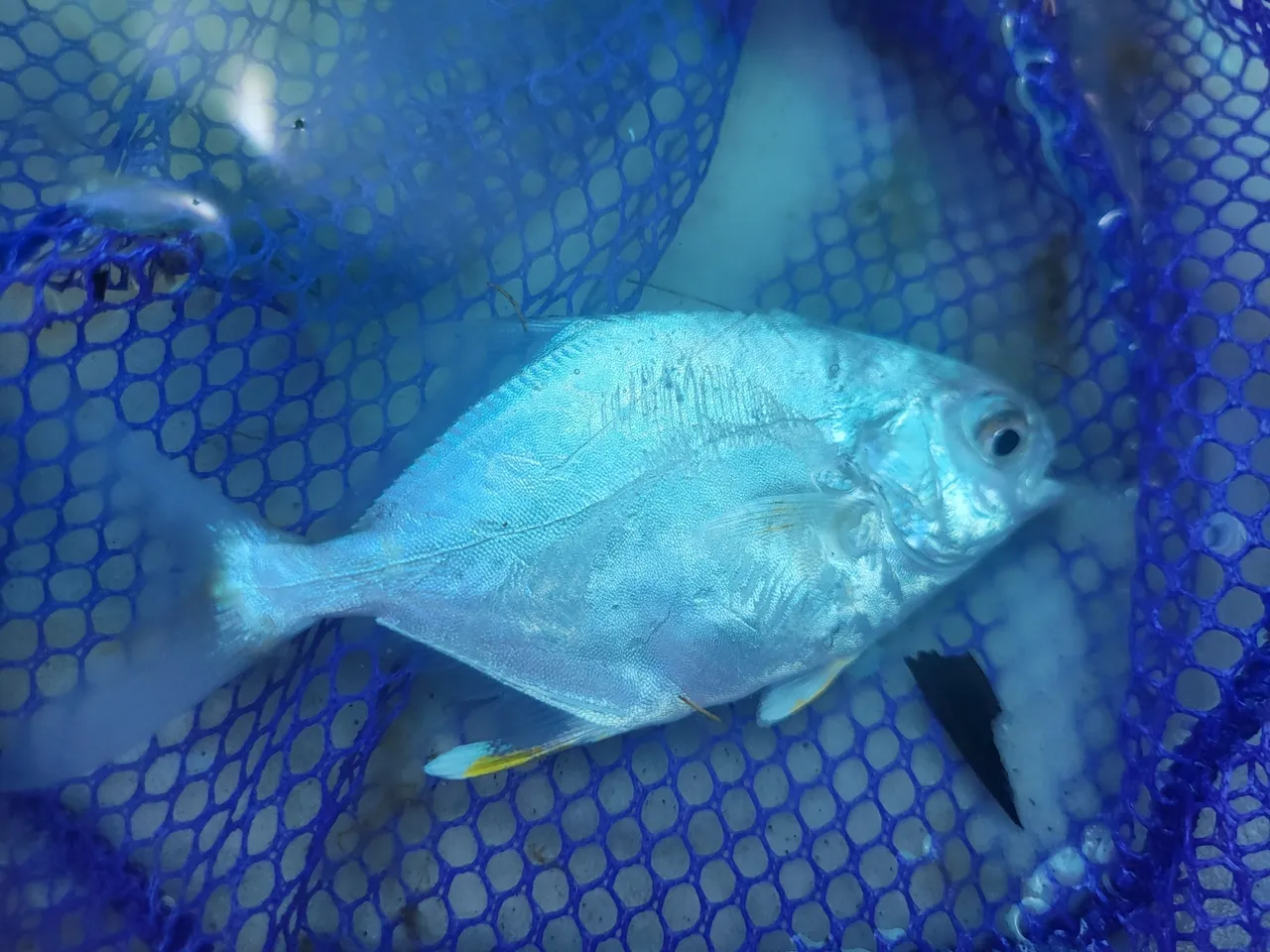
Identified by: Short forward lobes on the dorsal and anal fins — the character that distinguishes it from the permit published in this same batch — on a deep strongly compressed body with a blunt rounded head, a small mouth, a deeply forked tail and a smooth rear lateral line carrying no scutes. Yellow persists on the anal and pelvic fins.Brandon McCracken — CC BY, via iNaturalist — source, licenceAbout the image above: The photograph shows the fish lying in a wet blue landing net, which throws a heavy cyan cast across the flank. The brilliant silver the page describes does not read true here; the fin geometry and body proportions do.
Look at this first
This is the permit test run backwards. Find where the dorsal and anal fins rise off the body and check whether the leading rays are short. On a pompano they are stubby and unremarkable; on a permit of the same shape they trail back in long sickles that nobody misses.
Diagnostic — settles it on its own
Each of these settles the identification on its own. If one is clear, you have your answer.
Short leading rays on the dorsal and anal fins
The front of both fins rises to a modest point and stops. There is no long trailing curve, at any size, on any fish. Because the two species otherwise share a body plan and a colour, and because they are caught from the same beaches, this is the whole of the identification and it takes one glance at a side view to make. Any frame that does not show the fish in profile cannot be used for it.
Supporting — use with other characters
Real characters that are not conclusive by themselves. Use two or three together.
No hard bony plates along the rear lateral line
Run a finger along the lateral line towards the tail. On a true jack it becomes a row of hard raised scutes that catch on skin. On both pompano and permit it stays smooth all the way. This does not separate the two from each other, but it removes an entire family of similar-looking silver fish from consideration, which is worth doing before arguing about fin lobes.
A small mouth in a blunt rounded head
The head runs up steeply from a small mouth set low and forward, with no projecting snout. This is the head of an animal that crushes small shellfish and crabs rather than chasing fish, and it is a useful cross-check against the more pointed head of a similarly silver, similarly deep-bodied jack or a small tarpon in the surf.
Suggestive only — varies with condition
Hints only. These vary with condition, season, water and how long the fish has been out of it, and a fish that contradicts them is still the same species.
Warm colour low on the throat, belly and anal fin
The underside frequently carries a yellow or faintly orange wash running from the throat back along the belly and onto the anal fin. It reads well on a fresh fish in daylight and it fades within an hour, and it can be strong on a permit too. It is worth seeing and it is not worth relying on, particularly in any image taken through water, where warm tones are the first thing the water removes.
Where and when the fish is available at all
Pompano appear along a given stretch of coast as water temperature carries them there and disappear when it falls, so the fish is often either abundant or entirely absent rather than thinly present. Knowing the run is on does not identify anything by itself, and it does raise the prior odds that a deep silver fish of a kilogramme in the surf is this one rather than a juvenile of something larger.
What it gets confused with
- Permit, constantly, and the only test that matters between them is the length of the front lobes on the dorsal and anal fins.
- Palometa, which carries long dark fin lobes and dark bars on the flank, and which turns up in the same surf.
- Juvenile jacks of several species in the wash, separated by the hard scutes along the rear lateral line that a pompano does not have.
- Small permit, which are the genuinely hard case, because the sickle lobes that separate the adults have not yet grown out.
Side by side: Florida pompano vs Permit.
Where this stops working
A juvenile permit and an adult pompano are close to the same size and the same shape, and the fin lobes on the young permit are not yet long, so the one comparison the page rests on is at its weakest exactly where it is most needed. Very small fish of both species recruit to the same surf zone and are not reliably separable in a photograph at all. The warm colour on the underside is shared, fades fast, and is absent on plenty of good fish, so a pompano identified on yellow alone has not been identified. Where the answer has to be certain, the fish needs to be in the hand and in profile.
The full record
This page covers identification only. The Florida pompano record covers behaviour, lifecycle, distribution, handling and the sources behind all of it.
Reviewed 2026-08-16.
More about this fish
Telling it apart is one question. Here are the others.
Similar and related fish
How it is caught
Where it lives
Where you will find it
Why the 5 connections on this page are here, and the sources
Similar and related fish
Backed by research — 1 connection
Supported by peer-reviewed research or fisheries science. The sources are listed and can be checked.
Permit
An identification comparison naming both binomials: Trachinotus falcatus and Trachinotus carolinus.
- FishBase: a global information system on fishes — Froese, R. and D. Pauly, eds. — FishBase Consortium (Scientific institute)Relied on for: Morphological and distributional data for Trachinotus falcatus and for Trachinotus carolinus.States this directlyPassage read and verified
- The IUCN Red List of Threatened Species — International Union for Conservation of Nature (Conservation authority)Relied on for: Separate assessments treating Trachinotus falcatus and Trachinotus carolinus as distinct species.States this directlyCitation checked — the work exists and is described correctly
How it is caught
What experienced anglers do — 1 connection
Widely and independently recommended by experienced anglers and specialist sources. This is real angling knowledge, not proof: controlled evidence for it is limited, and FishingHQ records it as convention rather than as a demonstrated effect.
Surfcasting
A practitioner claim about how Trachinotus carolinus is commonly fished, following from where and how it feeds.
- General angling website restatements of established technique — Various (Credible secondary source)Relied on for: Widely restated practitioner accounts of fishing for florida pompano.Citation checked — the work exists and is described correctly
- Sea Angler — Bauer Media (Specialist angling publication)Relied on for: Practitioner treatment of the methods used for florida pompano and comparable species.Citation checked — the work exists and is described correctly
Where it lives
Backed by research — 1 connection
Supported by peer-reviewed research or fisheries science. The sources are listed and can be checked.
Surf beaches
A habitat association for Trachinotus carolinus taken from the environment and distribution data on its FishBase summary.
- FishBase: a global information system on fishes — Froese, R. and D. Pauly, eds. — FishBase Consortium (Scientific institute)Relied on for: The environment, depth range and habitat description recorded for Trachinotus carolinus.States this directlyPassage read and verified
Where you will find it
Backed by research — 2 connections
Supported by peer-reviewed research or fisheries science. The sources are listed and can be checked.
Florida
A distribution association between an animal and a kind of water, rather than a claim about any named mark.
- NOAA National Ocean Service education on estuaries and the National Estuarine Research Reserve System — National Oceanic and Atmospheric Administration, United States (Government fisheries body)Relied on for: Estuarine, seagrass and coastal habitat function in North American waters, and the nursery role of shallow habitat for the species concerned.Background and mechanism onlyCitation checked — the work exists and is described correctly
- FishBase: a global information system on fishes — Froese, R. and D. Pauly, eds. — FishBase Consortium (Scientific institute)Relied on for: Distribution, habitat association, depth range and life history recorded for the species.States this directlyPassage read and verified
The Gulf of Mexico
A distribution association between an animal and a kind of water, rather than a claim about any named mark.
- FishBase: a global information system on fishes — Froese, R. and D. Pauly, eds. — FishBase Consortium (Scientific institute)Relied on for: Distribution, habitat association and depth range recorded for the species, including its occurrence in the water body concerned.States this directlyPassage read and verified
- The IUCN Red List of Threatened Species — International Union for Conservation of Nature (Conservation authority)Relied on for: Assessment and range account for the species, including the systems and coasts it occupies.Background and mechanism onlyCitation checked — the work exists and is described correctly