How to identify permit
Trachinotus falcatus · Carangidae
The characters that identify permit, ranked by how far each one can be trusted on its own.
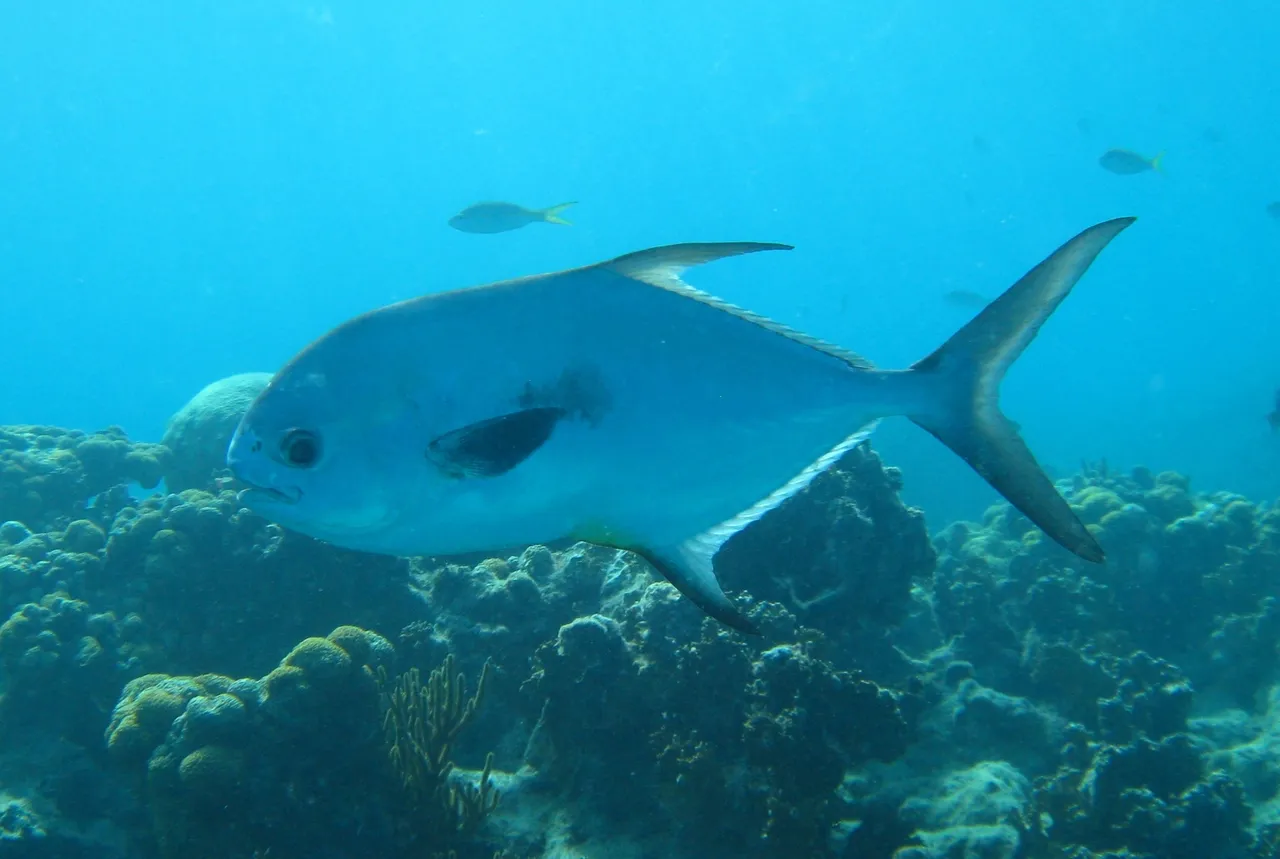
How this was identified, and who took it
Identified by: The long falcate forward lobes on both dorsal and anal fins, on a very deep strongly compressed body with a steep blunt forehead, a dark-margined deeply forked tail and a faint yellow wash on the belly ahead of the anal fin. Four agreeing identifications on the source, none disagreeing.Robert Webster — CC BY-SA, via iNaturalist — source, licenceAbout the image above: Both permit photographs are underwater frames and carry a blue-green cast, so the silver of the flank does not read true. The fin geometry the page depends on is unaffected, and the reef frame and the sand frame show it against two different backgrounds.
Look at this first
Measure the front of the dorsal fin against the depth of the fish. On a permit those leading rays draw out into a long curved sickle that reaches back a long way over the body, and the anal fin does the same underneath. If the lobes are stubby, you are holding the other one.
Diagnostic — settles it on its own
Each of these settles the identification on its own. If one is clear, you have your answer.
Long curved lobes at the front of the dorsal and anal fins
Look at the leading edge of the dorsal fin where it rises off the back, and at the matching point on the anal fin below. On a permit these run out into pronounced curved points, often black-tipped, long enough that on a fish of any size they are impossible to overlook. A Florida pompano in the same water carries stubby lobes in exactly the same place. This is a proportion rather than a shade, it survives death, poor light and a phone camera, and it is the single test worth learning.
Supporting — use with other characters
Real characters that are not conclusive by themselves. Use two or three together.
A very deep body behind a steeply rising blunt forehead
Seen side on, the fish is close to a disc: the depth of the body approaches half its length, and the head runs up from the mouth to the nape at a steep angle with almost no snout in front of it. Both permit and pompano share this build, so it will not separate them, but it does place the fish in the genus and rule out the true jacks, which are more elongate and carry a hard row of bony plates along the rear lateral line that neither of these two has.
The size the fish reaches
A permit taken on the flats commonly runs into double figures of kilogrammes and fish over fifteen are unremarkable in the fishery. A Florida pompano is a much smaller animal that rarely passes a couple of kilogrammes. Size never settles an identification on its own, because juveniles of the larger fish exist, but a very deep silver carangid of ten kilogrammes is not a pompano and the fin lobes should confirm it.
Suggestive only — varies with condition
Hints only. These vary with condition, season, water and how long the fish has been out of it, and a fish that contradicts them is still the same species.
An orange or yellow patch low on the belly
Ahead of the anal fin, on the underside, many permit carry a wash of orange or dull yellow. It is a real mark and it is worth noticing, but it is inconsistent between individuals, it is strongest on some fish and absent on others, and it washes out badly in a photograph taken more than a metre or two down. Treat it as agreement with the fin lobes rather than as a test in its own right.
What it gets confused with
- Florida pompano, overwhelmingly, and in the same water. The two share a genus, a body shape and a colour; the length of the front fin lobes separates them and nothing else needs to.
- Palometa and other Trachinotus of the western Atlantic, several of which also carry extended fin lobes, so a fish outside the size and range of a permit deserves a second look.
- Jacks generally, at distance and in poor light, which are more elongate and carry hard scutes along the rear lateral line where both of these fish are smooth.
Side by side: Permit vs Florida pompano.
Where this stops working
Small permit and large pompano overlap in size, and on a young permit the fin lobes have not yet grown out to their adult length, so the very fish most likely to cause doubt is the one where the test is weakest. Reports of this species from African waters are misidentifications of a different Trachinotus, so a deep silver carangid outside the western Atlantic is probably something else regardless of how well it matches. A photograph taken from directly above, or of a fish held head-on, flattens the fin lobes into nothing and settles neither species; the frame has to be a side view.
The full record
This page covers identification only. The Permit record covers behaviour, lifecycle, distribution, handling and the sources behind all of it.
Reviewed 2026-08-16.
More about this fish
Telling it apart is one question. Here are the others.
Similar and related fish
How it is caught
Where it lives
- Coral reefTails on shallow tropical flats rooting for crabs, and holds around wrecks as it grows.
- EstuaryTails on shallow tropical flats rooting for crabs, and holds around wrecks as it grows.
- Seagrass bedsFeeds over turtle grass and mixed seagrass flats, and the crabs it is hunting are animals of exactly that ground.
Where you will find it
- CubaLong-lived, site-attached and aggregating to spawn predictably, which is the life history that collapses fastest under concentrated fishing — and the reason catch-and-release is a management measure here rather than an ethic.
- FloridaOccupies flats, wrecks and reef, and is regarded as the hardest of the flats species to take on a fly — which is a large part of its standing here.
- The Yucatán and Mexican Caribbean coastOver turtle grass and coral rubble, and the species that decides whether a week here is remembered — long-lived, wary, site-attached and the hardest of the flats fish to convert.
Why the 9 connections on this page are here, and the sources
Similar and related fish
Backed by research — 1 connection
Supported by peer-reviewed research or fisheries science. The sources are listed and can be checked.
Florida pompano
An identification comparison naming both binomials: Trachinotus falcatus and Trachinotus carolinus.
- FishBase: a global information system on fishes — Froese, R. and D. Pauly, eds. — FishBase Consortium (Scientific institute)Relied on for: Morphological and distributional data for Trachinotus falcatus and for Trachinotus carolinus.States this directlyPassage read and verified
- The IUCN Red List of Threatened Species — International Union for Conservation of Nature (Conservation authority)Relied on for: Separate assessments treating Trachinotus falcatus and Trachinotus carolinus as distinct species.States this directlyCitation checked — the work exists and is described correctly
How it is caught
What experienced anglers do — 2 connections
Widely and independently recommended by experienced anglers and specialist sources. This is real angling knowledge, not proof: controlled evidence for it is limited, and FishingHQ records it as convention rather than as a demonstrated effect.
Saltwater fly fishing
A practitioner claim about how Trachinotus falcatus is commonly fished, following from where and how it feeds.
- General angling website restatements of established technique — Various (Credible secondary source)Relied on for: Widely restated practitioner accounts of fishing for permit.Citation checked — the work exists and is described correctly
- Sea Angler — Bauer Media (Specialist angling publication)Relied on for: Practitioner treatment of the methods used for permit and comparable species.Citation checked — the work exists and is described correctly
A statement about how a species is fished, which is angling convention rather than biology and is labelled as such.
- Still Water Fly-Fishing — Andre Deutsch, 1952 (Specialist angling publication)Relied on for: Fly-fishing practice from a practitioner tradition: line control, depth management, retrieve and the reading of water.States this directlyCitation checked — the work exists and is described correctly
- Sea Angler — Bauer Media (Specialist angling publication)Relied on for: Contemporary UK sea angling practice as reported by practitioners: ground, tackle, presentation and seasonal timing.States this directlyCitation checked — the work exists and is described correctly
Popping and stickbaiting
A practitioner claim about how Trachinotus falcatus is commonly fished, following from where and how it feeds.
- General angling website restatements of established technique — Various (Credible secondary source)Relied on for: Widely restated practitioner accounts of fishing for permit.Citation checked — the work exists and is described correctly
- Sea Angler — Bauer Media (Specialist angling publication)Relied on for: Practitioner treatment of the methods used for permit and comparable species.Citation checked — the work exists and is described correctly
Where it lives
Backed by research — 3 connections
Supported by peer-reviewed research or fisheries science. The sources are listed and can be checked.
Coral reef
A habitat association for Trachinotus falcatus taken from the environment and distribution data on its FishBase summary.
- FishBase: a global information system on fishes — Froese, R. and D. Pauly, eds. — FishBase Consortium (Scientific institute)Relied on for: The environment, depth range and habitat description recorded for Trachinotus falcatus.States this directlyPassage read and verified
Estuary
A habitat association for Trachinotus falcatus taken from the environment and distribution data on its FishBase summary.
- FishBase: a global information system on fishes — Froese, R. and D. Pauly, eds. — FishBase Consortium (Scientific institute)Relied on for: The environment, depth range and habitat description recorded for Trachinotus falcatus.States this directlyPassage read and verified
Seagrass beds
A habitat association resting on the regional identification and fisheries literature rather than on angling report.
- JNCC species and habitat conservation advice — Joint Nature Conservation Committee (Conservation authority)Relied on for: UK and European habitat classification and the conservation status of seagrass beds, including the species associated with them.States this directlyCitation checked — the work exists and is described correctly
- FAO Species Identification Guides for Fishery Purposes and the FAO Species Catalogues — Food and Agriculture Organization of the United Nations (Scientific institute)Relied on for: Habitat association and distribution of the species concerned.States this directlyCitation checked — the work exists and is described correctly
Where you will find it
Backed by research — 3 connections
Supported by peer-reviewed research or fisheries science. The sources are listed and can be checked.
Cuba
That a species occurs in these waters, drawn from distribution science. It is a statement about where the animal lives and is not a statement that anybody will catch one, still less where.
- The IUCN Red List of Threatened Species — International Union for Conservation of Nature (Conservation authority)Relied on for: Current conservation assessment of the species and systems concerned, with the assessment date.States this directlyCitation checked — the work exists and is described correctly
- Reef Fish Spawning Aggregations: Biology, Research and Management — Springer, Fish & Fisheries Series vol. 35, 2012 (Scientific literature)Relied on for: The exploitation and management of aggregating reef species, and the evidence on which protection is argued.States this directlyCitation checked — the work exists and is described correctly
Florida
A distribution association between an animal and a kind of water, rather than a claim about any named mark.
- NOAA National Ocean Service education on estuaries and the National Estuarine Research Reserve System — National Oceanic and Atmospheric Administration, United States (Government fisheries body)Relied on for: Estuarine, seagrass and coastal habitat function in North American waters, and the nursery role of shallow habitat for the species concerned.Background and mechanism onlyCitation checked — the work exists and is described correctly
- FishBase: a global information system on fishes — Froese, R. and D. Pauly, eds. — FishBase Consortium (Scientific institute)Relied on for: Distribution, habitat association, depth range and life history recorded for the species.States this directlyPassage read and verified
The Yucatán and Mexican Caribbean coast
That a species occurs in these waters, drawn from distribution science. It is a statement about where the animal lives and is not a statement that anybody will catch one, still less where.
- FAO Species Identification Guides for Fishery Purposes and the FAO Species Catalogues — Food and Agriculture Organization of the United Nations (Scientific institute)Relied on for: Identification, distribution and habitat association of the fishes and invertebrates of the tropical region named.States this directlyCitation checked — the work exists and is described correctly
- FishBase: a global information system on fishes — Froese, R. and D. Pauly, eds. — FishBase Consortium (Scientific institute)Relied on for: Recorded distribution, depth range and habitat association of the species named, including its occurrence in the waters concerned.States this directlyPassage read and verified