Atlantic goliath grouper
Fish · Last reviewed 2026-08-10
An enormous, slow-growing reef grouper that was fished to collapse, is now protected across much of its range, and must be released without being lifted.
Safety: injury while handling fish — can cause serious injury or death. One more point applies here.
Barotrauma and pressure injury — Can cause injury needing treatment
Fish brought up quickly from depth suffer swim bladder expansion and cannot return to the bottom unaided.
What reduces it: Prepare a descending device before fishing deep structure, and return the fish to depth promptly.
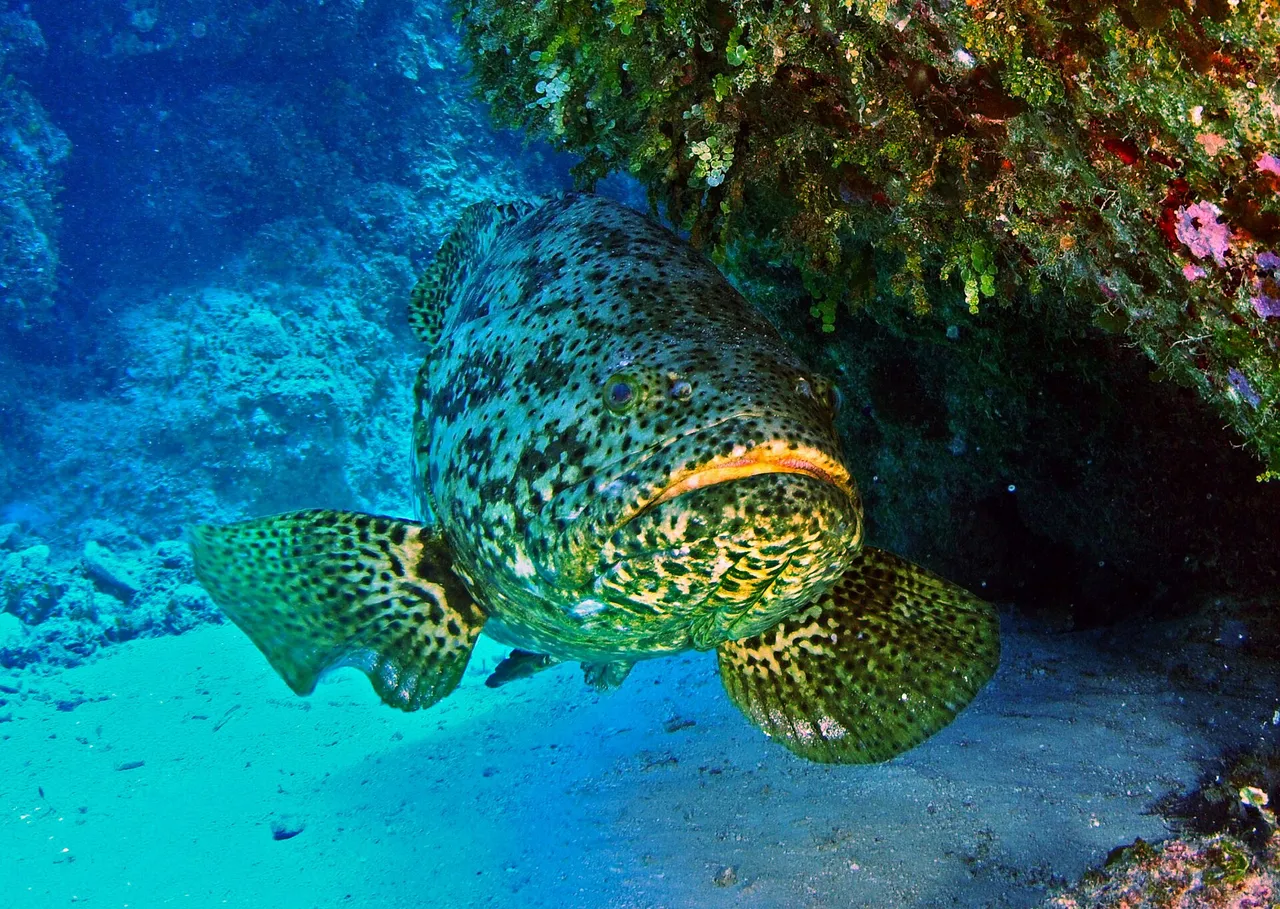
How this was identified, and who took it
Identified by: Identified on the spotting and head proportion together: small dark spots are scattered across the head, the body and both pectoral fins, and the eyes are conspicuously small relative to a very broad heavy head. The pectoral fins are rounded. The fish faces the camera at an angle, so the rounded caudal fin and the faint flank bars the record also names are not shown and are not claimed.Albert kok — CC BY-SA 3.0, via Wikimedia Commons — source, licence
Catching Atlantic goliath grouper
Everything here on fishing for it. Each entry opens the page behind it.
- Ground
Atlantic goliath grouper is the largest grouper of the Atlantic and one of the clearest cases on FishingHQ of what happens when a slow-growing, site-faithful, aggregating fish meets sustained fishing pressure.
It grows to several hundred kilograms, takes many years to mature, and forms predictable spawning aggregations at known sites. Every one of those traits is a vulnerability. Populations collapsed through the twentieth century and the species was placed under protection in United States waters in 1990 and elsewhere subsequently; recovery has been real but slow, and the species remains of serious conservation concern.
For an angler the practical position is simple: this is a fish that is very often hooked incidentally and must be released in the water, and a fish this heavy cannot be lifted without doing it damage.
How it is caught
Identification
- Scientific name
- Epinephelus itajara
- Family
- Epinephelidae
- Water
- Saltwater, Brackish
- Conservation status
- Vulnerable
- Regions
- North America, Caribbean, Central & South America, West Africa
- Enormous, heavy-bodied grouper with a broad head and small eyes relative to the head.
- Rounded caudal fin and rounded pectoral fins, with the dorsal spines shorter than the soft rays behind them.
- Mottled brown, olive or yellowish body with small dark spots scattered over the head, body and fins.
- Five faint irregular dark bars on the flank, most visible in smaller fish.
Size
- Typical
- Most encountered fish 20–90 kg (44–200 lb)
- Large
- 130–200 kg (285–440 lb)
Exceptional: FishBase records a maximum of 250 cm and 455 kg
A summer aggregation, a booming call, and a species still recovering
Goliath grouper seasonality is dominated by a late-summer spawning aggregation that is one of the best-documented in the Atlantic.
AGGREGATIONS FORM IN LATE SUMMER AND EARLY AUTUMN at specific offshore sites — wrecks, ledges and reef promontories — with fish travelling from resident home ranges to reach them. The same sites are used year after year.
THE AGGREGATIONS ARE ACOUSTICALLY OBVIOUS. Goliath grouper produce a low-frequency boom by contracting muscles against the swim bladder, audible and detectable at distance, and acoustic monitoring of aggregations uses it directly. The sound is also used defensively against divers.
SPAWNING IS TIED TO THE LUNAR CYCLE within the season, which is the standard pattern for aggregating groupers.
OUTSIDE THE AGGREGATION PERIOD adults are strongly site-attached, occupying individual structures — wrecks, ledges, bridge pilings and mangrove as juveniles — for long periods.
JUVENILES USE MANGROVE, and mangrove condition is a direct control on recruitment, which is why the species' recovery has tracked both fishing protection and mangrove protection.
THE SPECIES WAS SEVERELY DEPLETED and has been protected from harvest in parts of its range for decades, with a documented and substantial recovery in some areas. It remains of conservation concern across much of the range.
AND THE AGGREGATION IS THE REASON THE PROTECTION EXISTS. A very large, slow-growing, site-faithful fish that gathers predictably in known places is the most removable animal on FishingHQ, which this page states as biology and not as direction.
Backed by research — why, and the sources (2)
Supported by peer-reviewed research or fisheries science. The sources are listed and can be checked.
- Reef Fish Spawning Aggregations: Biology, Research and Management — Springer, Fish & Fisheries Series vol. 35, 2012 (Scientific literature)Relied on for: Reef fish spawning aggregations, their predictability in space and time, and the vulnerability that predictability creates.States this directlyCitation checked — the work exists and is described correctly
- The IUCN Red List of Threatened Species — International Union for Conservation of Nature (Conservation authority)Relied on for: Assessment and range account for the species, including the habitats it depends on, its life history and the pressures acting on it.States this directlyCitation checked — the work exists and is described correctly
A protected fish that must never leave the water
The handling rule for Atlantic goliath grouper is unusually simple and unusually strict, and it exists because the fish is protected across much of its range: it stays in the water.
WHY. This is a very large, heavy-bodied fish with no structural support out of water. Lifting one — by the jaw, by a gaff, by a rope, onto a deck — causes internal damage that is invisible and often fatal, and in the jurisdictions where the species is protected, removing it from the water is generally prohibited outright. A photograph taken with the fish held up is both a dead fish and, frequently, an offence.
SO THE RELEASE HAPPENS BOAT-SIDE. Control the fish alongside, remove the hook with a long dehooker, or cut the leader close if it is deep, and let it go. Do not attempt to bring it aboard for any reason.
THE BAROTRAUMA QUESTION. Goliath grouper are frequently taken from depth and can suffer swim bladder expansion. A fish that cannot submerge needs recompression, which on an animal this size means getting it down rather than venting it.
THE MOUTH IS ENORMOUS AND HAS NO CUTTING TEETH — dense rasping pads — but the jaws close with tremendous force and the gill plates on a fish this size are large and hard-edged. Keep hands out entirely and use tools of adequate length.
AND THE INHALATION RISK IS REAL. A goliath grouper strikes by opening a very large mouth and inhaling, and divers and anglers working close to one have been startled at close range. It is not an aggressive animal toward people; it is a very large one operating a very powerful suction feed, and proximity should be deliberate rather than accidental.
Official guidance — why, and the sources (1)
Stated by a fisheries authority, scientific institute or recognised angling body. Authoritative, but summarising rather than demonstrating.
- The IUCN Red List of Threatened Species — International Union for Conservation of Nature (Conservation authority)Relied on for: Conservation status of this species and the protective measures applied across much of its range.States this directlyCitation checked — the work exists and is described correctly
Aggregation spawning, and why predictability is the vulnerability
Atlantic goliath grouper illustrate the single most exploitable reproductive behaviour in the ocean, and the mechanism is worth understanding because it applies to a great many reef species.
WHAT AN AGGREGATION IS. Adults travel from a wide area — tens to hundreds of kilometres — to specific sites at specific times, forming dense concentrations that persist for a period and then disperse. The sites are traditional, used year after year, and typically associated with particular structures: a wreck, a reef promontory, a shelf edge. Goliath grouper form these in late summer, and individuals return to the same sites.
AND THE PREDICTABILITY IS THE PROBLEM. A fishery that finds an aggregation site has found, in one place, a large share of the reproductive adults from a very wide surrounding area, at the only time of year they are all together, in a spot that can be revisited. Everything that makes an aggregation biologically effective — density, timing, site fidelity — makes it easy to remove.
THE CONSEQUENCE IS DISPROPORTIONATE. Fishing an aggregation does not take a share of a population proportional to the effort; it takes a share of that population's REPRODUCTIVE CAPACITY, concentrated. A site fished out does not merely have fewer fish — the aggregation itself can cease to form, and the tradition of using that site, which appears to be socially transmitted between fish, is lost with the animals that knew it. Sites documented historically across the Caribbean and western Atlantic have simply stopped occurring.
GOLIATH GROUPER COMPOUND THIS with everything else about them: extremely large, very slow-growing, late-maturing, long-lived, site-attached as adults, and famously unwary — a fish that approaches divers rather than fleeing. The species was reduced to a small fraction of its former abundance across its range and is assessed accordingly.
THAT IS BIOLOGY, AND IT IS THE REASONING behind why aggregation sites are protected as sites rather than by catch limits in many jurisdictions: a bag limit does not help if the whole spawning stock is in one place. What protection is currently in force anywhere, and what may be done with the species, is current local information this page does not state.
Backed by research — why, and the sources (2)
Supported by peer-reviewed research or fisheries science. The sources are listed and can be checked.
- Reef Fish Spawning Aggregations: Biology, Research and Management — Springer, Fish & Fisheries Series vol. 35, 2012 (Scientific literature)Relied on for: The biology of reef fish spawning aggregations, their predictability in time and space, and the disproportionate effect of fishing them on population reproductive output.States this directlyCitation checked — the work exists and is described correctly
- FishBase: a global information system on fishes — Froese, R. and D. Pauly, eds. — FishBase Consortium (Scientific institute)Relied on for: Spawning season, aggregation behaviour and reproductive mode recorded for the species.States this directlyPassage read and verified
A very large fish in very shallow structure, and a nursery in the mangroves
Atlantic goliath grouper habitat is unusual for a fish of its size: the adults occupy shallow inshore structure rather than deep offshore ground, and the juveniles occupy something else entirely.
THE ADULTS HOLD ON SHALLOW STRUCTURE. Wrecks, artificial reefs, bridge and pier pilings, rock ledges, dock structure and shallow coral reef, generally in relatively modest depths of warm coastal water. A fish of this size sitting under a bridge in a few metres of water is the species' signature, and it is why they are so visible to divers and so easily located.
THEY ARE STRONGLY SITE-ATTACHED. Individuals occupy particular structures for long periods and return to them, with home ranges that are small for an animal of that size. That combination — very large, very findable, very sedentary — is precisely why the species was reduced so rapidly and why recovery has been so slow.
THE JUVENILE HABITAT IS MANGROVE, AND IT IS NON-NEGOTIABLE. Young goliath grouper spend their first years in mangrove-lined creeks, backwaters and estuarine shorelines, using the root systems as shelter. That habitat is entirely separate from the adult ground and is exactly what coastal development removes, which makes mangrove condition a limiting factor on a fish that adults never visit.
SO THE POPULATION NEEDS TWO HABITATS SEPARATED IN SPACE AND CONNECTED BY A MIGRATION, and protecting one without the other achieves little.
STRUCTURE COMPLEXITY MATTERS MORE THAN DEPTH. What the adults need is a hole, ledge or overhang big enough to occupy, with prey around it, and artificial structure serves as well as natural — which is why wrecks and bridges hold so many.
AND THE CONSERVATION POSITION SITS OVER THE HABITAT ACCOUNT. The species is assessed as threatened and has been subject to prohibitions on retention across much of its range for decades, with any fishing or handling of them tightly restricted. What applies anywhere is a matter for the competent authority, and it is not derivable from anything above.
Backed by research — why, and the sources (2)
Supported by peer-reviewed research or fisheries science. The sources are listed and can be checked.
- Reef Fish Spawning Aggregations: Biology, Research and Management — Springer, Fish & Fisheries Series vol. 35, 2012 (Scientific literature)Relied on for: Reef fish spawning aggregations, their predictability, their vulnerability to fishing, and the consequences of aggregation fishing for stock structure.States this directlyCitation checked — the work exists and is described correctly
- FishBase: a global information system on fishes — Froese, R. and D. Pauly, eds. — FishBase Consortium (Scientific institute)Relied on for: Reproductive mode, sexual pattern, spawning season and maturity for the species.States this directlyPassage read and verified
Lifecycle and reproduction
Very slow-growing and long-lived, maturing late and living for decades. Individuals are highly site-faithful, returning to the same wrecks and reef structures, which makes local populations easy to identify and easy to remove.
Forms predictable spawning aggregations at specific sites in late summer, with fish travelling to them from a wide area. Aggregation spawning is the species' greatest vulnerability: a fishery targeting an aggregation removes a large share of a population's reproductive capacity at once.
Feeding and senses
Takes crustaceans — particularly spiny lobster and crabs — along with fish, stingrays and octopus, engulfing prey with a rapid suction strike rather than chasing it.
An ambush predator relying on suction feeding at close range around structure. It also produces a loud low-frequency boom by contracting the swim bladder, used in territorial and courtship contexts and audible to divers.
Through the year
Largely resident on structure through the year, with a pronounced movement to aggregation sites in the spawning season. Juveniles depend on mangrove habitat, which ties recovery to the condition of those nurseries.
Distribution
Western Atlantic: Florida, USA to southern Brazil, including the Gulf of Mexico and the Caribbean. Eastern Atlantic: Senegal to Congo (reported as Epinephelus esonue , , 6809 ); rare in Canary Islands . Eastern Pacific (Gulf of California to Peru) species refers to Epinephelus quinquefasciatus . Discrete populations of E. itajara exist in the western Atlantic
This is a biological range — where the species occurs, not a prediction that you will catch one. To browse the fishing geography FishingHQ holds, start at fishing places.
Why anglers care
Largely a catch-and-release proposition, and subject to retention prohibitions across much of its range. Its significance to anglers is now mostly as an incidental capture on wreck and reef marks, and as a conservation case study — its collapse and partial recovery is among the best-documented examples of what aggregation spawning means for fisheries management. FishingHQ does not state what any rule is; check the authority for the water you are on before fishing structure that holds this species.
Handling and returning
A very large fish must not be lifted from the water. Unhook it alongside the boat or cut the leader close to the hook. Vertical lifting of a fish of this mass causes internal injury regardless of how briefly it is done. Fish brought up from depth also suffer barotrauma, and a descending device should be prepared before fishing ground that holds them.
Going further
- Atlantic goliath grouper vs Gag grouper — how to tell them apart.
Safety
Barotrauma and pressure injury is set out at the top of this page, where it cannot be missed.
Injury while handling fish — Can cause serious injury or death
A fish of this mass can pull an angler overboard, trap a hand in line or leader, and cause serious injury during landing attempts.
What reduces it: Fish with appropriate tackle, never wrap line or leader around a hand, and release at the boat without attempting to lift the fish.
Where to go next
Similar and related fish
Where it lives
Where you will find it
- FloridaUses mangrove as juvenile habitat and wreck and ledge as an adult, and its recovery after decades of harvest closure is one of the state's clearest conservation outcomes.
- The West African coastOccurs on the structure and reef ground of the tropical part of the range, where it is a large, long-lived and highly vulnerable resident.
Understanding this fish
Sources and evidence
- FishBase: a global information system on fishes — Froese, R. and D. Pauly, eds. — FishBase Consortium (Scientific institute)Relied on for: Family, maximum size, depth and environment, distribution and the IUCN assessment for Epinephelus itajara.States this directlyPassage read and verified
- The IUCN Red List of Threatened Species — International Union for Conservation of Nature (Conservation authority)Relied on for: The Vulnerable assessment for Epinephelus itajara, assessed 20 November 2016.States this directlyCitation checked — the work exists and is described correctly
Why the 7 connections on this page are here, and the sources
Similar and related fish
Backed by research — 1 connection
Supported by peer-reviewed research or fisheries science. The sources are listed and can be checked.
Gag grouper
An identification comparison naming both binomials: Epinephelus itajara and Mycteroperca microlepis.
- FishBase: a global information system on fishes — Froese, R. and D. Pauly, eds. — FishBase Consortium (Scientific institute)Relied on for: Morphological and distributional data for Epinephelus itajara and for Mycteroperca microlepis.States this directlyPassage read and verified
- The IUCN Red List of Threatened Species — International Union for Conservation of Nature (Conservation authority)Relied on for: Separate assessments treating Epinephelus itajara and Mycteroperca microlepis as distinct species.States this directlyCitation checked — the work exists and is described correctly
How it is caught
What experienced anglers do — 1 connection
Widely and independently recommended by experienced anglers and specialist sources. This is real angling knowledge, not proof: controlled evidence for it is limited, and FishingHQ records it as convention rather than as a demonstrated effect.
Deep-drop fishing
A practitioner claim about how Epinephelus itajara is commonly fished, following from where and how it feeds.
- General angling website restatements of established technique — Various (Credible secondary source)Relied on for: Widely restated practitioner accounts of fishing for goliath grouper.Citation checked — the work exists and is described correctly
- Sea Angler — Bauer Media (Specialist angling publication)Relied on for: Practitioner treatment of the methods used for goliath grouper and comparable species.Citation checked — the work exists and is described correctly
Where it lives
Backed by research — 2 connections
Supported by peer-reviewed research or fisheries science. The sources are listed and can be checked.
Coral reef
A habitat association for Epinephelus itajara taken from the environment and distribution data on its FishBase summary.
- FishBase: a global information system on fishes — Froese, R. and D. Pauly, eds. — FishBase Consortium (Scientific institute)Relied on for: The environment, depth range and habitat description recorded for Epinephelus itajara.States this directlyPassage read and verified
Inshore ground
A habitat association for Epinephelus itajara taken from the environment and distribution data on its FishBase summary.
- FishBase: a global information system on fishes — Froese, R. and D. Pauly, eds. — FishBase Consortium (Scientific institute)Relied on for: The environment, depth range and habitat description recorded for Epinephelus itajara.States this directlyPassage read and verified
Where you will find it
Backed by research — 2 connections
Supported by peer-reviewed research or fisheries science. The sources are listed and can be checked.
Florida
A distribution association between an animal and a kind of water, rather than a claim about any named mark.
- NOAA National Ocean Service education on estuaries and the National Estuarine Research Reserve System — National Oceanic and Atmospheric Administration, United States (Government fisheries body)Relied on for: Estuarine, seagrass and coastal habitat function in North American waters, and the nursery role of shallow habitat for the species concerned.Background and mechanism onlyCitation checked — the work exists and is described correctly
- FishBase: a global information system on fishes — Froese, R. and D. Pauly, eds. — FishBase Consortium (Scientific institute)Relied on for: Distribution, habitat association, depth range and life history recorded for the species.States this directlyPassage read and verified
The West African coast
A distribution association between an animal and a kind of water, rather than a claim about any named mark.
- FAO Species Identification Guides for Fishery Purposes and the FAO Species Catalogues — Food and Agriculture Organization of the United Nations (Scientific institute)Relied on for: Distribution, habitat, depth and fishery accounts for the species in the FAO regional identification guides for the ocean area concerned.States this directlyCitation checked — the work exists and is described correctly
- FishBase: a global information system on fishes — Froese, R. and D. Pauly, eds. — FishBase Consortium (Scientific institute)Relied on for: Distribution, habitat association and depth range recorded for the species.States this directlyPassage read and verified
Understanding this fish
Backed by research — 1 connection
Supported by peer-reviewed research or fisheries science. The sources are listed and can be checked.
Ciguatera and reef fish poisoning
A link from a species or a place to the accumulation mechanism that decides whether what is caught there should be eaten, resting on published seafood-hazard guidance and on the species' recorded diet and trophic position.
- FAO Species Identification Guides for Fishery Purposes and the FAO Species Catalogues — Food and Agriculture Organization of the United Nations (Scientific institute)Relied on for: Identification, distribution and trophic position of tropical reef fishes, including the large predatory species associated with reef toxin.States this directlyCitation checked — the work exists and is described correctly
- FishBase: a global information system on fishes — Froese, R. and D. Pauly, eds. — FishBase Consortium (Scientific institute)Relied on for: Recorded distribution, diet, size and trophic level of the species named, which is the basis for its position in a reef food web.States this directlyPassage read and verified
How FishingHQ labels evidence is explained in the evidence policy.