How to identify atlantic goliath grouper
Epinephelus itajara · Epinephelidae
The characters that identify atlantic goliath grouper, ranked by how far each one can be trusted on its own.
Safety: injury while handling fish — can cause serious injury or death. One more point applies here.
How this was identified, and who took it
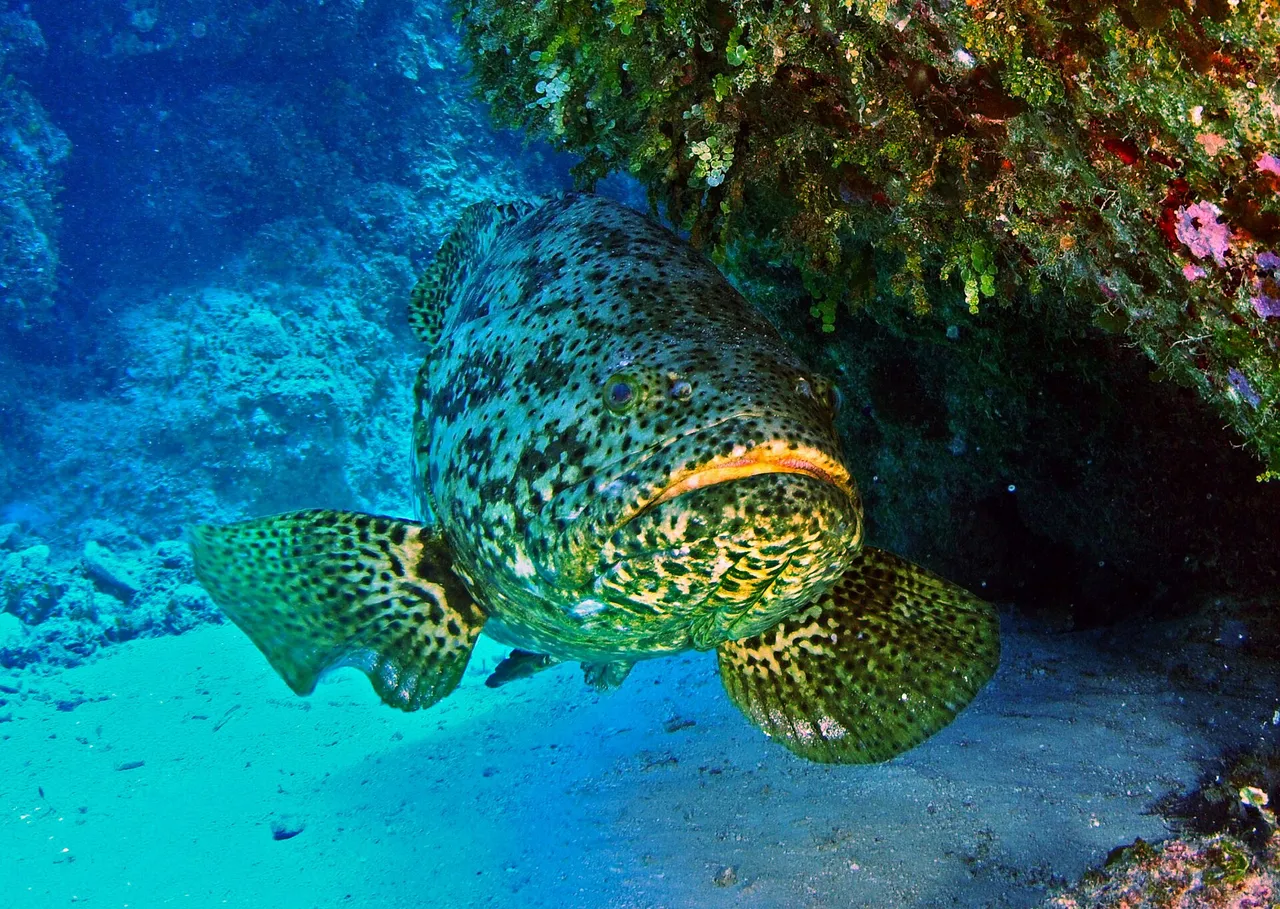
Identified by: Identified on the spotting and head proportion together: small dark spots are scattered across the head, the body and both pectoral fins, and the eyes are conspicuously small relative to a very broad heavy head. The pectoral fins are rounded. The fish faces the camera at an angle, so the rounded caudal fin and the faint flank bars the record also names are not shown and are not claimed.Albert kok — CC BY-SA 3.0, via Wikimedia Commons — source, licenceLook at this first
Judge the head before anything else. A goliath grouper has an extremely broad head with eyes that look far too small for it, and the head, body and fins are all peppered with small dark spots. At size the fish is unmistakable; at a few kilos it needs the spotting checked properly.
Diagnostic — settles it on its own
Each of these settles the identification on its own. If one is clear, you have your answer.
Small dark spots on head, body and fins
Fine dark spots are scattered over the whole animal, including the head and out onto the pectoral and dorsal fins. The distinction that matters is between SPOTS and a reticulate net of pale lines: Nassau grouper and black grouper carry coarse blotching or vermiculation rather than a peppering of discrete spots, and the difference reads clearly at a metre.
Supporting — use with other characters
Real characters that are not conclusive by themselves. Use two or three together.
Small eyes in a very broad head
The head is exceptionally wide across the top and the eye is proportionally tiny within it. Most groupers of comparable length have an eye that reads as substantial. It is a proportion, so it works on a fish underwater as well as in the hand.
Rounded caudal and pectoral fins
Both the tail and the pectorals are evenly rounded, and the dorsal spines are shorter than the soft rays behind them, so the dorsal profile rises towards the rear rather than peaking at the front. Several confusable groupers have a squarer tail or a taller spinous dorsal.
Suggestive only — varies with condition
Hints only. These vary with condition, season, water and how long the fish has been out of it, and a fish that contradicts them is still the same species.
Five faint bars in smaller fish
Irregular dark bars cross the flank of younger fish and fade with age. They help on a small fish, which is the size class where the identification is hardest, and they are absent from the very large fish that need no help at all.
What it gets confused with
- Nassau grouper, similar in ground colour but marked with coarse dark bars and a distinctive dark saddle on the tail wrist, with a tuning-fork mark on the head.
- Black grouper and gag grouper, both carrying reticulate or vermiculate flank markings rather than discrete spots, and both with a squarer, less rounded tail.
- Pacific goliath grouper (Epinephelus quinquefasciatus), a separate species of the eastern Pacific that shares the appearance — range settles that one.
Side by side: Atlantic goliath grouper vs Gag grouper.
Where this stops working
The whole point of this identification is that it matters most at the size where it is hardest. A 200 kg fish under a wreck is not confusable with anything; a 3 kg fish on an inshore ledge is confusable with several groupers, and the spotting is the character to work from at that size. Colour is worthless — the ground ranges from olive through brown to yellowish depending on ground and mood. Atlantic goliath grouper has been protected across much of its range for decades and where limited harvest exists it is tightly permitted; a fish taken in mistake for something else is not a neutral error, and you must verify current protection status with the responsible authority before doing anything but releasing one. A very large fish must never be lifted from the water at all: unhook it alongside or cut the leader.
The full record
This page covers identification only. The Atlantic goliath grouper record covers behaviour, lifecycle, distribution, handling and the sources behind all of it.
Reviewed 2026-08-15.
More about this fish
Telling it apart is one question. Here are the others.
Similar and related fish
How it is caught
Where it lives
Where you will find it
- FloridaUses mangrove as juvenile habitat and wreck and ledge as an adult, and its recovery after decades of harvest closure is one of the state's clearest conservation outcomes.
- The West African coastOccurs on the structure and reef ground of the tropical part of the range, where it is a large, long-lived and highly vulnerable resident.
Why the 6 connections on this page are here, and the sources
Similar and related fish
Backed by research — 1 connection
Supported by peer-reviewed research or fisheries science. The sources are listed and can be checked.
Gag grouper
An identification comparison naming both binomials: Epinephelus itajara and Mycteroperca microlepis.
- FishBase: a global information system on fishes — Froese, R. and D. Pauly, eds. — FishBase Consortium (Scientific institute)Relied on for: Morphological and distributional data for Epinephelus itajara and for Mycteroperca microlepis.States this directlyPassage read and verified
- The IUCN Red List of Threatened Species — International Union for Conservation of Nature (Conservation authority)Relied on for: Separate assessments treating Epinephelus itajara and Mycteroperca microlepis as distinct species.States this directlyCitation checked — the work exists and is described correctly
How it is caught
What experienced anglers do — 1 connection
Widely and independently recommended by experienced anglers and specialist sources. This is real angling knowledge, not proof: controlled evidence for it is limited, and FishingHQ records it as convention rather than as a demonstrated effect.
Deep-drop fishing
A practitioner claim about how Epinephelus itajara is commonly fished, following from where and how it feeds.
- General angling website restatements of established technique — Various (Credible secondary source)Relied on for: Widely restated practitioner accounts of fishing for goliath grouper.Citation checked — the work exists and is described correctly
- Sea Angler — Bauer Media (Specialist angling publication)Relied on for: Practitioner treatment of the methods used for goliath grouper and comparable species.Citation checked — the work exists and is described correctly
Where it lives
Backed by research — 2 connections
Supported by peer-reviewed research or fisheries science. The sources are listed and can be checked.
Coral reef
A habitat association for Epinephelus itajara taken from the environment and distribution data on its FishBase summary.
- FishBase: a global information system on fishes — Froese, R. and D. Pauly, eds. — FishBase Consortium (Scientific institute)Relied on for: The environment, depth range and habitat description recorded for Epinephelus itajara.States this directlyPassage read and verified
Inshore ground
A habitat association for Epinephelus itajara taken from the environment and distribution data on its FishBase summary.
- FishBase: a global information system on fishes — Froese, R. and D. Pauly, eds. — FishBase Consortium (Scientific institute)Relied on for: The environment, depth range and habitat description recorded for Epinephelus itajara.States this directlyPassage read and verified
Where you will find it
Backed by research — 2 connections
Supported by peer-reviewed research or fisheries science. The sources are listed and can be checked.
Florida
A distribution association between an animal and a kind of water, rather than a claim about any named mark.
- NOAA National Ocean Service education on estuaries and the National Estuarine Research Reserve System — National Oceanic and Atmospheric Administration, United States (Government fisheries body)Relied on for: Estuarine, seagrass and coastal habitat function in North American waters, and the nursery role of shallow habitat for the species concerned.Background and mechanism onlyCitation checked — the work exists and is described correctly
- FishBase: a global information system on fishes — Froese, R. and D. Pauly, eds. — FishBase Consortium (Scientific institute)Relied on for: Distribution, habitat association, depth range and life history recorded for the species.States this directlyPassage read and verified
The West African coast
A distribution association between an animal and a kind of water, rather than a claim about any named mark.
- FAO Species Identification Guides for Fishery Purposes and the FAO Species Catalogues — Food and Agriculture Organization of the United Nations (Scientific institute)Relied on for: Distribution, habitat, depth and fishery accounts for the species in the FAO regional identification guides for the ocean area concerned.States this directlyCitation checked — the work exists and is described correctly
- FishBase: a global information system on fishes — Froese, R. and D. Pauly, eds. — FishBase Consortium (Scientific institute)Relied on for: Distribution, habitat association and depth range recorded for the species.States this directlyPassage read and verified
Safety
Barotrauma and pressure injury is set out at the top of this page, where it cannot be missed.
Injury while handling fish — Can cause serious injury or death
A fish of this mass can pull an angler overboard, trap a hand in line or leader, and cause serious injury during landing attempts.
What reduces it: Fish with appropriate tackle, never wrap line or leader around a hand, and release at the boat without attempting to lift the fish.