Gag grouper vs Atlantic goliath grouper
How to tell them apart, and what follows from getting it right.
Why they get confused
At size nobody confuses them — a 200 kg goliath is not a gag. The confusion is at the small end, where a juvenile goliath of a few kilos on inshore structure is a mottled brown grouper among other mottled brown groupers, and where an angler who has only ever seen photographs of enormous fish does not expect one. Both use wrecks, ledges and artificial reef in the same water off Florida and the Gulf, and both come to the same baits.
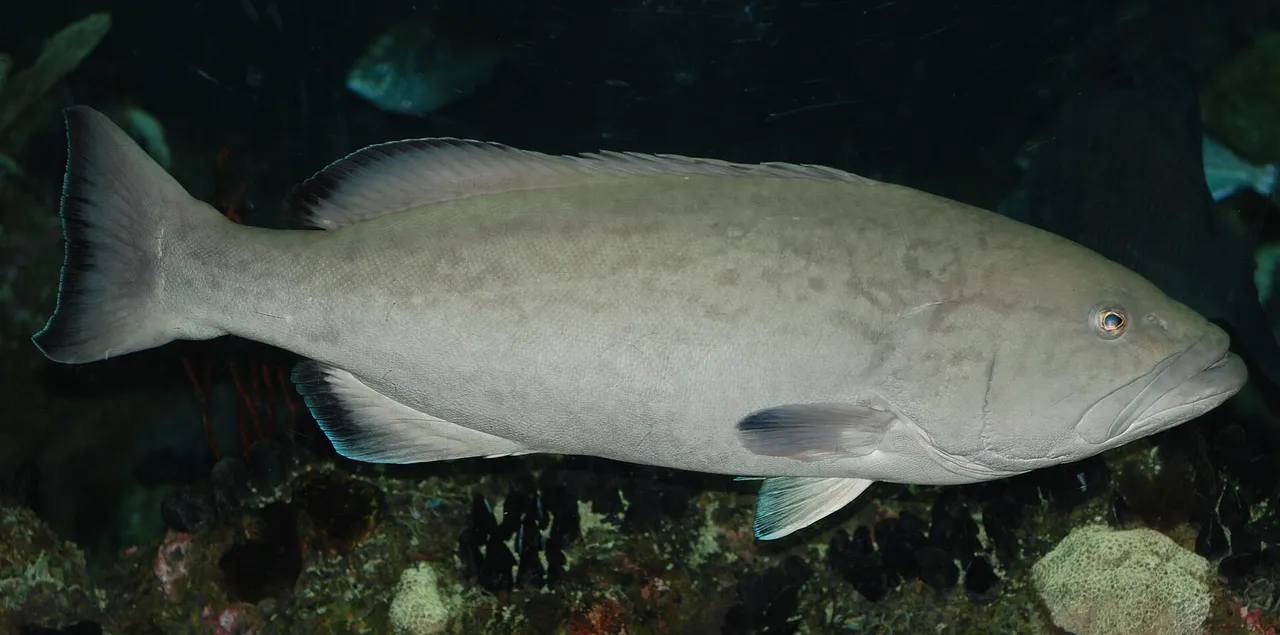
Gag grouper
Mycteroperca microlepis — Epinephelidae

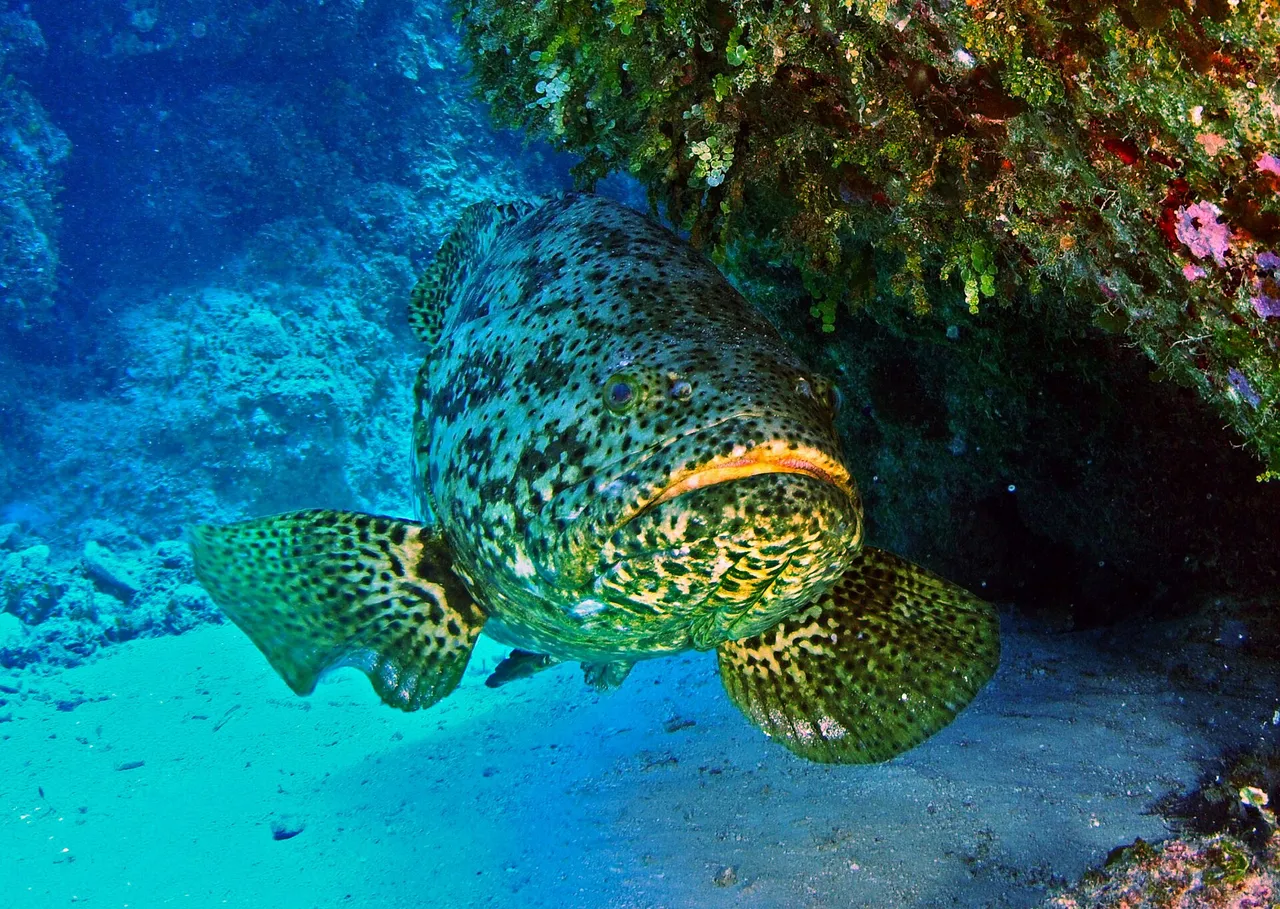
Atlantic goliath grouper
Epinephelus itajara — Epinephelidae

The differences
Each difference is marked with how far it can be trusted on its own. A single diagnostic character settles the identification; suggestive ones only narrow it.
| Character | Gag grouper | Atlantic goliath grouper | Reliability |
|---|---|---|---|
| Spots versus a net of markingsIdentification | The flank carries darker worm-like or box-shaped markings forming a reticulate pattern, most visible in smaller fish. | Small discrete dark spots are peppered over the head, the body and out onto the fins, rather than forming a connected pattern. | Diagnostic on its own |
| Shape of the tailIdentification | Slightly concave with the outer rays extended, giving a notched trailing edge. | Evenly rounded, with no notch and no extended rays. | Diagnostic on its own |
| Head and eye proportionIdentification | A more elongate, less heavy-set body with an eye that reads as normal for the head. | An extremely broad head with eyes that look far too small within it, on a much heavier body. | Supporting — use with others |
| The weight range you are dealing withSize | Commonly 2–8 kg, with good fish 12–20 kg and a maximum around 36 kg. | Commonly 20–90 kg where populations are healthy, with fish of 130–200 kg regular and a recorded maximum of 455 kg. | Supporting — use with others |
| How spawning concentrates themSpawning | Spawns offshore on reef; juveniles use shallow estuarine and seagrass habitat before recruiting to deeper structure. | Forms predictable spawning aggregations at specific sites in late summer, drawing fish from a wide area — the species' single greatest vulnerability. | Suggestive only — varies |
| What you must not do with a large fishHandling | Fish from depth need a descending device; a large gag can be handled aboard with care. | A very large fish must NOT be lifted from the water at all — unhook alongside or cut the leader. Vertical lifting of that mass causes internal injury however briefly it is done. | Supporting — use with others |
Why it matters
This is the comparison in the file with the sharpest consequence. Atlantic goliath grouper has been protected across most of its range for decades, and where any limited harvest exists it is tightly permitted and separately regulated; gag grouper is a managed but retainable species with seasons, size limits and bag limits that change between years and between federal and state waters. A goliath killed in mistake for a gag is not a paperwork error. Verify the current status of both with the responsible authority before fishing structure that holds them, and treat any large unfamiliar grouper as protected until you know otherwise.
The full records
This page compares two species. Each of them has a complete record covering biology, behaviour, handling and the evidence behind all of it.
More about gag grouper
Where it lives, how it is caught, and what else it is confused with.
Similar and related fish
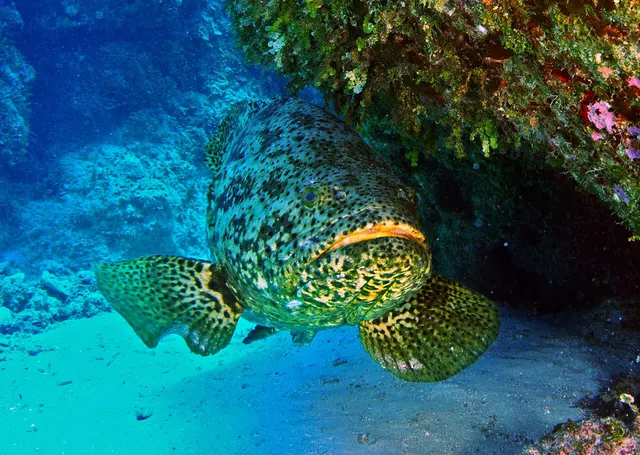 Atlantic goliath grouperGroupers of the same structure separated by size, tail shape and spotting.
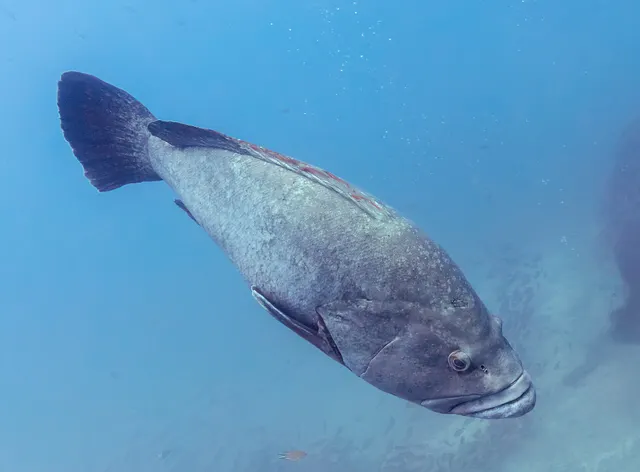 Dusky grouperBoth are protogynous groupers whose entire male population comes from sex-changed females, which is why size-selective fishing removes males specifically in both.
- Scaled sardineSmall clupeids are a principal fish prey for gag over inshore and nearshore structure.
How it is caught
Gear for this fish
Why the 6 connections on this page are here, and the sources
Similar and related fish
Backed by research — 3 connections
Supported by peer-reviewed research or fisheries science. The sources are listed and can be checked.
Atlantic goliath grouper
An identification comparison naming both binomials: Epinephelus itajara and Mycteroperca microlepis.
- FishBase: a global information system on fishes — Froese, R. and D. Pauly, eds. — FishBase Consortium (Scientific institute)Relied on for: Morphological and distributional data for Epinephelus itajara and for Mycteroperca microlepis.States this directlyPassage read and verified
- The IUCN Red List of Threatened Species — International Union for Conservation of Nature (Conservation authority)Relied on for: Separate assessments treating Epinephelus itajara and Mycteroperca microlepis as distinct species.States this directlyCitation checked — the work exists and is described correctly
Dusky grouper
A comparison resting on shared reproductive biology, naming both binomials, and the basis of the demographic argument on both records.
- FishBase: a global information system on fishes — Froese, R. and D. Pauly, eds. — FishBase Consortium (Scientific institute)Relied on for: That Mycteroperca microlepis and Epinephelus marginatus are both protogynous hermaphrodites in which individuals mature as female and change sex to male with size and age.States this directlyPassage read and verified
Scaled sardine
Recorded diet evidence identifies Harengula jaguana as a food item of this predator at species level. The edge is written at that granularity and no further.
- FishBase: a global information system on fishes — Froese, R. and D. Pauly, eds. — FishBase Consortium (Scientific institute)Relied on for: Food items recorded for this predator, including Harengula jaguana.States this directlyPassage read and verified
- FAO Species Identification Guides for Fishery Purposes and the FAO Species Catalogues — Food and Agriculture Organization of the United Nations (Scientific institute)Relied on for: Species account describing the diet of this predator in the region where Harengula jaguana occurs.Background and mechanism onlyCitation checked — the work exists and is described correctly
How it is caught
What experienced anglers do — 2 connections
Widely and independently recommended by experienced anglers and specialist sources. This is real angling knowledge, not proof: controlled evidence for it is limited, and FishingHQ records it as convention rather than as a demonstrated effect.
Jigging
The page names jigs as the second technique. It matters separately because area closures protecting spawning aggregations apply to the fishery rather than to the bait.
- Florida saltwater fishing regulations and Keys sanctuary rules — Florida state wildlife authority and the Florida Keys National Marine Sanctuary (Government fisheries body)Relied on for: Documents which fishery and which technique takes this species.States this directlyCitation checked — the work exists and is described correctly
- General angling website restatements of established technique — Various (Credible secondary source)Relied on for: Independently corroborates the species' recreational capture and range.Background and mechanism onlyCitation checked — the work exists and is described correctly
Livebaiting at sea
The page names live and dead bait over structure. A grouper takes a live bait and runs for the reef, and that first run is what the tackle in this fishery is chosen for.
- Florida saltwater fishing regulations and Keys sanctuary rules — Florida state wildlife authority and the Florida Keys National Marine Sanctuary (Government fisheries body)Relied on for: Documents which fishery and which technique takes this species.States this directlyCitation checked — the work exists and is described correctly
- General angling website restatements of established technique — Various (Credible secondary source)Relied on for: Independently corroborates the species' recreational capture and range.Background and mechanism onlyCitation checked — the work exists and is described correctly
Gear for this fish
What experienced anglers do — 1 connection
Widely and independently recommended by experienced anglers and specialist sources. This is real angling knowledge, not proof: controlled evidence for it is limited, and FishingHQ records it as convention rather than as a demonstrated effect.
Swimbaits
A practitioner claim about which lure family answers this species' feeding or holding behaviour.
- General angling website restatements of established technique — Various (Credible secondary source)Relied on for: Widely restated North American lure practice for this species.Background and mechanism onlyCitation checked — the work exists and is described correctly
- IGFA International Angling Rules and World Record Requirements — International Game Fish Association (Angling or fisheries organisation)Relied on for: Recognition of the species as an established sport fish taken on artificial lures, and the tackle conventions used for it.States this directlyPassage read and verified
Reviewed 2026-08-15. FishingHQ does not state what any rule is or where any rule applies. Where this page says the two species are managed differently, that is a reason to check the authority for the water you are on — not a statement of what it requires.