How to identify northern red snapper
Lutjanus campechanus · Lutjanidae
The characters that identify northern red snapper, ranked by how far each one can be trusted on its own.
Safety: barotrauma and pressure injury — can cause serious injury or death. One more point applies here.
How this was identified, and who took it
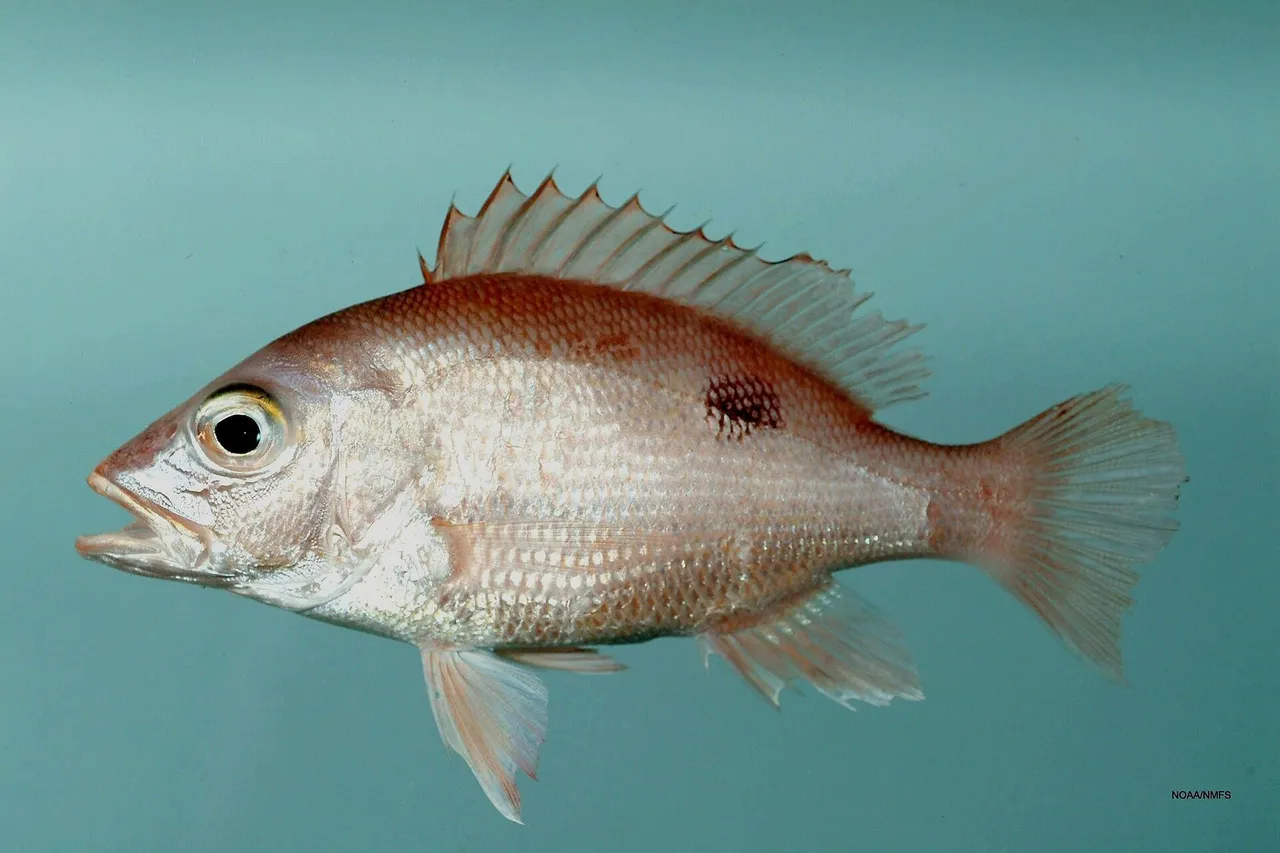
Identified by: A NOAA fisheries laboratory voucher photographed on a plain ground. The dark spot on the upper flank below the front of the soft dorsal is prominent, and the anal fin is sharply angular rather than rounded, which is the record's stated separation from the similar vermilion snapper. Body rose-red above shading to silver below with red fins. Identified on the anal-fin shape rather than on the spot, because the spot is a life-stage character.SEFSC Pascagoula Laboratory, NOAA/NMFS — public domain, via Wikimedia Commons — source, licenceAbout the image above: The photograph shows a young fish, in which the dark flank spot is at its most prominent. It fades as the fish grows and a large adult may show none at all — the pointed anal fin is the character that works at every size.
Look at this first
Look at the shape of the anal fin, not at the colour of the fish. Red snapper's anal fin comes to a distinct point at the rear; a vermilion snapper's is rounded. On a boat where several red fish are coming over the side, that one outline is the check that holds.
Diagnostic — settles it on its own
Each of these settles the identification on its own. If one is clear, you have your answer.
Pointed anal fin
Spread the anal fin and look at its rear corner. In red snapper the last rays are the longest, so the fin comes to an angular point. In the vermilion snapper — the species most often landed alongside it and most often confused with it — the fin is evenly rounded. This is a structural character and it does not change with age or with how long the fish has been in the box.
Supporting — use with other characters
Real characters that are not conclusive by themselves. Use two or three together.
Dark spot high on the flank
A dark blotch sits on the upper flank beneath the front of the soft dorsal fin. It is bold and obvious in a young fish and fades progressively as the fish grows, so a big red snapper may have none. Its presence helps; its absence proves nothing.
Canine teeth in both jaws
There are enlarged conical canines at the front of the jaws, as there are in all the snappers. It places the fish in the family rather than naming it, and it is worth respecting when unhooking.
Suggestive only — varies with condition
Hints only. These vary with condition, season, water and how long the fish has been out of it, and a fish that contradicts them is still the same species.
Red iris
The eye of a fresh red snapper is strikingly red rather than yellow or amber. It is a genuinely useful field check on a boat and it dulls quickly once the fish has been dead a while, so it is a confirming character on fresh fish only.
What it gets confused with
- Vermilion snapper, the most frequent confusion and the one that matters for regulation — its anal fin is rounded, its eye is yellower, and it lacks the flank spot at every size.
- Lane snapper, which has yellow stripes along the flank and a spot below the soft dorsal but keeps it into adulthood.
- Silk snapper and blackfin snapper in deeper water, both red-bodied — silk snapper has a yellow eye, blackfin a dark blotch at the pectoral base.
Side by side: Northern red snapper vs Yellowtail snapper.
Where this stops working
The colour that gives the fish its name is the least reliable thing about it: several Gulf and south-eastern snappers are red, and a fish that has been on ice loses the depth of it within hours. Work from the anal fin. Very small snappers of several species are hard to separate and the flank spot is shared by more than one of them. Red snapper is one of the most closely managed recreational species in the western Atlantic, and its practical season is set by management rather than by the fish; size limits, bag limits and open dates change from year to year and between federal and state waters, so verify the current rules with the responsible authority before retaining one. Fish brought up from reef depths suffer barotrauma and need a descending device if they are to be released alive.
The full record
This page covers identification only. The Northern red snapper record covers behaviour, lifecycle, distribution, handling and the sources behind all of it.
Reviewed 2026-08-15.
More about this fish
Telling it apart is one question. Here are the others.
Similar and related fish
How it is caught
Where it lives
Where you will find it
- FloridaHolds hard bottom, ledges and artificial structure on the Gulf shelf, in the fishery whose season is among the most contested in the United States.
- The Gulf of MexicoThe Gulf's defining and most contested reef species, concentrated on natural hard bottom, artificial reef and standing platform structure.
Why the 6 connections on this page are here, and the sources
Similar and related fish
Backed by research — 1 connection
Supported by peer-reviewed research or fisheries science. The sources are listed and can be checked.
Yellowtail snapper
An identification comparison naming both binomials: Ocyurus chrysurus and Lutjanus campechanus.
- FishBase: a global information system on fishes — Froese, R. and D. Pauly, eds. — FishBase Consortium (Scientific institute)Relied on for: Morphological and distributional data for Ocyurus chrysurus and for Lutjanus campechanus.States this directlyPassage read and verified
- The IUCN Red List of Threatened Species — International Union for Conservation of Nature (Conservation authority)Relied on for: Separate assessments treating Ocyurus chrysurus and Lutjanus campechanus as distinct species.States this directlyCitation checked — the work exists and is described correctly
How it is caught
What experienced anglers do — 2 connections
Widely and independently recommended by experienced anglers and specialist sources. This is real angling knowledge, not proof: controlled evidence for it is limited, and FishingHQ records it as convention rather than as a demonstrated effect.
Drift fishing
The page names bait and jigs over structure. Descending-device requirements for released fish are now standard through much of the range, which is a fact about this fishery and not about the fish.
- Florida saltwater fishing regulations and Keys sanctuary rules — Florida state wildlife authority and the Florida Keys National Marine Sanctuary (Government fisheries body)Relied on for: Documents which fishery and which technique takes this species.States this directlyCitation checked — the work exists and is described correctly
- General angling website restatements of established technique — Various (Credible secondary source)Relied on for: Independently corroborates the species' recreational capture and range.Background and mechanism onlyCitation checked — the work exists and is described correctly
Jigging
The page names jigs beside bait as the two ways the species is fished. Jigging is separated because it is a lure fishery with a different selectivity and a different release profile.
- Florida saltwater fishing regulations and Keys sanctuary rules — Florida state wildlife authority and the Florida Keys National Marine Sanctuary (Government fisheries body)Relied on for: Documents which fishery and which technique takes this species.States this directlyCitation checked — the work exists and is described correctly
- General angling website restatements of established technique — Various (Credible secondary source)Relied on for: Independently corroborates the species' recreational capture and range.Background and mechanism onlyCitation checked — the work exists and is described correctly
Where it lives
Backed by research — 1 connection
Supported by peer-reviewed research or fisheries science. The sources are listed and can be checked.
Inshore ground
A habitat claim held to a scientific standard.
- FishBase: a global information system on fishes — Froese, R. and D. Pauly, eds. — FishBase Consortium (Scientific institute)Relied on for: That Lutjanus campechanus is a reef-associated species of the western Atlantic and Gulf of Mexico, generally between about 10 and 190 m.States this directlyPassage read and verified
Where you will find it
Backed by research — 2 connections
Supported by peer-reviewed research or fisheries science. The sources are listed and can be checked.
Florida
A distribution association between an animal and a kind of water, rather than a claim about any named mark.
- NOAA National Ocean Service education on estuaries and the National Estuarine Research Reserve System — National Oceanic and Atmospheric Administration, United States (Government fisheries body)Relied on for: Estuarine, seagrass and coastal habitat function in North American waters, and the nursery role of shallow habitat for the species concerned.Background and mechanism onlyCitation checked — the work exists and is described correctly
- FishBase: a global information system on fishes — Froese, R. and D. Pauly, eds. — FishBase Consortium (Scientific institute)Relied on for: Distribution, habitat association, depth range and life history recorded for the species.States this directlyPassage read and verified
The Gulf of Mexico
A distribution association between an animal and a kind of water, rather than a claim about any named mark.
- FishBase: a global information system on fishes — Froese, R. and D. Pauly, eds. — FishBase Consortium (Scientific institute)Relied on for: Distribution, habitat association and depth range recorded for the species, including its occurrence in the water body concerned.States this directlyPassage read and verified
- The IUCN Red List of Threatened Species — International Union for Conservation of Nature (Conservation authority)Relied on for: Assessment and range account for the species, including the systems and coasts it occupies.Background and mechanism onlyCitation checked — the work exists and is described correctly
Safety
Barotrauma and pressure injury is set out at the top of this page, where it cannot be missed.
Venomous and spined species — Can cause injury needing treatment
Sharp dorsal and anal spines and canine teeth on a fish handled quickly in numbers on a moving deck.
What reduces it: Wet hands, support the body, keep fingers clear of the spines and mouth, and use pliers and a proper grip rather than improvising.