Spotted seatrout
Fish · Last reviewed 2026-08-10
A drum-family inshore predator of American southern estuaries, marked with distinct round black spots and armed with two prominent canine teeth.
Safety: injury while handling fish — minor injury.
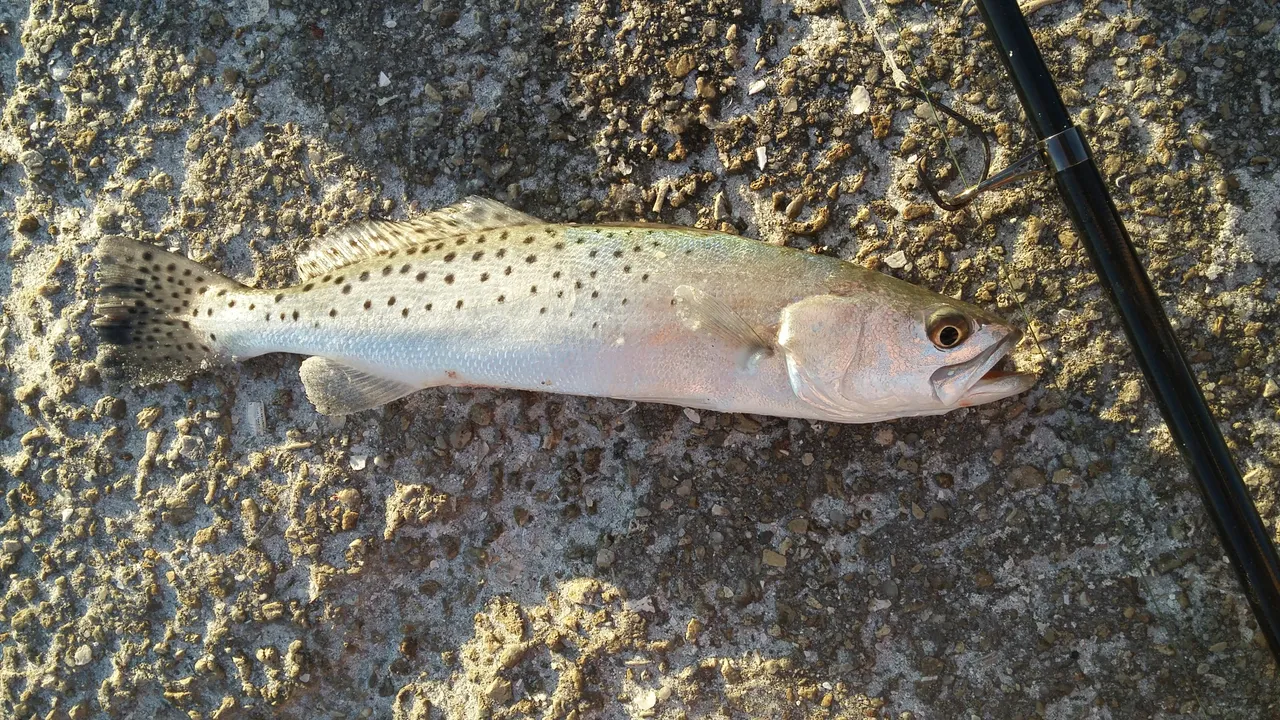
How this was identified, and who took it
Identified by: Discrete round black spots over the upper body extending onto the soft dorsal and caudal fins, an elongate silvery body with an olive back, two dorsal fins and prominent canines at the front of the upper jaw — the combination separating Cynoscion nebulosus from C. regalis and C. arenarius. Two agreeing identifications on the source, none disagreeing.Quinn — CC BY, via iNaturalist — source, licenceCatching Spotted seatrout
Everything here on fishing for it. Each entry opens the page behind it.
- Ground
- Where
- 1 place FishingHQ documents — strongest claim anywhere: recorded here · From a boat, Fly fishing
Spotted seatrout is not a trout. It is a drum — a member of the Sciaenidae, related to red drum and meagre — and like all drums the males produce sound with the swim bladder, drumming audibly during spawning.
It is the defining inshore sport fish of the American Gulf and south Atlantic estuaries: a predator of seagrass flats, oyster bars and marsh edges, silvery with a purple-blue sheen and scattered with distinct round black spots that run onto the dorsal and tail fins.
The pair of large canine teeth in the upper jaw are diagnostic and are the reason light leaders get cut. It is a fragile fish relative to its reputation and a poor candidate for careless handling.
How it is caught
Gear for this fish
Where Spotted seatrout is documented
Places where public sources describe this species as fished, with how it is fished and how strongly the evidence supports it. This is not a range map and it is not a recommendation — it is what has been written down about a fishery rather than a record of any individual catch, and being listed is never permission to fish.
What these strengths mean
- Recorded here
- At least one credible public account of this species being caught here. That is all it means.
Identification
- Scientific name
- Cynoscion nebulosus
- Family
- Sciaenidae
- Water
- Saltwater, Brackish
- Conservation status
- Least Concern
- Regions
- North America
- Distinct round black spots scattered over the upper body, running onto the second dorsal and the tail.
- Two prominent canine teeth at the front of the upper jaw.
- Elongate silvery body with a purple-blue iridescent sheen along the back.
- No barbels on the chin, which separates it from most other drums of the same water.
Size
- Typical
- 0.5–1.5 kg (1.1–3.3 lb)
- Large
- 2.5–4.5 kg (5.5–10 lb)
Exceptional: FishBase records a maximum of 100 cm and 7.9 kg
A soft mouth, a thin membrane, and a fish less robust than its abundance suggests
Spotted seatrout are abundant, easy to catch, and handled as though those two facts imply a third one. They do not: this is a delicate fish that is treated like a hardy one.
THE MOUTH IS THE PROBLEM AND IT IS STRUCTURAL. The membrane around the jaw is thin and poorly supported, and it tears under a load it will meet routinely — the weight of the fish itself, if it is lifted by the lip. A lip grip that is entirely appropriate for a black bass, whose jaw is a solid bony structure, tears a seatrout's mouth open. Once torn, the fish can still feed, but the damage is permanent and the hook hold in that fish was always going to fail, which is why they are famous for coming off.
THE TWO CANINES AT THE FRONT of the upper jaw are prominent, sharp, and positioned exactly where a thumb goes if somebody lips the fish anyway. They are the reason this species teaches the lesson twice.
SO THE FISH IS SUPPORTED, NOT SUSPENDED — a wet hand under the belly, the other steadying, and the weight carried by the body rather than by the head. A knotless net is worth having because it removes the decision entirely.
AND THE WATER IT IS CAUGHT IN MAKES EVERYTHING SLOWER. Seatrout are taken over shallow, warm grass flats and in bays where summer water temperatures are high and dissolved oxygen is correspondingly low. A fish that has fought hard in that water needs a genuinely long time to recover, and the recovery is being attempted in conditions that supply less oxygen than it needs. The combination of a delicate mouth, warm shallow water and an easy, high-volume fishery is why the release mortality on this species is higher than its reputation implies.
Backed by research — why, and the sources (2)
Supported by peer-reviewed research or fisheries science. The sources are listed and can be checked.
- Do we need species-specific guidelines for catch-and-release recreational angling? — Biodiversity and Conservation 14:1195–1209, 2005 (Scientific literature)Relied on for: That post-release mortality varies with species, capture depth, water temperature, air exposure and handling duration, and that species-specific guidance outperforms general guidance.States this directlyCitation checked — the work exists and is described correctly
- A review of catch-and-release angling mortality with implications for no-take reserves — Reviews in Fish Biology and Fisheries 15:129–154, 2005 (Scientific literature)Relied on for: Review of hooking and release mortality across fisheries, including the contribution of capture depth, handling and anatomical hooking location.States this directlyCitation checked — the work exists and is described correctly
A fish that cannot leave the estuary, and a winter that can kill it
Spotted seatrout are unusually sedentary for an inshore predator, and that single fact governs their entire seasonal pattern — including the part that occasionally kills large numbers of them.
THEY DO NOT MIGRATE FAR. Unlike red drum or striped bass, spotted seatrout largely stay within an estuary system for life, with modest movements between deeper and shallower water rather than along a coast. Their season is therefore vertical and local rather than migratory, and a population belongs to its bay.
SUMMER SPREADS THEM OVER THE SHALLOWS AND THE GRASS. In warm months seatrout use seagrass flats, sand holes, marsh edge and shallow shorelines, feeding heavily on shrimp and small baitfish. Feeding is strongly crepuscular and nocturnal in the hottest periods, because shallow water becomes uncomfortably warm in the middle of the day and the fish move into deeper adjacent water or feed at night.
SPAWNING RUNS THROUGH THE WARM MONTHS AND IS REPEATED. Seatrout spawn many times across a long season, in the evenings, in and near passes, channels and deeper grass edges — and the males drum audibly, which is why spawning aggregations can be located by sound. That extended, multiple-batch strategy spreads reproductive risk across a whole summer rather than staking it on one event.
WINTER CONCENTRATES THEM IN DEEP HOLES AND THAT IS THE VULNERABLE PART. As water cools, seatrout move into deeper channels, holes, canals and any place with thermal stability. Because they do not leave the estuary, an unusually severe cold event can trap a large proportion of a population in water that becomes lethally cold, and cold-kill mortality events are a documented and periodically severe feature of this species at the northern end of its range.
WHICH MAKES THE WINTER FISHERY A MANAGEMENT QUESTION as well as an opportunity. Fish stacked in a hole in January are easy to find and are the survivors of the population; several jurisdictions manage that period specifically. What the rules are, where, and when is a matter for the competent authority and is not derivable from anything above.
AND THE SPRING RECOVERY IS PREDICTABLE. As water warms, the fish move back out of the holes, spread over the flats, and resume the summer pattern — which is why the transition periods in spring and autumn produce such concentrated fishing in the passages between deep and shallow ground.
Backed by research — why, and the sources (2)
Supported by peer-reviewed research or fisheries science. The sources are listed and can be checked.
- NOAA National Ocean Service education on estuaries and the National Estuarine Research Reserve System — National Oceanic and Atmospheric Administration, United States (Government fisheries body)Relied on for: Estuarine structure and function, the seasonal temperature and salinity regime, and the nursery role of estuarine habitat.States this directlyCitation checked — the work exists and is described correctly
- FishBase: a global information system on fishes — Froese, R. and D. Pauly, eds. — FishBase Consortium (Scientific institute)Relied on for: Spawning season, salinity tolerance, temperature preference and seasonal distribution for the species.States this directlyPassage read and verified
Lifecycle and reproduction
Fast-growing and moderately short-lived, with females growing larger and living longer than males. Large fish are almost always female, which is why many fisheries protect the upper size range rather than only the lower.
Spawns in estuaries and nearshore waters through spring and summer, with males drumming to attract females at dusk. Spawning is repeated in batches through a long season, and the aggregations are localised and predictable.
Feeding and senses
Takes shrimp and small fish over seagrass, oyster bar and marsh edge, ambushing prey at close range. Larger fish become increasingly piscivorous, particularly on mullet.
Hunts in low light and turbid estuarine water, using sight at short range supported by lateral-line detection, which is why the fishing concentrates at dawn, dusk and night.
Through the year
Moves between shallow flats and deeper holes with water temperature, concentrating in deep channels and holes during cold snaps — a movement that leaves fish vulnerable to both cold kills and concentrated fishing.
Distribution
Western Atlantic: New York to southern Florida in USA and the entire Gulf of Mexico. Northeastern Atlantic: recently reported from Guadalquivir River estuary in Spain
This is a biological range — where the species occurs, not a prediction that you will catch one. To browse the fishing geography FishingHQ holds, start at fishing places.
Why anglers care
Among the most-fished inshore species of the American south, taken on soft plastics, topwater lures, suspending plugs and live shrimp over grass flats and around structure. Its significance is accessibility: it is caught from small boats, kayaks and by wading, and it supports an enormous recreational fishery. Practitioner consensus favours low-light periods and moving water, though the fish are taken throughout the day in the right conditions.
Handling and returning
The mouth is soft and tears easily, and the fish is less robust than its abundance suggests. Use wet hands, support the body, avoid lipping the fish by the thin membrane, and keep fingers clear of the two canine teeth. Return fish quickly in warm shallow water where recovery is slow.
Going further
- Spotted seatrout vs Weakfish — how to tell them apart.
Safety
Injury while handling fish — Minor injury
The two upper canines and the sharp rear edge of the gill cover both cause cuts during unhooking and handling.
What reduces it: Grip across the body rather than by the jaw, and use pliers or a dehooker.
Where to go next
Similar and related fish
Where it lives
Where you will find it
Understanding this fish
Sources and evidence
- FishBase: a global information system on fishes — Froese, R. and D. Pauly, eds. — FishBase Consortium (Scientific institute)Relied on for: Family, maximum size, depth and environment, distribution and the IUCN assessment for Cynoscion nebulosus.States this directlyPassage read and verified
- The IUCN Red List of Threatened Species — International Union for Conservation of Nature (Conservation authority)Relied on for: The Least Concern assessment for Cynoscion nebulosus, assessed 03 February 2019.States this directlyCitation checked — the work exists and is described correctly
Why the 11 connections on this page are here, and the sources
Similar and related fish
Backed by research — 2 connections
Supported by peer-reviewed research or fisheries science. The sources are listed and can be checked.
Bay anchovy
Recorded diet evidence identifies Anchoa mitchilli as a food item of this predator at species level. The edge is written at that granularity and no further.
- FishBase: a global information system on fishes — Froese, R. and D. Pauly, eds. — FishBase Consortium (Scientific institute)Relied on for: Food items recorded for this predator, including Anchoa mitchilli.States this directlyPassage read and verified
- FAO Species Identification Guides for Fishery Purposes and the FAO Species Catalogues — Food and Agriculture Organization of the United Nations (Scientific institute)Relied on for: Species account describing the diet of this predator in the region where Anchoa mitchilli occurs.Background and mechanism onlyCitation checked — the work exists and is described correctly
Weakfish
An identification comparison naming both binomials: Cynoscion nebulosus and Cynoscion regalis.
- FishBase: a global information system on fishes — Froese, R. and D. Pauly, eds. — FishBase Consortium (Scientific institute)Relied on for: Morphological and distributional data for Cynoscion nebulosus and for Cynoscion regalis.States this directlyPassage read and verified
- The IUCN Red List of Threatened Species — International Union for Conservation of Nature (Conservation authority)Relied on for: Separate assessments treating Cynoscion nebulosus and Cynoscion regalis as distinct species.States this directlyCitation checked — the work exists and is described correctly
How it is caught
What experienced anglers do — 2 connections
Widely and independently recommended by experienced anglers and specialist sources. This is real angling knowledge, not proof: controlled evidence for it is limited, and FishingHQ records it as convention rather than as a demonstrated effect.
Saltwater fly fishing
A practitioner claim about how Cynoscion nebulosus is commonly fished, following from where and how it feeds.
- General angling website restatements of established technique — Various (Credible secondary source)Relied on for: Widely restated practitioner accounts of fishing for spotted seatrout.Citation checked — the work exists and is described correctly
- Sea Angler — Bauer Media (Specialist angling publication)Relied on for: Practitioner treatment of the methods used for spotted seatrout and comparable species.Citation checked — the work exists and is described correctly
Spinning
A practitioner claim about how Cynoscion nebulosus is commonly fished, following from where and how it feeds.
- General angling website restatements of established technique — Various (Credible secondary source)Relied on for: Widely restated practitioner accounts of fishing for spotted seatrout.Citation checked — the work exists and is described correctly
- Sea Angler — Bauer Media (Specialist angling publication)Relied on for: Practitioner treatment of the methods used for spotted seatrout and comparable species.Citation checked — the work exists and is described correctly
Gear for this fish
What experienced anglers do — 2 connections
Widely and independently recommended by experienced anglers and specialist sources. This is real angling knowledge, not proof: controlled evidence for it is limited, and FishingHQ records it as convention rather than as a demonstrated effect.
Soft plastics
A practitioner claim about tackle commonly used for Cynoscion nebulosus.
- General angling website restatements of established technique — Various (Credible secondary source)Relied on for: Widely restated practitioner accounts of this presentation for spotted seatrout.Citation checked — the work exists and is described correctly
- Angling Times — Bauer Media (Specialist angling publication)Relied on for: Practitioner treatment of comparable presentations for the species group.Citation checked — the work exists and is described correctly
Surface lures
A practitioner claim about tackle commonly used for Cynoscion nebulosus.
- General angling website restatements of established technique — Various (Credible secondary source)Relied on for: Widely restated practitioner accounts of this presentation for spotted seatrout.Citation checked — the work exists and is described correctly
- Angling Times — Bauer Media (Specialist angling publication)Relied on for: Practitioner treatment of comparable presentations for the species group.Citation checked — the work exists and is described correctly
Where it lives
Backed by research — 2 connections
Supported by peer-reviewed research or fisheries science. The sources are listed and can be checked.
Estuary
A habitat association for Cynoscion nebulosus taken from the environment and distribution data on its FishBase summary.
- FishBase: a global information system on fishes — Froese, R. and D. Pauly, eds. — FishBase Consortium (Scientific institute)Relied on for: The environment, depth range and habitat description recorded for Cynoscion nebulosus.States this directlyPassage read and verified
Surf beaches
A habitat association for Cynoscion nebulosus taken from the environment and distribution data on its FishBase summary.
- FishBase: a global information system on fishes — Froese, R. and D. Pauly, eds. — FishBase Consortium (Scientific institute)Relied on for: The environment, depth range and habitat description recorded for Cynoscion nebulosus.States this directlyPassage read and verified
Where you will find it
Backed by research — 2 connections
Supported by peer-reviewed research or fisheries science. The sources are listed and can be checked.
Florida
A distribution association between an animal and a kind of water, rather than a claim about any named mark.
- NOAA National Ocean Service education on estuaries and the National Estuarine Research Reserve System — National Oceanic and Atmospheric Administration, United States (Government fisheries body)Relied on for: Estuarine, seagrass and coastal habitat function in North American waters, and the nursery role of shallow habitat for the species concerned.Background and mechanism onlyCitation checked — the work exists and is described correctly
- FishBase: a global information system on fishes — Froese, R. and D. Pauly, eds. — FishBase Consortium (Scientific institute)Relied on for: Distribution, habitat association, depth range and life history recorded for the species.States this directlyPassage read and verified
The Gulf of Mexico
A distribution association between an animal and a kind of water, rather than a claim about any named mark.
- FishBase: a global information system on fishes — Froese, R. and D. Pauly, eds. — FishBase Consortium (Scientific institute)Relied on for: Distribution, habitat association and depth range recorded for the species, including its occurrence in the water body concerned.States this directlyPassage read and verified
- The IUCN Red List of Threatened Species — International Union for Conservation of Nature (Conservation authority)Relied on for: Assessment and range account for the species, including the systems and coasts it occupies.Background and mechanism onlyCitation checked — the work exists and is described correctly
Understanding this fish
Backed by research — 1 connection
Supported by peer-reviewed research or fisheries science. The sources are listed and can be checked.
Decapod crustaceans as prey
Recorded diet evidence identifies penaeid shrimps and other decapod crustaceans as a food item of this predator at group level rather than to species. The edge points at the taxon record for that reason, and encoding it as a species-level claim would assert something the source does not.
- FishBase: a global information system on fishes — Froese, R. and D. Pauly, eds. — FishBase Consortium (Scientific institute)Relied on for: Food items recorded for this predator, given as penaeid shrimps and other decapod crustaceans.States this directlyPassage read and verified
- FAO Species Identification Guides for Fishery Purposes and the FAO Species Catalogues — Food and Agriculture Organization of the United Nations (Scientific institute)Relied on for: Species account describing this predator's diet, recorded at the level of penaeid shrimps and other decapod crustaceans.Background and mechanism onlyCitation checked — the work exists and is described correctly
How FishingHQ labels evidence is explained in the evidence policy.