Spotted seatrout vs Weakfish
How to tell them apart, and what follows from getting it right.
Why they get confused
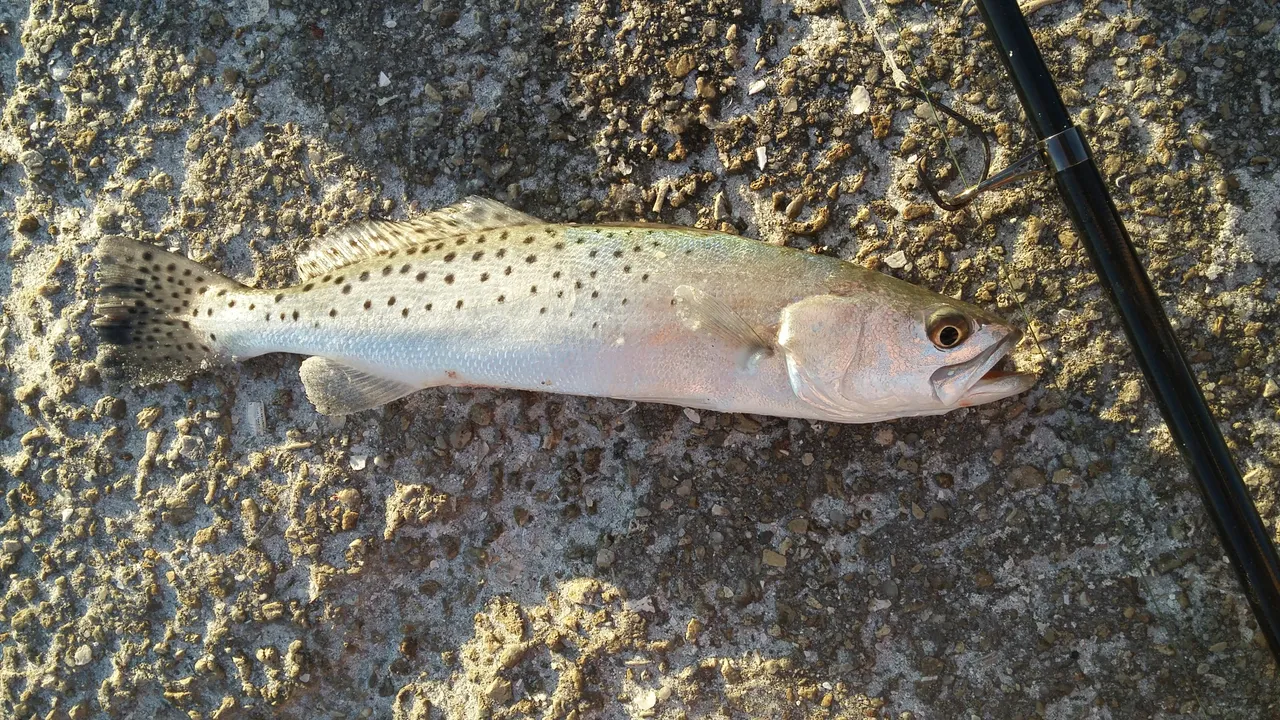
Congeners of the same American Atlantic estuaries, both called sea trout by somebody, both silver with a purple sheen and a pair of prominent canine teeth. They are caught on the same lures in the same water, and anglers routinely report one as the other.
Spotted seatrout
Cynoscion nebulosus — Sciaenidae
Weakfish
Cynoscion regalis — Sciaenidae
No photograph of Weakfish has passed identity review yet, so none is shown. A photograph is published only once somebody has checked the animal in it against the diagnostic features described on this page.
The differences
Each difference is marked with how far it can be trusted on its own. A single diagnostic character settles the identification; suggestive ones only narrow it.
| Character | Spotted seatrout | Weakfish | Reliability |
|---|---|---|---|
| SpottingIdentification | Distinct round black spots scattered over the back and running onto the dorsal and tail fins. | No distinct round black spots; instead fine gold and green flecks forming faint diagonal lines. | Diagnostic on its own |
| Fin colourIdentification | Fins largely dusky, without a strong yellow cast. | Pelvic, anal and caudal fins with a distinct yellow tinge. | Supporting — use with others |
| Range and movementRange | Largely resident within estuaries and nearby coastal water, moving with temperature rather than migrating far. | Migrates seasonally along the coast, moving north and inshore in spring and south and offshore in autumn. | Supporting — use with others |
| HandlingHandling | Soft mouth that tears; support the body rather than lipping the fish. | Even more fragile in the mouth — the trait the name refers to — so a net rather than a lift. | Supporting — use with others |
Why it matters
The two carry different limits in most states, and their stock positions are quite different — weakfish abundance has remained low for an extended period while spotted seatrout supports a large fishery. Reporting one as the other muddies both pictures.
The full records
This page compares two species. Each of them has a complete record covering biology, behaviour, handling and the evidence behind all of it.
More about spotted seatrout
Where it lives, how it is caught, and what else it is confused with.
Similar and related fish
How it is caught
Gear for this fish
Where it lives
Why the 8 connections on this page are here, and the sources
Similar and related fish
Backed by research — 2 connections
Supported by peer-reviewed research or fisheries science. The sources are listed and can be checked.
Bay anchovy
Recorded diet evidence identifies Anchoa mitchilli as a food item of this predator at species level. The edge is written at that granularity and no further.
- FishBase: a global information system on fishes — Froese, R. and D. Pauly, eds. — FishBase Consortium (Scientific institute)Relied on for: Food items recorded for this predator, including Anchoa mitchilli.States this directlyPassage read and verified
- FAO Species Identification Guides for Fishery Purposes and the FAO Species Catalogues — Food and Agriculture Organization of the United Nations (Scientific institute)Relied on for: Species account describing the diet of this predator in the region where Anchoa mitchilli occurs.Background and mechanism onlyCitation checked — the work exists and is described correctly
Weakfish
An identification comparison naming both binomials: Cynoscion nebulosus and Cynoscion regalis.
- FishBase: a global information system on fishes — Froese, R. and D. Pauly, eds. — FishBase Consortium (Scientific institute)Relied on for: Morphological and distributional data for Cynoscion nebulosus and for Cynoscion regalis.States this directlyPassage read and verified
- The IUCN Red List of Threatened Species — International Union for Conservation of Nature (Conservation authority)Relied on for: Separate assessments treating Cynoscion nebulosus and Cynoscion regalis as distinct species.States this directlyCitation checked — the work exists and is described correctly
How it is caught
What experienced anglers do — 2 connections
Widely and independently recommended by experienced anglers and specialist sources. This is real angling knowledge, not proof: controlled evidence for it is limited, and FishingHQ records it as convention rather than as a demonstrated effect.
Saltwater fly fishing
A practitioner claim about how Cynoscion nebulosus is commonly fished, following from where and how it feeds.
- General angling website restatements of established technique — Various (Credible secondary source)Relied on for: Widely restated practitioner accounts of fishing for spotted seatrout.Citation checked — the work exists and is described correctly
- Sea Angler — Bauer Media (Specialist angling publication)Relied on for: Practitioner treatment of the methods used for spotted seatrout and comparable species.Citation checked — the work exists and is described correctly
Spinning
A practitioner claim about how Cynoscion nebulosus is commonly fished, following from where and how it feeds.
- General angling website restatements of established technique — Various (Credible secondary source)Relied on for: Widely restated practitioner accounts of fishing for spotted seatrout.Citation checked — the work exists and is described correctly
- Sea Angler — Bauer Media (Specialist angling publication)Relied on for: Practitioner treatment of the methods used for spotted seatrout and comparable species.Citation checked — the work exists and is described correctly
Gear for this fish
What experienced anglers do — 2 connections
Widely and independently recommended by experienced anglers and specialist sources. This is real angling knowledge, not proof: controlled evidence for it is limited, and FishingHQ records it as convention rather than as a demonstrated effect.
Soft plastics
A practitioner claim about tackle commonly used for Cynoscion nebulosus.
- General angling website restatements of established technique — Various (Credible secondary source)Relied on for: Widely restated practitioner accounts of this presentation for spotted seatrout.Citation checked — the work exists and is described correctly
- Angling Times — Bauer Media (Specialist angling publication)Relied on for: Practitioner treatment of comparable presentations for the species group.Citation checked — the work exists and is described correctly
Surface lures
A practitioner claim about tackle commonly used for Cynoscion nebulosus.
- General angling website restatements of established technique — Various (Credible secondary source)Relied on for: Widely restated practitioner accounts of this presentation for spotted seatrout.Citation checked — the work exists and is described correctly
- Angling Times — Bauer Media (Specialist angling publication)Relied on for: Practitioner treatment of comparable presentations for the species group.Citation checked — the work exists and is described correctly
Where it lives
Backed by research — 2 connections
Supported by peer-reviewed research or fisheries science. The sources are listed and can be checked.
Estuary
A habitat association for Cynoscion nebulosus taken from the environment and distribution data on its FishBase summary.
- FishBase: a global information system on fishes — Froese, R. and D. Pauly, eds. — FishBase Consortium (Scientific institute)Relied on for: The environment, depth range and habitat description recorded for Cynoscion nebulosus.States this directlyPassage read and verified
Surf beaches
A habitat association for Cynoscion nebulosus taken from the environment and distribution data on its FishBase summary.
- FishBase: a global information system on fishes — Froese, R. and D. Pauly, eds. — FishBase Consortium (Scientific institute)Relied on for: The environment, depth range and habitat description recorded for Cynoscion nebulosus.States this directlyPassage read and verified
Reviewed 2026-08-10. FishingHQ does not state what any rule is or where any rule applies. Where this page says the two species are managed differently, that is a reason to check the authority for the water you are on — not a statement of what it requires.