Weakfish
Fish · Last reviewed 2026-08-10
A purple-sheened Atlantic drum named for its fragile mouth rather than any lack of fight, and a species whose stock has declined sharply.
Safety: injury while handling fish — minor injury.
Catching Weakfish
Everything here on fishing for it. Each entry opens the page behind it.
- Ground
Weakfish is named for its mouth. The membrane is thin and tears easily, so hooks pull out under pressure — nothing to do with the fish's strength, which is considerable.
It is a drum of the American Atlantic coast, iridescent purple-green above with gold and green flecking along the flank, and it hunts shrimp and small fish in estuaries, bays and surf. Like other sciaenids the males drum audibly during spawning.
It is also a genuine conservation concern: the Atlantic stock declined sharply from historical levels and has not recovered, and the causes are still debated. That decline is a material part of what an angler should know about the species.
How it is caught
Identification
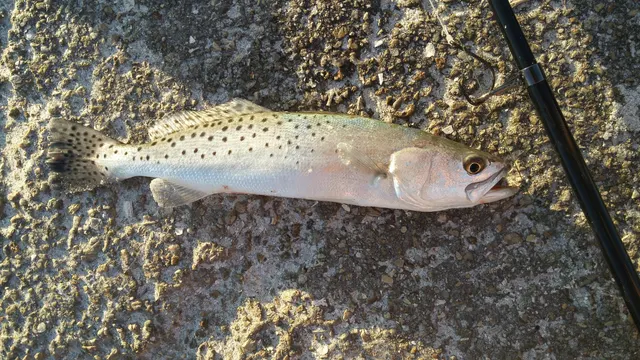
No photograph of Weakfish has passed identity review yet, so none is shown. A photograph is published only once somebody has checked the animal in it against the diagnostic features described on this page.
- Scientific name
- Cynoscion regalis
- Family
- Sciaenidae
- Water
- Saltwater, Brackish
- Conservation status
- Endangered
- Regions
- North America
- Iridescent purple, green and blue sheen on the back with gold and green flecks forming faint diagonal lines.
- Two prominent canine teeth at the front of the upper jaw, as in spotted seatrout.
- No distinct round black spots on the body or tail, which separates it from spotted seatrout.
- Yellow tinge to the pelvic, anal and caudal fins, and no barbels.
Size
- Typical
- 0.5–1.5 kg (1.1–3.3 lb)
- Large
- 2.5–5 kg (5.5–11 lb)
Exceptional: FishBase records a maximum of 98 cm and 8.9 kg
Lifecycle and reproduction
Moderately long-lived and fast-growing, with females reaching a larger size than males. The Atlantic stock has been at low abundance for an extended period despite substantial reductions in fishing pressure, which points to causes beyond harvest alone.
Spawns in estuaries and coastal waters from spring into summer, with males drumming during courtship. Juveniles use estuaries as nursery habitat.
Feeding and senses
Takes shrimp, small fish and crustaceans in estuaries, bays and surf, feeding actively in low light and after dark. Larger fish become increasingly piscivorous, and the species follows moving water on the tide rather than holding on a fixed feature.
Hunts in turbid estuarine and coastal water using sight at close range and lateral-line detection, with sound production playing a role in spawning rather than in feeding.
Through the year
Migrates seasonally along the coast, moving inshore and northward in spring and summer and offshore and southward in autumn.
Distribution
Western Atlantic: Nova Scotia, Canada to northern Florida, USA. Introduced in Europe
This is a biological range — where the species occurs, not a prediction that you will catch one. To browse the fishing geography FishingHQ holds, start at fishing places.
Why anglers care
An Atlantic coast target taken on soft plastics, jigs, plugs and shrimp baits from shore, bay and small boat. Its significance is partly historical — it was once a far more important recreational fishery than it is now — and its decline is a live management issue. The soft mouth demands a light drag and a net rather than lifting.
Handling and returning
The mouth membrane tears easily, so never lift a weakfish by the jaw or swing it in on the line. Use a net, support the body, wet hands, and return promptly given the stock's condition.
Going further
- Weakfish vs Spotted seatrout — how to tell them apart.
Safety
Injury while handling fish — Minor injury
The two upper canines cause cuts to fingers during unhooking.
What reduces it: Grip across the body rather than by the jaw and use pliers or a dehooker.
Where to go next
Similar and related fish
Where it lives
Sources and evidence
- FishBase: a global information system on fishes — Froese, R. and D. Pauly, eds. — FishBase Consortium (Scientific institute)Relied on for: Family, maximum size, depth and environment, distribution and the IUCN assessment for Cynoscion regalis.States this directlyPassage read and verified
- The IUCN Red List of Threatened Species — International Union for Conservation of Nature (Conservation authority)Relied on for: The Endangered assessment for Cynoscion regalis, assessed 08 August 2019.States this directlyCitation checked — the work exists and is described correctly
Why the 7 connections on this page are here, and the sources
Similar and related fish
Backed by research — 2 connections
Supported by peer-reviewed research or fisheries science. The sources are listed and can be checked.
Bay anchovy
Recorded diet evidence identifies Anchoa mitchilli as a food item of this predator at species level. The edge is written at that granularity and no further.
- FishBase: a global information system on fishes — Froese, R. and D. Pauly, eds. — FishBase Consortium (Scientific institute)Relied on for: Food items recorded for this predator, including Anchoa mitchilli.States this directlyPassage read and verified
- FAO Species Identification Guides for Fishery Purposes and the FAO Species Catalogues — Food and Agriculture Organization of the United Nations (Scientific institute)Relied on for: Species account describing the diet of this predator in the region where Anchoa mitchilli occurs.Background and mechanism onlyCitation checked — the work exists and is described correctly
Spotted seatrout
An identification comparison naming both binomials: Cynoscion nebulosus and Cynoscion regalis.
- FishBase: a global information system on fishes — Froese, R. and D. Pauly, eds. — FishBase Consortium (Scientific institute)Relied on for: Morphological and distributional data for Cynoscion nebulosus and for Cynoscion regalis.States this directlyPassage read and verified
- The IUCN Red List of Threatened Species — International Union for Conservation of Nature (Conservation authority)Relied on for: Separate assessments treating Cynoscion nebulosus and Cynoscion regalis as distinct species.States this directlyCitation checked — the work exists and is described correctly
How it is caught
What experienced anglers do — 2 connections
Widely and independently recommended by experienced anglers and specialist sources. This is real angling knowledge, not proof: controlled evidence for it is limited, and FishingHQ records it as convention rather than as a demonstrated effect.
Saltwater fly fishing
A practitioner claim about how Cynoscion regalis is commonly fished, following from where and how it feeds.
- General angling website restatements of established technique — Various (Credible secondary source)Relied on for: Widely restated practitioner accounts of fishing for weakfish.Citation checked — the work exists and is described correctly
- Sea Angler — Bauer Media (Specialist angling publication)Relied on for: Practitioner treatment of the methods used for weakfish and comparable species.Citation checked — the work exists and is described correctly
Spinning
A practitioner claim about how Cynoscion regalis is commonly fished, following from where and how it feeds.
- General angling website restatements of established technique — Various (Credible secondary source)Relied on for: Widely restated practitioner accounts of fishing for weakfish.Citation checked — the work exists and is described correctly
- Sea Angler — Bauer Media (Specialist angling publication)Relied on for: Practitioner treatment of the methods used for weakfish and comparable species.Citation checked — the work exists and is described correctly
Gear for this fish
What experienced anglers do — 1 connection
Widely and independently recommended by experienced anglers and specialist sources. This is real angling knowledge, not proof: controlled evidence for it is limited, and FishingHQ records it as convention rather than as a demonstrated effect.
Soft plastics
A practitioner claim about which lure family answers this species' feeding or holding behaviour.
- General angling website restatements of established technique — Various (Credible secondary source)Relied on for: Widely restated North American lure practice for this species.Background and mechanism onlyCitation checked — the work exists and is described correctly
- IGFA International Angling Rules and World Record Requirements — International Game Fish Association (Angling or fisheries organisation)Relied on for: Recognition of the species as an established sport fish taken on artificial lures, and the tackle conventions used for it.States this directlyPassage read and verified
Where it lives
Backed by research — 2 connections
Supported by peer-reviewed research or fisheries science. The sources are listed and can be checked.
Estuary
A habitat association for Cynoscion regalis taken from the environment and distribution data on its FishBase summary.
- FishBase: a global information system on fishes — Froese, R. and D. Pauly, eds. — FishBase Consortium (Scientific institute)Relied on for: The environment, depth range and habitat description recorded for Cynoscion regalis.States this directlyPassage read and verified
Surf beaches
A habitat association for Cynoscion regalis taken from the environment and distribution data on its FishBase summary.
- FishBase: a global information system on fishes — Froese, R. and D. Pauly, eds. — FishBase Consortium (Scientific institute)Relied on for: The environment, depth range and habitat description recorded for Cynoscion regalis.States this directlyPassage read and verified
How FishingHQ labels evidence is explained in the evidence policy.