How to identify spotted seatrout
Cynoscion nebulosus · Sciaenidae
The characters that identify spotted seatrout, ranked by how far each one can be trusted on its own.
Safety: injury while handling fish — minor injury.
How this was identified, and who took it
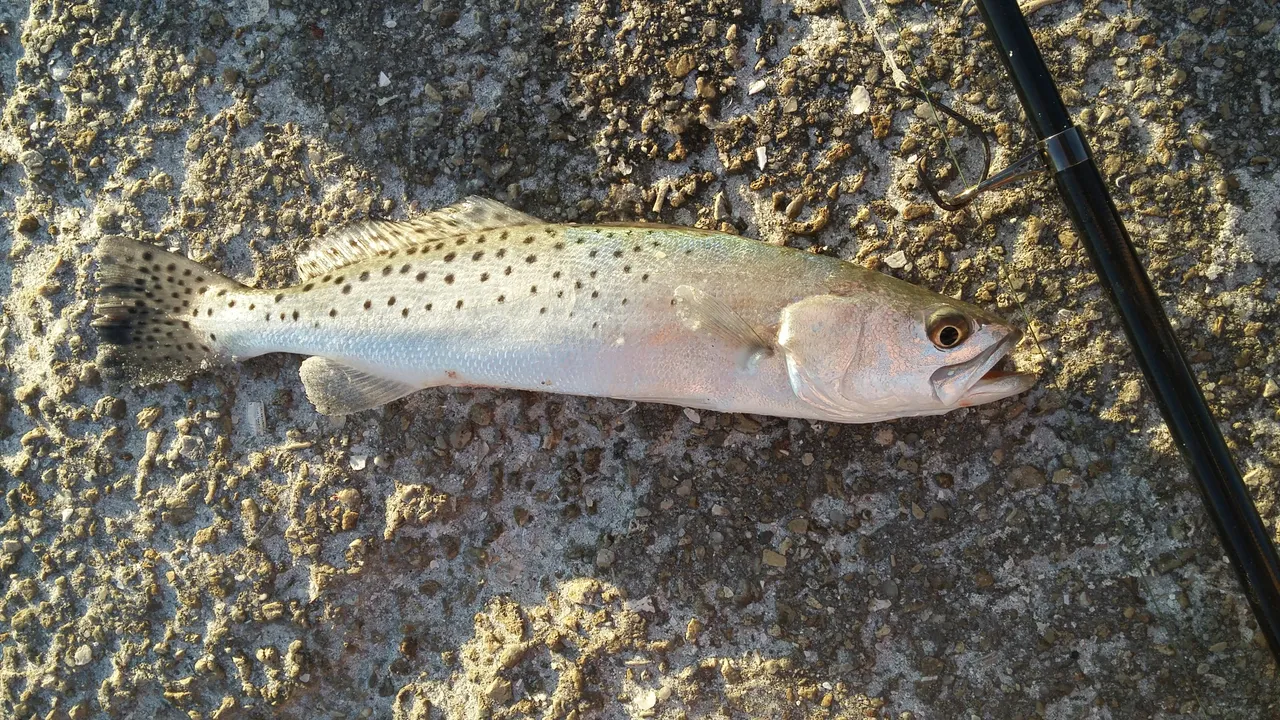
Identified by: Discrete round black spots over the upper body extending onto the soft dorsal and caudal fins, an elongate silvery body with an olive back, two dorsal fins and prominent canines at the front of the upper jaw — the combination separating Cynoscion nebulosus from C. regalis and C. arenarius. Two agreeing identifications on the source, none disagreeing.Quinn — CC BY, via iNaturalist — source, licenceAbout the image above: The photograph beside this page shows a dead fish rather than a live one. The spotting and the canines are clear, but the purple-blue sheen over the back described below is already gone from it, and a live fish is more strongly coloured than this picture suggests.
Look at this first
The spots are the test, and where they run matters more than how many there are. Follow them back from the shoulder: on this fish they carry on across the second dorsal fin and onto the tail itself, and that continuation onto the fins is what separates it from the drums it shares an estuary with.
Diagnostic — settles it on its own
Each of these settles the identification on its own. If one is clear, you have your answer.
Round dark spots that continue onto the tail and rear dorsal
Look for well-defined circular spots scattered over the upper half of a silvery body, then follow them backwards. The important observation is that they do not stop where the body stops: they are carried across the membrane of the rear dorsal fin and onto the caudal fin. Several silvery fish of the same water carry body spotting; the fin spotting is far more restricted, and on a fresh fish it is unambiguous.
A pair of large canines at the front of the upper jaw
Open the mouth and look at the front of the upper jaw for two prominent, well-separated fangs standing clear of the smaller teeth around them. They are a structural character, present at every size and unaffected by how long the fish has been dead. In combination with the spotting they close the identification, and they are also the reason to keep fingers away from the front of the mouth while checking.
Nothing under the chin
Turn the head over and check the underside of the lower jaw. It is clean. Many of the drums sharing this water carry one or more short whiskers there, and finding any at all moves the fish out of this species immediately. A negative character is worth ranking highly when it is this quick to check and this hard to misread, and it is the fastest way to rule out the croakers and the black drum.
Supporting — use with other characters
Real characters that are not conclusive by themselves. Use two or three together.
Size, and what a large one is
Most fish run half a kilo to a kilo and a half. A large one is two and a half to four and a half kilos, and the published maximum is 100 cm and 7.9 kg. Size does not separate this species from the weakfish it is most often confused with, since the two overlap through their whole range of sizes, but a very large individual in the northern part of the range is worth a second look at the spotting pattern before it is claimed.
Suggestive only — varies with condition
Hints only. These vary with condition, season, water and how long the fish has been out of it, and a fish that contradicts them is still the same species.
An elongate silver body with a dark iridescent back
Seen side on the fish is long and moderately slim rather than deep-bodied, silver on the flank, with a purple or blue sheen over the back that is obvious on a fresh fish in good light and gone within an hour. Treat the sheen as a pleasant confirmation rather than as evidence: it is the first thing to disappear, and a photograph taken on a deck at midday may show none of it at all.
Western Atlantic estuaries and the Gulf of Mexico
The range runs from New York south through Florida and across the whole Gulf of Mexico, and there is a recent report from the Guadalquivir estuary in Spain. This is an estuarine fish rather than an offshore one. Range is a weak character here because the congeners that cause the confusion share most of it, but it does exclude the superficially similar spotted fishes of other coasts.
A soft mouth that tears
The membrane around the jaw is notably thin and tears easily, and the fish as a whole is less robust than its abundance suggests. This is a handling character rather than an identification one, and it is here because a reader who has identified the fish and intends to return it needs it in the same breath: support the body with wet hands rather than hanging the fish from its jaw, and expect slow recovery in warm shallow water.
What it gets confused with
- Weakfish, a congener sharing much of the range, whose spotting is finer, less rounded and does not run boldly onto the tail.
- Sand seatrout and silver seatrout, both plainer and largely unspotted on the body.
- Atlantic croaker and black drum, both of which carry chin barbels this species does not have.
- Red drum, which has a bold black spot at the base of the tail rather than scattered spotting over the back.
Side by side: Spotted seatrout vs Weakfish.
Where this stops working
The genus is the problem rather than the family. Weakfish overlaps this species through most of its northern range and the two are routinely confused by anglers who have caught both, so a fish from the mid-Atlantic coast should be identified from the spotting on the tail and rear dorsal rather than from general impression. Spots fade and the iridescent sheen disappears within an hour of death, so a photograph of a fish that has been iced tells you less than the same fish told the person who caught it. Small juveniles are more sparsely spotted than adults and can be genuinely difficult. Hybrids between Cynoscion species are reported and are not separable by eye.
The full record
This page covers identification only. The Spotted seatrout record covers behaviour, lifecycle, distribution, handling and the sources behind all of it.
Reviewed 2026-08-17.
More about this fish
Telling it apart is one question. Here are the others.
Similar and related fish
How it is caught
Where it lives
Where you will find it
Why the 8 connections on this page are here, and the sources
Similar and related fish
Backed by research — 2 connections
Supported by peer-reviewed research or fisheries science. The sources are listed and can be checked.
Bay anchovy
Recorded diet evidence identifies Anchoa mitchilli as a food item of this predator at species level. The edge is written at that granularity and no further.
- FishBase: a global information system on fishes — Froese, R. and D. Pauly, eds. — FishBase Consortium (Scientific institute)Relied on for: Food items recorded for this predator, including Anchoa mitchilli.States this directlyPassage read and verified
- FAO Species Identification Guides for Fishery Purposes and the FAO Species Catalogues — Food and Agriculture Organization of the United Nations (Scientific institute)Relied on for: Species account describing the diet of this predator in the region where Anchoa mitchilli occurs.Background and mechanism onlyCitation checked — the work exists and is described correctly
Weakfish
An identification comparison naming both binomials: Cynoscion nebulosus and Cynoscion regalis.
- FishBase: a global information system on fishes — Froese, R. and D. Pauly, eds. — FishBase Consortium (Scientific institute)Relied on for: Morphological and distributional data for Cynoscion nebulosus and for Cynoscion regalis.States this directlyPassage read and verified
- The IUCN Red List of Threatened Species — International Union for Conservation of Nature (Conservation authority)Relied on for: Separate assessments treating Cynoscion nebulosus and Cynoscion regalis as distinct species.States this directlyCitation checked — the work exists and is described correctly
How it is caught
What experienced anglers do — 2 connections
Widely and independently recommended by experienced anglers and specialist sources. This is real angling knowledge, not proof: controlled evidence for it is limited, and FishingHQ records it as convention rather than as a demonstrated effect.
Saltwater fly fishing
A practitioner claim about how Cynoscion nebulosus is commonly fished, following from where and how it feeds.
- General angling website restatements of established technique — Various (Credible secondary source)Relied on for: Widely restated practitioner accounts of fishing for spotted seatrout.Citation checked — the work exists and is described correctly
- Sea Angler — Bauer Media (Specialist angling publication)Relied on for: Practitioner treatment of the methods used for spotted seatrout and comparable species.Citation checked — the work exists and is described correctly
Spinning
A practitioner claim about how Cynoscion nebulosus is commonly fished, following from where and how it feeds.
- General angling website restatements of established technique — Various (Credible secondary source)Relied on for: Widely restated practitioner accounts of fishing for spotted seatrout.Citation checked — the work exists and is described correctly
- Sea Angler — Bauer Media (Specialist angling publication)Relied on for: Practitioner treatment of the methods used for spotted seatrout and comparable species.Citation checked — the work exists and is described correctly
Where it lives
Backed by research — 2 connections
Supported by peer-reviewed research or fisheries science. The sources are listed and can be checked.
Estuary
A habitat association for Cynoscion nebulosus taken from the environment and distribution data on its FishBase summary.
- FishBase: a global information system on fishes — Froese, R. and D. Pauly, eds. — FishBase Consortium (Scientific institute)Relied on for: The environment, depth range and habitat description recorded for Cynoscion nebulosus.States this directlyPassage read and verified
Surf beaches
A habitat association for Cynoscion nebulosus taken from the environment and distribution data on its FishBase summary.
- FishBase: a global information system on fishes — Froese, R. and D. Pauly, eds. — FishBase Consortium (Scientific institute)Relied on for: The environment, depth range and habitat description recorded for Cynoscion nebulosus.States this directlyPassage read and verified
Where you will find it
Backed by research — 2 connections
Supported by peer-reviewed research or fisheries science. The sources are listed and can be checked.
Florida
A distribution association between an animal and a kind of water, rather than a claim about any named mark.
- NOAA National Ocean Service education on estuaries and the National Estuarine Research Reserve System — National Oceanic and Atmospheric Administration, United States (Government fisheries body)Relied on for: Estuarine, seagrass and coastal habitat function in North American waters, and the nursery role of shallow habitat for the species concerned.Background and mechanism onlyCitation checked — the work exists and is described correctly
- FishBase: a global information system on fishes — Froese, R. and D. Pauly, eds. — FishBase Consortium (Scientific institute)Relied on for: Distribution, habitat association, depth range and life history recorded for the species.States this directlyPassage read and verified
The Gulf of Mexico
A distribution association between an animal and a kind of water, rather than a claim about any named mark.
- FishBase: a global information system on fishes — Froese, R. and D. Pauly, eds. — FishBase Consortium (Scientific institute)Relied on for: Distribution, habitat association and depth range recorded for the species, including its occurrence in the water body concerned.States this directlyPassage read and verified
- The IUCN Red List of Threatened Species — International Union for Conservation of Nature (Conservation authority)Relied on for: Assessment and range account for the species, including the systems and coasts it occupies.Background and mechanism onlyCitation checked — the work exists and is described correctly
Safety
Injury while handling fish — Minor injury
The two upper canines and the sharp rear edge of the gill cover both cause cuts during unhooking and handling.
What reduces it: Grip across the body rather than by the jaw, and use pliers or a dehooker.