What does gag grouper eat?
What is established about how gag grouper feeds, kept separate from what anglers infer from it.
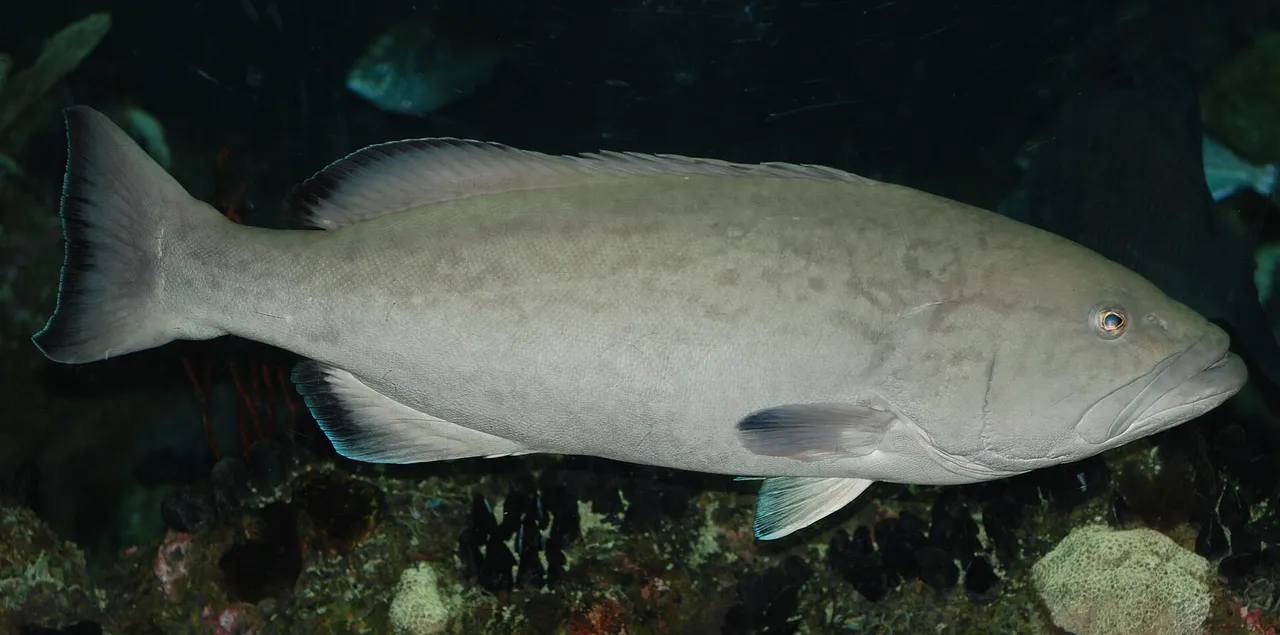
How this was identified, and who took it
Identified by: Complete lateral view, sharp, with the whole fish in frame. The elongate Mycteroperca body form, the faint darker marbling over a pale grey-brown ground, the dark margins to the soft dorsal, anal and caudal fins and the projecting lower jaw are all visible. Photographed in an aquarium rather than in the wild, which is recorded in the caption.Jarek Tuszyński — CC BY 4.0, via Wikimedia Commons — source, licenceWhat is known about how it feeds
A gag grouper's feeding and its escape are the same movement performed twice.
The fish holds in a hole, a ledge or a wreck, and takes prey with a sudden suction strike through a large mouth — then returns immediately to cover. The strike is a short, explosive lunge from structure, and the return is automatic. It is not a pursuit predator in any sense; it is a hole with a mouth.
The two verified relationships reflect what passes within range of that hole. Decapod crustaceans, taken particularly by smaller fish on inshore structure, and scaled sardines standing for the small shoaling clupeids that move over nearshore reef.
Size changes the address rather than the method. Juvenile gags use estuarine seagrass beds as nursery habitat, sub-adults occupy inshore structure, and large fish move to deeper offshore reef — the same ambush strategy applied at increasing depth.
Gags are protogynous: individuals function as females first and may later become males, so the largest fish in a population are disproportionately male and removing them alters the sex ratio rather than simply the numbers. That is a management fact rather than a dietary one, and it is why the species is regulated as carefully as it is.
The barotrauma consequence of the depth belongs here too: a gag brought up from offshore structure suffers pressure injury, and the depth the fish lives at is the reason.
The food
Prey with a verified dietary link to this fish. Each entry carries its own evidence, and each is written at the precision the source actually used: a named species where the source named one, a group or food category where it said “polychaetes”, “crustaceans” or “detritus” and meant it. That is why this list is shorter than the animal’s real diet rather than longer.
- Decapod crustaceans as prey — a group rather than a species: the evidence names the group
Crustaceans are taken alongside fish, particularly by smaller gag grouper on inshore structure before they move to deeper reefs.
- Scaled sardine — Harengula jaguana
Small clupeids are a principal fish prey for gag over inshore and nearshore structure.
Food with no page of its own here yet
These are real components of the diet, listed as plain text because FishingHQ has no page for them yet. Inventing pages to make the list look fuller would be the fabrication this whole approach exists to prevent.
- pinfish and grunts
- squid
- octopus
- small snapper
- crabs
What anglers do with this
Everything below is interpretation, not finding. It is what experienced anglers conclude from the biology above, and the reasoning is usually sound and almost never tested. It is separated from the biology deliberately.
The return-to-cover habit is the defining practical fact and it is mechanical rather than tactical: a gag that reaches structure is generally lost, and the outcome is decided in the first seconds. Everything about how the fish is played follows from that.
The ambush-from-structure feeding converts into a location argument — fish the structure, not the ground around it — which is convention with an obvious basis.
The barotrauma point is not interpretation. A fish brought up from depth and intended for release needs venting or a descending device, and in several fisheries carrying one is required. What applies is a question for the relevant authority, and retention rules for this species change frequently.
What this does not establish
The crustacean relationship is group-level and the sardine relationship stands for a broader group of small shoaling fish. Diet changes with the depth and size class of the fish, and juveniles in seagrass nurseries feed quite differently. Nothing here establishes proportions.
Where this connects
These are the baits, lures, methods and explainers FishingHQ already joins to this fish — which is why the list is sometimes short. They are not chosen for this page, and a link here means an evidenced relationship exists, not that it follows from the diet.
Lures recorded for this species
Methods used for it
The science behind the feeding
This page covers feeding. The Gag grouper record covers identification, lifecycle, seasonal behaviour, handling and the sources behind all of it.
Reviewed 2026-08-12.