Dusky grouper vs Gag grouper
How to tell them apart, and what follows from getting it right.
Why they get confused
Two large, mottled grey-brown groupers of similar size and habit, both holding on structure, both changing colour and pattern with mood and depth, and both routinely photographed in circumstances that flatten every distinguishing feature. Divers and anglers moving between the eastern Atlantic and the western Atlantic meet one having learned the other, and 'grouper' does an enormous amount of unhelpful work in both languages. Colour is the character people use and it is the least reliable one this pair has.
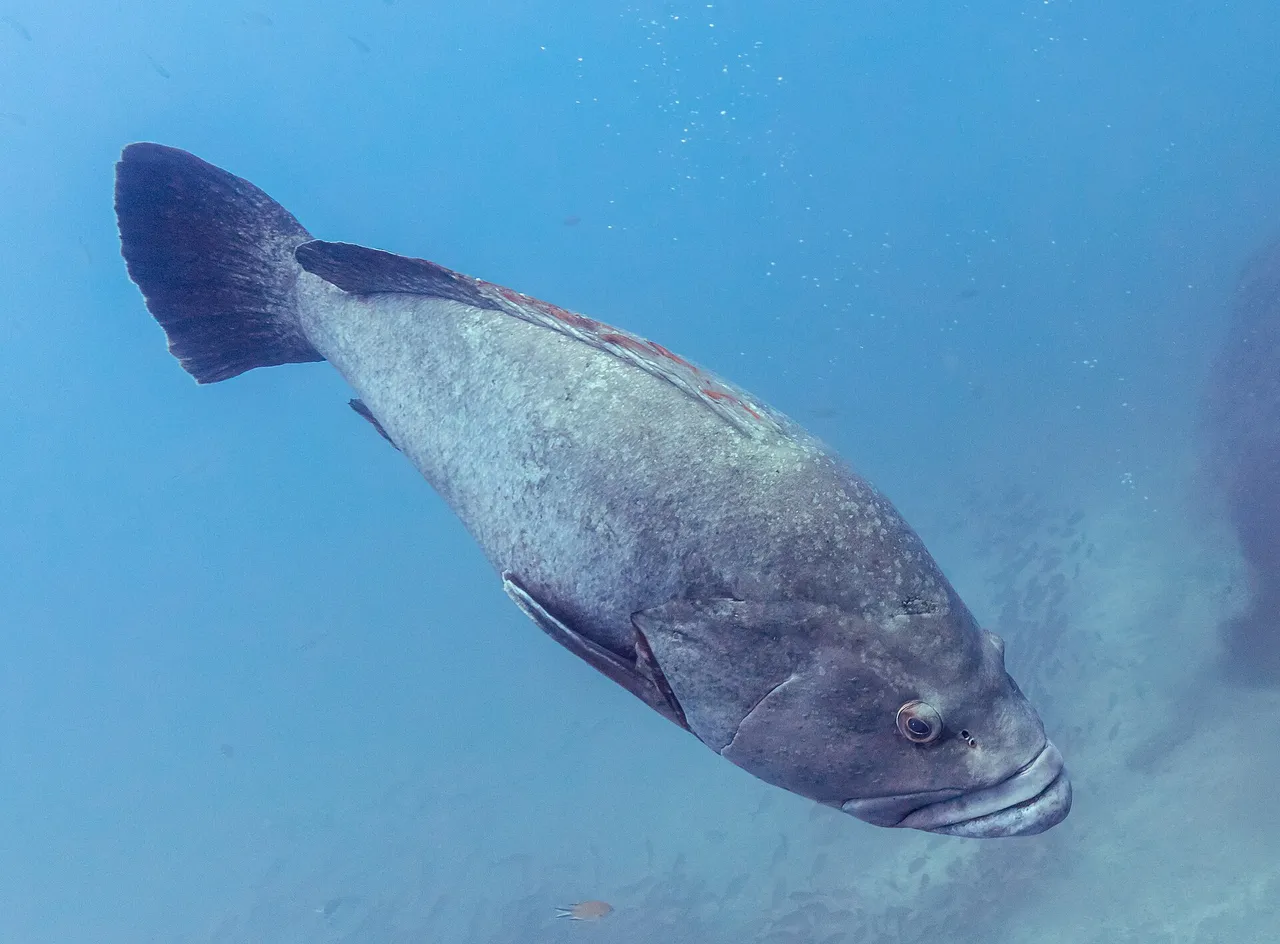
Gag grouper
Mycteroperca microlepis — Epinephelidae
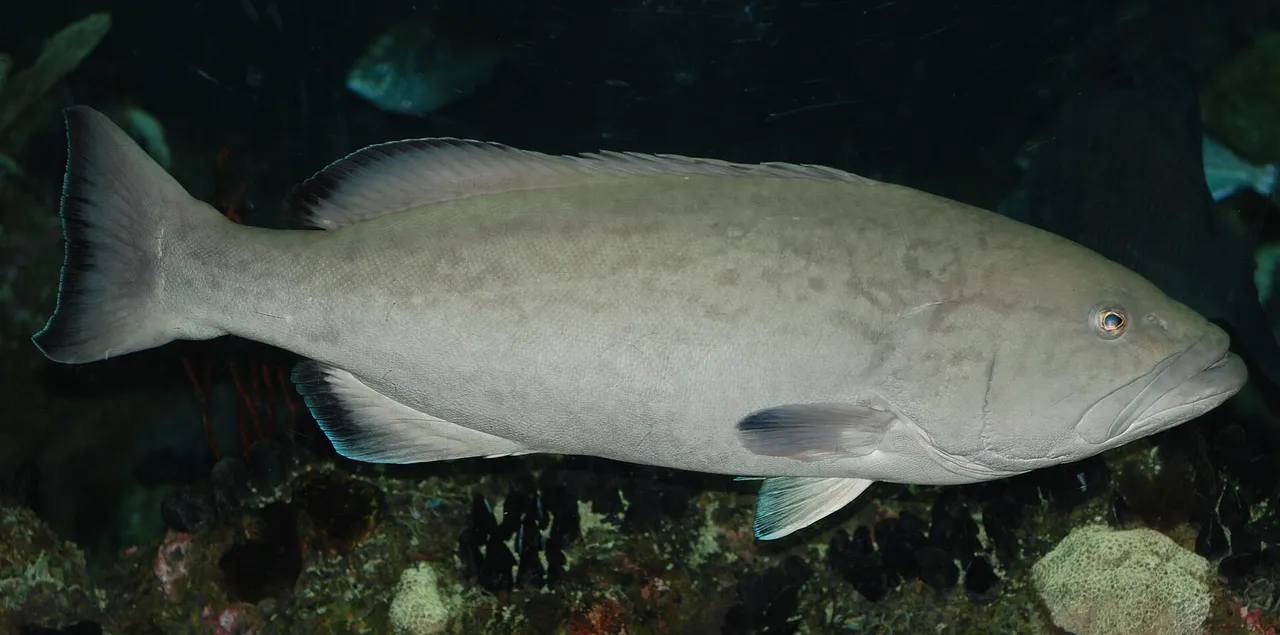
The differences
Each difference is marked with how far it can be trusted on its own. A single diagnostic character settles the identification; suggestive ones only narrow it.
| Character | Dusky grouper | Gag grouper | Reliability |
|---|---|---|---|
| Body proportion and bulkIdentification | Massive, deep and heavy-set with a very large mouth and a projecting lower jaw — the classic Epinephelus outline. | Distinctly more elongate and less heavy-set for its length, in the Mycteroperca form rather than the Epinephelus one. | Diagnostic on its own |
| Shape of the trailing edge of the tailIdentification | Tail rounded, with an even convex trailing edge. | Tail slightly concave with the outer rays extended, giving a notched trailing edge. | Diagnostic on its own |
| Pattern on the flankIdentification | Irregular pale blotches and mottling over a dark ground, strongest in juveniles and shifting with mood. | Darker worm-like or box-shaped markings, most visible in smaller fish and fading with size. | Supporting — use with others |
| Where in the world you areRange | Eastern Atlantic and the Mediterranean, with the Mediterranean population the one most anglers and divers encounter. | Western Atlantic, principally the south-eastern United States, the Gulf and the Caribbean. | Supporting — use with others |
| Conservation positionConservation status | Assessed as threatened, with a declining population trend and legal protection or restriction in a number of Mediterranean jurisdictions. | Assessed with its own status and managed under active federal and state fishery measures in the western Atlantic, including seasonal closures. | Supporting — use with others |
| Handling on the way upHandling | A closed swim bladder means barotrauma from any depth; the release decision is really a decision about what depth to fish. | The same physiology and the same consequence; descending devices and venting practice are part of the fishery where release is intended. | Supporting — use with others |
Why it matters
Both are slow-growing, long-lived, protogynous fish whose largest individuals are the breeding males, and both are managed accordingly — but by completely different authorities under completely different regimes on opposite sides of an ocean. Dusky grouper are protected or restricted in a number of Mediterranean jurisdictions, including for spearfishing; gag are managed in the western Atlantic with seasonal closures, size limits and gear requirements that are revised frequently. Assuming that experience of one transfers to the other is how visiting anglers and divers get it wrong. What applies anywhere is a matter for the competent authority.
The full records
This page compares two species. Each of them has a complete record covering biology, behaviour, handling and the evidence behind all of it.
More about dusky grouper
Where it lives, how it is caught, and what else it is confused with.
Similar and related fish
,_Madeira,_Portugal,_2019-05-31,_DD_24.jpg)

How it is caught
- Hole huntingThe grouper's habit of holding in a known hole and not fleeing makes it findable and makes it exceptionally vulnerable — a fish that stays put is not adapted to a predator that can follow it home.
- Reef spearfishingFour specimens for 8.61 kg in the Canary catch, and EVERY ONE of them below the minimum scientifically advised length. The species is IUCN-vulnerable, sequentially hermaphroditic, and matures late — which is what makes an all-immature catch a finding rather than a footnote.
Why the 4 connections on this page are here, and the sources
Similar and related fish
Backed by research — 2 connections
Supported by peer-reviewed research or fisheries science. The sources are listed and can be checked.
Gag grouper
A comparison resting on shared reproductive biology, naming both binomials, and the basis of the demographic argument on both records.
- FishBase: a global information system on fishes — Froese, R. and D. Pauly, eds. — FishBase Consortium (Scientific institute)Relied on for: That Mycteroperca microlepis and Epinephelus marginatus are both protogynous hermaphrodites in which individuals mature as female and change sex to male with size and age.States this directlyPassage read and verified
Island grouper
Mycteroperca fusca is longer-bodied, reaches 80 cm and 3 kg, and is known with certainty only from four eastern Atlantic archipelagos; Epinephelus marginatus is deeper-bodied, heavier-headed and much larger, with a far wider range. The island grouper is assessed as Vulnerable and the dusky grouper's assessment is its own.
- FishBase: a global information system on fishes — Froese, R. and D. Pauly, eds. — FishBase Consortium (Scientific institute)Relied on for: The morphology, size, depth range and distribution that separate these two species from one another.States this directlyPassage read and verified
How it is caught
Backed by research — 1 connection
Supported by peer-reviewed research or fisheries science. The sources are listed and can be checked.
Hole hunting
A claim resting on the species' documented territoriality and habitat use rather than on practitioner report, because it is the basis of the conservation argument on both records.
- FishBase: a global information system on fishes — Froese, R. and D. Pauly, eds. — FishBase Consortium (Scientific institute)Relied on for: That Epinephelus marginatus is reef-associated on rocky bottom, with adults solitary and territorial, and that it has low resilience with a minimum population doubling time of 4.5 to 14 years and a vulnerability score of 64 out of 100.States this directlyPassage read and verified
- Good Fish Guide — Marine Conservation Society (Conservation authority)Relied on for: That site fidelity and slow replacement are material to whether a local population can sustain harvest.FishingHQ's interpretation of what it saysCitation checked — the work exists and is described correctly
Official guidance — 1 connection
Stated by a fisheries authority, scientific institute or recognised angling body. Authoritative, but summarising rather than demonstrating.
Reef spearfishing
A scientific institute reporting what its own survey of the fishery recorded: a two-year catch-recording programme across the Canary archipelago counted and weighed every specimen, and this species appears in its published catch table. That is what Canary spearfishers were measured taking, rather than an inference from where the species lives or an assertion about what people do.
- Spearfishing in the Canary Islands: is the devil as black as it seems to be? — Pablo Martín-Sosa, Instituto Español de Oceanografía — Revista Scientia Insularum, 2019 (Scientific literature)Relied on for: The Canary spearfishing catch table, in which this species appears with a specimen count and a landed weight over the study's two-year recording period.States this directlyPassage read and verified
Reviewed 2026-08-13. FishingHQ does not state what any rule is or where any rule applies. Where this page says the two species are managed differently, that is a reason to check the authority for the water you are on — not a statement of what it requires.