Summer flounder
Fish · Last reviewed 2026-08-10
A large left-eyed ambush flatfish of the American Atlantic coast with a toothy mouth, fished by drifting rather than by static bottom fishing.
Safety: injury while handling fish — can cause injury needing treatment.
How this was identified, and who took it
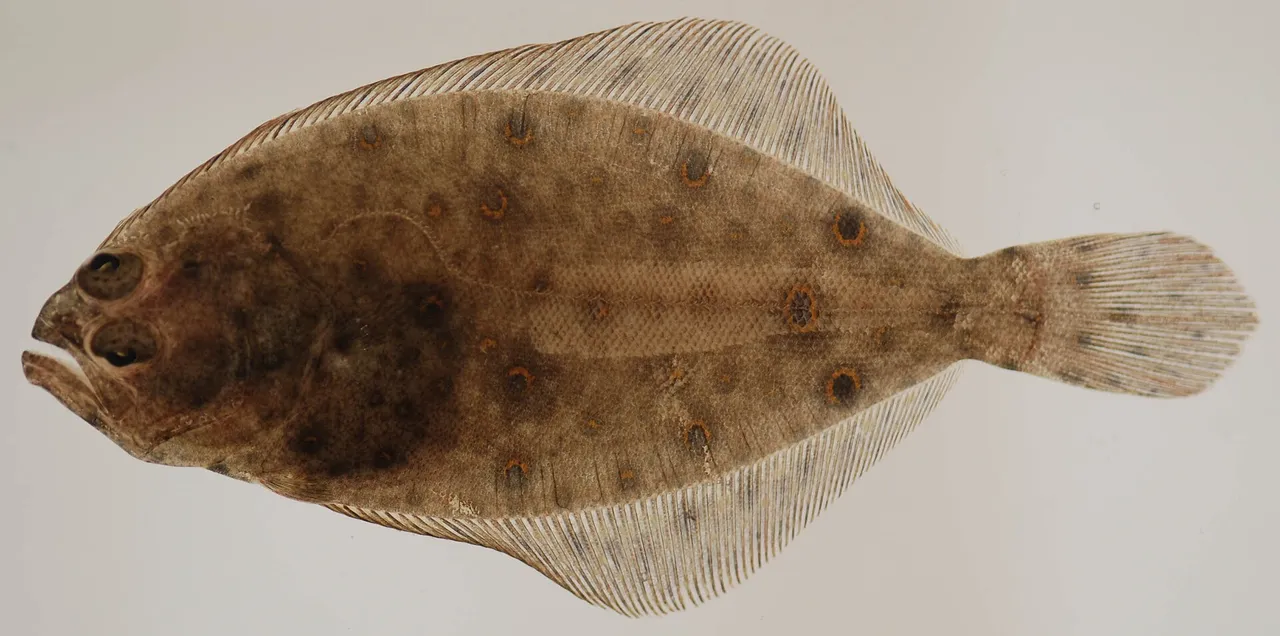
Identified by: A Smithsonian Environmental Research Center voucher at 59 mm standard length, recorded from the Manokin River, Maryland. Both eyes are on the left side, the mouth extends back well past the eye — the character that separates a Paralichthys from a true flounder — and numerous ocellated spots, dark centres in pale rings, are scattered over the upper surface. Unlike many juvenile patterns this one persists into adult fish, so it does not mislead a reader holding a larger fish.Robert Aguilar, Smithsonian Environmental Research Center — CC BY 2.0, via Wikimedia Commons — source, licence_(12593682393).jpg)
Catching Summer flounder
Everything here on fishing for it. Each entry opens the page behind it.
Summer flounder — fluke to most of the anglers who fish for it — is the principal flatfish of the American mid-Atlantic. It is a left-eyed ambush predator with a large mouth full of sharp teeth, and it hunts far more actively than the word flatfish suggests.
It lies part-buried on sand and rises to take small fish and squid, and it will pursue prey up into the water column. That is why the fishery is a drifting fishery: baits and jigs are worked along the bottom while the boat moves, because a static presentation rarely finds a fish.
It migrates seasonally, moving inshore into bays and along beaches in summer — the origin of the name — and offshore into deep water in winter.
How it is caught
- Drift fishingDrifted bucktails and bait strips, because movement is what triggers the strike.
- GiggingFlounder gigging works because the fish lies buried and still on sand in shallow water at night and does not flee a light. That is the whole method: the animal's ambush strategy is exactly what makes it takeable by hand-held spear in the shallows.
- SurfcastingDrifted bucktails and bait strips, because movement is what triggers the strike.
Identification
- Scientific name
- Paralichthys dentatus
- Family
- Paralichthyidae
- Water
- Saltwater, Brackish
- Conservation status
- Least Concern
- Regions
- North America
- Eyes on the left side, with a large mouth extending back past the eye and armed with sharp teeth.
- Numerous eyespots — dark rings with pale centres — scattered over the upper surface, typically including a distinctive pattern of five.
- Ability to change colour and pattern rapidly to match the bottom.
- Broad body with a nearly straight lateral line, unlike the arched line of some other flatfish.
Size
- Typical
- 0.7–2.5 kg (1.5–5.5 lb)
- Large
- 3.5–7 kg (7.7–15 lb)
Exceptional: FishBase records a maximum of 94 cm and 12 kg
Bucktailing a drift, and a flatfish that chases
Summer flounder methods are built around the same insight as California halibut and are worth setting out separately because the fishery is larger and the techniques are more developed: this is a flatfish that pursues.
THE FISH IS AN ACTIVE AMBUSH PREDATOR ON SAND AND MIXED GROUND, taking small fish, squid and crustaceans by launching upward from the bottom. It will follow a bait some distance, which no plaice or sole does, and that changes everything about how it is fished.
DRIFTING IS THE CORE METHOD. Covering ground over sand, sandy mud, channel edges, inlets and around structure on a controlled drift, with a bait or lure working just off the bottom, is how the fish are located and how the movement that provokes an attack is generated. Drift speed is a variable anglers actively manage with drift socks and boat positioning.
BUCKTAIL-AND-TEASER RIGS ARE THE SIGNATURE TECHNIQUE. A weighted bucktail jig worked with a lift-and-drop along the bottom, frequently with a smaller teaser above it, imitates a small fish moving over the sand and is the most effective approach in the fishery. The lift is what triggers the take; a bait dragged passively catches far less.
BAIT STRIPS AND LIVE BAIT ADD SCENT AND MOVEMENT — squid strip, fish belly, live killifish or small baitfish — and are frequently combined with the jig rather than used alone.
STRUCTURE AND EDGES CONCENTRATE THEM, particularly in inlets and channels where tidal flow moves bait past holding fish. Tide state matters here as much as it does for any inshore species.
THE DELAYED HOOK-SET IS THE SAME LESSON AS FOR HALIBUT. Flounder frequently take and hold, and an immediate strike pulls the offering away. Dropping back and letting the fish turn is what converts takes into hooked fish.
AND THE REGULATION IS UNUSUALLY DYNAMIC. Summer flounder are managed with size limits, bag limits and seasons that differ by state and are revised frequently, sometimes annually. Undersized fish are extremely common in this fishery, so careful release practice is ordinary. What applies is a matter for the competent authority.
What experienced anglers do — why, and the sources (2)
Widely and independently recommended by experienced anglers and specialist sources. This is real angling knowledge, not proof: controlled evidence for it is limited, and FishingHQ records it as convention rather than as a demonstrated effect.
- Sea Angler — Bauer Media (Specialist angling publication)Relied on for: Established shore and boat angling practice, including method selection and the reasoning behind it.States this directlyCitation checked — the work exists and is described correctly
- General angling website restatements of established technique — Various (Credible secondary source)Relied on for: The widely restated practice for this species, recorded as a consensus position rather than as an original observation.States this directlyCitation checked — the work exists and is described correctly
Lifecycle and reproduction
Fast-growing with females reaching a considerably larger size and greater age than males, so almost all large fluke are female. Size limits therefore bear directly on the female component of the stock.
Spawns offshore in autumn and winter during the migration to deeper water, broadcasting pelagic eggs. Larvae drift inshore and juveniles use estuaries and bays as nursery habitat.
Feeding and senses
An active ambush predator taking small fish, squid and crustaceans, rising from the bottom and pursuing prey upward rather than waiting passively.
Hunts by sight from concealment with both eyes on the upper side, using rapid camouflage change to remain hidden until the strike.
Through the year
Moves inshore into bays, inlets and beach zones through the summer and offshore into deep water for winter spawning — a strongly seasonal pattern that structures the whole fishery.
Distribution
Northwest Atlantic: Maine (rarely Nova Scotia, Canada) to southern Florida, USA
This is a biological range — where the species occurs, not a prediction that you will catch one. To browse the fishing geography FishingHQ holds, start at fishing places.
Why anglers care
A major American Atlantic recreational target, fished by drifting bucktails, teasers and bait strips over sand and structure edges. Its significance is accessibility from small boats, party boats and shore, and eating quality. Practitioner consensus is that movement of the bait is essential and that a drifting presentation outfishes a static one substantially.
Handling and returning
Sharp teeth and a fish that thrashes hard when landed. Use pliers, keep fingers out of the mouth, and control the fish against the deck or in a net. Return undersized fish promptly and gently.
Going further
- Summer flounder vs California halibut — how to tell them apart.
Safety
Injury while handling fish — Can cause injury needing treatment
The mouth carries numerous sharp teeth and the fish thrashes violently when boated, which is when most injuries occur.
What reduces it: Use pliers or a dehooker, keep fingers out of the mouth, and pin the fish or use a net rather than gripping it in mid-air.
Where to go next
Similar and related fish
Where it lives
More fish
Not related to this page — just the rest of the section. There is little else joined to this subject yet, and a short page should still lead somewhere.
Sources and evidence
- FishBase: a global information system on fishes — Froese, R. and D. Pauly, eds. — FishBase Consortium (Scientific institute)Relied on for: Family, maximum size, depth and environment, distribution and the IUCN assessment for Paralichthys dentatus.States this directlyPassage read and verified
- The IUCN Red List of Threatened Species — International Union for Conservation of Nature (Conservation authority)Relied on for: The Least Concern assessment for Paralichthys dentatus, assessed 04 February 2009.States this directlyCitation checked — the work exists and is described correctly
Why the 7 connections on this page are here, and the sources
Similar and related fish
Backed by research — 1 connection
Supported by peer-reviewed research or fisheries science. The sources are listed and can be checked.
California halibut
An identification comparison naming both binomials: Paralichthys dentatus and Paralichthys californicus.
- FishBase: a global information system on fishes — Froese, R. and D. Pauly, eds. — FishBase Consortium (Scientific institute)Relied on for: Morphological and distributional data for Paralichthys dentatus and for Paralichthys californicus.States this directlyPassage read and verified
- The IUCN Red List of Threatened Species — International Union for Conservation of Nature (Conservation authority)Relied on for: Separate assessments treating Paralichthys dentatus and Paralichthys californicus as distinct species.States this directlyCitation checked — the work exists and is described correctly
How it is caught
What experienced anglers do — 3 connections
Widely and independently recommended by experienced anglers and specialist sources. This is real angling knowledge, not proof: controlled evidence for it is limited, and FishingHQ records it as convention rather than as a demonstrated effect.
Drift fishing
A practitioner claim about how Paralichthys dentatus is commonly fished, following from where and how it feeds.
- General angling website restatements of established technique — Various (Credible secondary source)Relied on for: Widely restated practitioner accounts of fishing for summer flounder.Citation checked — the work exists and is described correctly
- Sea Angler — Bauer Media (Specialist angling publication)Relied on for: Practitioner treatment of the methods used for summer flounder and comparable species.Citation checked — the work exists and is described correctly
Gigging
Established angling practice for this species, recorded as convention. The note states the property of the animal or its water that makes the method the answer.
- Fishers' Craft and Lettered Art: Tracts on Fishing from the End of the Middle Ages — University of Toronto Press, 1997 (Scientific literature)Relied on for: That fishing practices develop around the fish and water available to them, and the historical method of reading such traditions.Background and mechanism onlyCitation checked — the work exists and is described correctly
- FAO fishing gear types and fishing technology information — Food and Agriculture Organization of the United Nations (Scientific institute)Relied on for: Classification and operation of the gear type described.States this directlyCitation checked — the work exists and is described correctly
Surfcasting
A practitioner claim about how Paralichthys dentatus is commonly fished, following from where and how it feeds.
- General angling website restatements of established technique — Various (Credible secondary source)Relied on for: Widely restated practitioner accounts of fishing for summer flounder.Citation checked — the work exists and is described correctly
- Sea Angler — Bauer Media (Specialist angling publication)Relied on for: Practitioner treatment of the methods used for summer flounder and comparable species.Citation checked — the work exists and is described correctly
Gear for this fish
What experienced anglers do — 1 connection
Widely and independently recommended by experienced anglers and specialist sources. This is real angling knowledge, not proof: controlled evidence for it is limited, and FishingHQ records it as convention rather than as a demonstrated effect.
Jigs and jig heads
A practitioner claim about tackle commonly used for Paralichthys dentatus.
- General angling website restatements of established technique — Various (Credible secondary source)Relied on for: Widely restated practitioner accounts of this presentation for summer flounder.Citation checked — the work exists and is described correctly
- Angling Times — Bauer Media (Specialist angling publication)Relied on for: Practitioner treatment of comparable presentations for the species group.Citation checked — the work exists and is described correctly
Where it lives
Backed by research — 2 connections
Supported by peer-reviewed research or fisheries science. The sources are listed and can be checked.
Inshore ground
A habitat association for Paralichthys dentatus taken from the environment and distribution data on its FishBase summary.
- FishBase: a global information system on fishes — Froese, R. and D. Pauly, eds. — FishBase Consortium (Scientific institute)Relied on for: The environment, depth range and habitat description recorded for Paralichthys dentatus.States this directlyPassage read and verified
Surf beaches
A habitat association for Paralichthys dentatus taken from the environment and distribution data on its FishBase summary.
- FishBase: a global information system on fishes — Froese, R. and D. Pauly, eds. — FishBase Consortium (Scientific institute)Relied on for: The environment, depth range and habitat description recorded for Paralichthys dentatus.States this directlyPassage read and verified
How FishingHQ labels evidence is explained in the evidence policy.