California halibut vs Summer flounder
How to tell them apart, and what follows from getting it right.
Why they get confused
Two large-mouthed Paralichthys on two coasts of the same country, both called 'flounder' by some anglers and 'halibut' by others, both with toothy jaws and mottled sandy backs, and both sharing the awkward habit of turning up with their eyes on either side. Photographs of the two circulate interchangeably online, and a reader who has learned one from a picture will recognise the other and name it wrong.
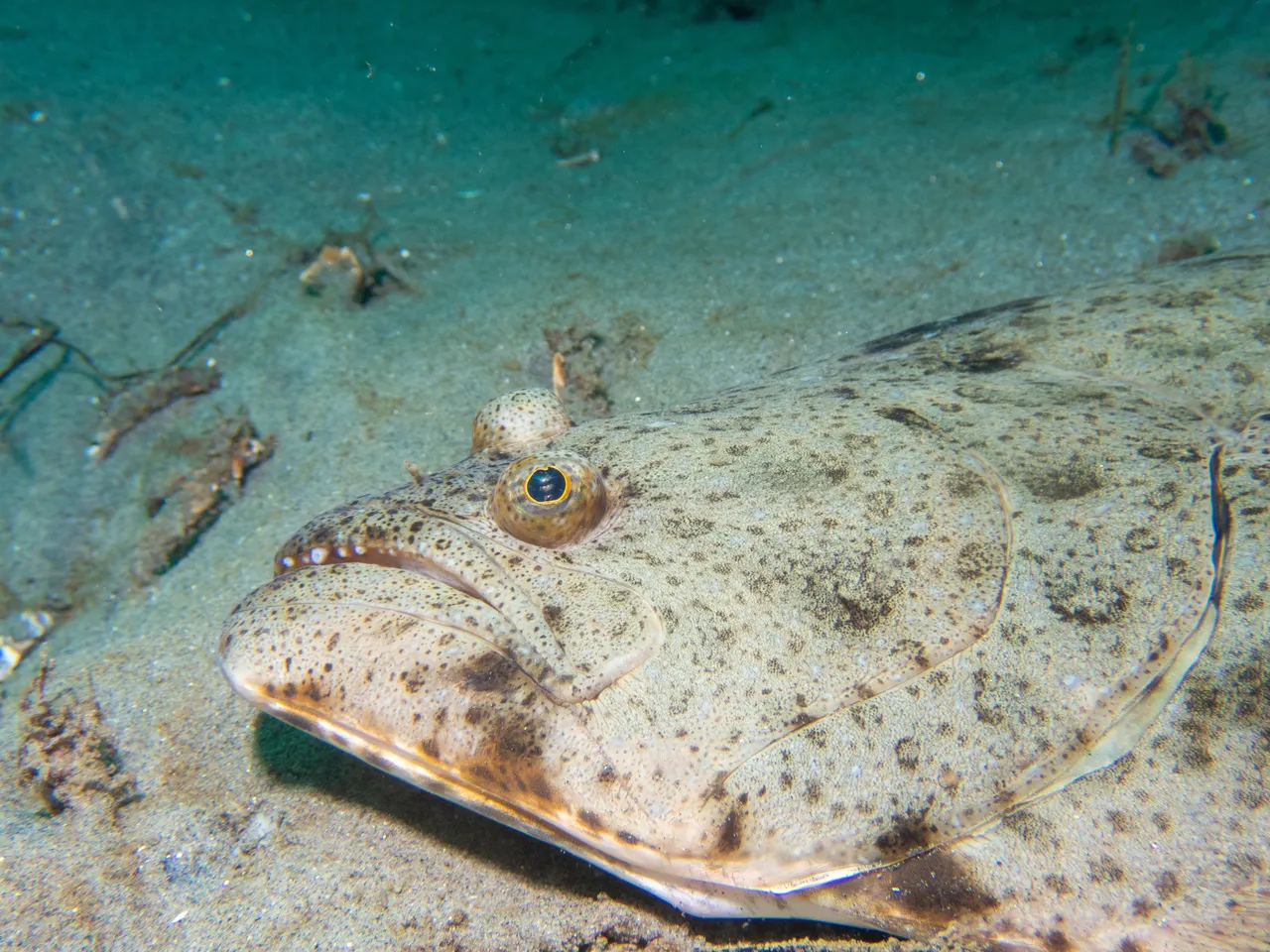
California halibut
Paralichthys californicus — Paralichthyidae
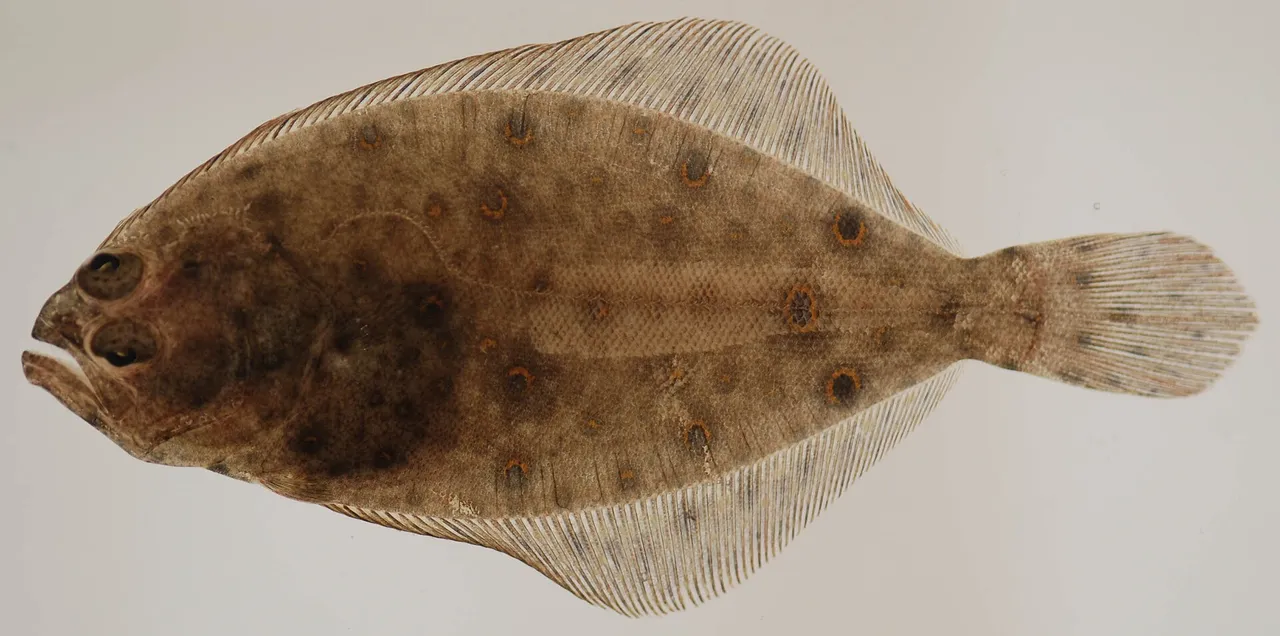
Summer flounder
Paralichthys dentatus — Paralichthyidae
_(12593682393).jpg)
The differences
Each difference is marked with how far it can be trusted on its own. A single diagnostic character settles the identification; suggestive ones only narrow it.
| Character | California halibut | Summer flounder | Reliability |
|---|---|---|---|
| Where the jaw hinge sitsIdentification | The corner of the upper jaw sits behind the eye entirely, on a gape armed with sharp canines. | Also a large oblique mouth extending back past the eye with sharp teeth — the two share this character, which is why it identifies the genus and not the species. | Supporting — use with others |
| Which side the eyes are onIdentification | Left or right depending on the individual, with reversals common enough that side alone rules nothing out. | Left-eyed as the rule, with reversals much rarer, so a right-eyed fish of this build on the Atlantic coast wants a second look. | Supporting — use with others |
| Ocellated spots on the eyed sideIdentification | Plain to mottled brown, without a set of ringed eye-spots; the pattern is camouflage rather than markings. | Carries a scatter of distinct dark spots on the eyed side, several of them ringed with a pale halo, in a pattern that is characteristic on a fresh fish. | Diagnostic on its own |
| Which ocean it is inRange | The eastern Pacific, from about central California down the Baja peninsula, on open sandy coast and in the surf. | The north-west Atlantic, from the Gulf of Maine to the Carolinas, in estuaries, sounds and on the inshore shelf. | Diagnostic on its own |
| Size classSize | FishBase records a maximum of 152 cm and 33 kg, and most rod-caught fish are one to four kilos. | A smaller fish overall, with most rod-caught summer flounder well under three kilos. | Suggestive only — varies |
Why it matters
This is the rare pair where geography is the diagnostic and the anatomy is not, and saying so is more useful than pretending otherwise. Standing on a beach, the ocean has already told you which fish you have, and the toothy mouth only confirms you are in Paralichthys rather than holding a true flounder or a sanddab. The page exists anyway because photographs travel and captions do not: a reader working from an image found online, with no locality attached, has none of that and needs the ocellated spots. Both species carry minimum sizes and seasons that differ by state and change; the responsible fisheries authority is the only source for what may be kept.
The full records
This page compares two species. Each of them has a complete record covering biology, behaviour, handling and the evidence behind all of it.
More about california halibut
Where it lives, how it is caught, and what else it is confused with.
Similar and related fish
How it is caught
- Drift fishingDrifted baits and slow-worked soft plastics, because a static presentation rarely reaches a buried fish.
- GiggingThe same shallow-water night gigging is practised on other flatfish in the same way and for the same reason, and it is separately regulated everywhere it happens.
- SurfcastingDrifted baits and slow-worked soft plastics, because a static presentation rarely reaches a buried fish.
Gear for this fish
Where it lives
Why the 7 connections on this page are here, and the sources
Similar and related fish
Backed by research — 1 connection
Supported by peer-reviewed research or fisheries science. The sources are listed and can be checked.
Summer flounder
An identification comparison naming both binomials: Paralichthys dentatus and Paralichthys californicus.
- FishBase: a global information system on fishes — Froese, R. and D. Pauly, eds. — FishBase Consortium (Scientific institute)Relied on for: Morphological and distributional data for Paralichthys dentatus and for Paralichthys californicus.States this directlyPassage read and verified
- The IUCN Red List of Threatened Species — International Union for Conservation of Nature (Conservation authority)Relied on for: Separate assessments treating Paralichthys dentatus and Paralichthys californicus as distinct species.States this directlyCitation checked — the work exists and is described correctly
How it is caught
What experienced anglers do — 3 connections
Widely and independently recommended by experienced anglers and specialist sources. This is real angling knowledge, not proof: controlled evidence for it is limited, and FishingHQ records it as convention rather than as a demonstrated effect.
Drift fishing
A practitioner claim about how Paralichthys californicus is commonly fished, following from where and how it feeds.
- General angling website restatements of established technique — Various (Credible secondary source)Relied on for: Widely restated practitioner accounts of fishing for california halibut.Citation checked — the work exists and is described correctly
- Sea Angler — Bauer Media (Specialist angling publication)Relied on for: Practitioner treatment of the methods used for california halibut and comparable species.Citation checked — the work exists and is described correctly
Gigging
Established angling practice for this species, recorded as convention. The note states the property of the animal or its water that makes the method the answer.
- Fishers' Craft and Lettered Art: Tracts on Fishing from the End of the Middle Ages — University of Toronto Press, 1997 (Scientific literature)Relied on for: That fishing practices develop around the fish and water available to them, and the historical method of reading such traditions.Background and mechanism onlyCitation checked — the work exists and is described correctly
- FAO fishing gear types and fishing technology information — Food and Agriculture Organization of the United Nations (Scientific institute)Relied on for: Classification and operation of the gear type described.States this directlyCitation checked — the work exists and is described correctly
Surfcasting
A practitioner claim about how Paralichthys californicus is commonly fished, following from where and how it feeds.
- General angling website restatements of established technique — Various (Credible secondary source)Relied on for: Widely restated practitioner accounts of fishing for california halibut.Citation checked — the work exists and is described correctly
- Sea Angler — Bauer Media (Specialist angling publication)Relied on for: Practitioner treatment of the methods used for california halibut and comparable species.Citation checked — the work exists and is described correctly
Gear for this fish
What experienced anglers do — 1 connection
Widely and independently recommended by experienced anglers and specialist sources. This is real angling knowledge, not proof: controlled evidence for it is limited, and FishingHQ records it as convention rather than as a demonstrated effect.
Soft plastics
A practitioner claim about which lure family answers this species' feeding or holding behaviour.
- General angling website restatements of established technique — Various (Credible secondary source)Relied on for: Widely restated North American lure practice for this species.Background and mechanism onlyCitation checked — the work exists and is described correctly
- IGFA International Angling Rules and World Record Requirements — International Game Fish Association (Angling or fisheries organisation)Relied on for: Recognition of the species as an established sport fish taken on artificial lures, and the tackle conventions used for it.States this directlyPassage read and verified
Where it lives
Backed by research — 2 connections
Supported by peer-reviewed research or fisheries science. The sources are listed and can be checked.
Inshore ground
A habitat association for Paralichthys californicus taken from the environment and distribution data on its FishBase summary.
- FishBase: a global information system on fishes — Froese, R. and D. Pauly, eds. — FishBase Consortium (Scientific institute)Relied on for: The environment, depth range and habitat description recorded for Paralichthys californicus.States this directlyPassage read and verified
Surf beaches
A habitat association for Paralichthys californicus taken from the environment and distribution data on its FishBase summary.
- FishBase: a global information system on fishes — Froese, R. and D. Pauly, eds. — FishBase Consortium (Scientific institute)Relied on for: The environment, depth range and habitat description recorded for Paralichthys californicus.States this directlyPassage read and verified
Reviewed 2026-08-16. FishingHQ does not state what any rule is or where any rule applies. Where this page says the two species are managed differently, that is a reason to check the authority for the water you are on — not a statement of what it requires.