California halibut
Fish · Last reviewed 2026-08-10
A large ambush flatfish of Pacific sand and surf, unusual in that individuals may be either left-eyed or right-eyed, with a mouth full of sharp teeth.
Safety: injury while handling fish — can cause injury needing treatment.
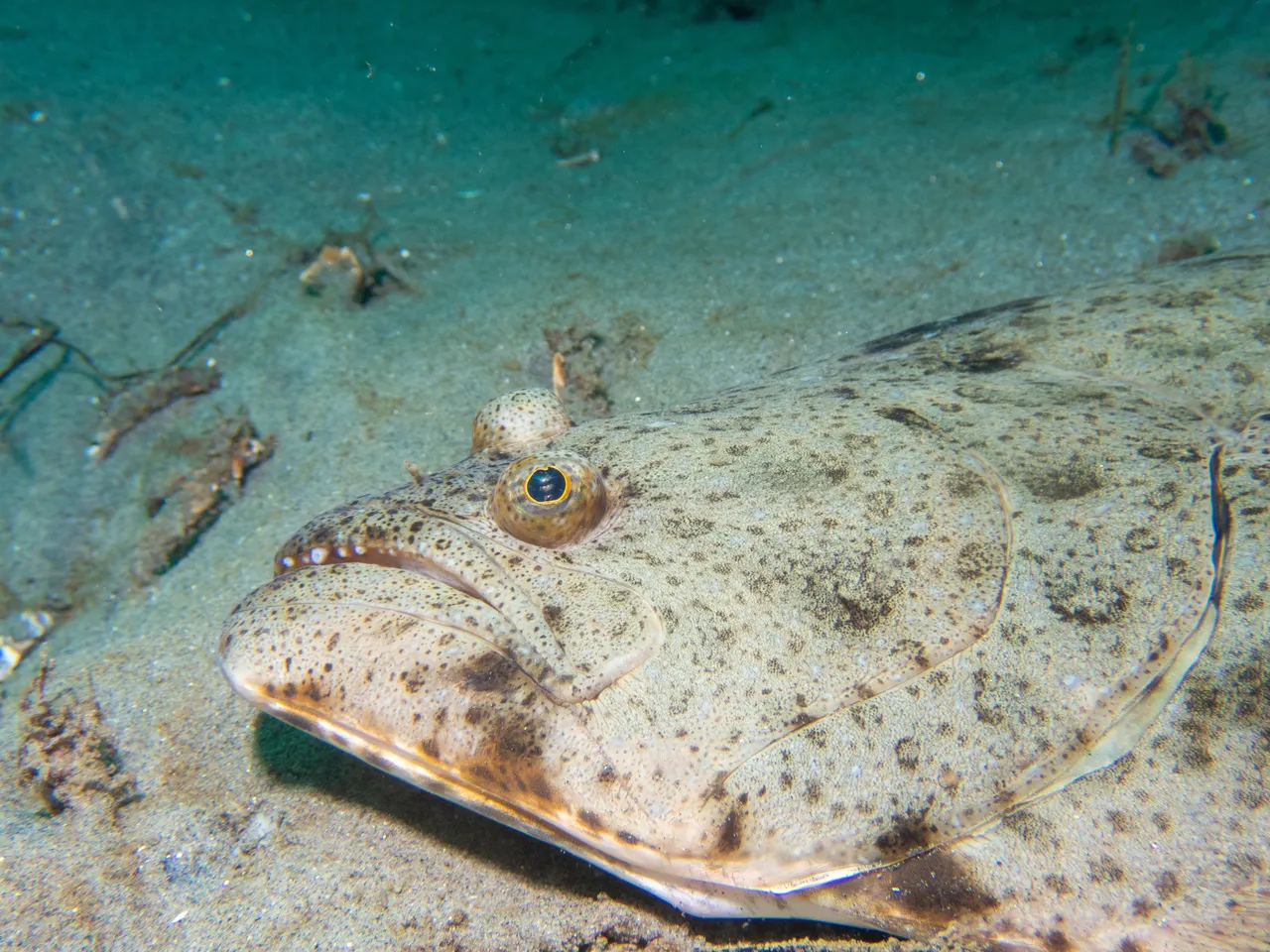
How this was identified, and who took it
Identified by: The record's leading character is fully legible: the mouth is large and oblique and the jaw articulation runs back well past the rear margin of the eye, with sharp canine-like teeth visible along the upper jaw. That separates Paralichthys from the small-mouthed true flounders and from the sanddabs. Both eyes are on the upper surface and the mottled camouflage is intact on an undisturbed fish.Mike Carr — CC BY, via iNaturalist — source, licenceCatching California halibut
Everything here on fishing for it. Each entry opens the page behind it.
California halibut is the principal flatfish target of the American Pacific coast south of the cold-water halibut grounds, and it is a genuinely different animal from the deep-water halibuts of the north — smaller, shallower, and taken over sand from the surf line out to moderate depths.
Its oddity is eye migration. Most flatfish are consistently right-eyed or left-eyed as a species; California halibut is roughly evenly split, so a catch will contain both. That confuses anybody trying to identify it by the usual rule.
It is an active ambush predator rather than a bottom grubber: it lies buried in sand and rises to take anchovies, sardines and squid, and the mouth reflects that — large, oblique and armed with sharp teeth.
How it is caught
- Drift fishingDrifted baits and slow-worked soft plastics, because a static presentation rarely reaches a buried fish.
- GiggingThe same shallow-water night gigging is practised on other flatfish in the same way and for the same reason, and it is separately regulated everywhere it happens.
- SurfcastingDrifted baits and slow-worked soft plastics, because a static presentation rarely reaches a buried fish.
Identification
- Scientific name
- Paralichthys californicus
- Family
- Paralichthyidae
- Water
- Saltwater, Brackish
- Conservation status
- Least Concern
- Regions
- North America
- A large oblique mouth extending back past the eye, armed with sharp canine-like teeth — not the small mouth of a true flounder.
- Eyes on either the left or the right side depending on the individual, which is unusual and rules out identification by side alone.
- A high arch in the lateral line above the pectoral fin.
- Plain to mottled brown upper side over a white blind side, with no bold orange spotting.
Size
- Typical
- 1–4 kg (2.2–8.8 lb)
- Large
- 6–12 kg (13–26 lb)
Exceptional: FishBase records a maximum of 152 cm and 33 kg
A flatfish with a predator's mouth, and why it should never be held in the air
California halibut break the assumption people bring to flatfish, and the assumption is dangerous rather than merely wrong.
MOST FLATFISH ARE SMALL-MOUTHED BOTTOM FEEDERS. Plaice, dab, sole and flounder take worms, molluscs and small crustaceans, and there is nothing in their mouths worth avoiding. Somebody who has handled those and then picks up a California halibut the same way discovers the difference immediately.
A CALIFORNIA HALIBUT IS AN AMBUSH PISCIVORE. It lies buried on sand and takes fish — anchovy, sardine, small surfperch — by launching upward and seizing them, and the mouth is equipped accordingly: large, and carrying rows of sharp, recurved canine-like teeth. It is a predator's mouth on a flatfish's body, and it is the reason this species has a reputation for taking fingers.
AND THE THRASH IS THE OTHER HALF. A flatfish's escape response is a violent full-body flexion, and a large halibut held clear of the ground generates a great deal of force through a body that is essentially one large flat muscle. The injuries in this fishery happen when the two combine: a thrashing fish, held in mid-air, with somebody's hand near the head.
SO THE RULE IS THAT THE FISH IS NEVER HELD IN THE AIR while it is being unhooked. It is controlled against the deck, the sand or the bottom of a net, where its thrashing has nowhere to go, and the hook is removed with a long tool from outside the mouth. A large fish that is being lifted is supported flat and horizontally with both hands underneath, not gripped.
AND THE SKIN MATTERS ON A SAND-CAUGHT FISH. Flatfish carry a mucus layer that is their principal defence against infection, and dry sand strips it off completely. A halibut dragged up a beach and handled with dry hands has lost that layer over a large surface area. Wet hands, wet ground, and back quickly.
What experienced anglers do — why, and the sources (4)
Widely and independently recommended by experienced anglers and specialist sources. This is real angling knowledge, not proof: controlled evidence for it is limited, and FishingHQ records it as convention rather than as a demonstrated effect.
- FishBase: a global information system on fishes — Froese, R. and D. Pauly, eds. — FishBase Consortium (Scientific institute)Relied on for: Morphology, dentition, spination, thermal tolerance, reproductive strategy and depth range recorded for the species.States this directlyPassage read and verified
- The IUCN Red List of Threatened Species — International Union for Conservation of Nature (Conservation authority)Relied on for: Assessment, population trend and the life-history traits — longevity, growth rate, sex structure — that determine a population's sensitivity to the removal of large individuals.Background and mechanism onlyCitation checked — the work exists and is described correctly
- Understanding the Complexity of Catch-and-Release in Recreational Fishing — Reviews in Fisheries Science 15:75–167, 2007 (Scientific literature)Relied on for: The determinants of catch-and-release outcome in recreational fisheries, and the gap between angler belief and measured survival.States this directlyCitation checked — the work exists and is described correctly
- Do we need species-specific guidelines for catch-and-release recreational angling? — Biodiversity and Conservation 14:1195–1209, 2005 (Scientific literature)Relied on for: That air exposure, handling duration and water temperature are the dominant modifiable determinants of post-release survival.States this directlyCitation checked — the work exists and is described correctly
Drifting sand for an ambush flatfish, and why the bait has to move
California halibut methods follow from an unusual fact about the fish: it is a flatfish that hunts actively in the water column rather than waiting on the bottom for something to crawl past.
THE FISH AMBUSHES UPWARD FROM SAND. California halibut bury on sand and mixed bottom in relatively shallow water and attack prey moving above them, taking small fish rather than the worms and molluscs most flatfish live on. That single difference is why the methods look nothing like plaice or sole fishing.
SO THE BAIT OR LURE MUST BE MOVING AND SLIGHTLY OFF THE BOTTOM. Drifting live bait — anchovy, smelt, small baitfish — on a sliding sinker rig so it swims just above the sand is the classic and most effective approach, and the drift is what gives the bait the movement that triggers an attack.
DRIFTING IS THE METHOD RATHER THAN A CONVENIENCE. Halibut are scattered over large areas of apparently featureless sand, so covering ground on a controlled drift is how they are found. Anchoring works only where a specific feature concentrates fish.
SOFT PLASTICS AND SWIMBAITS ON LEADHEADS have become a major approach, bounced and swum along the bottom over sand flats, in bays and along beaches. It is a mobile, light-tackle fishery and it works from shore as well as from a boat.
STRUCTURE EDGES CONCENTRATE THEM even on open sand: the margin between sand and reef, a drop-off, a channel edge, a patch of eelgrass. Halibut position where the sand meets something.
THE HOOK-SET IS THE PART THAT COSTS FISH. A halibut frequently grabs and holds a bait without moving off, and striking immediately pulls the bait out of its mouth. Dropping back and allowing the fish to turn before setting is the practice most experienced anglers use, and it is the opposite of the instinct.
AND SIZE AND BAG LIMITS APPLY AND DIFFER BY AREA, set by the state authority. Undersized fish are common in this fishery, so a measure aboard and a careful release are ordinary requirements rather than refinements.
What experienced anglers do — why, and the sources (2)
Widely and independently recommended by experienced anglers and specialist sources. This is real angling knowledge, not proof: controlled evidence for it is limited, and FishingHQ records it as convention rather than as a demonstrated effect.
- Sea Angler — Bauer Media (Specialist angling publication)Relied on for: Established shore and boat angling practice, including method selection and the reasoning behind it.States this directlyCitation checked — the work exists and is described correctly
- General angling website restatements of established technique — Various (Credible secondary source)Relied on for: The widely restated practice for this species, recorded as a consensus position rather than as an original observation.States this directlyCitation checked — the work exists and is described correctly
Lifecycle and reproduction
Females grow substantially larger and live longer than males; most large halibut are female. Growth is moderate and maturity comes within a few years, which makes the species more resilient than the long-lived reef fishes it shares the coast with.
Spawns in relatively shallow coastal water in spring and summer, broadcasting eggs with no parental care. Juveniles use bays and estuaries as nursery ground, which ties the fishery to the condition of those habitats.
Feeding and senses
An ambush predator that lies buried in sand and rises to take anchovy, sardine, smelt and squid. Prey is taken by a fast upward lunge rather than by grubbing, which is why moving baits and lures outfish static ones.
Hunts by sight from concealment, with both eyes on the upper side giving an upward field of view. Ambush depends on camouflage against sand rather than on stealth in approach.
Through the year
Moves inshore into the surf zone and shallow bays as water warms, and spreads deeper in cold months. The inshore movement is what makes the species available to shore anglers at all.
Distribution
Eastern Pacific: Quillayute River in northern Washington, USA to southern Baja California, Mexico. Also in northern Gulf of California
This is a biological range — where the species occurs, not a prediction that you will catch one. To browse the fishing geography FishingHQ holds, start at fishing places.
Why anglers care
The main Pacific inshore flatfish target, taken on drifted live bait, soft plastics and metal worked slowly over sand from surf, pier and small boat. Its significance is that it puts a large, hard-fighting and excellent-eating fish within reach of shore anglers over featureless ground that holds little else. Drifting is the dominant technique because a stationary bait rarely reaches a buried fish.
Handling and returning
The teeth are sharp and the fish thrashes hard when landed; control it against the ground or in a net rather than holding it clear. Support a large fish horizontally with both hands. Handle sand-caught fish with wet hands to avoid stripping the mucus layer, and return undersized fish promptly.
Going further
- California halibut vs Summer flounder — how to tell them apart.
Safety
Injury while handling fish — Can cause injury needing treatment
The mouth carries sharp canine-like teeth and the fish thrashes violently when landed, which is how most injuries happen.
What reduces it: Use pliers or a dehooker, keep fingers out of the mouth, and pin the fish or use a net rather than gripping it in mid-air.
Where to go next
Similar and related fish
Where it lives
More fish
Not related to this page — just the rest of the section. There is little else joined to this subject yet, and a short page should still lead somewhere.
Sources and evidence
- FishBase: a global information system on fishes — Froese, R. and D. Pauly, eds. — FishBase Consortium (Scientific institute)Relied on for: Family, maximum size, depth and environment, distribution and the IUCN assessment for Paralichthys californicus.States this directlyPassage read and verified
- The IUCN Red List of Threatened Species — International Union for Conservation of Nature (Conservation authority)Relied on for: The Least Concern assessment for Paralichthys californicus, assessed 25 May 2007.States this directlyCitation checked — the work exists and is described correctly
Why the 7 connections on this page are here, and the sources
Similar and related fish
Backed by research — 1 connection
Supported by peer-reviewed research or fisheries science. The sources are listed and can be checked.
Summer flounder
An identification comparison naming both binomials: Paralichthys dentatus and Paralichthys californicus.
- FishBase: a global information system on fishes — Froese, R. and D. Pauly, eds. — FishBase Consortium (Scientific institute)Relied on for: Morphological and distributional data for Paralichthys dentatus and for Paralichthys californicus.States this directlyPassage read and verified
- The IUCN Red List of Threatened Species — International Union for Conservation of Nature (Conservation authority)Relied on for: Separate assessments treating Paralichthys dentatus and Paralichthys californicus as distinct species.States this directlyCitation checked — the work exists and is described correctly
How it is caught
What experienced anglers do — 3 connections
Widely and independently recommended by experienced anglers and specialist sources. This is real angling knowledge, not proof: controlled evidence for it is limited, and FishingHQ records it as convention rather than as a demonstrated effect.
Drift fishing
A practitioner claim about how Paralichthys californicus is commonly fished, following from where and how it feeds.
- General angling website restatements of established technique — Various (Credible secondary source)Relied on for: Widely restated practitioner accounts of fishing for california halibut.Citation checked — the work exists and is described correctly
- Sea Angler — Bauer Media (Specialist angling publication)Relied on for: Practitioner treatment of the methods used for california halibut and comparable species.Citation checked — the work exists and is described correctly
Gigging
Established angling practice for this species, recorded as convention. The note states the property of the animal or its water that makes the method the answer.
- Fishers' Craft and Lettered Art: Tracts on Fishing from the End of the Middle Ages — University of Toronto Press, 1997 (Scientific literature)Relied on for: That fishing practices develop around the fish and water available to them, and the historical method of reading such traditions.Background and mechanism onlyCitation checked — the work exists and is described correctly
- FAO fishing gear types and fishing technology information — Food and Agriculture Organization of the United Nations (Scientific institute)Relied on for: Classification and operation of the gear type described.States this directlyCitation checked — the work exists and is described correctly
Surfcasting
A practitioner claim about how Paralichthys californicus is commonly fished, following from where and how it feeds.
- General angling website restatements of established technique — Various (Credible secondary source)Relied on for: Widely restated practitioner accounts of fishing for california halibut.Citation checked — the work exists and is described correctly
- Sea Angler — Bauer Media (Specialist angling publication)Relied on for: Practitioner treatment of the methods used for california halibut and comparable species.Citation checked — the work exists and is described correctly
Gear for this fish
What experienced anglers do — 1 connection
Widely and independently recommended by experienced anglers and specialist sources. This is real angling knowledge, not proof: controlled evidence for it is limited, and FishingHQ records it as convention rather than as a demonstrated effect.
Soft plastics
A practitioner claim about which lure family answers this species' feeding or holding behaviour.
- General angling website restatements of established technique — Various (Credible secondary source)Relied on for: Widely restated North American lure practice for this species.Background and mechanism onlyCitation checked — the work exists and is described correctly
- IGFA International Angling Rules and World Record Requirements — International Game Fish Association (Angling or fisheries organisation)Relied on for: Recognition of the species as an established sport fish taken on artificial lures, and the tackle conventions used for it.States this directlyPassage read and verified
Where it lives
Backed by research — 2 connections
Supported by peer-reviewed research or fisheries science. The sources are listed and can be checked.
Inshore ground
A habitat association for Paralichthys californicus taken from the environment and distribution data on its FishBase summary.
- FishBase: a global information system on fishes — Froese, R. and D. Pauly, eds. — FishBase Consortium (Scientific institute)Relied on for: The environment, depth range and habitat description recorded for Paralichthys californicus.States this directlyPassage read and verified
Surf beaches
A habitat association for Paralichthys californicus taken from the environment and distribution data on its FishBase summary.
- FishBase: a global information system on fishes — Froese, R. and D. Pauly, eds. — FishBase Consortium (Scientific institute)Relied on for: The environment, depth range and habitat description recorded for Paralichthys californicus.States this directlyPassage read and verified
How FishingHQ labels evidence is explained in the evidence policy.