How to identify california halibut
Paralichthys californicus · Paralichthyidae
The characters that identify california halibut, ranked by how far each one can be trusted on its own.
Safety: injury while handling fish — can cause injury needing treatment.
How this was identified, and who took it
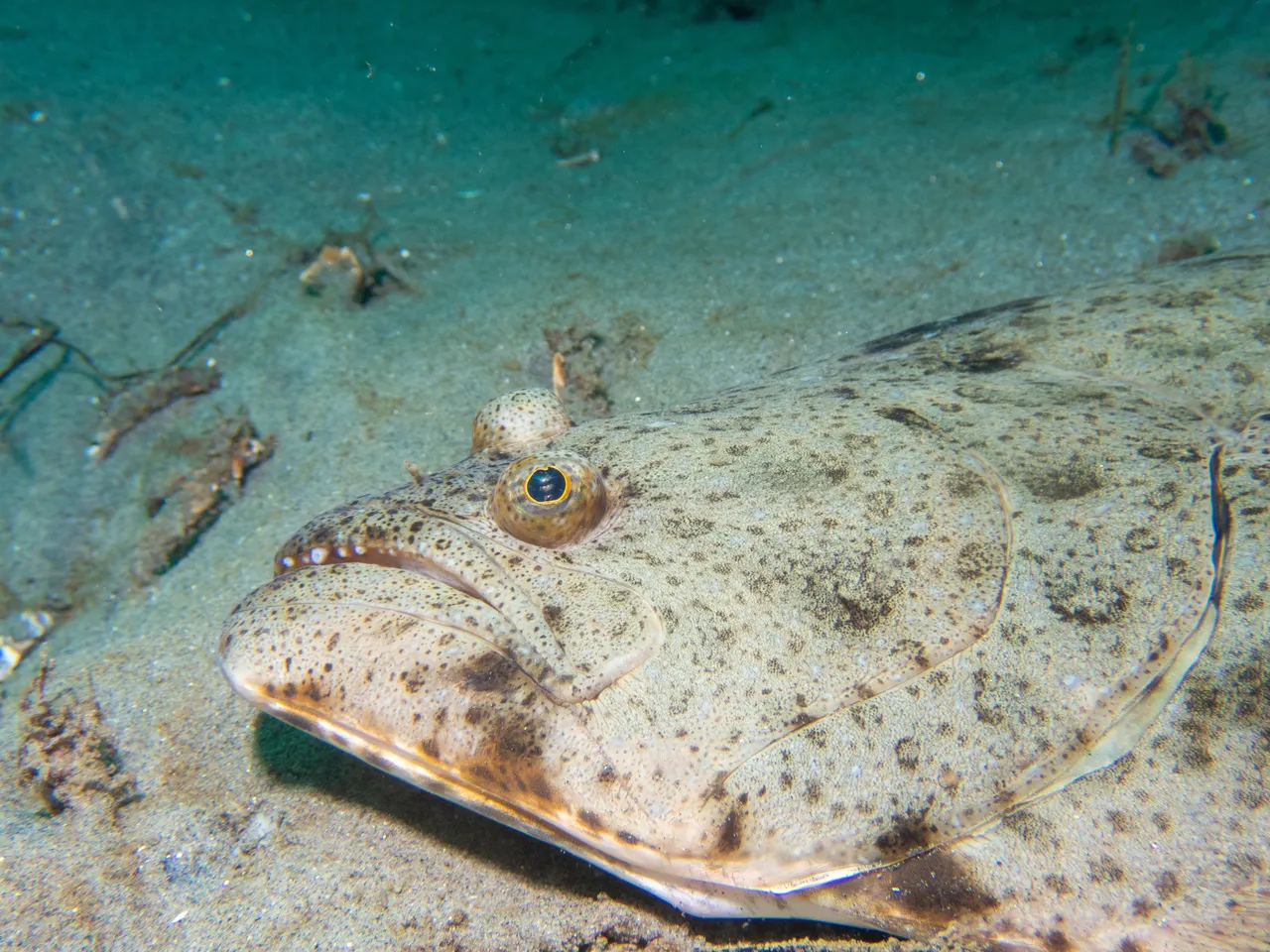
Identified by: The record's leading character is fully legible: the mouth is large and oblique and the jaw articulation runs back well past the rear margin of the eye, with sharp canine-like teeth visible along the upper jaw. That separates Paralichthys from the small-mouthed true flounders and from the sanddabs. Both eyes are on the upper surface and the mottled camouflage is intact on an undisturbed fish.Mike Carr — CC BY, via iNaturalist — source, licenceAbout the image above: The photograph is a head-and-shoulder view; the body aft of the head is outside the frame, so the outline, the lateral line arch and the tail shape cannot be judged from it. It shows the character the page leads on, and nothing else.
Look at this first
Find the corner of the upper jaw and see how far back it sits. On a California halibut it is behind the eye entirely and the gape is armed with sharp canine teeth — the mouth of an ambush predator that eats anchovies, not the small pursed mouth of a flounder that eats worms. Everything else about this fish, including which side its eyes are on, is less reliable than that.
Diagnostic — settles it on its own
Each of these settles the identification on its own. If one is clear, you have your answer.
Jaw hinge running back past the rear edge of the eye
Follow the line of the upper jaw backwards and find the corner. On this fish it sits behind the eye entirely, and the gape is large enough and toothed enough that it is obvious once you look for it. Starry flounder, sanddabs and the true flounders of the same beaches all have mouths that stop well short of the eye. Because it is a relationship between two structures on one head, it survives death, freezing and a bad photograph.
Sharp canine-like teeth in both jaws
The jaws carry distinct, spaced, pointed teeth rather than the fine sandpaper bands or the crushing pads of the bottom-picking flatfishes. A fish that will take a whole bait head-first has the dentition to match. Check it together with the jaw hinge; the two together are conclusive.
Supporting — use with other characters
Real characters that are not conclusive by themselves. Use two or three together.
A high arch in the lateral line over the pectoral fin
The lateral line rises steeply above the pectoral fin before running straight to the tail. It is a good confirming character and it separates this fish from the sanddabs, whose lateral line runs nearly straight. It is easiest to see on a wet fish in good light and it disappears on a dried one.
Suggestive only — varies with condition
Hints only. These vary with condition, season, water and how long the fish has been out of it, and a fish that contradicts them is still the same species.
Eyes on the left OR the right, roughly one in three reversed
This is the character to distrust. Most flatfish species are consistently one-sided and a reader taught that rule will use it. California halibut is not: a substantial minority of individuals are reversed, so a fish with its eyes on the 'wrong' side is not evidence of anything. Note which side yours is and then ignore it.
Plain to mottled brown above with no bold orange spotting
The eyed side is brown, sometimes with pale mottling that the fish can change to match the bottom, and the blind side is white. There is no pattern of strong orange or red spots. That distinguishes it from several Atlantic and European flatfishes but does very little against the Pacific species it actually shares a beach with.
What it gets confused with
- Pacific halibut, a far larger and more northerly fish; the two overlap little, and Pacific halibut has a crescent tail where California halibut's is more nearly straight.
- Speckled sanddab and Pacific sanddab, which are small, have small mouths that stop short of the eye and a nearly straight lateral line.
- Starry flounder, which has bold orange and black bars in the fins and rough star-shaped tubercles in the skin, and whose small mouth settles it at once.
- Diamond turbot and hornyhead turbot of the same surf, both small-mouthed and both separated by the jaw line.
Side by side: California halibut vs Summer flounder.
Where this stops working
The mouth character is reliable at every size, but the fish that a reader most needs to separate from a California halibut is a legal question rather than a biological one, and this page does not answer it: minimum sizes for flatfish vary by state and by season and must come from the current regulations of the relevant fisheries authority. Biologically, hybrids between California halibut and other Paralichthys are not a practical concern, but very small flatfish of several genera are genuinely hard, and a fish under about twenty centimetres should be treated as unresolved unless the jaw line is clearly readable.
The full record
This page covers identification only. The California halibut record covers behaviour, lifecycle, distribution, handling and the sources behind all of it.
Reviewed 2026-08-16.
More about this fish
Telling it apart is one question. Here are the others.
Similar and related fish
How it is caught
- Drift fishingDrifted baits and slow-worked soft plastics, because a static presentation rarely reaches a buried fish.
- GiggingThe same shallow-water night gigging is practised on other flatfish in the same way and for the same reason, and it is separately regulated everywhere it happens.
- SurfcastingDrifted baits and slow-worked soft plastics, because a static presentation rarely reaches a buried fish.
Where it lives
Why the 6 connections on this page are here, and the sources
Similar and related fish
Backed by research — 1 connection
Supported by peer-reviewed research or fisheries science. The sources are listed and can be checked.
Summer flounder
An identification comparison naming both binomials: Paralichthys dentatus and Paralichthys californicus.
- FishBase: a global information system on fishes — Froese, R. and D. Pauly, eds. — FishBase Consortium (Scientific institute)Relied on for: Morphological and distributional data for Paralichthys dentatus and for Paralichthys californicus.States this directlyPassage read and verified
- The IUCN Red List of Threatened Species — International Union for Conservation of Nature (Conservation authority)Relied on for: Separate assessments treating Paralichthys dentatus and Paralichthys californicus as distinct species.States this directlyCitation checked — the work exists and is described correctly
How it is caught
What experienced anglers do — 3 connections
Widely and independently recommended by experienced anglers and specialist sources. This is real angling knowledge, not proof: controlled evidence for it is limited, and FishingHQ records it as convention rather than as a demonstrated effect.
Drift fishing
A practitioner claim about how Paralichthys californicus is commonly fished, following from where and how it feeds.
- General angling website restatements of established technique — Various (Credible secondary source)Relied on for: Widely restated practitioner accounts of fishing for california halibut.Citation checked — the work exists and is described correctly
- Sea Angler — Bauer Media (Specialist angling publication)Relied on for: Practitioner treatment of the methods used for california halibut and comparable species.Citation checked — the work exists and is described correctly
Gigging
Established angling practice for this species, recorded as convention. The note states the property of the animal or its water that makes the method the answer.
- Fishers' Craft and Lettered Art: Tracts on Fishing from the End of the Middle Ages — University of Toronto Press, 1997 (Scientific literature)Relied on for: That fishing practices develop around the fish and water available to them, and the historical method of reading such traditions.Background and mechanism onlyCitation checked — the work exists and is described correctly
- FAO fishing gear types and fishing technology information — Food and Agriculture Organization of the United Nations (Scientific institute)Relied on for: Classification and operation of the gear type described.States this directlyCitation checked — the work exists and is described correctly
Surfcasting
A practitioner claim about how Paralichthys californicus is commonly fished, following from where and how it feeds.
- General angling website restatements of established technique — Various (Credible secondary source)Relied on for: Widely restated practitioner accounts of fishing for california halibut.Citation checked — the work exists and is described correctly
- Sea Angler — Bauer Media (Specialist angling publication)Relied on for: Practitioner treatment of the methods used for california halibut and comparable species.Citation checked — the work exists and is described correctly
Where it lives
Backed by research — 2 connections
Supported by peer-reviewed research or fisheries science. The sources are listed and can be checked.
Inshore ground
A habitat association for Paralichthys californicus taken from the environment and distribution data on its FishBase summary.
- FishBase: a global information system on fishes — Froese, R. and D. Pauly, eds. — FishBase Consortium (Scientific institute)Relied on for: The environment, depth range and habitat description recorded for Paralichthys californicus.States this directlyPassage read and verified
Surf beaches
A habitat association for Paralichthys californicus taken from the environment and distribution data on its FishBase summary.
- FishBase: a global information system on fishes — Froese, R. and D. Pauly, eds. — FishBase Consortium (Scientific institute)Relied on for: The environment, depth range and habitat description recorded for Paralichthys californicus.States this directlyPassage read and verified
Safety
Injury while handling fish — Can cause injury needing treatment
The mouth carries sharp canine-like teeth and the fish thrashes violently when landed, which is how most injuries happen.
What reduces it: Use pliers or a dehooker, keep fingers out of the mouth, and pin the fish or use a net rather than gripping it in mid-air.