How to identify summer flounder
Paralichthys dentatus · Paralichthyidae
The characters that identify summer flounder, ranked by how far each one can be trusted on its own.
Safety: injury while handling fish — can cause injury needing treatment.
How this was identified, and who took it
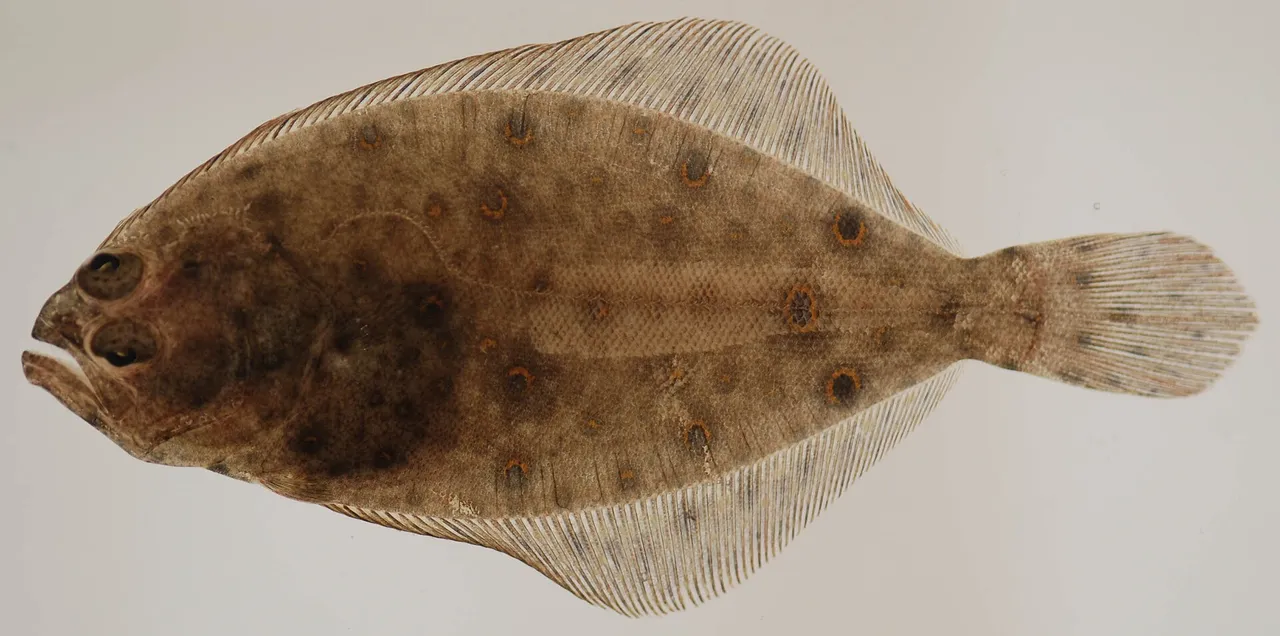
Identified by: A Smithsonian Environmental Research Center voucher at 59 mm standard length, recorded from the Manokin River, Maryland. Both eyes are on the left side, the mouth extends back well past the eye — the character that separates a Paralichthys from a true flounder — and numerous ocellated spots, dark centres in pale rings, are scattered over the upper surface. Unlike many juvenile patterns this one persists into adult fish, so it does not mislead a reader holding a larger fish.Robert Aguilar, Smithsonian Environmental Research Center — CC BY 2.0, via Wikimedia Commons — source, licenceAbout the image above: The photograph is a laboratory voucher of a fish about 59 mm long, so the scale is nothing like a fish you would keep. The ocellated spotting shown persists into adult fish, which is why the small specimen is still the right picture to work from.
Look at this first
Put the fish dark side up with the head towards you and see which side the eyes are on. Summer flounder are left-eyed, and the mouth runs back past the eye and is full of teeth. A big toothy mouth on a left-eyed flatfish is most of the identification in one glance.
Diagnostic — settles it on its own
Each of these settles the identification on its own. If one is clear, you have your answer.
Left-eyed, with a large toothed mouth
Both eyes sit on the left side when the fish is viewed with the dorsal edge uppermost, and the jaw hinge is behind the rear margin of the eye. The mouth carries obvious sharp teeth. Winter flounder — the other common flatfish of the same water — is right-eyed with a small mouth that would not admit a finger, so the two characters agree and settle it together.
Supporting — use with other characters
Real characters that are not conclusive by themselves. Use two or three together.
Scattered ocellated spots
The upper surface carries numerous eyespots — a dark centre inside a pale ring — spread over the body and out onto the fin margins. Unlike most juvenile markings these persist into adult fish. They vary in contrast because the fish matches itself to the bottom, but the arrangement is there whatever the intensity.
A nearly straight lateral line
Trace the lateral line forward from the tail. In summer flounder it runs almost straight along the flank with only a shallow rise over the pectoral. Several other Paralichthys carry a pronounced high arch there, and where two flatfish of similar pattern are in question the line is the tie-breaker.
Suggestive only — varies with condition
Hints only. These vary with condition, season, water and how long the fish has been out of it, and a fish that contradicts them is still the same species.
Rapid pattern change
Watched in a bucket or over sand, the fish alters both its tone and the contrast of its spotting within a minute or two to match what it is lying on. That behaviour is a good sign you have a Paralichthys and a warning not to identify it on the shade of its back.
What it gets confused with
- Winter flounder, right-eyed with a small toothless-looking mouth — the two characters are opposite, so a single look settles it.
- Southern flounder, also left-eyed and toothy but without the distinct ocellated spots; where the ranges overlap this is the genuinely hard pair.
- Windowpane flounder, thin and translucent with a much rounder outline and a differently placed dorsal fin origin.
Side by side: Summer flounder vs California halibut.
Where this stops working
Left-eyed and right-eyed is a reliable rule with known exceptions: reversed individuals occur in most flatfish populations at low frequency, so a right-eyed fish with a big toothed mouth is more likely a reversed summer flounder than a winter flounder with the wrong mouth. Southern flounder is the real difficulty where the two meet, and the separation there rests on the presence of the ocelli, which are variable. Summer flounder is size-limited and bag-limited everywhere it is fished recreationally, and both limits change between states and between years, so verify the current rules with the responsible authority before retaining one.
The full record
This page covers identification only. The Summer flounder record covers behaviour, lifecycle, distribution, handling and the sources behind all of it.
Reviewed 2026-08-15.
More about this fish
Telling it apart is one question. Here are the others.
Similar and related fish
How it is caught
- Drift fishingDrifted bucktails and bait strips, because movement is what triggers the strike.
- GiggingFlounder gigging works because the fish lies buried and still on sand in shallow water at night and does not flee a light. That is the whole method: the animal's ambush strategy is exactly what makes it takeable by hand-held spear in the shallows.
- SurfcastingDrifted bucktails and bait strips, because movement is what triggers the strike.
Where it lives
Why the 6 connections on this page are here, and the sources
Similar and related fish
Backed by research — 1 connection
Supported by peer-reviewed research or fisheries science. The sources are listed and can be checked.
California halibut
An identification comparison naming both binomials: Paralichthys dentatus and Paralichthys californicus.
- FishBase: a global information system on fishes — Froese, R. and D. Pauly, eds. — FishBase Consortium (Scientific institute)Relied on for: Morphological and distributional data for Paralichthys dentatus and for Paralichthys californicus.States this directlyPassage read and verified
- The IUCN Red List of Threatened Species — International Union for Conservation of Nature (Conservation authority)Relied on for: Separate assessments treating Paralichthys dentatus and Paralichthys californicus as distinct species.States this directlyCitation checked — the work exists and is described correctly
How it is caught
What experienced anglers do — 3 connections
Widely and independently recommended by experienced anglers and specialist sources. This is real angling knowledge, not proof: controlled evidence for it is limited, and FishingHQ records it as convention rather than as a demonstrated effect.
Drift fishing
A practitioner claim about how Paralichthys dentatus is commonly fished, following from where and how it feeds.
- General angling website restatements of established technique — Various (Credible secondary source)Relied on for: Widely restated practitioner accounts of fishing for summer flounder.Citation checked — the work exists and is described correctly
- Sea Angler — Bauer Media (Specialist angling publication)Relied on for: Practitioner treatment of the methods used for summer flounder and comparable species.Citation checked — the work exists and is described correctly
Gigging
Established angling practice for this species, recorded as convention. The note states the property of the animal or its water that makes the method the answer.
- Fishers' Craft and Lettered Art: Tracts on Fishing from the End of the Middle Ages — University of Toronto Press, 1997 (Scientific literature)Relied on for: That fishing practices develop around the fish and water available to them, and the historical method of reading such traditions.Background and mechanism onlyCitation checked — the work exists and is described correctly
- FAO fishing gear types and fishing technology information — Food and Agriculture Organization of the United Nations (Scientific institute)Relied on for: Classification and operation of the gear type described.States this directlyCitation checked — the work exists and is described correctly
Surfcasting
A practitioner claim about how Paralichthys dentatus is commonly fished, following from where and how it feeds.
- General angling website restatements of established technique — Various (Credible secondary source)Relied on for: Widely restated practitioner accounts of fishing for summer flounder.Citation checked — the work exists and is described correctly
- Sea Angler — Bauer Media (Specialist angling publication)Relied on for: Practitioner treatment of the methods used for summer flounder and comparable species.Citation checked — the work exists and is described correctly
Where it lives
Backed by research — 2 connections
Supported by peer-reviewed research or fisheries science. The sources are listed and can be checked.
Inshore ground
A habitat association for Paralichthys dentatus taken from the environment and distribution data on its FishBase summary.
- FishBase: a global information system on fishes — Froese, R. and D. Pauly, eds. — FishBase Consortium (Scientific institute)Relied on for: The environment, depth range and habitat description recorded for Paralichthys dentatus.States this directlyPassage read and verified
Surf beaches
A habitat association for Paralichthys dentatus taken from the environment and distribution data on its FishBase summary.
- FishBase: a global information system on fishes — Froese, R. and D. Pauly, eds. — FishBase Consortium (Scientific institute)Relied on for: The environment, depth range and habitat description recorded for Paralichthys dentatus.States this directlyPassage read and verified
Safety
Injury while handling fish — Can cause injury needing treatment
The mouth carries numerous sharp teeth and the fish thrashes violently when boated, which is when most injuries occur.
What reduces it: Use pliers or a dehooker, keep fingers out of the mouth, and pin the fish or use a net rather than gripping it in mid-air.