How to identify rainbow trout
Oncorhynchus mykiss · Salmonidae
The characters that identify rainbow trout, ranked by how far each one can be trusted on its own.
Safety: biosecurity and disease transfer — can cause serious injury or death. One more point applies here.
How this was identified, and who took it
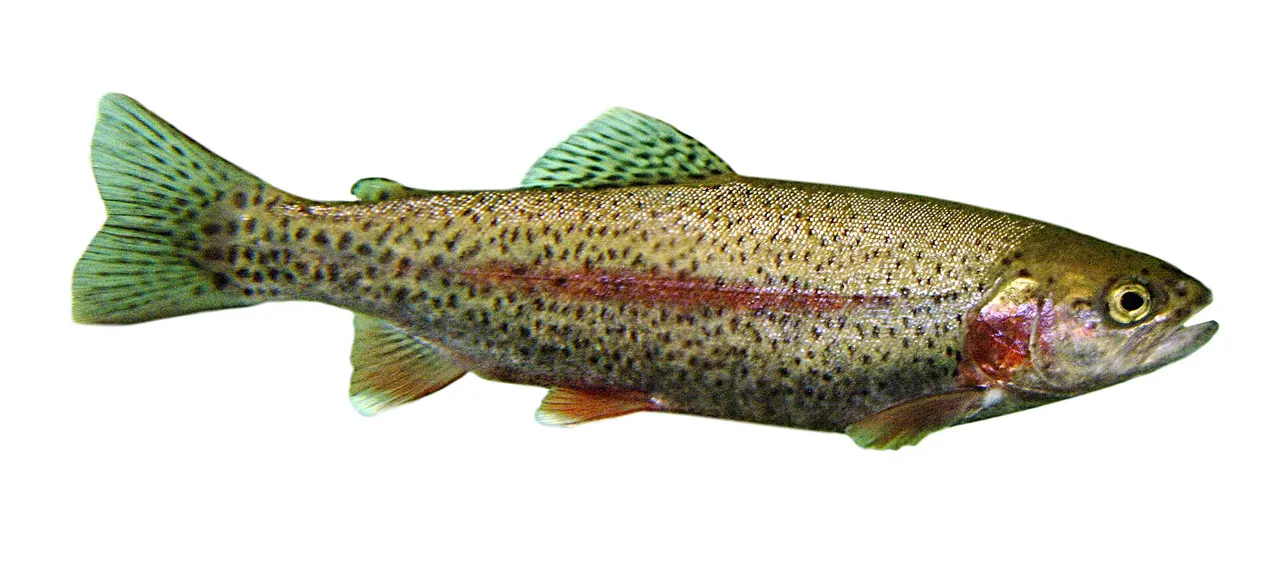
Identified by: Complete lateral view with every diagnostic character legible: the broad pink to red lateral band, heavy black spotting extending onto the dorsal and caudal fins, the adipose fin, and the blunt salmonid head. Nothing is obscured and the fish is whole.Jonathunder — CC BY-SA 3.0, via Wikimedia Commons — source, licenceLook at this first
Look at the tail. A rainbow trout carries small black spots right across it; a brown trout's tail is generally clean. That works on a silver sea-run fish where the pink band has gone, which is exactly when the identification is difficult.
Diagnostic — settles it on its own
Each of these settles the identification on its own. If one is clear, you have your answer.
Black spots on the tail
Small dark spots scattered over the caudal fin as well as the back and flanks. Brown trout generally has none there. This is the character to use when the flank band is absent, and it is present at every size and life stage.
Supporting — use with other characters
Real characters that are not conclusive by themselves. Use two or three together.
No red or orange spots anywhere
Rainbow trout carry black spotting only, so a single haloed red spot means you are holding a brown trout instead. The inference runs in one direction: finding a red spot is conclusive against rainbow, while finding none is not conclusive for it, because sea-run brown trout lose them too.
An adipose fin
Present, as in every salmonid. On stocked fish it is sometimes clipped as a hatchery mark, which is itself worth noticing — a clipped adipose says the fish was reared.
Suggestive only — varies with condition
Hints only. These vary with condition, season, water and how long the fish has been out of it, and a fish that contradicts them is still the same species.
A broad pink band along the flank
The character the fish is named for and the one to trust least. It is strong in freshwater residents and in spawning fish, and close to invisible in fresh-run sea-going steelhead. A rainbow with no pink is still a rainbow.
What it gets confused with
- Brown trout, in any water stocked with both. Tail spotting and the absence of red spots.
- Steelhead, which is the same species in its sea-run form and not a separate fish.
- Cutthroat trout in western North America, where the two hybridise freely and the red throat slash is the character to look for.
Side by side: Rainbow trout vs Brown trout, Rainbow trout vs Chinook salmon, Rainbow trout vs Cutthroat trout.
Where this stops working
Where rainbow and cutthroat trout occur together they hybridise extensively, and a hybrid can carry a faint throat slash and rainbow spotting at once — that identification cannot be settled visually and is a genuine conservation problem rather than an angler's inconvenience. Recently stocked fish may have worn fins and faded colour that make everything except the tail spotting unreliable.
The full record
This page covers identification only. The Rainbow trout record covers behaviour, lifecycle, distribution, handling and the sources behind all of it.
Reviewed 2026-08-13.
More about this fish
Telling it apart is one question. Here are the others.
Similar and related fish
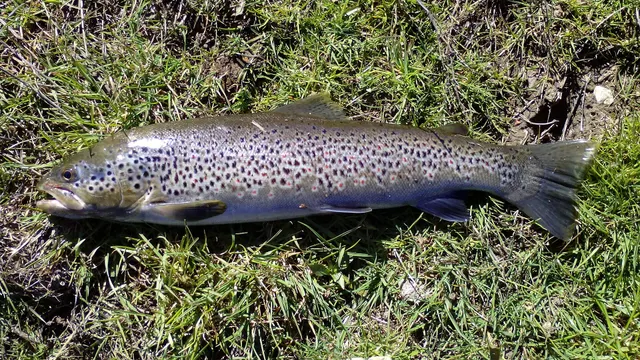 Brown troutBoth are salmonids of the same broad group and are constantly confused. The separation is simple once known: rainbows are spotted on the tail and have no red spots; brown trout have red spots and a clean tail.
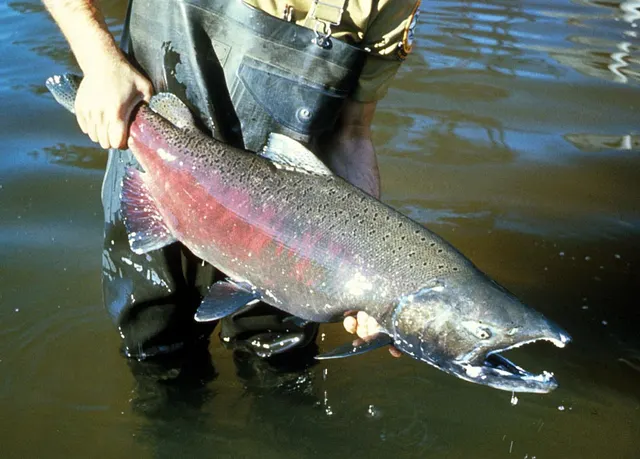 Chinook salmonCongeners in the genus Oncorhynchus. The difference that matters is that chinook is semelparous and dies after spawning while rainbow trout is not — the same genus, two entirely different life strategies.
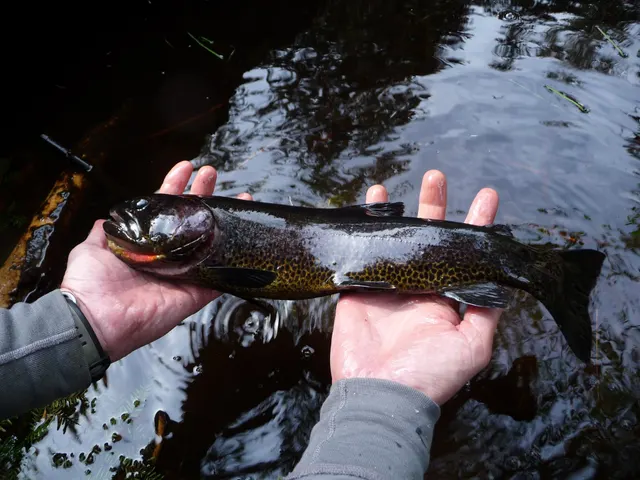 Cutthroat troutCongeners that hybridise readily and produce fertile offspring, which is why introduced rainbows swamp native cutthroat genetically rather than out-competing them.
How it is caught
- Float-tube fishingA float tube puts a fly angler afloat on a small stillwater with a draught of nothing and no wake, which reaches the open-water fish a bank angler cannot cover and does not push them the way a boat does.
- NymphingStillwater rainbows feed heavily on buzzer pupae and other subsurface invertebrates, and imitative nymph fishing at a set depth answers that directly.
- SpinningThe principal non-fly approach on stocked waters and on rivers where rainbows have naturalised, where fishery rules permit it.
- Stillwater fly fishingThe reservoir and small-fishery method the species is stocked for. Rainbows cruise open water rather than holding stations, so the fly is fished to a moving fish at a controlled depth rather than to a lie.
Where it lives
- ReservoirsThe stocked species most British stillwater trout fishing is built on, feeding on open-water items rather than the marginal life drawdown prevents.
- Tailwaters below damsCold, thermally stable dam releases support rainbow trout well outside the latitudes and altitudes that would otherwise hold them, and the dense invertebrate populations of those reaches grow fish quickly.
Where you will find it
- AlaskaResident populations in the salmon drainages reach exceptional size on a diet of salmon eggs and flesh, which is the basis of the state's trout fishery.
- CyprusStocked in the higher and colder Troodos reservoirs, which is the only cold-water fishing on the island and the only part of it that a visitor would recognise as game fishing.
- Mauritius and RéunionIntroduced into the upland streams of Réunion, which is high, wet and steep enough to hold permanent cold rivers — a combination almost no other Indian Ocean island has.
- PatagoniaEstablished across the region's rivers and lakes following deliberate stocking, and self-sustaining in most of them.
- The English trout reservoirsThe principal stocked species of these fisheries, growing fast on the enormous daphnia, buzzer and fry production of nutrient-rich water. A fish that has been in a season is a different animal from the one that went in.
- The Great LakesPresent as lake-run steelhead, feeding in open water and ascending tributaries, and supporting a major seasonal river fishery.
- The Himalayan mahseer riversStocked into the same cold upper tributaries as brown trout and persisting in several of them.
- The Pacific Northwest coastPresent as native steelhead, whose sea-run populations are of high conservation concern across much of this coast.
1 more
- The Soča and Slovenia's Adriatic rivers Fishing regions
Why the 18 connections on this page are here, and the sources
Similar and related fish
Backed by research — 3 connections
Supported by peer-reviewed research or fisheries science. The sources are listed and can be checked.
Brown trout
A taxonomic and identification comparison, naming both scientific names so there is no ambiguity about which animals are being compared.
- FishBase: a global information system on fishes — Froese, R. and D. Pauly, eds. — FishBase Consortium (Scientific institute)Relied on for: That Oncorhynchus mykiss is a Salmonidae native to Pacific drainages of North America and eastern Asia and introduced worldwide.States this directlyPassage read and verified
- The Fishes of the British Isles and North-West Europe — Macmillan, 1969 (Reference work)Relied on for: The morphological separation of Salmo trutta from introduced Oncorhynchus mykiss by spotting pattern and tail markings.States this directlyCitation checked — the work exists and is described correctly
Chinook salmon
A taxonomic claim naming both binomials, with the life-history contrast being the useful content.
- FishBase: a global information system on fishes — Froese, R. and D. Pauly, eds. — FishBase Consortium (Scientific institute)Relied on for: That Oncorhynchus mykiss and Oncorhynchus tshawytscha are congeners in the genus Oncorhynchus, the Pacific salmon and trout.States this directlyPassage read and verified
Cutthroat trout
A comparison whose substance is the hybridisation, which is the species' principal conservation problem.
- FishBase: a global information system on fishes — Froese, R. and D. Pauly, eds. — FishBase Consortium (Scientific institute)Relied on for: That Oncorhynchus clarkii and Oncorhynchus mykiss are congeners in the genus Oncorhynchus with overlapping western North American ranges.States this directlyPassage read and verified
- Check Clean Dry — biosecurity guidance for water users — GB Non-native Species Secretariat (Conservation authority)Relied on for: That hybridisation with introduced congeners is a recognised harm in the assessment of non-native fish.FishingHQ's interpretation of what it saysPassage read and verified
How it is caught
What experienced anglers do — 4 connections
Widely and independently recommended by experienced anglers and specialist sources. This is real angling knowledge, not proof: controlled evidence for it is limited, and FishingHQ records it as convention rather than as a demonstrated effect.
Float-tube fishing
Established angling practice for this species, recorded as convention. The note states the property of the animal or its water that makes the method the answer.
- Still Water Fly-Fishing — Andre Deutsch, 1952 (Specialist angling publication)Relied on for: Still-water fly technique and the feeding behaviour it is built on.States this directlyCitation checked — the work exists and is described correctly
- Trout & Salmon — Bauer Media (Specialist angling publication)Relied on for: Contemporary still-water fly practice.Background and mechanism onlyCitation checked — the work exists and is described correctly
Nymphing
Established angling practice for this species, recorded as convention. The note states the property of the animal or its water that makes the method the answer.
- Still Water Fly-Fishing — Andre Deutsch, 1952 (Specialist angling publication)Relied on for: Still-water fly technique and the feeding behaviour it is built on.States this directlyCitation checked — the work exists and is described correctly
- Trout & Salmon — Bauer Media (Specialist angling publication)Relied on for: Contemporary still-water fly practice.Background and mechanism onlyCitation checked — the work exists and is described correctly
Spinning
Established angling practice for this species, recorded as convention. The note states the property of the animal or its water that makes the method the answer.
- Trout & Salmon — Bauer Media (Specialist angling publication)Relied on for: Established salmonid angling technique and its application to this species.States this directlyCitation checked — the work exists and is described correctly
- General angling website restatements of established technique — Various (Credible secondary source)Relied on for: Widely restated practice connecting this species and method.Background and mechanism onlyCitation checked — the work exists and is described correctly
Stillwater fly fishing
Established angling practice for this species, recorded as convention. The note states the property of the animal or its water that makes the method the answer.
- Still Water Fly-Fishing — Andre Deutsch, 1952 (Specialist angling publication)Relied on for: Still-water fly technique and the feeding behaviour it is built on.States this directlyCitation checked — the work exists and is described correctly
- Trout & Salmon — Bauer Media (Specialist angling publication)Relied on for: Contemporary still-water fly practice.Background and mechanism onlyCitation checked — the work exists and is described correctly
Where it lives
Backed by research — 2 connections
Supported by peer-reviewed research or fisheries science. The sources are listed and can be checked.
Reservoirs
Habitat association recorded for the species, in an environment FishingHQ describes on its own page.
- Freshwater Fishes of the British Isles — HarperCollins (New Naturalist 75), 1992 (Reference work)Relied on for: Habitat association and distribution of European freshwater fishes, including occurrence in artificial and modified waters.States this directlyCitation checked — the work exists and is described correctly
- FishBase: a global information system on fishes — Froese, R. and D. Pauly, eds. — FishBase Consortium (Scientific institute)Relied on for: Habitat association, depth range and water-type tolerance recorded for the species.States this directlyPassage read and verified
Tailwaters below dams
A claim that a species occupies an engineered habitat outside its natural thermal range, resting on documented distribution rather than on angling report.
- FishBase: a global information system on fishes — Froese, R. and D. Pauly, eds. — FishBase Consortium (Scientific institute)Relied on for: Recorded depth range, temperature tolerance and habitat association for the species outside north-west Europe.States this directlyPassage read and verified
- The IUCN Red List of Threatened Species — International Union for Conservation of Nature (Conservation authority)Relied on for: Global conservation assessment, range and recorded threats for the species.States this directlyCitation checked — the work exists and is described correctly
Where you will find it
Backed by research — 9 connections
Supported by peer-reviewed research or fisheries science. The sources are listed and can be checked.
Alaska
A distribution association between an animal and a kind of water, rather than a claim about any named mark.
- FishBase: a global information system on fishes — Froese, R. and D. Pauly, eds. — FishBase Consortium (Scientific institute)Relied on for: Distribution, habitat association and depth range recorded for the species, including its occurrence in the water body concerned.States this directlyPassage read and verified
- The IUCN Red List of Threatened Species — International Union for Conservation of Nature (Conservation authority)Relied on for: Assessment and range account for the species, including the systems and coasts it occupies.Background and mechanism onlyCitation checked — the work exists and is described correctly
Cyprus
A distribution edge resting on published regional identification and distribution references, written where the species is genuinely characteristic of the destination's fishing rather than merely recorded from its waters.
- FAO Species Identification Guides for Fishery Purposes and the FAO Species Catalogues — Food and Agriculture Organization of the United Nations (Scientific institute)Relied on for: Distribution, habitat association and biology of the fishes of the eastern central Atlantic and the Mediterranean, from the regional identification guides prepared for fishery purposes.States this directlyCitation checked — the work exists and is described correctly
- FishBase: a global information system on fishes — Froese, R. and D. Pauly, eds. — FishBase Consortium (Scientific institute)Relied on for: Recorded environment, depth range, distribution and biology of the species named.States this directlyPassage read and verified
Mauritius and Réunion
That a species occurs in these waters, drawn from distribution science. It is a statement about where the animal lives and is not a statement that anybody will catch one, still less where.
- FishBase: a global information system on fishes — Froese, R. and D. Pauly, eds. — FishBase Consortium (Scientific institute)Relied on for: Recorded distribution, habitat association and life history of the freshwater species named, including introduced populations where those are recorded.States this directlyPassage read and verified
- The Flood Pulse Concept in River-Floodplain Systems — Canadian Special Publication of Fisheries and Aquatic Sciences 106, Department of Fisheries and Oceans, Ottawa, 1989 (Scientific literature)Relied on for: That in tropical river-floodplain systems the seasonal flood pulse organises fish movement and production, which is the basis for stating where and when a species is available.Background and mechanism onlyCitation checked — the work exists and is described correctly
Patagonia
A distribution association between an animal and a kind of water, rather than a claim about any named mark.
- The IUCN Red List of Threatened Species — International Union for Conservation of Nature (Conservation authority)Relied on for: Assessment and habitat account for the species, including the river or lake system it occupies and the pressures acting on it.States this directlyCitation checked — the work exists and is described correctly
- FishBase: a global information system on fishes — Froese, R. and D. Pauly, eds. — FishBase Consortium (Scientific institute)Relied on for: Distribution, habitat association, size and life history recorded for the species in the system concerned.States this directlyPassage read and verified
The English trout reservoirs
A claim that a place contains the ground, water and seasonal conditions the species is associated with. It is a distributional statement about the world, it rests on the regional reference literature, and it deliberately asserts nothing about access, permission or catch.
- Freshwater Fishes of the British Isles — HarperCollins (New Naturalist 75), 1992 (Reference work)Relied on for: Distribution, ecology and conservation status of the freshwater fishes of the British Isles, including in artificial and modified waters.States this directlyCitation checked — the work exists and is described correctly
- Environment Agency fisheries management, byelaws and rod licensing information — Environment Agency (Government fisheries body)Relied on for: Fisheries monitoring, water quality and species distribution in English rivers, canals and still waters.States this directlyCitation checked — the work exists and is described correctly
The Great Lakes
Occurrence of the species in this system or along this coast: a statement about the animal's distribution, not a venue recommendation.
- FishBase: a global information system on fishes — Froese, R. and D. Pauly, eds. — FishBase Consortium (Scientific institute)Relied on for: Distribution, salinity tolerance and habitat association recorded for the species, including its occurrence in this system.States this directlyPassage read and verified
- The IUCN Red List of Threatened Species — International Union for Conservation of Nature (Conservation authority)Relied on for: Assessment and range description for the species, including the waters in which it occurs.Background and mechanism onlyCitation checked — the work exists and is described correctly
The Himalayan mahseer rivers
A distribution association between an animal and a kind of water, rather than a claim about any named mark.
- The IUCN Red List of Threatened Species — International Union for Conservation of Nature (Conservation authority)Relied on for: Assessment and habitat account for the species, including the river or lake system it occupies and the pressures acting on it.States this directlyCitation checked — the work exists and is described correctly
- FishBase: a global information system on fishes — Froese, R. and D. Pauly, eds. — FishBase Consortium (Scientific institute)Relied on for: Distribution, habitat association, size and life history recorded for the species in the system concerned.States this directlyPassage read and verified
The Pacific Northwest coast
Occurrence of the species in this system or along this coast: a statement about the animal's distribution, not a venue recommendation.
- FishBase: a global information system on fishes — Froese, R. and D. Pauly, eds. — FishBase Consortium (Scientific institute)Relied on for: Distribution, salinity tolerance and habitat association recorded for the species, including its occurrence in this system.States this directlyPassage read and verified
- The IUCN Red List of Threatened Species — International Union for Conservation of Nature (Conservation authority)Relied on for: Assessment and range description for the species, including the waters in which it occurs.Background and mechanism onlyCitation checked — the work exists and is described correctly
The Soča and Slovenia's Adriatic rivers
A distributional claim about where a species occurs, which is a claim about the world and rests on the reference literature rather than on angling report.
- FishBase: a global information system on fishes — Froese, R. and D. Pauly, eds. — FishBase Consortium (Scientific institute)Relied on for: Distribution, habitat association and life history recorded for the species.States this directlyPassage read and verified
- The IUCN Red List of Threatened Species — International Union for Conservation of Nature (Conservation authority)Relied on for: Global conservation assessment, range and recorded threats for the species.States this directlyCitation checked — the work exists and is described correctly
Safety
Biosecurity and disease transfer — Can cause serious injury or death
Introduced rainbow trout compete with and prey on native fish, and are documented as a pressure on native species across several continents. Live movement of fish and of water between systems is how it spreads.
What reduces it: Never move live fish or water between waters. Clean, drain, dry and check equipment between waters — this species in particular is associated with the spread of pathogens through stocking and equipment. Where the fish is non-native, establish the local requirement rather than assuming it should be returned.
Fish welfare — Can cause injury needing treatment
Released trout survive poorly in warm water, and a fish played hard and handled in water above about 20 degrees frequently dies after apparently swimming away.
What reduces it: Stop fishing when the water is too warm rather than fishing more carefully. Play fish quickly, keep them in the water, use barbless hooks and revive properly before release.