What does rainbow trout eat?
What is established about how rainbow trout feeds, kept separate from what anglers infer from it.
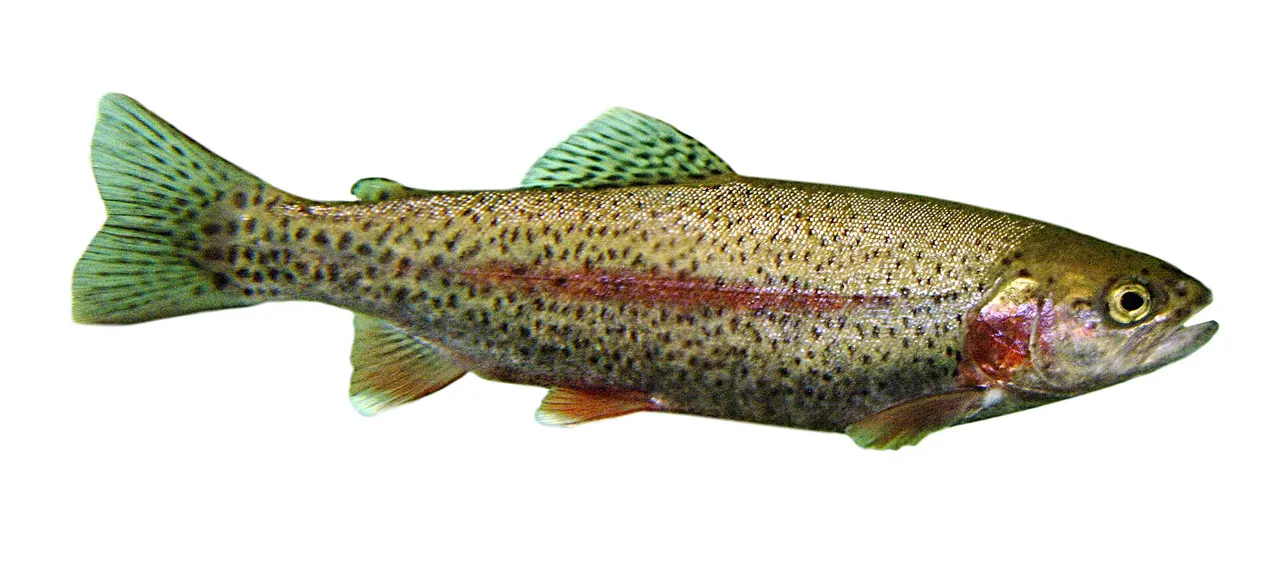
How this was identified, and who took it
Identified by: Complete lateral view with every diagnostic character legible: the broad pink to red lateral band, heavy black spotting extending onto the dorsal and caudal fins, the adipose fin, and the blunt salmonid head. Nothing is obscured and the fish is whole.Jonathunder — CC BY-SA 3.0, via Wikimedia Commons — source, licenceWhat is known about how it feeds
The rainbow trout has been moved to every continent except Antarctica, and one consequence is that its diet is a description of wherever it has been put rather than of anywhere in particular.
In its stream form the pattern is the salmonid one: a feeding station held in current, drifting invertebrates intercepted, and an energy calculation that decides how far the fish will move for what. The verified relationship — aquatic insect larvae at group level — is the staple of that life.
In lakes the fish patrols rather than holds. In large systems with forage fish it becomes piscivorous. In the sea-run steelhead form it feeds at sea like a salmon and stops on entering fresh water. These are the same species with four feeding ecologies.
The stream diet is where the verified relationship sits, and mayfly, caddis, stonefly and midge larvae dominate it across the range.
The introduction history has a second consequence worth stating on a diet page: where rainbow trout have been stocked outside their native range they compete with and prey on native fish, and the effect on native galaxiids, cutthroat trout and other species is well documented. The diet is part of a conservation problem in several countries.
Stocked fish complicate any account further. A recently stocked rainbow has been eating pellets and takes some time to switch to natural food, which is a real dietary state and one no relationship models.
The food
Prey with a verified dietary link to this fish. Each entry carries its own evidence, and each is written at the precision the source actually used: a named species where the source named one, a group or food category where it said “polychaetes”, “crustaceans” or “detritus” and meant it. That is why this list is shorter than the animal’s real diet rather than longer.
- Aquatic insect larvae as prey — a group rather than a species: the evidence names the group
Aquatic insect larvae are the staple of stream rainbow trout, and the fish's position in the current is chosen to intercept the drift carrying them.
Food with no page of its own here yet
These are real components of the diet, listed as plain text because FishingHQ has no page for them yet. Inventing pages to make the list look fuller would be the fabrication this whole approach exists to prevent.
- terrestrial insects
- freshwater shrimp
- small fish, in large individuals
- fish eggs
- snails
- hatchery pellets, in recently stocked fish
What anglers do with this
Everything below is interpretation, not finding. It is what experienced anglers conclude from the biology above, and the reasoning is usually sound and almost never tested. It is separated from the biology deliberately.
The drift economics is the basis of stream tactics, as it is for every stream salmonid, and the reasoning is the same.
The stocked-fish complication is the practically important one and anglers discuss it openly: a recently introduced fish behaves and feeds differently from a resident one, and approaches that work on one frequently fail on the other. That is observation rather than a studied effect.
The lake and sea-run forms require entirely different approaches, and treating the species as one angling problem is the commonest error made with it.
Where rainbow trout are introduced, the conservation position is a matter for the relevant fisheries authority, and in several countries moving live fish between waters is prohibited.
What this does not establish
One group-level relationship for a species with at least four distinct feeding ecologies across a global introduced range. It describes stream-resident fish and says nothing about lake, piscivorous or sea-run forms. Nothing here establishes proportions or describes a particular water.
Where this connects
These are the baits, lures, methods and explainers FishingHQ already joins to this fish — which is why the list is sometimes short. They are not chosen for this page, and a link here means an evidenced relationship exists, not that it follows from the diet.
Methods used for it
Where it lives
The science behind the feeding
This page covers feeding. The Rainbow trout record covers identification, lifecycle, seasonal behaviour, handling and the sources behind all of it.
Reviewed 2026-08-12.