What does atlantic salmon eat?
What is established about how atlantic salmon feeds, kept separate from what anglers infer from it.
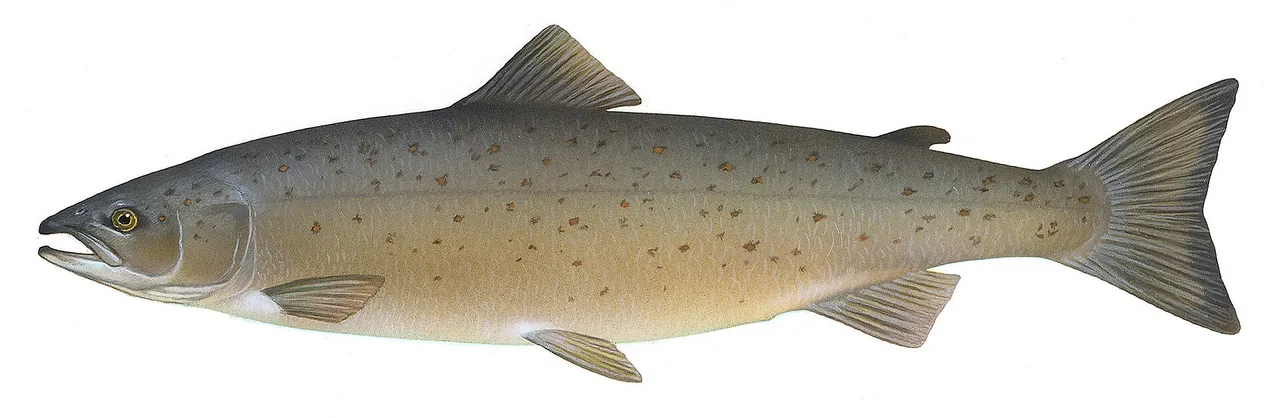
How this was identified, and who took it
Identified by: Sparse dark spotting concentrated above the lateral line with no red spots, an adipose fin, a slim caudal wrist and a pointed head — the standard separation from brown trout.Knepp, Timothy, Public domain, via Wikimedia Commons — source, licenceWhat is known about how it feeds
A salmon's diet has two phases and one of them is not eating at all.
At sea, essentially all of the animal's growth occurs, and it occurs quickly: a fish that left fresh water at a few tens of grams returns weighing kilograms. FishingHQ's two verified prey relationships — sandeel and capelin — are the northern marine forage species that make that possible, alongside the planktonic crustaceans that give the flesh its colour.
On entering fresh water to spawn the fish effectively stops feeding and lives on stored reserves. This is not a reduction in appetite but a physiological shift, and a salmon in a river in autumn has been metabolising its own body for months.
Which leaves the question the species is famous for. If a salmon in fresh water is not feeding, why does it take anything at all? Aggression, territorial response and a residual feeding reflex have all been proposed and none is established. FishingHQ records the question as unresolved rather than choosing the most satisfying answer, and that is a deliberate refusal rather than an omission.
The practical consequence of the two phases is that a salmon's diet page is really a page about the sea. What happens in the river is behaviour, and what drives it is open.
The food
Prey with a verified dietary link to this fish. Each entry carries its own evidence, and each is written at the precision the source actually used: a named species where the source named one, a group or food category where it said “polychaetes”, “crustaceans” or “detritus” and meant it. That is why this list is shorter than the animal’s real diet rather than longer.
- Lesser sandeel — Ammodytes marinus
At sea, salmon feed heavily on sandeel, and the growth a salmon achieves during its marine phase is largely a function of forage fish availability rather than anything that happens in fresh water.
- Capelin — Mallotus villosus
In northern feeding areas capelin is a principal item in the marine diet, which is one of the connections between capelin stock health and salmon returns.
Food with no page of its own here yet
These are real components of the diet, listed as plain text because FishingHQ has no page for them yet. Inventing pages to make the list look fuller would be the fabrication this whole approach exists to prevent.
- amphipods and euphausiids
- herring and sprat
- aquatic insect larvae, in the freshwater parr stage
- small crustaceans in estuaries
What anglers do with this
Everything below is interpretation, not finding. It is what experienced anglers conclude from the biology above, and the reasoning is usually sound and almost never tested. It is separated from the biology deliberately.
Everything an angler does for salmon in fresh water rests on a behaviour nobody has explained, which is an unusual position and worth stating plainly. The conventions that follow — that size, depth and speed of presentation matter far more than colour or pattern — are practitioner consensus of considerable depth and no experimental support.
The marine feeding phase has almost no angling application, because the sea fishery for salmon is largely closed or heavily restricted across the range.
The conservation position is the part that is not interpretation. Atlantic salmon are assessed as Near Threatened globally, many river stocks are in serious decline, and catch-and-release is mandatory on a large number of rivers. What applies on any particular water is a question for the relevant fisheries authority, and it changes.
What this does not establish
Two verified prey relationships describe the marine phase only, and the marine diet is far broader than two species. Nothing here explains why a non-feeding fish takes an angler's offering, because nothing establishes it. Freshwater feeding by parr is a different subject with a different diet and is not covered by these relationships.
Where this connects
These are the baits, lures, methods and explainers FishingHQ already joins to this fish — which is why the list is sometimes short. They are not chosen for this page, and a link here means an evidenced relationship exists, not that it follows from the diet.
Methods used for it
Where it lives
The science behind the feeding
- How salmon find their way home
- Redds, spawning, and what happens after
- Smoltification, and the change that makes the sea possible
- Spey and two-handed casting concepts
- The River Spey and Atlantic salmon
- Trout, char and salmon: what the words actually mean
- Warm-water fishing, and the oxygen problem
- What salmon eat at each stage of life
- Why fish migrate
This page covers feeding. The Atlantic salmon record covers identification, lifecycle, seasonal behaviour, handling and the sources behind all of it.
Reviewed 2026-08-12.