How to identify brown trout
Salmo trutta · Salmonidae
The characters that identify brown trout, ranked by how far each one can be trusted on its own.
Safety: moving water and currents — can cause serious injury or death.
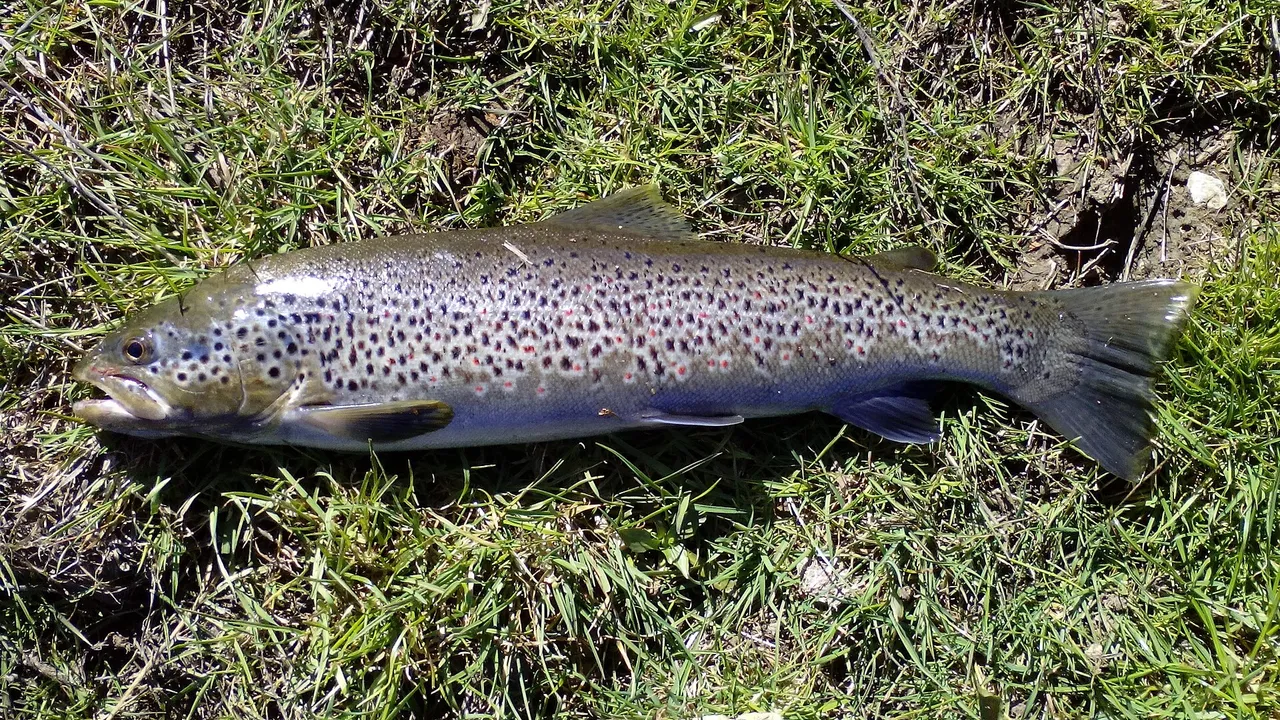
Photo: Robermix, via Wikimedia Commons, CC0. Resized and converted to WebP for the web; not otherwise altered.

How this was identified
Identified by: Both black and red spots, many ringed with pale haloes, spotting extending onto the gill cover, an adipose fin, and a thick caudal wrist — together separating it from Atlantic salmon, which lacks red spots and has a slimmer wrist.Look at this first
Find the back of the eye and follow the upper jaw. On a brown trout it runs past that point; on an Atlantic salmon it stops at or before it. If the fish is a silver sea-run trout — and it may be — that is the character that tells you what you are holding.
The parts of a fish, labelled — the fin and body names used below.
Diagnostic — settles it on its own
Each of these settles the identification on its own. If one is clear, you have your answer.
The upper jaw extends behind the rear of the eye
The single reliable separation from Atlantic salmon, and it holds regardless of colour, condition or how sea-silvered the fish is. Check it in profile with the mouth closed.
A thick tail wrist and a square tail
The root of the tail is deep and muscular and cannot usually be gripped and lifted the way a salmon's can, and the tail itself is squarer. Structural, and unaffected by season.
Supporting — use with other characters
Real characters that are not conclusive by themselves. Use two or three together.
Red spots among the black ones
Most brown trout carry red or orange spots, often with pale haloes, alongside the black. Rainbow trout have none at all, so their presence rules a rainbow out — but sea-run brown trout can lose them entirely, which is why this sits below the jaw.
No spots on the tail
The tail of a brown trout is generally clear. A heavily spotted tail points to rainbow trout. A useful quick check that fails on the occasional individual.
Suggestive only — varies with condition
Hints only. These vary with condition, season, water and how long the fish has been out of it, and a fish that contradicts them is still the same species.
Brown-gold flanks with haloed spotting
The classic look, and the least reliable thing on this page. Brown trout vary between populations more than almost any European freshwater fish — from near-black moorland fish to silver estuarine ones — and two from neighbouring streams can look like different species.
What it gets confused with
- Atlantic salmon, where the fish is sea-run and silver. Jaw and tail wrist.
- Rainbow trout, where the fish is stocked. Look for red spots and a clear tail.
- Brook trout in waters holding both — but brook trout has pale spots on a dark ground, the reverse pattern.
Side by side: Brown trout vs Atlantic salmon, Brown trout vs Grayling, Brown trout vs Rainbow trout.
Where this stops working
Sea trout are brown trout and are not a separate species, so a page cannot help you distinguish them — they are the same animal in a different life stage. Colour and spotting vary so widely between populations that neither is usable as a primary character. Hybrids with Atlantic salmon occur and are intermediate in exactly the characters listed above.
The full species page
This page covers identification only. The Brown trout page covers behaviour, lifecycle, distribution, handling and the sources behind all of it.
Reviewed 2026-08-13.
More about this fish
Telling it apart is one question. Here are the others.
Similar and related fish
- GraylingGrayling are salmonids — the same family as trout and salmon — which surprises people who meet them as a coarse-season fish, and it is why they share so much water with trout.
- Rainbow troutBoth are salmonids of the same broad group and are constantly confused. The separation is simple once known: rainbows are spotted on the tail and have no red spots; brown trout have red spots and a clean tail.
How it is caught
- Dry fly fishingDrift feeding is what makes a dry fly work at all — a trout holding station and judging drifting items is a trout that can be deceived by one.
- Float-tube fishingOn small lochs and lakes where bank access is limited by trees or by depth, a float tube is often the only way to fish the water at all, and the angler sits at eye level with the surface.
- Salmon fly fishingCarries the sea trout, which runs the same rivers and is fished with the same swung fly — most distinctively at night.
1 more
- Tenkara Method
Where it lives
- Chalk streamsThe combination of stable temperature, alkalinity and clean gravel is close to ideal for trout, which is why chalk streams support the densities they do.
- ReservoirsStocked and in some waters naturally recruiting, generally taking a wider range of food and holding deeper than stocked rainbows.
- Spate riversResident brown trout populate spate rivers throughout their range, typically numerous and small because the water is nutrient-poor; the sea-run form uses the same rivers and the same flood cycle as salmon.
2 more
- Tailwaters below dams Habitat
- Upland lakes and hill lochs Habitat
Where you will find it
- AustriaThe fish of the Alpine limestone rivers, on beats where rod numbers are limited and the water is managed intensively by whoever holds the fishing right.
- Cardigan Bay and the sarnauAs sewin — sea trout — in the Dyfi, Mawddach and Teifi and along the coastal margin around their mouths. Sea trout stay close to home at sea, so this bay is their marine habitat rather than a corridor.
- Czechia and SlovakiaThe fish the legal water classification is built around: water designated trout water is managed for this species before any other consideration applies.
32 more
- Denmark Fishing regions
- France Fishing regions
- Germany Fishing regions
- Iceland Fishing regions
- Lake Geneva Fishing regions
- Lough Corrib Fishing regions
- Lough Erne Fishing regions
- Lough Neagh Fishing regions
- Moroccan mountain and reservoir fresh water Fishing regions
- Patagonia Fishing regions
- Scotland Fishing regions
- Scottish sea lochs Fishing regions
- Shetland Fishing regions
- Skye and the Inner Hebrides Fishing regions
- The Atlantic coast of Ireland Fishing regions
- The Baltic Sea Fishing regions
- The Baltic states Fishing regions
- The English trout reservoirs Fishing regions
- The Finnish lake district Fishing regions
- The Hampshire chalk streams Fishing regions
- The Himalayan mahseer rivers Fishing regions
- The Lake District lakes Fishing regions
- The Moray Firth Fishing regions
- The Moy and Lough Conn Fishing regions
- The Republic of Ireland Fishing regions
- The River Spey Fishing regions
- The River Tay Fishing regions
- The River Tweed Fishing regions
- The Shannon system Fishing regions
- The Soča and Slovenia's Adriatic rivers Fishing regions
- The Welsh sewin rivers Fishing regions
- The Western Balkans Fishing regions
Why the 46 connections on this page are here, and the sources
Similar and related fish
Backed by research — 2 connections
Supported by peer-reviewed research or fisheries science. The sources are listed and can be checked.
Grayling
A taxonomic claim held to a scientific standard, and one that matters practically because it explains both the habitat overlap and the regulatory oddity of a salmonid fished in the coarse season.
- The Fishes of the British Isles and North-West Europe — Macmillan, 1969 (Reference work)Relied on for: The placement of Thymallus thymallus within the Salmonidae alongside Salmo trutta and Salmo salar.States this directlyCitation checked — the work exists and is described correctly
- FishBase: a global information system on fishes — Froese, R. and D. Pauly, eds. — FishBase Consortium (Scientific institute)Relied on for: Family placement for Thymallus thymallus.States this directlyPassage read and verified
Rainbow trout
A taxonomic and identification comparison, naming both scientific names so there is no ambiguity about which animals are being compared.
- FishBase: a global information system on fishes — relied on for: That Oncorhynchus mykiss is a Salmonidae native to Pacific drainages of North America and eastern Asia and introduced worldwide.
- The Fishes of the British Isles and North-West Europe — relied on for: The morphological separation of Salmo trutta from introduced Oncorhynchus mykiss by spotting pattern and tail markings.
How it is caught
What experienced anglers do — 3 connections
Widely and independently recommended by experienced anglers and specialist sources. This is real angling knowledge, not proof: controlled evidence for it is limited, and FishingHQ records it as convention rather than as a demonstrated effect.
Dry fly fishing
The foundational method for the species, described independently across the game literature.
- Still Water Fly-Fishing — Andre Deutsch, 1952 (Specialist angling publication)Relied on for: Fly fishing method and fly selection for trout.Citation checked — the work exists and is described correctly
- Trout & Salmon — Bauer Media (Specialist angling publication)Relied on for: Contemporary dry fly practice from independent contributors.Citation checked — the work exists and is described correctly
Float-tube fishing
Established angling practice for this species, recorded as convention. The note states the property of the animal or its water that makes the method the answer.
- Still Water Fly-Fishing — relied on for: Still-water fly technique and the feeding behaviour it is built on.
- Trout & Salmon — relied on for: Contemporary still-water fly practice.
Tenkara
An established way this species is taken on small streams.
- General angling website restatements of established technique — Various (Credible secondary source)Relied on for: Widely restated practice connecting this species, method or place, recorded as practitioner consensus rather than as tested fact.Background and mechanism onlyCitation checked — the work exists and is described correctly
- Fishers' Craft and Lettered Art: Tracts on Fishing from the End of the Middle Ages — University of Toronto Press, 1997 (Scientific literature)Relied on for: That fishing traditions develop around the water and fish available to them, and the historical method of reading such traditions.Background and mechanism onlyCitation checked — the work exists and is described correctly
Official guidance — 1 connection
Stated by a fisheries authority, scientific institute or recognised angling body. Authoritative, but summarising rather than demonstrating.
Salmon fly fishing
Sea trout are the anadromous form of the brown trout and are regulated alongside salmon across the salmon fishery districts. They run the same rivers and are fished with the same swung fly, most distinctively after dark.
- Trout & Salmon — relied on for: Long-running published description of British and Irish game angling practice by river, beat and season, including the technique, tackle and seasonal decisions of salmon fly fishing.
- General angling website restatements of established technique — relied on for: Widely restated public descriptions of salmon fly technique — the down-and-across swing, Spey casting, and the water-temperature convention for fly size and line density — recorded as practitioner consensus rather than as scholarship, including where that consensus is openly disputed.
Where it lives
Backed by research — 5 connections
Supported by peer-reviewed research or fisheries science. The sources are listed and can be checked.
Chalk streams
Habitat association and the ecological basis for it are documented.
- FishBase: a global information system on fishes — relied on for: Habitat and water quality requirements for Salmo trutta.
- JNCC species and habitat conservation advice — Joint Nature Conservation Committee (Conservation authority)Relied on for: The characterisation of chalk rivers and their associated species.FishingHQ's interpretation of what it saysCitation checked — the work exists and is described correctly
Reservoirs
Habitat association recorded for the species, in an environment FishingHQ describes on its own page.
- Freshwater Fishes of the British Isles — HarperCollins (New Naturalist 75), 1992 (Reference work)Relied on for: Habitat association and distribution of European freshwater fishes, including occurrence in artificial and modified waters.States this directlyCitation checked — the work exists and is described correctly
- FishBase: a global information system on fishes — relied on for: Habitat association, depth range and water-type tolerance recorded for the species.
Spate rivers
A claim that the species uses rain-fed rivers on impermeable geology, resting on documented distribution and spawning habitat rather than on angling report.
- Freshwater Fishes of the British Isles — relied on for: Distribution, habitat association, thermal requirements and life history of the freshwater fishes of the British Isles and north-west Europe.
- FishBase: a global information system on fishes — relied on for: Recorded depth range, temperature tolerance and habitat association for the species.
Tailwaters below dams
A claim that a species occupies an engineered habitat outside its natural thermal range, resting on documented distribution rather than on angling report.
- FishBase: a global information system on fishes — relied on for: Recorded depth range, temperature tolerance and habitat association for the species outside north-west Europe.
- The IUCN Red List of Threatened Species — International Union for Conservation of Nature (Conservation authority)Relied on for: Global conservation assessment, range and recorded threats for the species.States this directlyCitation checked — the work exists and is described correctly
Upland lakes and hill lochs
Habitat association recorded for the species, in an environment FishingHQ describes on its own page.
- Freshwater Fishes of the British Isles — relied on for: Habitat association and distribution of European freshwater fishes, including occurrence in artificial and modified waters.
- FishBase: a global information system on fishes — relied on for: Habitat association, depth range and water-type tolerance recorded for the species.
Where you will find it
Backed by research — 35 connections
Supported by peer-reviewed research or fisheries science. The sources are listed and can be checked.
Austria
That a species occurs in these waters, drawn from distribution science and stock assessment. It is a statement about where the animal lives and is not a statement that anybody will catch one, still less where.
- Freshwater Fishes of the British Isles — relied on for: Distribution, habitat requirement and life history of European freshwater fishes, including their occurrence across the continental range named.
- FishBase: a global information system on fishes — relied on for: Recorded distribution and habitat association of the freshwater and migratory species named.
Cardigan Bay and the sarnau
A claim that a place contains the ground, water and seasonal conditions the species is associated with. It is a distributional statement about the world, it rests on the regional reference literature, and it deliberately asserts nothing about access, permission or catch.
- Freshwater Fishes of the British Isles — relied on for: Distribution, ecology and conservation status of the freshwater fishes of the British Isles, including in artificial and modified waters.
- Environment Agency fisheries management, byelaws and rod licensing information — Environment Agency (Government fisheries body)Relied on for: Fisheries monitoring, water quality and species distribution in English rivers, canals and still waters.States this directlyCitation checked — the work exists and is described correctly
Czechia and Slovakia
That a species occurs in these waters, drawn from distribution science and stock assessment. It is a statement about where the animal lives and is not a statement that anybody will catch one, still less where.
- Freshwater Fishes of the British Isles — relied on for: Distribution, habitat requirement and life history of European freshwater fishes, including their occurrence across the continental range named.
- FishBase: a global information system on fishes — relied on for: Recorded distribution and habitat association of the freshwater and migratory species named.
Denmark
That a species occurs in these waters, drawn from distribution science and stock assessment. It is a statement about where the animal lives and is not a statement that anybody will catch one, still less where.
- Freshwater Fishes of the British Isles — relied on for: Distribution, habitat requirement and life history of European freshwater fishes, including their occurrence across the continental range named.
- FishBase: a global information system on fishes — relied on for: Recorded distribution and habitat association of the freshwater and migratory species named.
France
That a species occurs in these waters, drawn from distribution science and stock assessment. It is a statement about where the animal lives and is not a statement that anybody will catch one, still less where.
- Freshwater Fishes of the British Isles — relied on for: Distribution, habitat requirement and life history of European freshwater fishes, including their occurrence across the continental range named.
- FishBase: a global information system on fishes — relied on for: Recorded distribution and habitat association of the freshwater and migratory species named.
Germany
That a species occurs in these waters, drawn from distribution science and stock assessment. It is a statement about where the animal lives and is not a statement that anybody will catch one, still less where.
- Freshwater Fishes of the British Isles — relied on for: Distribution, habitat requirement and life history of European freshwater fishes, including their occurrence across the continental range named.
- FishBase: a global information system on fishes — relied on for: Recorded distribution and habitat association of the freshwater and migratory species named.
Iceland
That a species occurs in these waters, drawn from distribution science and stock assessment. It is a statement about where the animal lives and is not a statement that anybody will catch one, still less where.
- Freshwater Fishes of the British Isles — relied on for: Distribution, habitat requirement and life history of European freshwater fishes, including their occurrence across the continental range named.
- FishBase: a global information system on fishes — relied on for: Recorded distribution and habitat association of the freshwater and migratory species named.
Lake Geneva
A distributional claim taken from reference works and databases on the fishes of the region rather than from angling report. It states presence and asserts nothing about a fishery.
- FishBase: a global information system on fishes — relied on for: Distribution, habitat association, life history and size recorded for the species concerned.
- Freshwater Fishes of the British Isles — relied on for: Biology, distribution, life history and conservation status of northern European freshwater and diadromous fishes.
Lough Corrib
A distribution association between an animal and a kind of water, rather than a claim about any named mark.
- Freshwater Fishes of the British Isles — relied on for: Distribution, habitat association and ecology of British and Irish freshwater fishes, including occurrence in the water body concerned.
- FishBase: a global information system on fishes — relied on for: Distribution, habitat association and life history recorded for the species.
Lough Erne
A claim that a place contains the ground, water and seasonal conditions the species is associated with. It is a distributional statement about the world, it rests on the regional reference literature, and it deliberately asserts nothing about access, permission or catch.
- Freshwater Fishes of the British Isles — relied on for: Distribution, ecology and conservation status of the freshwater fishes of the British Isles, including in artificial and modified waters.
- Environment Agency fisheries management, byelaws and rod licensing information — relied on for: Fisheries monitoring, water quality and species distribution in English rivers, canals and still waters.
Lough Neagh
A distributional claim taken from reference works on the fishes of the region rather than from angling report. It states presence and asserts nothing about a fishery.
- FishBase: a global information system on fishes — relied on for: Distribution, habitat association, life history and depth range recorded for the species concerned.
- Freshwater Fishes of the British Isles — relied on for: Biology, distribution and conservation status of British and Irish freshwater and diadromous fishes.
- The Fishes of the British Isles and North-West Europe — relied on for: Distribution, habitat and biology of the fishes of the British Isles and north-west Europe.
Moroccan mountain and reservoir fresh water
A distribution claim about the world, so it rests on the reference datasets rather than on angling report. FishingHQ's evidence policy requires it.
- FishBase: a global information system on fishes — relied on for: Distribution, habitat association and depth range recorded for the species, including its occurrence in the water body concerned.
- FAO Species Identification Guides for Fishery Purposes and the FAO Species Catalogues — Food and Agriculture Organization of the United Nations (Scientific institute)Relied on for: Distribution, habitat, depth and fishery accounts for the species of the eastern central Atlantic and Mediterranean.States this directlyCitation checked — the work exists and is described correctly
Patagonia
A distribution association between an animal and a kind of water, rather than a claim about any named mark.
- The IUCN Red List of Threatened Species — relied on for: Assessment and habitat account for the species, including the river or lake system it occupies and the pressures acting on it.
- FishBase: a global information system on fishes — relied on for: Distribution, habitat association, size and life history recorded for the species in the system concerned.
Scotland
A distribution claim about the world, so it rests on the reference works rather than on angling report. FishingHQ's evidence policy requires it.
- FishBase: a global information system on fishes — relied on for: Distribution, habitat association, water-type tolerance and occurrence records for the species, including its presence in the countries concerned.
- The IUCN Red List of Threatened Species — relied on for: Assessment and range account for the species, including the countries and systems it occupies and its population trend within them.
Scottish sea lochs
A claim that a place contains the ground and conditions the species is associated with. It is a distributional statement about the world, it rests on the regional reference literature, and it deliberately asserts nothing about access, permission or catch.
- The Fishes of the British Isles and North-West Europe — relied on for: Distribution and habitat association of the marine and estuarine fishes of the British Isles, including which coasts and ground types a species occupies.
- FishBase: a global information system on fishes — relied on for: Recorded distribution, depth range and habitat association for the species named.
Shetland
A distribution association between an animal and a kind of water, rather than a claim about any named mark.
- The Fishes of the British Isles and North-West Europe — relied on for: Distribution, habitat association, depth and ground preference of fishes in British and north-west European waters.
- FishBase: a global information system on fishes — relied on for: Distribution, habitat association and depth range recorded for the species.
Skye and the Inner Hebrides
A distribution association between an animal and a kind of water, rather than a claim about any named mark.
- The Fishes of the British Isles and North-West Europe — relied on for: Distribution, habitat association and ground type of fishes in British and north-west European waters.
- FishBase: a global information system on fishes — relied on for: Distribution, habitat association and depth range recorded for the species.
The Atlantic coast of Ireland
A claim that a place contains the ground and conditions the species is associated with. It is a distributional statement about the world, it rests on the regional reference literature, and it deliberately asserts nothing about access, permission or catch.
- The Fishes of the British Isles and North-West Europe — relied on for: Distribution and habitat association of the marine and estuarine fishes of the British Isles, including which coasts and ground types a species occupies.
- FishBase: a global information system on fishes — relied on for: Recorded distribution, depth range and habitat association for the species named.
The Baltic Sea
Occurrence of the species in this system or along this coast: a statement about the animal's distribution, not a venue recommendation.
- Freshwater Fishes of the British Isles — relied on for: Distribution and habitat association of European freshwater fishes, including their occurrence in brackish and coastal waters.
- FishBase: a global information system on fishes — relied on for: Salinity tolerance and distribution recorded for the species.
The Baltic states
That a species occurs in these waters, drawn from distribution science and stock assessment. It is a statement about where the animal lives and is not a statement that anybody will catch one, still less where.
- Freshwater Fishes of the British Isles — relied on for: Distribution, habitat requirement and life history of European freshwater fishes, including their occurrence across the continental range named.
- FishBase: a global information system on fishes — relied on for: Recorded distribution and habitat association of the freshwater and migratory species named.
The English trout reservoirs
A claim that a place contains the ground, water and seasonal conditions the species is associated with. It is a distributional statement about the world, it rests on the regional reference literature, and it deliberately asserts nothing about access, permission or catch.
- Freshwater Fishes of the British Isles — relied on for: Distribution, ecology and conservation status of the freshwater fishes of the British Isles, including in artificial and modified waters.
- Environment Agency fisheries management, byelaws and rod licensing information — relied on for: Fisheries monitoring, water quality and species distribution in English rivers, canals and still waters.
The Finnish lake district
A claim that a place contains the ground, water and seasonal conditions the species is associated with. It is a distributional statement about the world, it rests on the regional reference literature, and it deliberately asserts nothing about access, permission or catch.
- Freshwater Fishes of the British Isles — relied on for: Distribution, ecology and conservation status of European freshwater and migratory fishes, including in modified and artificial waters.
- FishBase: a global information system on fishes — relied on for: Recorded distribution, habitat association and life history for the freshwater and migratory species named.
The Hampshire chalk streams
A distributional claim taken from reference works on the fishes of the region rather than from angling report. It states presence and asserts nothing about a fishery.
- FishBase: a global information system on fishes — relied on for: Distribution, habitat association, life history and depth range recorded for the species concerned.
- Freshwater Fishes of the British Isles — relied on for: Biology, distribution and conservation status of British and Irish freshwater and diadromous fishes.
- The Fishes of the British Isles and North-West Europe — relied on for: Distribution, habitat and biology of the fishes of the British Isles and north-west Europe.
The Himalayan mahseer rivers
A distribution association between an animal and a kind of water, rather than a claim about any named mark.
- The IUCN Red List of Threatened Species — relied on for: Assessment and habitat account for the species, including the river or lake system it occupies and the pressures acting on it.
- FishBase: a global information system on fishes — relied on for: Distribution, habitat association, size and life history recorded for the species in the system concerned.
The Lake District lakes
A claim that a place contains the ground, water and seasonal conditions the species is associated with. It is a distributional statement about the world, it rests on the regional reference literature, and it deliberately asserts nothing about access, permission or catch.
- Freshwater Fishes of the British Isles — relied on for: Distribution, habitat and conservation status of British freshwater fishes, including the isolated glacial-relict populations of northern England.
- Environment Agency fisheries management, byelaws and rod licensing information — relied on for: Fisheries monitoring, water quality and species distribution in English rivers and still waters.
The Moray Firth
A claim that a place contains the ground, water and seasonal conditions the species is associated with. It is a distributional statement about the world, it rests on the regional reference literature, and it deliberately asserts nothing about access, permission or catch.
- The Fishes of the British Isles and North-West Europe — relied on for: Distribution and habitat association of the marine, estuarine and freshwater fishes of the British Isles, including which coasts, estuaries and ground types a species occupies.
- FishBase: a global information system on fishes — relied on for: Recorded distribution, depth range and habitat association for the species named.
The Moy and Lough Conn
A claim that a coast contains the ground and conditions the species is associated with. It is a distributional statement about the world, it rests on the regional reference literature, and it deliberately asserts nothing about access, permission or catch.
- The Fishes of the British Isles and North-West Europe — relied on for: Distribution and habitat association of the marine and estuarine fishes of the British Isles and north-west Europe, including which coasts and ground types a species occupies.
- FishBase: a global information system on fishes — relied on for: Recorded distribution, depth range and habitat association for the species named.
The Republic of Ireland
A distribution claim about the world, so it rests on the reference works rather than on angling report. FishingHQ's evidence policy requires it.
- FishBase: a global information system on fishes — relied on for: Distribution, habitat association, water-type tolerance and occurrence records for the species, including its presence in the countries concerned.
- The IUCN Red List of Threatened Species — relied on for: Assessment and range account for the species, including the countries and systems it occupies and its population trend within them.
The River Spey
A distributional claim about where a species occurs, which is a claim about the world and rests on the reference literature rather than on angling report.
- Freshwater Fishes of the British Isles — relied on for: Distribution, habitat association and ecology of the freshwater fishes of the British Isles.
- FishBase: a global information system on fishes — relied on for: Distribution, habitat association and life history recorded for the species.
The River Tay
A claim that a place contains the ground, water and seasonal conditions the species is associated with. It is a distributional statement about the world, it rests on the regional reference literature, and it deliberately asserts nothing about access, permission or catch.
- Freshwater Fishes of the British Isles — relied on for: Distribution, ecology and conservation status of the freshwater fishes of the British Isles, including in artificial and modified waters.
- Environment Agency fisheries management, byelaws and rod licensing information — relied on for: Fisheries monitoring, water quality and species distribution in English rivers, canals and still waters.
The River Tweed
A distribution association between an animal and a kind of water, rather than a claim about any named mark.
- Freshwater Fishes of the British Isles — relied on for: Distribution, habitat association and ecology of British and Irish freshwater fishes, including occurrence in the water body concerned.
- FishBase: a global information system on fishes — relied on for: Distribution, habitat association and life history recorded for the species.
The Shannon system
A claim that a place contains the ground, water and seasonal conditions the species is associated with. It is a distributional statement about the world, it rests on the regional reference literature, and it deliberately asserts nothing about access, permission or catch.
- Freshwater Fishes of the British Isles — relied on for: Distribution, ecology and conservation status of the freshwater fishes of the British Isles, including in artificial and modified waters.
- Environment Agency fisheries management, byelaws and rod licensing information — relied on for: Fisheries monitoring, water quality and species distribution in English rivers, canals and still waters.
The Soča and Slovenia's Adriatic rivers
A distributional claim about where a species occurs, which is a claim about the world and rests on the reference literature rather than on angling report.
- FishBase: a global information system on fishes — relied on for: Distribution, habitat association and life history recorded for the species.
- The IUCN Red List of Threatened Species — relied on for: Global conservation assessment, range and recorded threats for the species.
The Welsh sewin rivers
A claim that a place contains the ground, water and seasonal conditions the species is associated with. It is a distributional statement about the world, it rests on the regional reference literature, and it deliberately asserts nothing about access, permission or catch.
- Freshwater Fishes of the British Isles — relied on for: Distribution, ecology and conservation status of the freshwater fishes of the British Isles, including in artificial and modified waters.
- Environment Agency fisheries management, byelaws and rod licensing information — relied on for: Fisheries monitoring, water quality and species distribution in English rivers, canals and still waters.
The Western Balkans
That a species occurs in these waters, drawn from distribution science and stock assessment. It is a statement about where the animal lives and is not a statement that anybody will catch one, still less where.
- Freshwater Fishes of the British Isles — relied on for: Distribution, habitat requirement and life history of European freshwater fishes, including their occurrence across the continental range named.
- FishBase: a global information system on fishes — relied on for: Recorded distribution and habitat association of the freshwater and migratory species named.
Safety
Moving water and currents — Can cause serious injury or death
Trout fishing means wading, and wading in moving water is the most dangerous thing most anglers routinely do. Knee-deep fast water can take a person off their feet; waders full of water make swimming to a bank extremely difficult; and a fall in cold water triggers cold water shock before any of that matters.
What reduces it: Wear a buoyancy aid and a wading belt, use a wading staff, do not wade alone, move one foot at a time and never cross your feet, and turn back at the point where it starts to feel committing rather than at the point where it becomes committing. Read the water from the bank before entering it.
Worse when:
- Rising or coloured water, which hides the bed and increases the force
- Cold water, where an immersion becomes a survival problem within a minute
- Alone, and out of sight of anyone