The Western Balkans
Fishing regions · Last reviewed 2026-08-18
Limestone rivers of extraordinary clarity, three ancient lakes, and the densest cluster of endemic salmonids in Europe — inside a region where fisheries law is written below the national level and the fish are older than the borders.
Safety: slips, trips and falls — can cause serious injury or death. 3 more points apply here.
Being listed here is not permission to fish. What that meansClose
Access, fishing rights, seasons, licences, local bylaws and permitted methods vary and can change. Check current access, permission, local regulations, closures and restrictions before you travel or fish. FishingHQ describes what the ground is and names who holds the answer; it does not hold the answer itself.
Find the authority for a jurisdiction · What FishingHQ does and does not cover
The Western Balkans are treated as one record because the thing that makes them exceptional does not respect a single border in the region.
KARST IS THE ORGANISING FACT. Most of the region is limestone, and limestone does not hold surface water the way other rock does — it dissolves. Rivers sink underground, run through cave systems and reappear as enormous springs. The consequence for fishing is direct: water emerges cold, clear, mineral-rich and stable in flow and temperature, which is close to ideal for salmonids and for the invertebrates they eat. Some of these rivers are among the clearest fishable water anywhere on earth.
AND ISOLATION PRODUCED ENDEMICS. Because karst catchments are hydrologically separated from one another, salmonid populations in the region evolved apart, and the result is the densest cluster of endemic trout in Europe — softmouth trout in the Adriatic drainages, marble trout in the Soča and Neretva systems, the Ohrid trouts, and a set of locally distinct brown trout lineages that are still being untangled. Several are threatened, several are the reason a river has catch-and-release conditions on it, and several were nearly lost to introduced stocked fish before anybody realised what was being replaced.
THE ANCIENT LAKES ARE THE OTHER TREASURE. Ohrid, Prespa and Skadar are among the oldest lakes on earth — Ohrid on the scale of millions of years — and their fish faunas include species found nowhere else, which is precisely why they carry the protections they do.
THE DANUBE SIDE IS A DIFFERENT COUNTRY. Serbia's rivers — the Danube, Sava, Tisa and Drina — are big-water predator fisheries for catfish, zander, pike and asp, with the Danube's sturgeon problem running through them.
AND THE ADMINISTRATION IS THE REGION'S GENUINE COMPLICATION. Bosnia and Herzegovina legislates fisheries at entity and cantonal level rather than nationally, which means the law can differ between valleys. Everywhere in the region, angling clubs and concessionaires manage the water and sell the permits. There is no shortcut around asking locally.
What fishing here is like
A mountainous limestone region between the Adriatic and the Danube plain. Karst dominates the west and south: rock that dissolves rather than sheds, producing sinking rivers, cave systems, enormous springs and rivers that emerge full-sized from a hillside. Those rivers are cold, exceptionally clear, mineral-rich and hydrologically buffered, running over pale limestone gravel through steep canyons. Three ancient tectonic lakes — Ohrid, Prespa and Skadar — sit in the south, of which Ohrid is among the oldest and deepest lakes on earth. The north and east fall away into the Pannonian plain, where the Sava, the Drina, the Tisa and the Danube are large, slow, engineered lowland rivers of an entirely different character. Montenegro has a short, steep, clear Adriatic coast with deep water close inshore. Reservoirs are numerous in the mountain valleys, many of them large hydro impoundments.
What dominates
Fly fishing for trout and grayling in the karst rivers, which is what draws visiting anglers and which is done in water clear enough that the fishing is genuinely visual. Specialist fishing for the region's endemic salmonids, frequently under catch-and-release and barbless conditions set as terms of the permit. Huchen fishing on the Drina, the Una and a small number of other rivers in the cold season — this region holds some of the most significant remaining huchen water anywhere. Big-river predator fishing on the Danube, Sava and Tisa for wels catfish, zander, pike and asp. Carp and feeder fishing on the lowland rivers and reservoirs. Lake fishing on the ancient lakes, closely managed because of their endemic species. On the Montenegrin coast, shore and boat fishing and spearfishing in typical Adriatic style, with deep clear water close in.
The water available
Karst rivers: cold, exceptionally clear, spring-fed, stable in flow and temperature, running over pale limestone gravel through steep canyons, several of them emerging full-sized from a single spring. Sinking rivers and cave systems, where a river disappears underground and reappears elsewhere. Enormous karst springs, some of the largest in Europe. Ancient tectonic lakes of great depth and age, with endemic faunas. Large, slow, engineered lowland rivers in the Pannonian plain with side arms and oxbows. Mountain reservoirs and hydro impoundments in steep valleys. A short, steep, clear Adriatic coast with rock, deep water close inshore and small pockets of sand.
How the rules are structured
The region's administrative structure is genuinely more variable than anywhere else in Europe, and a visitor has to accept that rather than look for the rule.
BOSNIA AND HERZEGOVINA LEGISLATES FISHERIES BELOW THE NATIONAL LEVEL. Its entities, and the cantons within one of them, make their own fisheries law. The practical result is that provisions can differ between neighbouring valleys and that a permit obtained in one place may have no standing in another. This is a structural fact about the country rather than a rule that might change, and it is the single most useful thing to know before planning a trip there.
EVERYWHERE IN THE REGION, THE WATER HAS A MANAGER. Angling clubs, associations and concessionaires hold the management of individual rivers, stretches and lakes, sell the day and period permits, and set the conditions. Those conditions are the operative rules for that water, and on the endemic salmonid rivers they frequently include catch-and-release, barbless hooks, restricted rod numbers and closed reaches — imposed as terms of the permit rather than by general law.
NATIONAL LICENSING SITS ABOVE THAT and differs by country: Serbia runs an annual state recreational permit alongside the area manager's terms; Montenegro and North Macedonia license nationally with concessionaires managing particular waters.
THE ANCIENT LAKES AND THE ENDEMIC SPECIES CARRY PROTECTION THAT IS NOT FISHERIES MANAGEMENT. Ohrid is a World Heritage property; Skadar and Prespa carry national park and wetland designations. Those designations constrain activity for conservation reasons and apply regardless of any fishing permit.
AND THE DANUBE'S STURGEONS ARE PROTECTED THROUGHOUT the Serbian reaches, as they are along the whole lower river.
FishingHQ does not state what any current rule is: no season, no size and no limit. Identify the club or concessionaire managing the specific water, and ask them — and in Bosnia and Herzegovina, establish which entity or canton's law applies before assuming anything transfers.
Who to ask
- The angling club, association or concessionaire managing the specific water, which sells the permit and sets its conditions.
- The entity or cantonal ministry responsible for fisheries in Bosnia and Herzegovina, which legislates for that territory rather than for the state.
- The national ministry responsible for fisheries in Serbia, Montenegro or North Macedonia, for the state permit and for protected species.
- The national park, World Heritage or protected-area administration, for Ohrid, Skadar, Prespa and the protected river canyons.
- The water management body operating a hydro scheme, for access and for release patterns.
Words you will meet
- Karst
- Landscape formed in soluble rock — here, limestone — where water moves underground through dissolved conduits rather than over the surface. It is the reason these rivers are clear, cold, stable and spring-fed, and the reason their catchments are hydrologically separated from one another.
- Vrelo
- A karst spring — the point where an underground river returns to the surface, sometimes as a full-sized river emerging from a rock face. Several of Europe's largest springs are in this region and some are the entire source of a famous river.
- Mekousna pastrmka
- Softmouth trout — an endemic salmonid of the Adriatic drainages of Bosnia and Montenegro, with a distinctively soft, protrusible mouth. Threatened, restricted in range, and one of the reasons particular rivers here carry release-only conditions.
- Glavatica / huchen
- The Danube salmon in its Balkan form — a large, wholly freshwater salmonid fished in the cold season on the Drina, the Una and a small number of other rivers. This region holds some of the most significant surviving water for it in the world.
- Ohrid trout
- The endemic salmonids of Lake Ohrid, found in that lake and nowhere else on earth, in a lake old enough to have produced its own fauna. Their management is a conservation matter first and a fisheries matter second.
Conditions and hazards
The Balkans combine mountain-water hazards with two problems that are specific to the region.
KARST RIVERS RUN IN CANYONS AND THE ACCESS IS THE DANGER. Getting down to the water frequently means a steep, loose, exposed descent, and getting out at the end of a long day means climbing it tired. A great deal of the actual risk here is on the path rather than in the river.
AND KARST HYDROLOGY MAKES FLOW HARD TO PREDICT. A river fed by an underground system can rise from rain that fell on a catchment the angler cannot see and that may be over the ridge in a different valley. The usual local cues — the sky here, the ground here — do not apply in a landscape where the water arrives from underneath.
UNEXPLODED ORDNANCE AND LANDMINE CONTAMINATION REMAINS A REAL CONSIDERATION IN PARTS OF BOSNIA AND HERZEGOVINA AND ADJACENT AREAS. Clearance has been extensive and continues, marked areas exist, and the standard advice from the clearance authorities is unambiguous: stay on established paths and cleared ground, do not enter marked or suspected areas, and take local guidance rather than exploring riverbank ground independently. This is not a historical footnote; it is a live reason to fish with local knowledge in some valleys.
HYDRO RELEASES CHANGE FLOW WITHOUT WEATHER on the many regulated rivers, with no upstream warning visible downstream.
THE WATER IS COLD IN EVERY SEASON in the karst rivers, being spring-fed, and cold water shock governs the first minute of an immersion.
WADING FAST LIMESTONE GRAVEL AND BOULDER BEDS carries the usual foot-entrapment mechanism, made worse by water clear enough that depth is systematically underestimated.
AND THE ANCIENT LAKES ARE DEEP AND COLD BELOW THE SURFACE, with a long way to shore from the middle.
Limestone that dissolves, rivers that come out of a hillside, and trout found nowhere else
The Balkans are the clearest demonstration in Europe of geology producing a fishery, and the chain of cause runs the whole way from rock to endemic species.
LIMESTONE DISSOLVES, SO THE WATER GOES UNDERGROUND. In karst country, rain does not run off in streams so much as sink through fissures, widen them into conduits over geological time, and travel through cave systems. Surface rivers disappear into swallow holes and reappear kilometres away as springs — some of them large enough that a full-sized river emerges from a single rock face.
WHICH GIVES THESE RIVERS FOUR PROPERTIES AT ONCE. They are COLD, because groundwater emerges near the mean annual temperature rather than the summer one. They are CLEAR, because the water has been filtered through rock rather than washed off fields. They are CHEMICALLY RICH, because dissolved limestone gives them hardness and alkalinity that supports abundant invertebrate life. And they are STABLE, because an aquifer buffers both flow and temperature against weather. Cold, clear, rich and stable is very close to the ideal specification for a salmonid river, which is why this region punches so far above its size.
THE CLARITY IS NOT AN EXAGGERATION and it changes the fishing. In water where the bed is visible at depths that would be opaque elsewhere, the angler can see the fish and the fish can see the angler. Approach, line control and tippet matter more than fly pattern, and the fishing is visual in a way most European trout fishing is not.
ISOLATION IS THE OTHER HALF OF THE STORY. Karst catchments are hydrologically separated — a river that runs underground is not connected to its neighbour over the ridge — and separated populations diverge. Over a very long time, this produced the densest concentration of endemic salmonids in Europe: softmouth trout in the Adriatic drainages, marble trout in the Soča and Neretva systems, the Ohrid trouts in their ancient lake, and a set of distinct brown trout lineages that genetic work is still resolving.
AND THAT IS WHY STOCKING IS THE REGION'S GREAT CONSERVATION PROBLEM. Introducing hatchery brown trout of a common European strain into a river holding a distinct native lineage does not add fish; it replaces them, by interbreeding, in a way that cannot be undone. A great deal of Balkan river management is now about not doing that, and it is the reason particular rivers carry release-only and barbless conditions.
Backed by research — why, and the sources (4)
Supported by peer-reviewed research or fisheries science. The sources are listed and can be checked.
- Freshwater Fishes of the British Isles — HarperCollins (New Naturalist 75), 1992 (Reference work)Relied on for: Distribution, ecology, life history and conservation status of European freshwater fishes, including the migratory salmonids and the cyprinid and percid communities named.States this directlyCitation checked — the work exists and is described correctly
- FishBase: a global information system on fishes — Froese, R. and D. Pauly, eds. — FishBase Consortium (Scientific institute)Relied on for: Recorded distribution, habitat association and life history of the freshwater and migratory species named.States this directlyPassage read and verified
- FishBase: a global information system on fishes — Froese, R. and D. Pauly, eds. — FishBase Consortium (Scientific institute)Relied on for: Recorded distribution, depth range, habitat association, size and biology of the species named.States this directlyPassage read and verified
- The IUCN Red List of Threatened Species — International Union for Conservation of Nature (Conservation authority)Relied on for: Current global and regional conservation assessment for the species named, with the assessment date.Background and mechanism onlyCitation checked — the work exists and is described correctly
Ancient lakes, the Danube salmon, and the lowland rivers that are a different fishery
THE ANCIENT LAKES ARE A SEPARATE MARVEL. Ohrid, Prespa and Skadar are tectonic rather than glacial, meaning they have existed continuously for a length of time no northern European lake approaches — Ohrid on the scale of millions of years. Continuous existence allows evolution in place, and Ohrid's fauna includes species found in that lake and nowhere else on earth. Its designations follow from that, and they are conservation designations rather than fisheries ones.
HUCHEN IS THE REGION'S GREAT PREDATOR. The Danube salmon, wholly freshwater, large, long-lived and critically reduced across its range; the Drina, the Una and a handful of other rivers here hold some of the most significant surviving water for it, and it is protected accordingly.
AND THE LOWLAND RIVERS ARE ANOTHER FISHERY ENTIRELY: the Sava, Tisa and Danube, big, slow and engineered, holding wels catfish, zander, asp, carp and barbel, with the same sturgeon tragedy running through them as the rest of the lower river.
Backed by research — why, and the sources (4)
Supported by peer-reviewed research or fisheries science. The sources are listed and can be checked.
- Freshwater Fishes of the British Isles — HarperCollins (New Naturalist 75), 1992 (Reference work)Relied on for: Distribution, ecology, life history and conservation status of European freshwater fishes, including the migratory salmonids and the cyprinid and percid communities named.States this directlyCitation checked — the work exists and is described correctly
- FishBase: a global information system on fishes — Froese, R. and D. Pauly, eds. — FishBase Consortium (Scientific institute)Relied on for: Recorded distribution, habitat association and life history of the freshwater and migratory species named.States this directlyPassage read and verified
- FishBase: a global information system on fishes — Froese, R. and D. Pauly, eds. — FishBase Consortium (Scientific institute)Relied on for: Recorded distribution, depth range, habitat association, size and biology of the species named.States this directlyPassage read and verified
- The IUCN Red List of Threatened Species — International Union for Conservation of Nature (Conservation authority)Relied on for: Current global and regional conservation assessment for the species named, with the assessment date.Background and mechanism onlyCitation checked — the work exists and is described correctly
Law written below the country, and permits that carry the real rules
The regulatory question here has a different shape from anywhere else in Europe, and the shape is the answer.
IN BOSNIA AND HERZEGOVINA, FISHERIES LAW IS NOT NATIONAL. The entities legislate separately and, within one of them, the cantons do too. Provisions can therefore differ between adjacent valleys, and a document obtained in one place may have no standing in the next. This is constitutional structure rather than a rule that might be revised next season, and it means the question "what are the rules in Bosnia?" does not have a single answer. Establish which territory's law applies to the water in question before assuming anything transfers.
EVERYWHERE IN THE REGION, THE OPERATIVE RULES ARE THE PERMIT'S TERMS. Angling clubs, associations and concessionaires manage individual rivers, stretches and lakes; they sell the permits and they set the conditions. On the endemic salmonid rivers those conditions routinely include catch-and-release, barbless hooks, limited rod numbers and closed reaches — and they are conditions of the permit rather than provisions of general law, which means reading the permit is not optional.
THAT ARRANGEMENT IS ALSO WHY THE FISHERIES SURVIVE. A club with a long horizon, a limited number of rods and a direct interest in the reputation of its water is a considerably better custodian of a threatened endemic trout than an open licence would be. The visiting angler is buying management as much as access.
NATIONAL LICENSING VARIES BY COUNTRY. Serbia runs an annual state recreational permit alongside the area manager's terms; Montenegro and North Macedonia license nationally with concessionaires managing particular waters; Bosnia and Herzegovina does it at the level described above.
CONSERVATION DESIGNATIONS SIT ABOVE ALL OF IT AND ARE NOT FISHERIES INSTRUMENTS. Ohrid is a World Heritage property. Skadar and Prespa carry national park and wetland designations. Several river canyons are protected landscapes. Those regimes constrain activity for reasons that have nothing to do with fisheries management and apply regardless of any permit.
AND THE STURGEONS OF THE SERBIAN DANUBE are protected as they are along the whole lower river, for the same reason: a very long-lived, late-maturing migratory fish whose migration route has been severed cannot absorb adult mortality.
FishingHQ does not state what any current rule is: no season, no size and no limit. Find the club or concessionaire that manages the water, ask them, and read what the permit actually says.
Official guidance — why, and the sources (2)
Stated by a fisheries authority, scientific institute or recognised angling body. Authoritative, but summarising rather than demonstrating.
- Code of Conduct for Responsible Fisheries — Food and Agriculture Organization of the United Nations, Rome, 1995 (Standards body)Relied on for: The international framework within which national and regional fisheries authorities set, revise and enforce measures, and the principle that responsible fishing includes the safety of fishers.Background and mechanism onlyCitation checked — the work exists and is described correctly
- ICES Advice on fishing opportunities, catch and effort — International Council for the Exploration of the Sea (Scientific institute)Relied on for: That the stock advice European fisheries measures are set against is produced internationally and revised annually, which is the mechanism by which a national measure changes without the national law changing.States this directlyCitation checked — the work exists and is described correctly
Canyon access, water that rises from nowhere, and ground that is not all cleared
Two of the region's hazards are ones a European angler will not have met before, and one of them is unlike anything else on FishingHQ.
THE ACCESS IS FREQUENTLY THE MOST DANGEROUS PART OF THE DAY. Karst rivers run in canyons. Reaching the water means a steep, loose, sometimes exposed descent; leaving it means climbing that descent at the end of a long day, tired, carrying gear, possibly in failing light. A great deal of the real risk on these rivers is on the path. Plan the exit before the descent, allow daylight for it, and treat a route that was fine on the way down as a different proposition on the way up.
KARST HYDROLOGY MAKES FLOW GENUINELY UNPREDICTABLE. A river fed by an underground conduit system can rise from rain that fell on a catchment invisible from where the angler is standing — over a ridge, in another valley, hours earlier. The ordinary cues fail: the sky above the river tells you nothing about what is arriving through the rock. Local knowledge of how a particular spring responds is the operative information, and a rising level or dropping clarity is a reason to leave immediately rather than to watch.
UNEXPLODED ORDNANCE AND MINE CONTAMINATION IS STILL A LIVE CONSIDERATION IN PARTS OF BOSNIA AND HERZEGOVINA AND SOME ADJACENT AREAS. Clearance has been extensive and continues, suspected areas are mapped and marked, and the guidance from the clearance authorities is consistent and simple: stay on established paths and known cleared ground, do not enter marked or suspected areas, and take local guidance rather than exploring riverbank and floodplain ground independently. Riverbanks are relevant here specifically because flooding can move material. This is a reason to fish with a local club or guide in some valleys, and it is not a historical curiosity.
HYDRO RELEASES CHANGE FLOW WITHOUT WEATHER on the region's many regulated rivers, with no warning visible from downstream. Ask locally on any impounded system.
THE WATER IS COLD IN EVERY SEASON because it is spring-fed, so cold water shock and rapid loss of hand function apply in July as much as in February.
CLARITY MAKES DEPTH LOOK SHALLOWER THAN IT IS. This is a specific and well-known effect in exceptionally clear water, and it leads people to step into water considerably deeper and stronger than they judged. Wade with a staff, one foot at a time, and treat the visible bed as a poor estimate of distance.
AND THE ANCIENT LAKES ARE DEEP, COLD BELOW THE SURFACE LAYER AND LARGE, so an immersion from a small craft in the middle of one is a long way from anywhere.
Official guidance — why, and the sources (4)
Stated by a fisheries authority, scientific institute or recognised angling body. Authoritative, but summarising rather than demonstrating.
- RNLI water safety guidance: cold water shock and Float to Live — Royal National Lifeboat Institution (Water-safety or diver-training authority)Relied on for: Cold water shock and the immersion response, tidal cut-off, and water-safety guidance for shore anglers and small-craft users.States this directlyPassage read and verified
- Met Office shipping forecast, inshore waters forecast and marine warnings — Met Office, United Kingdom (Government fisheries body)Relied on for: That inshore waters forecasts, sea state and swell are the operative inputs for shore and small-craft decisions in north-west European waters.States this directlyCitation checked — the work exists and is described correctly
- Code of Conduct for Responsible Fisheries — Food and Agriculture Organization of the United Nations, Rome, 1995 (Standards body)Relied on for: The international framework within which national and regional fisheries authorities set, revise and enforce measures, and the principle that responsible fishing includes the safety of fishers.Background and mechanism onlyCitation checked — the work exists and is described correctly
- ICES Advice on fishing opportunities, catch and effort — International Council for the Exploration of the Sea (Scientific institute)Relied on for: That the stock advice European fisheries measures are set against is produced internationally and revised annually, which is the mechanism by which a national measure changes without the national law changing.States this directlyCitation checked — the work exists and is described correctly
Some of what lives here
Fish recorded here that FishingHQ holds a reviewed photograph of. It is not a complete list of what The Western Balkans holds, and it is not a prediction that you will catch any of them — it is a way in to the ones we can show you.
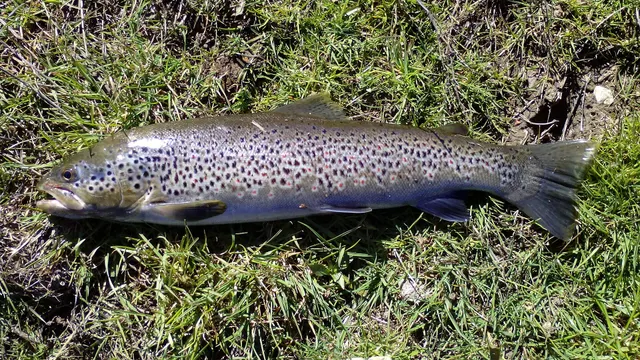 Brown troutA single, extraordinarily plastic species that appears as a tiny hill-stream fish, a deep-bodied loch trout and a silver sea-run migrant — all the same animal.
Robermix, CC0, via Wikimedia Commons
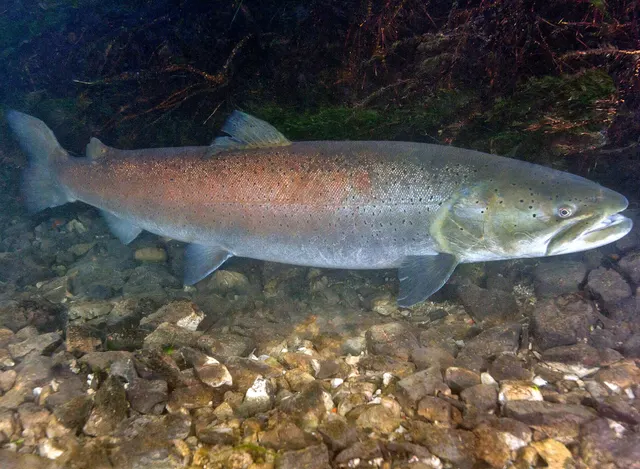 HuchenA very large predatory salmonid of the Danube basin, entirely freshwater, endangered through damming and habitat loss, and fished almost exclusively on a release basis.
Liquid Art — CC BY-SA 4.0, via Wikimedia Commons
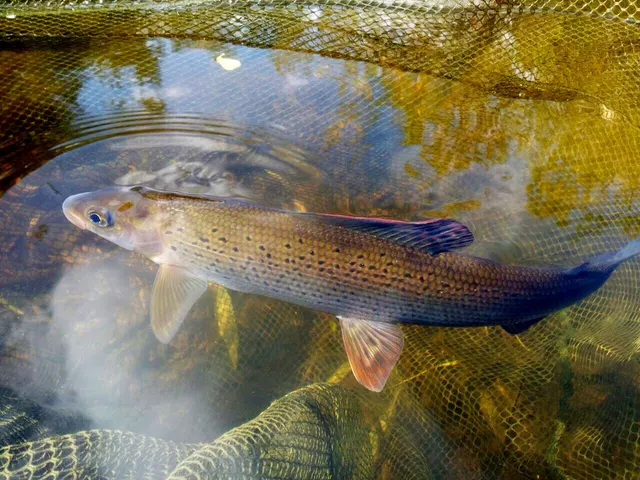 GraylingA salmonid with a sail for a dorsal fin that feeds hard through the winter — which makes it the game angler's season when the trout season has closed.
High Plains Grifter — CC BY-SA 4.0, via Wikimedia Commons
Safety
Slips, trips and falls — Can cause serious injury or death
Karst rivers run in canyons, so reaching the water means a steep, loose and sometimes exposed descent and leaving it means climbing that descent tired, loaded and possibly in failing light. Much of the real risk on these rivers is on the path rather than in the river.
What reduces it: Plan and time the exit before committing to the descent, allow daylight for the climb out, treat the return as a harder proposition than the approach, and do not descend a route you have not established a way back up.
Worse when:
- At the end of a long day, when fatigue and fading light arrive together.
- In wet weather, when limestone and loose scree become far less secure.
Drowning and immersion — Can cause serious injury or death
Karst rivers are fed through underground conduits, so they can rise from rain falling on a catchment invisible from the river — over a ridge, in another valley, hours earlier — with no local sign that anything is coming.
What reduces it: Ask locally how the particular spring or system responds to rain, treat a rising level or falling clarity as a reason to leave the water immediately rather than to watch, and identify the exit before wading.
Moving water and currents — Can cause serious injury or death
Exceptionally clear limestone water makes depth look considerably shallower than it is, so anglers step into water deeper and stronger than they judged, onto gravel and boulder beds where a trapped foot with current behind the body is the mechanism that drowns waders.
What reduces it: Use a wading staff and move one foot at a time with weight on the other, treat the visible bed as an unreliable estimate of depth, wear a belt on chest waders, and do not wade fast water alone.
Fishing alone — Can cause serious injury or death
Parts of Bosnia and Herzegovina and some adjacent areas retain unexploded ordnance and mine contamination. Clearance continues and suspected areas are mapped and marked, but floodplain and riverbank ground reached by wandering off established routes is exactly the ground the clearance authorities advise against entering.
What reduces it: Stay on established paths and known cleared ground, never enter marked or suspected areas, take local guidance from a club or guide rather than exploring riverbank ground independently, and treat this as current advice rather than as history.
Worse when:
- Away from established access points and beaten paths, which is exactly where an angler is tempted to go.
- On floodplain and riverbank ground, where flooding can move material from where it was recorded.
Further safety reading
- Wading safely — Karst rivers rise from rain falling on catchments invisible from the water, and limestone clarity makes depth look considerably shallower than it is.
Check the rules before you fish
Fishing laws, bylaws, access rules, seasons, bait restrictions and permitted methods vary by location and can change. Check the current rules from the relevant authority and the water you intend to fish before fishing.
Check with:
- Current national or regional law for where you are fishing
- Current local bylaws
- The relevant fisheries authority
- The landowner, club or fishery whose water it is
- Any restrictions specific to the species or the method you intend to use
Where to go next
What swims here
- Brown troutThe species the region's endemic salmonid radiation belongs to, in limestone rivers and ancient lakes that separated their populations long enough to produce forms found nowhere else.
- GraylingPresent through the cold karst middle reaches, on water clear enough that the fishing is visual in a way it rarely is elsewhere in Europe.
- HuchenThe Danube salmon persists in a small number of Balkan tributaries, and it is one of the two reasons specialist anglers travel to this region at all.
How people fish here
Rules and access
Environment and conservation
Sources and evidence
- Freshwater Fishes of the British Isles — HarperCollins (New Naturalist 75), 1992 (Reference work)Relied on for: Distribution, ecology, life history and conservation status of European freshwater fishes, including the migratory salmonids and the cyprinid and percid communities named.States this directlyCitation checked — the work exists and is described correctly
- FishBase: a global information system on fishes — Froese, R. and D. Pauly, eds. — FishBase Consortium (Scientific institute)Relied on for: Recorded distribution, habitat association and life history of the freshwater and migratory species named.States this directlyPassage read and verified
- FishBase: a global information system on fishes — Froese, R. and D. Pauly, eds. — FishBase Consortium (Scientific institute)Relied on for: Recorded distribution, depth range, habitat association, size and biology of the species named.States this directlyPassage read and verified
- The IUCN Red List of Threatened Species — International Union for Conservation of Nature (Conservation authority)Relied on for: Current global and regional conservation assessment for the species named, with the assessment date.Background and mechanism onlyCitation checked — the work exists and is described correctly
- Fishers' Craft and Lettered Art: Tracts on Fishing from the End of the Middle Ages — University of Toronto Press, 1997 (Scientific literature)Relied on for: That European fishing traditions develop around the water and fish available to them, and the historical method of reading such traditions.Background and mechanism onlyCitation checked — the work exists and is described correctly
- General angling website restatements of established technique — Various (Credible secondary source)Relied on for: Widely restated descriptions of regional angling practice, recorded as practitioner consensus rather than as scholarship.Background and mechanism onlyCitation checked — the work exists and is described correctly
- Sea Angler — Bauer Media (Specialist angling publication)Relied on for: Long-running published description of European sea angling practice by region and by ground type, including the destinations British anglers travel to.FishingHQ's interpretation of what it saysCitation checked — the work exists and is described correctly
- General angling website restatements of established technique — Various (Credible secondary source)Relied on for: Widely restated descriptions of which practices are conventionally used in the waters named, recorded as practitioner consensus rather than as scholarship.Background and mechanism onlyCitation checked — the work exists and is described correctly
Why the 7 connections on this page are here, and the sources
What swims here
Backed by research — 3 connections
Supported by peer-reviewed research or fisheries science. The sources are listed and can be checked.
Brown trout
That a species occurs in these waters, drawn from distribution science and stock assessment. It is a statement about where the animal lives and is not a statement that anybody will catch one, still less where.
- Freshwater Fishes of the British Isles — HarperCollins (New Naturalist 75), 1992 (Reference work)Relied on for: Distribution, habitat requirement and life history of European freshwater fishes, including their occurrence across the continental range named.States this directlyCitation checked — the work exists and is described correctly
- FishBase: a global information system on fishes — Froese, R. and D. Pauly, eds. — FishBase Consortium (Scientific institute)Relied on for: Recorded distribution and habitat association of the freshwater and migratory species named.States this directlyPassage read and verified
Grayling
That a species occurs in these waters, drawn from distribution science and stock assessment. It is a statement about where the animal lives and is not a statement that anybody will catch one, still less where.
- Freshwater Fishes of the British Isles — HarperCollins (New Naturalist 75), 1992 (Reference work)Relied on for: Distribution, habitat requirement and life history of European freshwater fishes, including their occurrence across the continental range named.States this directlyCitation checked — the work exists and is described correctly
- FishBase: a global information system on fishes — Froese, R. and D. Pauly, eds. — FishBase Consortium (Scientific institute)Relied on for: Recorded distribution and habitat association of the freshwater and migratory species named.States this directlyPassage read and verified
Huchen
That a species occurs in these waters, drawn from distribution science and stock assessment. It is a statement about where the animal lives and is not a statement that anybody will catch one, still less where.
- Freshwater Fishes of the British Isles — HarperCollins (New Naturalist 75), 1992 (Reference work)Relied on for: Distribution, habitat requirement and life history of European freshwater fishes, including their occurrence across the continental range named.States this directlyCitation checked — the work exists and is described correctly
- FishBase: a global information system on fishes — Froese, R. and D. Pauly, eds. — FishBase Consortium (Scientific institute)Relied on for: Recorded distribution and habitat association of the freshwater and migratory species named.States this directlyPassage read and verified
How people fish here
What experienced anglers do — 1 connection
Widely and independently recommended by experienced anglers and specialist sources. This is real angling knowledge, not proof: controlled evidence for it is limited, and FishingHQ records it as convention rather than as a demonstrated effect.
Fly fishing
That a discipline is conventionally practised in these waters, drawn from published description of practice rather than from participation data, and labelled as consensus accordingly.
- Sea Angler — Bauer Media (Specialist angling publication)Relied on for: Long-running published description of European sea angling practice by region and destination, including where British anglers travel and what they fish for there.FishingHQ's interpretation of what it saysCitation checked — the work exists and is described correctly
- General angling website restatements of established technique — Various (Credible secondary source)Relied on for: Widely restated descriptions of which disciplines are conventionally practised in the waters named, recorded as practitioner consensus rather than as scholarship.Background and mechanism onlyCitation checked — the work exists and is described correctly
Safety reading
Official guidance — 1 connection
Stated by a fisheries authority, scientific institute or recognised angling body. Authoritative, but summarising rather than demonstrating.
Wading safely
A link from the place to the substantial safety topic describing the mechanism that hurts people there, rather than a warning restated in prose on the record itself.
- RNLI water safety guidance: cold water shock and Float to Live — Royal National Lifeboat Institution (Water-safety or diver-training authority)Relied on for: Cold water shock and the immersion response, tidal cut-off, and water-safety guidance for shore anglers and small-craft users.States this directlyPassage read and verified
Rules and access
Official guidance — 1 connection
Stated by a fisheries authority, scientific institute or recognised angling body. Authoritative, but summarising rather than demonstrating.
Protected species, and why some fish may not be taken
This points to the kind of rule that applies rather than to a rule itself. The same question is administered differently in each of these countries, so the page says that the answer is held elsewhere and changes.
- Code of Conduct for Responsible Fisheries — Food and Agriculture Organization of the United Nations, Rome, 1995 (Standards body)Relied on for: The international framework within which national and regional fisheries authorities set, revise and enforce measures, and the principle that the responsible authority rather than a third party holds the current position.Background and mechanism onlyCitation checked — the work exists and is described correctly
- ICES Advice on fishing opportunities, catch and effort — International Council for the Exploration of the Sea (Scientific institute)Relied on for: That the stock advice European measures are set against is produced internationally and revised annually, which is how a national measure changes without the national law changing.States this directlyCitation checked — the work exists and is described correctly
Environment and conservation
Backed by research — 1 connection
Supported by peer-reviewed research or fisheries science. The sources are listed and can be checked.
Stocking: what it does to a fishery
An environmental claim attached to the geography where it operates, resting on published stock assessment and conservation status rather than on advocacy.
- The IUCN Red List of Threatened Species — International Union for Conservation of Nature (Conservation authority)Relied on for: The conservation assessment of the species and stocks concerned, with the assessment date, which is the basis for treating the pressure on them as established rather than asserted.States this directlyCitation checked — the work exists and is described correctly
- ICES Advice on fishing opportunities, catch and effort — International Council for the Exploration of the Sea (Scientific institute)Relied on for: Stock status and the advice on which management measures for the stocks concerned are set and revised.States this directlyCitation checked — the work exists and is described correctly
How FishingHQ labels evidence is explained in the evidence policy.