Austria
Fishing regions · Last reviewed 2026-08-18
Alpine limestone rivers of extraordinary clarity, nine separate state fishing laws, and an arrangement in which the fishing rights are private property — so the operative permission is bought from an owner rather than issued by a government.
Safety: drowning and immersion — can cause serious injury or death. 3 more points apply here.
Being listed here is not permission to fish. What that meansClose
Access, fishing rights, seasons, licences, local bylaws and permitted methods vary and can change. Check current access, permission, local regulations, closures and restrictions before you travel or fish. FishingHQ describes what the ground is and names who holds the answer; it does not hold the answer itself.
Find the authority for a jurisdiction · What FishingHQ does and does not cover
Austria is the European jurisdiction where the standard question is the wrong question.
THE FISHING RIGHTS ARE PRIVATE PROPERTY. On almost all Austrian water, the right to fish is a real property right attached to land or held separately, owned by an individual, an estate, a municipality, a club or a religious foundation, and recorded as property is recorded. It is bought, sold, inherited and leased. The operative permission to fish a stretch is therefore a permit issued by whoever owns the fishing there — not a state licence, and not something any government office can supply.
THE STATE LAYER EXISTS AND IS PLURAL. Nine federal states legislate fisheries separately, so seasons, methods, minimum sizes, gear restrictions and the documents required differ across state boundaries within one small country. Most states also require a state-issued angling document alongside the owner's permit, and several attach a competence requirement to it. The combination a visitor needs is therefore state document plus water permit, and both differ by state.
THE WATER IS THE REASON PEOPLE COME. Alpine limestone catchments produce rivers of a clarity and stability that is rare anywhere: cold, mineral-rich, spring-fed water running over pale gravel, with dense invertebrate life and visible fish. It is among the most demanding sight-fishing in Europe and among the most photographed.
AND IT IS EXPENSIVE AND LIMITED BY DESIGN. Because the fishing is property, its owners restrict rod numbers to protect its value, which produces beat systems, daily rod limits, advance booking and prices that surprise visitors. That is not a tourist premium; it is what happens when a fishery is owned rather than licensed.
AUSTRIA IS ALSO A DANUBE COUNTRY. The main stem and its larger tributaries hold huchen, and the lakes of the Salzkammergut hold deep cold-water species that the rivers do not.
What fishing here is like
An Alpine country whose water is defined by limestone geology and by altitude. Rivers rise in the high Alps, run cold, clear and mineral-rich over pale gravel, and hold dense invertebrate populations because the water chemistry supports them. Spring-fed reaches maintain remarkably stable temperature and flow through the year, which is what produces the famous clarity. The Danube crosses the north-east and receives the major Alpine tributaries — the Inn, the Salzach, the Enns, the Traun — carrying glacial and snowmelt influence in summer. The Salzkammergut and Carinthian lakes are deep, cold and steep-sided, holding a cold-water fish community entirely different from the rivers. The east, around the Neusiedler See, is flat, warm and steppe-like, and holds a very large, very shallow, reed-fringed lake unlike anything else in the country.
What dominates
Fly fishing above everything else, and specifically demanding sight-fishing for brown trout and grayling in exceptionally clear water — the discipline the country is known for internationally. Dry fly and nymph in the classic Alpine rivers; a strong local technical culture around fine tippets, long leaders and careful approach. Huchen fishing on the Danube tributaries in the cold season, a specialist pursuit under strict protection. Lake fishing on the deep Alpine lakes for char, whitefish and lake trout, frequently by trolling or deep methods that have little in common with the river fishing. Predator and coarse fishing on the Danube, its side arms and the eastern lowland waters, including pike, zander, catfish and carp. Ice fishing where lakes freeze, which the deep Alpine lakes largely do not.
The water available
Cold, clear, limestone-influenced Alpine rivers with pale gravel beds, stable spring-fed reaches and high invertebrate productivity. Steep mountain torrents at the top of the catchments. Glacially influenced rivers that carry rock flour and run milky in summer melt, which is a completely different fishing proposition from the clear reaches nearby. The Danube main stem with engineered reaches, hydro impoundments and side arms. Deep, steep-sided, cold Alpine lakes that stratify strongly and hold a cold-water community. Large shallow steppe lake in the east with extensive reed beds and no natural outflow. Reservoirs at altitude, several with seasonal drawdown.
How the rules are structured
Austria's structure is the clearest European example of fishing as property, and it has to be described in that order.
THE FISHING RIGHT IS OWNED. On almost all water, the right to fish is a real property right held by a person, an estate, a municipality, a club or a foundation. It is bought, sold, leased and inherited. The permission to fish a given stretch is issued by that owner or their lessee, generally as a day, week or season permit for a defined beat, frequently with a limited number of rods. There is no government office that can supply it and no national licence that overrides it.
THE STATES LEGISLATE SEPARATELY. Nine federal states each make their own fisheries law, so seasons, minimum sizes, permitted methods, gear restrictions, rod numbers and the documents an angler must hold differ across boundaries inside a small country. Most states require a state-issued angling document in addition to the owner's permit, and several attach a competence or examination requirement to obtaining it.
SO A VISITOR NEEDS TWO THINGS AND BOTH ARE LOCAL: the document required by the state the water is in, and the permit issued by whoever owns the fishing on that particular stretch.
PROTECTED SPECIES AND PROTECTED AREAS apply above both. Huchen is managed very tightly wherever it occurs, and national parks carry their own requirements.
AND THE PRACTICAL CONSEQUENCE IS THAT AVAILABILITY IS FINITE. Owners limit rods to protect the fishery, so beats book out and a visitor who arrives expecting to buy a day on arrival may find nothing available at any price. Arrange it in advance.
FishingHQ does not state what any current rule is: no season, no size, no method rule and no price. Identify the state, identify the owner of the fishing, and ask both.
Who to ask
- The owner or lessee of the fishing rights on the specific water, who issues the permit that is the operative permission.
- The federal state's fisheries administration, which sets the law for that state and issues the state angling document.
- The district authority, which administers the state document and any competence requirement attached to it.
- The national park or protected-area administration, where the water lies inside one.
- The nature protection authority, for protected species including huchen.
Words you will meet
- Fischereirecht
- The fishing right — a real property right attached to water, owned, transferable and inheritable. It is the reason permission in Austria comes from an owner rather than from a state office, and the reason there is no national licence.
- Lizenz or Tageskarte
- The permit for a beat, issued by the owner or lessee of the fishing right, usually for a defined stretch and a defined period, and frequently limited to a small number of rods per day.
- Revier
- A defined fishing beat or stretch — the unit the fishing right and the permit both attach to. Rules, rod limits and prices are set per beat rather than per river.
- Huchen
- The Danube salmon — a large, wholly freshwater salmonid of the Danube basin, critically reduced across its range, fished in the cold season by a small number of specialists and protected very tightly where it survives.
- Gletschermilch
- Glacial milk — the fine rock flour that turns a glacially fed river opaque pale grey in the summer melt. It makes clear-water sight fishing impossible on the affected reaches and is a seasonal condition rather than pollution.
Conditions and hazards
Austria's hazards are mountain hazards and they arrive faster than lowland ones.
ALPINE RIVERS RISE FAST AND COLD. A catchment falling steeply from high ground answers rain within an hour or two, and snowmelt adds an afternoon peak in spring and early summer that has nothing to do with the weather where somebody is standing. A river that was ankle-deep at breakfast can be unwadeable by mid-afternoon on a clear day.
WADING FAST BOULDER AND GRAVEL BEDS IS THE NORMAL METHOD and foot entrapment with current behind the body is the specific mechanism that drowns waders. It does not require deep water.
THE WATER IS GENUINELY COLD ALL YEAR. Spring-fed and snow-fed Alpine water stays cold through summer, so cold water shock and rapid loss of dexterity are year-round rather than seasonal considerations.
HYDROPOWER RELEASES CHANGE FLOW WITHOUT WEATHER. Austria is heavily developed for hydro and many reaches are regulated. A release alters level and current downstream with no visible warning, which is a genuine and specific hazard rather than a theoretical one.
THE MOUNTAIN ENVIRONMENT ITSELF is the wider risk: steep, loose approaches to river beats, exposure to weather that changes quickly with altitude, thunderstorms that build in the afternoon, and ground where a twisted ankle a long way from a road is a serious problem rather than an inconvenience.
DEEP ALPINE LAKES ARE VERY COLD BELOW THE SURFACE LAYER, and an immersion from a small boat in the middle of one is a long way from anywhere.
The fishing is property, which is why there is no licence to buy
The commonest question about fishing in Austria has no answer in the form it is asked, and understanding why is the fastest route to a productive trip.
"WHAT LICENCE DO I NEED FOR AUSTRIA?" ASSUMES A MODEL THAT DOES NOT APPLY. In Britain the state licenses the angler and somebody else grants access to the water. In much of central Europe the state examines the angler and an association permits the water. In Austria, the right to fish is itself a piece of property: owned, registered, bought, sold, leased and inherited, attached to defined stretches of water. Whoever owns that right on that stretch decides who fishes it and on what terms.
SO THE OPERATIVE DOCUMENT IS A PERMIT FROM AN OWNER. It is generally issued per beat, for a day, a week or a season, and frequently for a strictly limited number of rods. The owner may be an estate, a municipality, a hotel, an angling club, a foundation or an individual. There is no government office that can issue it, and no national document that overrides it.
THE STATE LAYER STILL EXISTS AND IT IS NINEFOLD. Austria's federal states each legislate fisheries separately. Seasons, minimum sizes, permitted methods, gear rules, rod numbers and the documents required all differ between them, inside a country a reader could drive across in a day. Most states also require their own angling document alongside the owner's permit, and several attach a competence requirement to it.
THE PRACTICAL COMBINATION IS THEREFORE: THE STATE'S DOCUMENT, PLUS THE OWNER'S PERMIT. Both are specific to where the water is and who owns it, and neither can be inferred from the other.
AND FINITE AVAILABILITY IS A DESIGN FEATURE RATHER THAN AN INCONVENIENCE. An owner whose asset is the quality of a fishery has a direct interest in limiting how many rods work it. That is why beats are rod-limited, why the good ones book out months ahead, and why prices are what they are. A visitor who turns up hoping to buy a day may find there is nothing to buy — not because they are unwelcome but because the day is already sold.
WHAT THIS ARRANGEMENT IS GOOD AT is protecting the fishery: owners with a long horizon, small rod numbers, and a direct financial reason to keep stocks and habitat in good order. What it is bad at is access for people without money, and Austrians debate that as vigorously as anybody.
HUCHEN IS MANAGED SEPARATELY AND TIGHTLY. It is critically reduced across its range, the Austrian Danube tributaries hold significant water for it, and nothing about it should be inferred from what applies to trout and grayling.
FishingHQ does not state what any current rule is: no season, no size, no method and no price. Establish the state, establish the owner, ask both, and do it well before travelling.
Official guidance — why, and the sources (2)
Stated by a fisheries authority, scientific institute or recognised angling body. Authoritative, but summarising rather than demonstrating.
- Code of Conduct for Responsible Fisheries — Food and Agriculture Organization of the United Nations, Rome, 1995 (Standards body)Relied on for: The international framework within which national and regional fisheries authorities set, revise and enforce measures, and the principle that responsible fishing includes the safety of fishers.Background and mechanism onlyCitation checked — the work exists and is described correctly
- ICES Advice on fishing opportunities, catch and effort — International Council for the Exploration of the Sea (Scientific institute)Relied on for: That the stock advice European fisheries measures are set against is produced internationally and revised annually, which is the mechanism by which a national measure changes without the national law changing.States this directlyCitation checked — the work exists and is described correctly
Limestone, springs and the clearest water in Europe
The reason anglers travel to Austria is a geological accident, and knowing the mechanism tells a reader which rivers will be worth the journey and when.
LIMESTONE CATCHMENTS PRODUCE HARD, ALKALINE, MINERAL-RICH WATER. Rain falling on limestone dissolves it, so the water that emerges carries calcium and bicarbonate. That chemistry supports abundant invertebrate life — mayfly, caddis, gammarus — far more than the acidic, soft water of a granite catchment does. More invertebrates means more and better-conditioned fish, which is the whole reason a chalk stream in England and a limestone river in Austria both punch above their size.
SPRING-FED REACHES ARE STABLE IN A WAY SURFACE-FED RIVERS ARE NOT. Water that has travelled through rock emerges at a nearly constant temperature and at a flow buffered against weather, so a spring-fed reach stays cool in a heatwave, ice-free in a hard frost, and clear when a rain-fed river beside it is in flood. That stability is what produces the famous clarity, and it is also what makes these fish so difficult: in water where a fish can see an angler at twenty metres, presentation is everything and approach matters more than fly choice.
WHICH IS WHY THE TECHNICAL CULTURE LOOKS AS IT DOES: long fine leaders, small flies, careful wading, and a great deal of looking before casting. This is sight fishing in the strict sense — the angler chooses a fish and fishes to it.
GLACIAL RIVERS ARE THE OPPOSITE AND ARE FREQUENTLY NEXT DOOR. Where a catchment is glacier-fed, summer melt carries fine rock flour that turns the water opaque pale grey. It is not pollution and it is not permanent; it is a seasonal condition driven by melt, strongest on hot afternoons, weakest in cold weather and early morning. A visitor who books a glacially influenced river in August for clear-water sight fishing has misread the catchment, and a visitor who understands the pattern can fish the mornings.
THE DEEP LAKES ARE A SEPARATE FISHERY ENTIRELY. Steep-sided Alpine lakes stratify strongly, hold cold water at depth year-round, and support char, whitefish and lake trout — a cold-water community that needs exactly those conditions and that the rivers do not hold. The methods have almost nothing in common with the river fishing.
AND THE EAST IS ANOTHER COUNTRY. The Neusiedler See is very large, very shallow, warm, reed-fringed and steppe-surrounded — a lowland lake with pike, zander and carp, closer in character to Hungary's water than to the Alps an hour away.
THE DANUBE AND ITS ALPINE TRIBUTARIES carry the huchen, the basin's great salmonid: wholly freshwater, large, long-lived and critically reduced, fished in cold weather by a small number of specialists under strict protection.
Backed by research — why, and the sources (4)
Supported by peer-reviewed research or fisheries science. The sources are listed and can be checked.
- Freshwater Fishes of the British Isles — HarperCollins (New Naturalist 75), 1992 (Reference work)Relied on for: Distribution, ecology, life history and conservation status of European freshwater fishes, including the migratory salmonids and the cyprinid and percid communities named.States this directlyCitation checked — the work exists and is described correctly
- FishBase: a global information system on fishes — Froese, R. and D. Pauly, eds. — FishBase Consortium (Scientific institute)Relied on for: Recorded distribution, habitat association and life history of the freshwater and migratory species named.States this directlyPassage read and verified
- FishBase: a global information system on fishes — Froese, R. and D. Pauly, eds. — FishBase Consortium (Scientific institute)Relied on for: Recorded distribution, depth range, habitat association, size and biology of the species named.States this directlyPassage read and verified
- The IUCN Red List of Threatened Species — International Union for Conservation of Nature (Conservation authority)Relied on for: Current global and regional conservation assessment for the species named, with the assessment date.Background and mechanism onlyCitation checked — the work exists and is described correctly
Rivers that rise on a clear day, and beds that hold a foot
Alpine water is beautiful and unforgiving, and three of its mechanisms give very little warning.
SNOWMELT PRODUCES A DAILY FLOOD ON A CLEAR DAY. In spring and early summer a snow-fed catchment peaks in the afternoon and evening, hours after the sun has done its work high up. Somebody wading at midday in ideal weather can be standing in substantially more water by four o'clock, from melt they never saw and a sky that never changed. This catches visitors more reliably than any storm does.
RAIN RESPONSE IS FAST TOO. A steep catchment answers rain within an hour or two, so weather in the mountains behind a beat matters more than weather over it.
FOOT ENTRAPMENT IS THE MECHANISM THAT DROWNS WADERS. A foot into a gap in a boulder or cobble bed, with current pushing the body downstream, folds a person over the trapped leg and holds their face in the water. It does not require deep water and it does not require impressive flow. A wading staff, one foot moved at a time with weight on the other, a belt on chest waders, a refusal to wade water that pushes harder than a comfortable stand, and not wading alone are the measures that actually address it.
HYDROPOWER RELEASES CHANGE FLOW WITHOUT ANY WEATHER AT ALL. Austria is extensively developed for hydro and many reaches are regulated. A release raises level and current downstream on a schedule that is invisible from the bank. Ask locally on any regulated reach, and treat an unexplained rise as a reason to get out immediately rather than to watch it.
THE WATER IS COLD IN EVERY SEASON. Spring-fed and snow-fed water does not warm up in July. Cold water shock decides the first minute of an unexpected immersion, and loss of hand dexterity arrives long before hypothermia does.
AND THE MOUNTAIN IS A HAZARD SEPARATE FROM THE RIVER. Steep loose approaches to beats, afternoon thunderstorms that build quickly at altitude, weather that changes far faster than it does in a valley, and terrain where an ankle injury a long way from a road becomes a serious incident rather than an annoyance. Tell somebody the beat and the return time, carry a means of calling for help on the person, and treat the walk in as part of the risk rather than as the bit before it.
THE DEEP LAKES ARE COLD BELOW THE SURFACE LAYER AND LARGE. An immersion from a small boat in the middle of one is a long way from help, in water that stays cold whatever the summer is doing at the surface.
Official guidance — why, and the sources (4)
Stated by a fisheries authority, scientific institute or recognised angling body. Authoritative, but summarising rather than demonstrating.
- RNLI water safety guidance: cold water shock and Float to Live — Royal National Lifeboat Institution (Water-safety or diver-training authority)Relied on for: Cold water shock and the immersion response, tidal cut-off, and water-safety guidance for shore anglers and small-craft users.States this directlyPassage read and verified
- Met Office shipping forecast, inshore waters forecast and marine warnings — Met Office, United Kingdom (Government fisheries body)Relied on for: That inshore waters forecasts, sea state and swell are the operative inputs for shore and small-craft decisions in north-west European waters.States this directlyCitation checked — the work exists and is described correctly
- Code of Conduct for Responsible Fisheries — Food and Agriculture Organization of the United Nations, Rome, 1995 (Standards body)Relied on for: The international framework within which national and regional fisheries authorities set, revise and enforce measures, and the principle that responsible fishing includes the safety of fishers.Background and mechanism onlyCitation checked — the work exists and is described correctly
- ICES Advice on fishing opportunities, catch and effort — International Council for the Exploration of the Sea (Scientific institute)Relied on for: That the stock advice European fisheries measures are set against is produced internationally and revised annually, which is the mechanism by which a national measure changes without the national law changing.States this directlyCitation checked — the work exists and is described correctly
Some of what lives here
Fish recorded here that FishingHQ holds a reviewed photograph of. It is not a complete list of what Austria holds, and it is not a prediction that you will catch any of them — it is a way in to the ones we can show you.
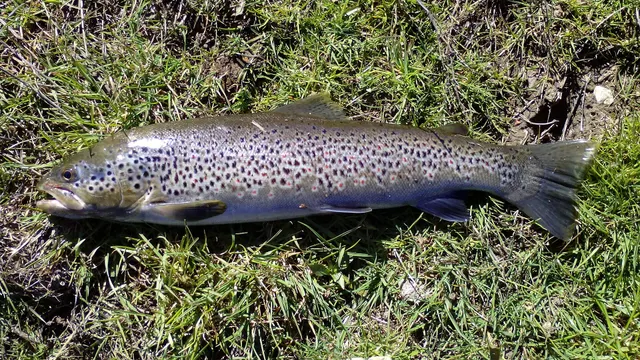 Brown troutA single, extraordinarily plastic species that appears as a tiny hill-stream fish, a deep-bodied loch trout and a silver sea-run migrant — all the same animal.
Robermix, CC0, via Wikimedia Commons
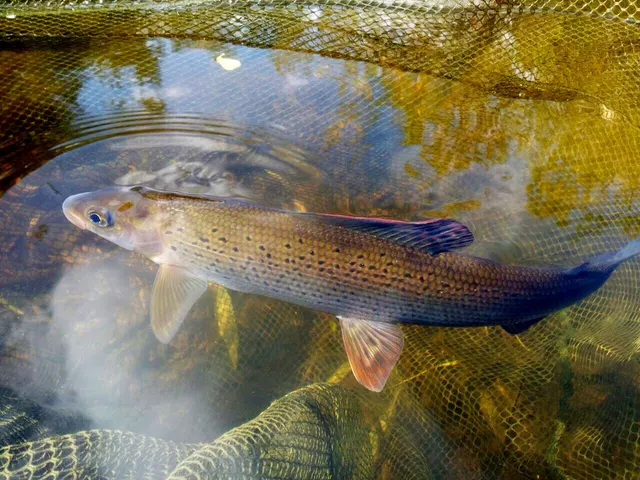 GraylingA salmonid with a sail for a dorsal fin that feeds hard through the winter — which makes it the game angler's season when the trout season has closed.
High Plains Grifter — CC BY-SA 4.0, via Wikimedia Commons
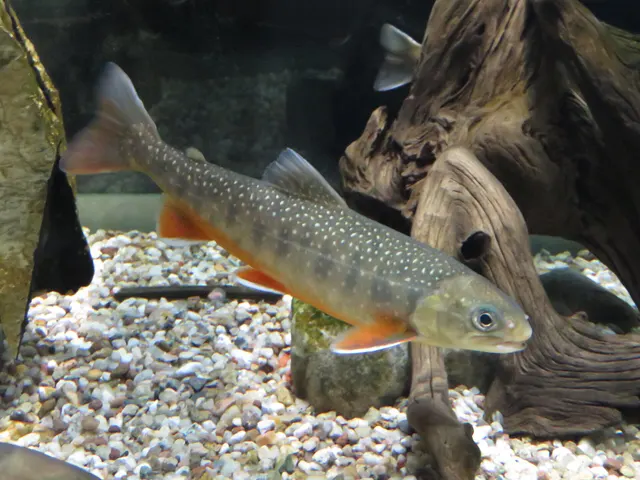 Arctic charThe most northerly freshwater fish in the world, a cold-demanding char with brilliant orange-red spawning bellies and highly distinct landlocked populations.
Xepheid — CC BY-SA 4.0, via Wikimedia Commons
Safety
Drowning and immersion — Can cause serious injury or death
Snow-fed Alpine rivers peak in the afternoon and evening on clear warm days, and steep catchments answer rain within an hour or two, so a wadeable river can become unwadeable around somebody standing in it with no local sign that anything has changed.
What reduces it: Treat spring and early-summer afternoons on snow-fed water as a rising-water period by default, watch the level against a fixed mark rather than by feel, check the forecast for the mountains behind the beat rather than over it, and identify the exit before wading.
Worse when:
- In spring and early summer, when snowmelt drives a daily afternoon peak.
- On glacially influenced rivers in hot weather, when melt is greatest.
Moving water and currents — Can cause serious injury or death
Wading fast boulder and cobble beds is the normal method here, and a foot trapped in a gap with current behind the body folds the wader downstream and holds their face under. It happens in water well short of waist deep.
What reduces it: Use a wading staff, move one foot at a time with weight on the other, wear a belt on chest waders, refuse water that pushes harder than a comfortable stand, and do not wade fast water alone.
Cold water shock — Can cause serious injury or death
Spring-fed and snow-fed Alpine water stays cold through the summer, so an unexpected immersion produces the gasp response and loss of breathing control at any time of year, and hands lose dexterity within minutes.
What reduces it: Wear flotation rather than carry it, keep a means of calling for help on the person, and treat cold-water precautions as a year-round rather than a winter matter on this water.
Weather and lightning — Can cause injury needing treatment
Mountain weather changes quickly with altitude and afternoon thunderstorms build fast, on ground where the approach to a beat may be steep and loose and where an injury far from a road becomes a serious incident.
What reduces it: Tell somebody the beat and the return time, carry a means of calling for help on the person rather than in a bag, treat the walk in and out as part of the risk, and turn back on a building afternoon sky rather than fishing through it.
Further safety reading
- Wading safely — Snow-fed Alpine rivers rise around a wader on warm afternoons and answer mountain rain within an hour or two, on boulder beds where a trapped foot is the mechanism that drowns.
Check the rules before you fish
Fishing laws, bylaws, access rules, seasons, bait restrictions and permitted methods vary by location and can change. Check the current rules from the relevant authority and the water you intend to fish before fishing.
Check with:
- Current national or regional law for where you are fishing
- Current local bylaws
- The relevant fisheries authority
- The landowner, club or fishery whose water it is
- Any restrictions specific to the species or the method you intend to use
Where to go next
What swims here
- Arctic charPresent in deep cold Alpine lakes as a relict of glaciation, which makes an Austrian lake one of the few places in central Europe the species can be met at all.
- Brown troutThe fish of the Alpine limestone rivers, on beats where rod numbers are limited and the water is managed intensively by whoever holds the fishing right.
- GraylingA defining species of the classic Austrian rivers and the reason a good deal of European dry-fly and nymphing technique was worked out on this water.
How people fish here
How this compares
Rules and access
Environment and conservation
Sources and evidence
- Freshwater Fishes of the British Isles — HarperCollins (New Naturalist 75), 1992 (Reference work)Relied on for: Distribution, ecology, life history and conservation status of European freshwater fishes, including the migratory salmonids and the cyprinid and percid communities named.States this directlyCitation checked — the work exists and is described correctly
- FishBase: a global information system on fishes — Froese, R. and D. Pauly, eds. — FishBase Consortium (Scientific institute)Relied on for: Recorded distribution, habitat association and life history of the freshwater and migratory species named.States this directlyPassage read and verified
- FishBase: a global information system on fishes — Froese, R. and D. Pauly, eds. — FishBase Consortium (Scientific institute)Relied on for: Recorded distribution, depth range, habitat association, size and biology of the species named.States this directlyPassage read and verified
- The IUCN Red List of Threatened Species — International Union for Conservation of Nature (Conservation authority)Relied on for: Current global and regional conservation assessment for the species named, with the assessment date.Background and mechanism onlyCitation checked — the work exists and is described correctly
- Fishers' Craft and Lettered Art: Tracts on Fishing from the End of the Middle Ages — University of Toronto Press, 1997 (Scientific literature)Relied on for: That European fishing traditions develop around the water and fish available to them, and the historical method of reading such traditions.Background and mechanism onlyCitation checked — the work exists and is described correctly
- General angling website restatements of established technique — Various (Credible secondary source)Relied on for: Widely restated descriptions of regional angling practice, recorded as practitioner consensus rather than as scholarship.Background and mechanism onlyCitation checked — the work exists and is described correctly
Why the 8 connections on this page are here, and the sources
What swims here
Backed by research — 3 connections
Supported by peer-reviewed research or fisheries science. The sources are listed and can be checked.
Arctic char
That a species occurs in these waters, drawn from distribution science and stock assessment. It is a statement about where the animal lives and is not a statement that anybody will catch one, still less where.
- Freshwater Fishes of the British Isles — HarperCollins (New Naturalist 75), 1992 (Reference work)Relied on for: Distribution, habitat requirement and life history of European freshwater fishes, including their occurrence across the continental range named.States this directlyCitation checked — the work exists and is described correctly
- FishBase: a global information system on fishes — Froese, R. and D. Pauly, eds. — FishBase Consortium (Scientific institute)Relied on for: Recorded distribution and habitat association of the freshwater and migratory species named.States this directlyPassage read and verified
Brown trout
That a species occurs in these waters, drawn from distribution science and stock assessment. It is a statement about where the animal lives and is not a statement that anybody will catch one, still less where.
- Freshwater Fishes of the British Isles — HarperCollins (New Naturalist 75), 1992 (Reference work)Relied on for: Distribution, habitat requirement and life history of European freshwater fishes, including their occurrence across the continental range named.States this directlyCitation checked — the work exists and is described correctly
- FishBase: a global information system on fishes — Froese, R. and D. Pauly, eds. — FishBase Consortium (Scientific institute)Relied on for: Recorded distribution and habitat association of the freshwater and migratory species named.States this directlyPassage read and verified
Grayling
That a species occurs in these waters, drawn from distribution science and stock assessment. It is a statement about where the animal lives and is not a statement that anybody will catch one, still less where.
- Freshwater Fishes of the British Isles — HarperCollins (New Naturalist 75), 1992 (Reference work)Relied on for: Distribution, habitat requirement and life history of European freshwater fishes, including their occurrence across the continental range named.States this directlyCitation checked — the work exists and is described correctly
- FishBase: a global information system on fishes — Froese, R. and D. Pauly, eds. — FishBase Consortium (Scientific institute)Relied on for: Recorded distribution and habitat association of the freshwater and migratory species named.States this directlyPassage read and verified
How people fish here
What experienced anglers do — 1 connection
Widely and independently recommended by experienced anglers and specialist sources. This is real angling knowledge, not proof: controlled evidence for it is limited, and FishingHQ records it as convention rather than as a demonstrated effect.
Fly fishing
That a discipline is conventionally practised in these waters, drawn from published description of practice rather than from participation data, and labelled as consensus accordingly.
- Sea Angler — Bauer Media (Specialist angling publication)Relied on for: Long-running published description of European sea angling practice by region and destination, including where British anglers travel and what they fish for there.FishingHQ's interpretation of what it saysCitation checked — the work exists and is described correctly
- General angling website restatements of established technique — Various (Credible secondary source)Relied on for: Widely restated descriptions of which disciplines are conventionally practised in the waters named, recorded as practitioner consensus rather than as scholarship.Background and mechanism onlyCitation checked — the work exists and is described correctly
How this compares
What experienced anglers do — 1 connection
Widely and independently recommended by experienced anglers and specialist sources. This is real angling knowledge, not proof: controlled evidence for it is limited, and FishingHQ records it as convention rather than as a demonstrated effect.
Hungary
A navigational link between two places a reader is genuinely choosing between or reasoning across, offered as orientation rather than as a ranking.
- Sea Angler — Bauer Media (Specialist angling publication)Relied on for: Long-running published description of European sea angling practice by region and destination, including where British anglers travel and what they fish for there.FishingHQ's interpretation of what it saysCitation checked — the work exists and is described correctly
- General angling website restatements of established technique — Various (Credible secondary source)Relied on for: Widely restated descriptions of which disciplines are conventionally practised in the waters named, recorded as practitioner consensus rather than as scholarship.Background and mechanism onlyCitation checked — the work exists and is described correctly
Safety reading
Official guidance — 1 connection
Stated by a fisheries authority, scientific institute or recognised angling body. Authoritative, but summarising rather than demonstrating.
Wading safely
A link from the place to the substantial safety topic describing the mechanism that hurts people there, rather than a warning restated in prose on the record itself.
- RNLI water safety guidance: cold water shock and Float to Live — Royal National Lifeboat Institution (Water-safety or diver-training authority)Relied on for: Cold water shock and the immersion response, tidal cut-off, and water-safety guidance for shore anglers and small-craft users.States this directlyPassage read and verified
Rules and access
Official guidance — 1 connection
Stated by a fisheries authority, scientific institute or recognised angling body. Authoritative, but summarising rather than demonstrating.
Licences and permission
This points to the kind of rule that applies rather than to a rule itself. The same question is administered differently in each of these countries, so the page says that the answer is held elsewhere and changes.
- Code of Conduct for Responsible Fisheries — Food and Agriculture Organization of the United Nations, Rome, 1995 (Standards body)Relied on for: The international framework within which national and regional fisheries authorities set, revise and enforce measures, and the principle that the responsible authority rather than a third party holds the current position.Background and mechanism onlyCitation checked — the work exists and is described correctly
- ICES Advice on fishing opportunities, catch and effort — International Council for the Exploration of the Sea (Scientific institute)Relied on for: That the stock advice European measures are set against is produced internationally and revised annually, which is how a national measure changes without the national law changing.States this directlyCitation checked — the work exists and is described correctly
Environment and conservation
Backed by research — 1 connection
Supported by peer-reviewed research or fisheries science. The sources are listed and can be checked.
Stocking: what it does to a fishery
An environmental claim attached to the geography where it operates, resting on published stock assessment and conservation status rather than on advocacy.
- The IUCN Red List of Threatened Species — International Union for Conservation of Nature (Conservation authority)Relied on for: The conservation assessment of the species and stocks concerned, with the assessment date, which is the basis for treating the pressure on them as established rather than asserted.States this directlyCitation checked — the work exists and is described correctly
- ICES Advice on fishing opportunities, catch and effort — International Council for the Exploration of the Sea (Scientific institute)Relied on for: Stock status and the advice on which management measures for the stocks concerned are set and revised.States this directlyCitation checked — the work exists and is described correctly
How FishingHQ labels evidence is explained in the evidence policy.