What does brown trout eat?
What is established about how brown trout feeds, kept separate from what anglers infer from it.
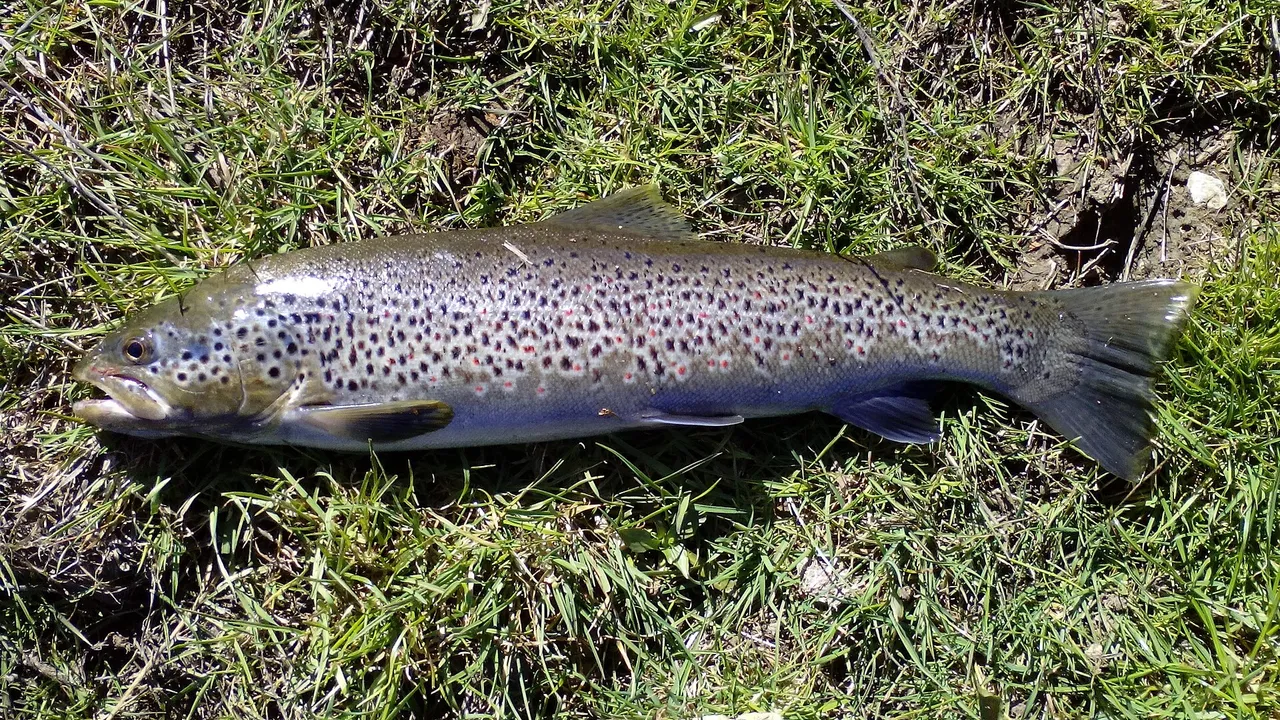
How this was identified, and who took it
Identified by: Both black and red spots, many ringed with pale haloes, spotting extending onto the gill cover, an adipose fin, and a thick caudal wrist — together separating it from Atlantic salmon, which lacks red spots and has a slimmer wrist.Robermix, CC0, via Wikimedia Commons — source, licenceWhat is known about how it feeds
A trout in a river is running an energy calculation, continuously.
The fish holds a feeding station in the current and intercepts what drifts past it, and the position is chosen so that the food delivered exceeds the cost of holding station there. That economics is precise and observable: a trout will not move far for a small item and will move a considerable distance for a large one, and the same fish will abandon a station that stops paying.
The two verified relationships are what the drift mostly consists of. Aquatic insect larvae — mayfly, caddis, stonefly and chironomid — are the staple across the range and across most of the fish's life. Gammarid amphipods are the second, and they matter most in clean stony rivers and in winter, when insect larvae are less available and the shrimp population is not.
Surface feeding is a minority of the total effort despite being the part everybody photographs. Most of what a river trout eats, it eats below the surface.
Stillwater trout patrol rather than hold, which is a different strategy for the same food, and large individuals in both environments become substantially piscivorous — a shift that takes the fish out of the drift economy entirely.
Vision dominates, and the restricted cone through which a trout sees the world above the surface is the reason approach angle matters so much to anyone trying to present something to one.
The food
Prey with a verified dietary link to this fish. Each entry carries its own evidence, and each is written at the precision the source actually used: a named species where the source named one, a group or food category where it said “polychaetes”, “crustaceans” or “detritus” and meant it. That is why this list is shorter than the animal’s real diet rather than longer.
- Aquatic insect larvae as prey — a group rather than a species: the evidence names the group
Aquatic insect larvae are the staple of the brown trout diet in running water for most of its life, and surface feeding on adults is a minority of the total feeding effort.
- Amphipods and mysids as prey — a group rather than a species: the evidence names the group
Gammarus is one of the most abundant invertebrates in clean stony rivers and a staple of trout diets, particularly in winter when insect larvae are less available.
Food with no page of its own here yet
These are real components of the diet, listed as plain text because FishingHQ has no page for them yet. Inventing pages to make the list look fuller would be the fabrication this whole approach exists to prevent.
- terrestrial insects fallen onto the surface
- minnows, bullheads and small fish
- snails
- fish eggs
- small crayfish, where present
What anglers do with this
Everything below is interpretation, not finding. It is what experienced anglers conclude from the biology above, and the reasoning is usually sound and almost never tested. It is separated from the biology deliberately.
The drift economics is the single most productive idea in river trout angling, and it converts into both location and presentation: find where food is delivered, and put something there that behaves as though it is being delivered. Everything about dead-drift presentation follows from it, and it is practitioner reasoning of great depth resting on well-observed behaviour.
The dominance of subsurface feeding is the reasoning behind the emphasis on nymphs, and the widely repeated observation that the visible surface activity represents a small share of what the fish is doing.
The visual window explains the approach conventions — low, from behind, off the skyline — which are convention derived from optics.
The shift to fish prey in large individuals is the reason a different approach reaches a different class of fish, and it is inference from the recorded diet rather than a demonstrated selection effect.
What this does not establish
Both relationships are group-level and neither establishes proportion. Diet varies enormously between chalk streams, freestone rivers, upland burns and stillwaters, between seasons, and between sizes of fish — and the piscivorous component in large trout is not represented by a verified relationship at all. Nothing here describes any particular water.
Where this connects
These are the baits, lures, methods and explainers FishingHQ already joins to this fish — which is why the list is sometimes short. They are not chosen for this page, and a link here means an evidenced relationship exists, not that it follows from the diet.
Methods used for it
The science behind the feeding
- Crustacean imitation in saltwater fly fishing
- Dry fly, nymph, wet fly and streamer: the four approaches
- Matching the hatch: what it means and when it is wrong
- Presentation and drag
- Redds, spawning, and what happens after
- The four fly types, and what each imitates
- The insects fly fishing imitates
- Trout, char and salmon: what the words actually mean
- Water temperature and what it does to a fish
This page covers feeding. The Brown trout record covers identification, lifecycle, seasonal behaviour, handling and the sources behind all of it.
Reviewed 2026-08-12.