Atlantic cod
Fish · Last reviewed 2026-08-10
A large, heavily-built demersal predator of the North Atlantic, and the species whose commercial history is the standard example of stock collapse.
Safety: boat safety — can cause serious injury or death. 5 more points apply here.
Barotrauma and pressure injury — Can cause injury needing treatment
A cod brought quickly from depth cannot vent the expanding gas in its swimbladder. It arrives bloated, sometimes with the stomach forced out of the mouth and the eyes protruding, and cannot swim back down if released — so it floats, and dies.
What reduces it: Retrieve more slowly from depth where possible, and use a weighted descending device to return the fish to depth if it is to be released. If a fish cannot be returned in a state where it can swim down, that is a reason to stop fishing that mark rather than to keep releasing fish that will not survive.
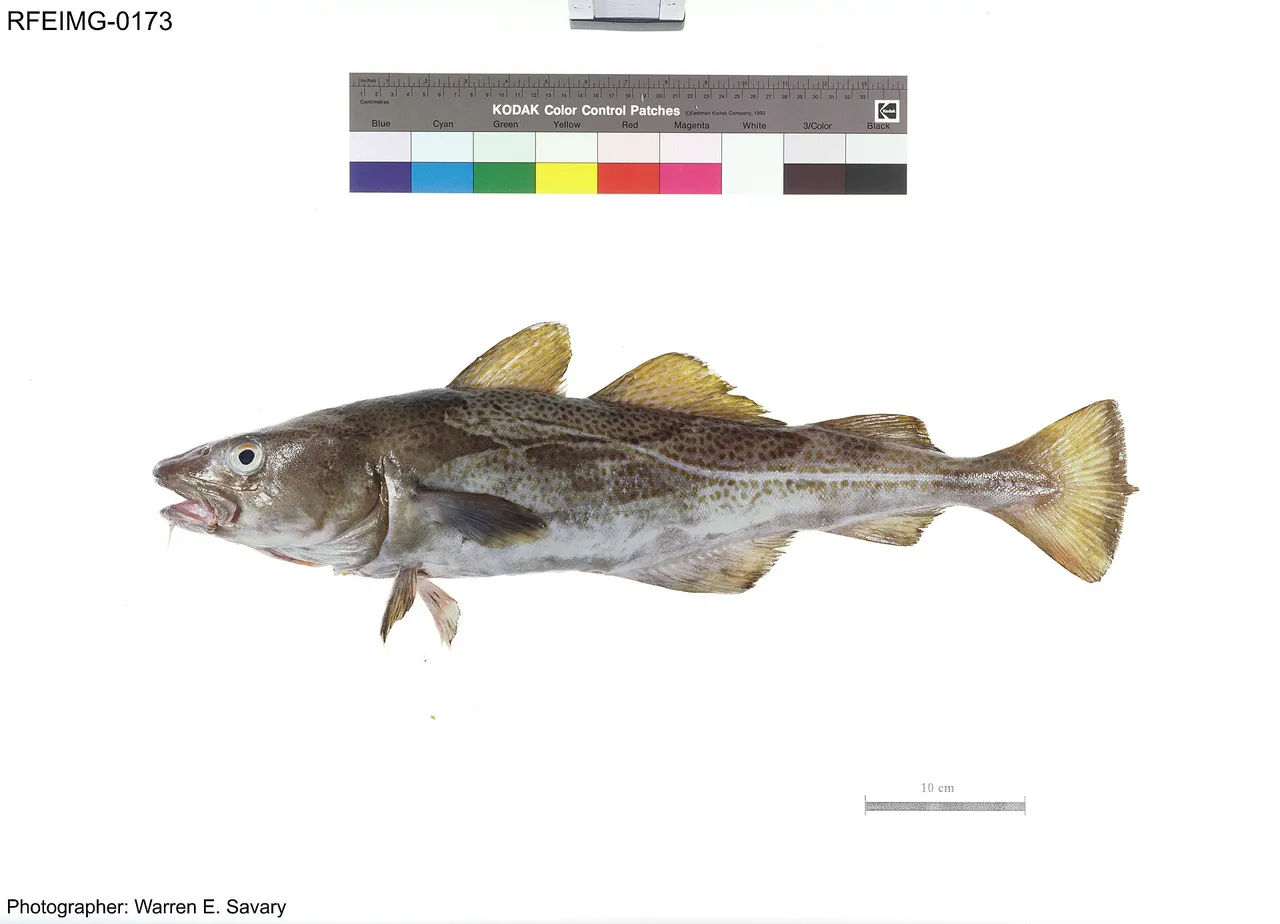
How this was identified, and who took it
Identified by: Three separate dorsal fins, two anal fins, a single chin barbel, and the pale lateral line curving above the pectoral fin. A scientific voucher photograph with colour calibration, which is the strongest identification basis in this manifest.The U.S. Food and Drug Administration, Public domain, via Wikimedia Commons — source, licence.jpg)
Catching Atlantic cod
Everything here on fishing for it. Each entry opens the page behind it.
- Ground
- When
- Somewhere documents it in almost every month, so there is no season for the species as a whole — the season is a property of the ground, and each place states its own.
- Where
- 197 places FishingHQ documents — strongest claim anywhere: characteristic of this water · From the shore, From a kayak, From a boat, On a charter
Cod are big, blunt and unfussy: a heavy-bodied bottom predator with a large mouth, a single conspicuous chin barbel and an appetite that has made 'anything a cod will eat' a category rather than a joke. They take crabs, worms, fish, squid and — regularly enough to be documented — objects that are not food at all.
For anglers, cod are a cold-water winter species over most of the accessible European range, taken from shore in surf and over rough ground, and from boats over wrecks and reefs. The tackle is heavier than almost anything else in sea angling, not because cod fight especially hard but because the ground they live over eats terminal tackle.
Cod are also the species that carries the heaviest historical weight in fisheries science. The collapse of the Newfoundland stock is the textbook case of a fishery managed past its capacity to recover, and it is impossible to write about cod without that context — which is why FishingHQ's environmental records treat cod as the worked example of stock sustainability rather than as a footnote.
Straight answers
For somebody who is already standing on the mark. Everything below this expands on it.
- When should I go?
- In Britain and Ireland, from the first autumn gale onwards — roughly October to February, and the days immediately after a big sea are the ones worth taking off work. In northern Norway, January to April, which is the opposite half of the year.
- Where should I stand?
- Where a rough sea has been putting food. A beach with rough ground at one end, the tide line of a storm, a gully in a rock mark, the scour off a pier stanchion. Cod come inshore to eat what the sea has dislodged.
- How far do I need to cast?
- Usually far less far than you think. Coloured water brings cod into the first gutter, and a great many winter cod are caught inside forty yards by people who watched somebody else cast a hundred and blank.
- What bait?
- Big, and more than one thing. A lugworm-and-squid cocktail is the default because it covers two of the prey types cod specialise on; a peeler crab covers a third. Find out what the local fish are eating rather than deciding in the shop.
- Can I keep it?
- There is no UK recreational bag limit for cod as at 2026, and minimum sizes are set district by district in England rather than nationally. Check your own IFCA or administration before you fish, not after.
Where you are fishing from
The same fish, and genuinely different fishing. Open the one you are standing on.
Beach
Open sand and shingle, and the question of range
The winter surf beach, and the case against casting further
- On or near the bottom
Methods: Surfcasting, Ledgering
How this mark actually fishes
Why fish are here
A steep-shingle or mixed-sand beach after a blow is a food conveyor. Broken shellfish, dislodged worm and crab, and weed all end up rolling in the coloured water inside the first or second bank, and cod come into extraordinarily shallow water to feed on it under cover of colour and darkness. The gutters — the troughs between banks, visible at low water on a spring tide and invisible at any other time — are where the food and the fish both end up.
How to fish it
Fish the gutter, not the horizon. On a coloured winter sea a hundred-yard cast frequently lands beyond the fish; forty to sixty yards into the first trough will out-fish it, and there are evenings when a bait dropped into the second wave is the one that goes. Use a grip lead heavy enough to stay where you put it, because a bait rolling in the sweep is a bait that has left the feature. Two rods if the venue allows: one short into the gutter, one long onto the outer bank, and let the fish tell you which.
What to look at on arrival
- Weed on the tide line and brown water. Both mean the sea has been working.
- A dropping swell rather than a rising one. Rising means it is about to become unfishable.
- Slack bites that pull the lead out of the sand rather than rattling the tip — a cod frequently moves towards you.
What goes wrong here
- Casting as far as possible on principle. On a coloured winter beach this is the single commonest way to fish past cod.
- Fishing a beach you have never seen at low water, which means fishing without knowing where the gutters are.
The conditions that make winter beach cod fishing good are the conditions that drown people. A big dropping sea still puts unpredictable waves up a shingle bank, and cold water plus dark plus alone is the combination behind most shore fishing fatalities.
What experienced anglers do — why, and the sources
Widely and independently recommended by experienced anglers and specialist sources. This is real angling knowledge, not proof: controlled evidence for it is limited, and FishingHQ records it as convention rather than as a demonstrated effect.
How beach marks fish for this species, from the evidence named here.
Rock marks
Depth close in, and the edge fish hunt along
Rough ground, where the food lives and the tackle dies
- On or near the bottom
- Deep water
Methods: Ledgering, Surfcasting
How this mark actually fishes
Why fish are here
Boulder fields, kelp and broken reef hold the crustaceans, small fish and shellfish that cod eat, and they hold them permanently rather than only after a storm. A rock mark with deep water close in gives a cod the two things it wants at once: food, and enough depth to feed in daylight. These marks frequently fish when beaches do not, because the food does not have to be delivered by a gale.
How to fish it
Accept that you will lose tackle and set up so that losing it is cheap and safe: a rotten-bottom link so the lead goes and the fish does not, and line heavy enough to pull a hook out of kelp. Fish shorter than you would on sand — the gullies close in are the feature. Bait big and tough, because everything on rough ground will strip a soft worm bait in minutes.
What to look at on arrival
- Gullies and channels running out through the rock, which are the paths fish use on a rising tide.
- The state of tide at which a particular gully has enough water to hold a fish.
What goes wrong here
- Fishing standard beach terminal tackle and losing a whole rig, and often a fish, at every snag.
- Standing where you cannot retreat as the tide rises. On rock this is the mistake that kills people rather than the one that costs a lead.
Rock marks cut off, and wet kelp-covered boulders are as slippery as ice. Know your escape route and the time it closes before you climb down to fish.
What experienced anglers do — why, and the sources
Widely and independently recommended by experienced anglers and specialist sources. This is real angling knowledge, not proof: controlled evidence for it is limited, and FishingHQ records it as convention rather than as a demonstrated effect.
How rock marks marks fish for this species, from the evidence named here.
Pier and jetty
Deep water without a boat
Deep water, structure and lights, without a boat
- On or near the bottom
- Deep water
Methods: Ledgering, Float fishing
How this mark actually fishes
Why fish are here
A pier gives an angler deep water without a hull, and it gives a cod exactly the kind of edge it hunts: piles that break the tide and scour holes downtide of them where food collects. Where a pier is lit, the lights concentrate small fish through the night, which concentrates what eats them. The structure is also permanent and mapped by everybody who fishes it, which makes a pier the easiest venue on which to learn where cod actually sit.
How to fish it
Fish tight to the structure rather than away from it — the scour hole behind a stanchion is often within a rod length of the rail. Down the side on a running ledger frequently beats a long cast. Work out which stanchions produce on which state of tide; on most piers it is a small number of them and the difference is large.
What to look at on arrival
- Where the tide breaks around the piles, and which side of the pier is downtide at the state you are fishing.
- Small fish under the lights after dark.
What goes wrong here
- Casting straight out and ignoring the structure you are standing on, which is the feature.
- Arriving without a drop net on a pier high enough to need one, and losing a good fish at the rail.
What experienced anglers do — why, and the sources
Widely and independently recommended by experienced anglers and specialist sources. This is real angling knowledge, not proof: controlled evidence for it is limited, and FishingHQ records it as convention rather than as a demonstrated effect.
How pier and jetty marks fish for this species, from the evidence named here.
Estuary
Where the river meets the tide
Where a river meets the tide, and colour arrives without a gale
- On or near the bottom
Methods: Ledgering
How this mark actually fishes
Why fish are here
An estuary is permanently doing what a storm does to a beach: moving water, carrying colour and food, over ground that changes with every tide. Cod push in on the flood to feed over mud and mussel scars that are dry six hours later, and a river carrying rain gives an estuary the coloured water that a beach only gets after a blow. Estuary cod are often smaller than open-coast fish and are frequently far more reliable.
How to fish it
Fish the flood and the first of the ebb, over the channel edges rather than the middle. Baits that hold up in moving water — squid, crab, tough worm — beat delicate ones. Watch the size of your lead against the run of the tide; an estuary in flood carries more water than the surf on the beach outside it.
What to look at on arrival
- A river running coloured after rain, which is an estuary's version of a gale.
- The channel edge, the mussel scars and the point where a creek joins the main run.
What goes wrong here
- Wading out onto flats that fill behind you. Estuary channels cut people off faster than any beach.
- Treating an estuary as a small sea. The tide runs harder and the ground changes more.
Soft mud and a filling channel are the two hazards, and they combine. An estuary flat that took twenty minutes to walk out over can be impassable in ten.
What experienced anglers do — why, and the sources
Widely and independently recommended by experienced anglers and specialist sources. This is real angling knowledge, not proof: controlled evidence for it is limited, and FishingHQ records it as convention rather than as a demonstrated effect.
How estuary marks fish for this species, from the evidence named here.
Boat
Your own hull, and the freedom to move
Over ground you could not otherwise reach
- On or near the bottom
- Deep water
Methods: Drift fishing, Ledgering, Jigging
How this mark actually fishes
Why fish are here
A boat removes the constraint that shapes all the venues above: you no longer have to fish where the fish happens to come to you. Banks, scoured channels, reef edges and rough ground that no cast reaches become fishable, and — decisively in winter — you can move when a mark is not producing rather than sitting it out. The fish are doing the same thing they do inshore; you are simply able to go to the edge rather than waiting at one.
How to fish it
Fish on the drift over ground rather than at anchor, unless the tide or the mark demands otherwise. Keep the bait in contact with the bottom: cod feed low and a bait swinging in mid-water is out of the game. Let a bite develop — a cod frequently mouths a large bait before taking it — and lift into it rather than striking.
What to look at on arrival
- The sounder showing the ground coming up, and fish sitting just off the up-tide side of it.
- The rate of drift. Too fast and the bait never gets down; too slow and you cover nothing.
What goes wrong here
- Too little lead. Losing the bottom is losing the fishing, and most anglers under-weight rather than over-weight.
What experienced anglers do — why, and the sources
Widely and independently recommended by experienced anglers and specialist sources. This is real angling knowledge, not proof: controlled evidence for it is limited, and FishingHQ records it as convention rather than as a demonstrated effect.
How boat marks fish for this species, from the evidence named here.
Reef and rough ground
Broken ground, weed and the fish that live in it
Wrecks and hard ground, where cod are reliable and tackle is not
- On or near the bottom
- Deep water
Methods: Drift fishing, Jigging
How this mark actually fishes
Why fish are here
A wreck concentrates everything: it interrupts current, it grows weed and shellfish, it holds small fish, and it has been doing all three for decades. Cod hold on and around it in numbers that open ground never produces, usually near the bottom and often tight to the structure on the up-tide side where the current brings food to them.
How to fish it
The pass is short and the timing is everything. Get down fast on the up-tide approach, fish the moment the ground rises, and be prepared to lose the rig on the far side. A pirk or a large shad worked close to the structure covers the same water a bait does with far less time spent sinking, which matters when a drift lasts ninety seconds.
What to look at on arrival
- The skipper's line-up. On a wreck the drift is planned rather than accidental, and being ready at the right moment is most of the skill.
What goes wrong here
- Fishing through the whole drift instead of the productive part of it, and donating tackle to the wreck on every pass.
- Winding the moment you feel the fish. A cod pulled up hard off a wreck brings the trace through everything you were trying to avoid.
What experienced anglers do — why, and the sources
Widely and independently recommended by experienced anglers and specialist sources. This is real angling knowledge, not proof: controlled evidence for it is limited, and FishingHQ records it as convention rather than as a demonstrated effect.
How reef and rough ground marks fish for this species, from the evidence named here.
Why cod are within reach, and when
Each of these is a piece of biology or hydrography, what it looks like from where you are standing, and what you can try as a result.
Cold water brings them within casting range
- What you may see
- Sea temperature falling through autumn, and the first sustained cold snap. Local reports of codling turning up at marks that produced nothing in August.
- What to try
- Start fishing the marks you wrote off in summer. The same rock ledge that gave you wrasse in July is a cod mark in November, and the change is in the water rather than in the ground.
- Where this breaks down
- Temperature is a permission rather than a cause. Cold water lets cod be there; it does not put them there, and a cold flat calm sea can be as empty as a warm one.
Why this happens
Cod are a cold-water gadoid, and their comfortable temperature band sits below what a British inshore summer provides. Through the warm months the fish that are within reach of a shore angler are mostly small, and the larger ones are further out and deeper where the water is cooler. As inshore water cools through autumn, that constraint relaxes: the band of water a cod will tolerate expands towards the beach, and fish that spent the summer offshore become catchable from ground a person can stand on. This is why the British cod season is not a migration story in the way the Norwegian one is — the fish do not arrive from somewhere else so much as the temperature stops excluding them from where you are.
What experienced anglers do — why, and the sources
Widely and independently recommended by experienced anglers and specialist sources. This is real angling knowledge, not proof: controlled evidence for it is limited, and FishingHQ records it as convention rather than as a demonstrated effect.
The mechanism above, and what it rests on.
A gale is a feeding event, and the fishing follows it
- What you may see
- Two to four days of strong onshore wind, then a dropping sea with the water still brown. Weed on the tide line. The point at which the surf is fishable but the water has not yet cleared.
- What to try
- Fish it. This is the window, and it is short — clearing water usually means the cod have gone back out. Fish close in, use a bait that smells, and expect bites much nearer the rod than in settled conditions.
- Where this breaks down
- There is a limit. Water carrying so much weed that a bait cannot stay in a fishable position is unfishable however good the theory, and the same sea that makes the fishing makes the ground dangerous.
Why this happens
The single most reliable pattern in British cod fishing is not a season, a tide or a bait: it is the two or three days after a big onshore sea. A storm tears weed off the ground, breaks open razor shells and mussel beds, dislodges crabs from under boulders and lifts worm beds out of the sand. That material does not vanish when the wind drops — it sits suspended and rolling in coloured water along the shore, and cod move in behind the sea to eat it. The colour matters twice over: it is the visible sign that food is in the water, and it is the cover that lets a large fish feed in three feet of water in daylight without feeling exposed.
What experienced anglers do — why, and the sources
Widely and independently recommended by experienced anglers and specialist sources. This is real angling knowledge, not proof: controlled evidence for it is limited, and FishingHQ records it as convention rather than as a demonstrated effect.
The mechanism above, and what it rests on.
Individual cod specialise, even though the species does not
- What you may see
- What is actually on the ground you are fishing. Razor shells on the tide line after a blow, a peeler crab run in spring, whitebait pushed into a harbour mouth, sandeel in the surf. And what comes out of the fish you keep.
- What to try
- Match the local prey rather than the species' reputation, and use two baits on a cocktail so you are asking two questions at once. If the cod you keep are full of crab, fish crab.
- Where this breaks down
- The sampling was August and September in the north-eastern central North Sea, which is a feeding season and not the winter inshore period most readers of this will fish. The finding transferred is the principle of individual specialisation, not the specific prey list.
Why this happens
Cod are famously opportunistic and that is a statement about the population. Sorting individual North Sea cod by stomach contents produced something different: six groups in which a single prey type made up three-quarters or more of what the fish had eaten by mass — sandeel, clupeids, Norway pout, flatfish, crustaceans, brittle stars. In other words, on a given piece of ground at a given time, a great many cod are eating largely one thing. Alongside that runs an ontogenetic shift: as cod get bigger the invertebrate share of the diet falls and the fish share, predominantly herring in that study, rises. A big cod is increasingly a fish-eater and a small one is increasingly not.
Backed by research — why, and the sources (1)
Supported by peer-reviewed research or fisheries science. The sources are listed and can be checked.
The mechanism above, and what it rests on.
- The influence of feeding behaviour on growth of Atlantic cod (Gadus morhua) in the North Sea — Journal of Applied Ichthyology (Wiley), 2016 (Scientific literature)Relied on for: Six feeding groups defined by one prey type exceeding 75 per cent of stomach contents by mass, and the ontogenetic shift from crustaceans to fish with increasing cod size.States this directlyPassage read and verified
In northern Norway the season is a migration, and it is the other half of the year
- What you may see
- The calendar, more than anything on the water. Late winter, and the arrival of the run being reported locally.
- What to try
- If you are planning a cod trip abroad, plan it against the local season rather than against the one you know. February in Lofoten and February in Lincolnshire are different propositions in the same fish.
- Where this breaks down
- The window is well documented and the detail is not claimed here. The source is Norway's tourism board rather than its marine research institute, so this profile states a season and nothing quantitative.
Why this happens
The Northeast Arctic cod stock spends five to seven years feeding in the Barents Sea and then travels over a thousand kilometres south-west to spawn along the Norwegian coast, concentrating around Lofoten. The run happens between January and April. That is not a variation on the British season; it is its opposite. The fish are large because they are mature spawners rather than the mixed year-classes a British beach produces, they are concentrated because they are going to one place for one purpose, and they are within reach of small boats because the coast shelves steeply into deep water. A British angler's mental model — cod as an autumn fish that gets scarcer after Christmas — is exactly wrong there.
Official guidance — why, and the sources (1)
Stated by a fisheries authority, scientific institute or recognised angling body. Authoritative, but summarising rather than demonstrating.
The mechanism above, and what it rests on.
- Skrei — the Norwegian Arctic cod, and the season it arrives in — Visit Norway (Innovation Norway), the national tourism board (Credible secondary source)Relied on for: Mature cod migrating over a thousand kilometres from the Barents Sea to spawn along the Norwegian coast around Lofoten between January and April.States this directlyCitation checked — the work exists and is described correctly
They hunt edges, not open ground
- What you may see
- The beach at low water on a big spring tide, which is the only time most of it is visible. Weed lines, colour changes in the water, standing waves over a bank, the way surf breaks differently over rough ground.
- What to try
- Walk the mark at low water before you fish it in the dark. Then cast to the feature rather than to a distance, which usually means shorter and much more deliberately.
Why this happens
A cod feeding inshore is working a boundary. The edge of a weed bed, the scour hole downtide of a pier stanchion, the gutter between two banks, the line where rough ground meets clean sand, the foot of a boulder field. Two things make an edge worth a fish's time: food collects there because moving water drops what it is carrying when it slows, and an ambush is possible there because the fish can be close to prey without being in the open. This is why a mark that looks featureless from the promenade can be extremely specific once you know where the gutters run, and why local knowledge is worth more in cod fishing than in almost anything else.
What experienced anglers do — why, and the sources
Widely and independently recommended by experienced anglers and specialist sources. This is real angling knowledge, not proof: controlled evidence for it is limited, and FishingHQ records it as convention rather than as a demonstrated effect.
The mechanism above, and what it rests on.
Offshore, a wreck is a permanent version of the same edge
- What you may see
- The sounder, and the skipper. On a drift, the moment the ground comes up and then falls away again is the fishable part of the pass.
- What to try
- Fish the up-tide side and be ready on the drop. Most wreck cod are hooked in the first part of the drift and lost in the tackle in the last part of it.
Why this happens
The mechanism that puts a cod in a beach gutter puts one on a wreck: structure interrupts current, current concentrates food, and a predator that can hold station near the structure eats without chasing. What differs offshore is permanence and depth. A gutter is remade by every storm; a wreck has been in the same place for eighty years, has grown its own ecosystem, and holds fish reliably enough that skippers name individual pieces of it. Depth changes the fishing rather than the reason for it — a bait or a lure has to be got down and kept in a narrow band near the structure while the boat drifts over it, and the whole technique is about that control.
What experienced anglers do — why, and the sources
Widely and independently recommended by experienced anglers and specialist sources. This is real angling knowledge, not proof: controlled evidence for it is limited, and FishingHQ records it as convention rather than as a demonstrated effect.
The mechanism above, and what it rests on.
Finding them
What to look for, what it means, and how much it is worth. None of these guarantees a fish — the third column says how far each one is worth trusting.
7 things to look for
Two to four days of onshore gale, then a dropping sea
Usually worth acting onThe sea has broken open shellfish beds, torn weed and lifted worm and crab into the water. Food is suspended along the shore and cod will move in behind the weather to take it.
What to do: Fish the first fishable tide after the sea starts to drop, while the water is still coloured. Fish close in and use a bait with scent.
What experienced anglers do — why, and the sources
Widely and independently recommended by experienced anglers and specialist sources. This is real angling knowledge, not proof: controlled evidence for it is limited, and FishingHQ records it as convention rather than as a demonstrated effect.
What this sign rests on.
Brown, coloured water with weed on the tide line
Usually worth acting onBoth the food and the cover are present. Cod will feed in very shallow water in coloured conditions that they would not enter in a clear calm sea.
What to do: Shorten the cast. On a coloured beach the first gutter frequently out-fishes anything you can reach.
What experienced anglers do — why, and the sources
Widely and independently recommended by experienced anglers and specialist sources. This is real angling knowledge, not proof: controlled evidence for it is limited, and FishingHQ records it as convention rather than as a demonstrated effect.
What this sign rests on.
Sea temperature falling through autumn to the season's first cold spell
Often worth acting onThe temperature constraint that kept larger cod offshore through summer is relaxing, and inshore marks become viable again.
What to do: Start covering the marks you abandoned in July, particularly rough ground with deep water close in.
What experienced anglers do — why, and the sources
Widely and independently recommended by experienced anglers and specialist sources. This is real angling knowledge, not proof: controlled evidence for it is limited, and FishingHQ records it as convention rather than as a demonstrated effect.
What this sign rests on.
Razor shells, crab carapaces and broken mussel on the strand line
Often worth acting onYou are looking at exactly what the sea has been feeding to the fish. This is the most direct evidence available of what the local cod have been eating.
What to do: Fish that. A beach littered with razor shells is telling you something a bait shop cannot.
What experienced anglers do — why, and the sources
Widely and independently recommended by experienced anglers and specialist sources. This is real angling knowledge, not proof: controlled evidence for it is limited, and FishingHQ records it as convention rather than as a demonstrated effect.
What this sign rests on.
A slack, dropping-back bite rather than a rattle
Often worth acting onA cod that has taken a bait and moved towards you, releasing the tension on the lead. It is frequently the biggest bite of the night and it looks like nothing.
What to do: Wind down until you feel weight and lift into it. Do not strike at slack line.
What experienced anglers do — why, and the sources
Widely and independently recommended by experienced anglers and specialist sources. This is real angling knowledge, not proof: controlled evidence for it is limited, and FishingHQ records it as convention rather than as a demonstrated effect.
What this sign rests on.
A clear, flat, cold sea after a settled week
Often worth acting onThe food has stopped being delivered and the cover has gone. Cod will be further out and much harder from the shore.
What to do: Go at night, fish deeper marks or rough ground, or accept it is a poor tide and fish for something else.
What experienced anglers do — why, and the sources
Widely and independently recommended by experienced anglers and specialist sources. This is real angling knowledge, not proof: controlled evidence for it is limited, and FishingHQ records it as convention rather than as a demonstrated effect.
What this sign rests on.
Small fish concentrated under pier lights after dark
Sometimes means fishPrey is being held in one place by the light. In the ontogenetic shift, larger cod are increasingly fish-eaters, so a concentration of small fish is worth more to a big cod than to a small one.
What to do: Fish a fish bait, or a bait that looks like one, down the side rather than out.
What experienced anglers do — why, and the sources (1)
Widely and independently recommended by experienced anglers and specialist sources. This is real angling knowledge, not proof: controlled evidence for it is limited, and FishingHQ records it as convention rather than as a demonstrated effect.
What this sign rests on.
- The influence of feeding behaviour on growth of Atlantic cod (Gadus morhua) in the North Sea — Journal of Applied Ichthyology (Wiley), 2016 (Scientific literature)Relied on for: The declining invertebrate share and rising fish share of the diet with increasing cod size.States this directlyPassage read and verified
How to fish for them
Beachcasting a big bait into the gutter
When: The default British winter shore method: coloured water, a dropping sea, October to February, from a surf beach or a mixed shingle strand.
Why it works, how to do it, and what it will not do
Why it works
Cod feeding after a blow are working a defined trough close in, taking food that is rolling rather than swimming. A large static bait sitting in that trough is exactly what they are looking for, and holds its position long enough for a fish working along the gutter to find it by scent.
How to fish it
Cast to the feature, not for distance — usually forty to eighty yards. Use a grip lead so the bait stays in the trough rather than being swept out of it. One large bait on a pulley or a flapper rig, cast, and then leave it: cod bites develop slowly and reeling in every four minutes to check the bait is the commonest way to miss them.
Tackle
A 12-to-13-foot beachcaster rated to throw 4 to 6 oz plus bait, a fixed-spool or multiplier holding 250 yards of 15 lb line, a shock leader of 60 lb, and 5 or 6 oz grip leads. Hooks 3/0 to 6/0, because the bait is the size of the hook rather than the other way round.
What it will not do
- Useless in a clear flat calm, when the conditions the method depends on are simply absent.
- Unfishable when the sea carries so much weed that a lead will not stay put.
- Rewards local knowledge of gutters more than it rewards technique, which makes a new beach genuinely hard.
What experienced anglers do — why, and the sources
Widely and independently recommended by experienced anglers and specialist sources. This is real angling knowledge, not proof: controlled evidence for it is limited, and FishingHQ records it as convention rather than as a demonstrated effect.
What this account of the method rests on.
Ledgering down the side of structure
When: From a pier, a harbour wall, a breakwater or a rock ledge with deep water at the foot of it. Any time of the cod season, and particularly at night.
Why it works, how to do it, and what it will not do
Why it works
The scour hole behind a pile and the gully at the foot of a wall are features within a rod length. Casting past them is casting past the fish. A running ledger down the side puts a bait in the feature and lets a cod take line without feeling the rod.
How to fish it
A running ledger so the fish can move with the bait, lowered rather than cast, into the scour behind the structure. Fish the state of tide at which that particular feature has flow across it. Let a slack bite develop, then wind down and lift.
Tackle
A 10-to-12-foot rod with a soft enough tip to show a dropping-back bite, 20 lb line straight through, a running boom and 3 to 5 oz. Heavier than a beach set-up because the fish is coming up a wall rather than across sand, and a drop net if the wall is high.
What it will not do
- Only works where structure and depth coincide, which rules out most of a low-water beach.
- Crowded venues make fishing tight to structure socially difficult before it is technically difficult.
What experienced anglers do — why, and the sources
Widely and independently recommended by experienced anglers and specialist sources. This is real angling knowledge, not proof: controlled evidence for it is limited, and FishingHQ records it as convention rather than as a demonstrated effect.
What this account of the method rests on.
Drifting bait over ground from a boat
When: Boat fishing over banks, reef edges and rough ground, through the cod season and beyond it in deeper water.
Why it works, how to do it, and what it will not do
Why it works
Drifting covers ground that anchoring cannot, and it presents a bait moving at the same speed as the water the food is in. On broken ground it also lets you find where on the mark the fish actually are rather than committing to one spot.
How to fish it
Enough lead to stay in contact as the drift runs. Feel for the ground rising, keep the bait just off the bottom rather than buried in it, and lift into weight rather than striking at a rattle. Reset the drift rather than fishing on through unproductive water.
Tackle
A 20-to-30 lb class boat rod, a multiplier holding 300 yards of 30 lb braid, and 6 to 16 oz depending on tide and depth. Braid rather than mono because feeling the ground through 40 metres of water is the whole method, and mono stretch removes exactly that.
What it will not do
- Needs a skipper or your own boat, which puts it out of reach for most readers most of the time.
- A fast drift over deep water can make it impossible to get a bait down at all.
What experienced anglers do — why, and the sources
Widely and independently recommended by experienced anglers and specialist sources. This is real angling knowledge, not proof: controlled evidence for it is limited, and FishingHQ records it as convention rather than as a demonstrated effect.
What this account of the method rests on.
Pirking and jigging over wrecks and hard ground
When: Over wrecks and deep hard ground, particularly where the drift is short and repeated, and the standard approach on Norwegian and Icelandic deep-water cod grounds.
Why it works, how to do it, and what it will not do
Why it works
A short drift over a wreck gives very little fishing time, and a heavy metal gets down and starts working immediately where a bait is still sinking. It also exploits a cod's willingness to attack a large moving object near the bottom, which is a reflex rather than a feeding decision and does not require the fish to be hungry.
How to fish it
Drop to the bottom, wind up two or three turns, and work the lure in long lifts and controlled drops rather than short jerks — the take is almost always on the drop. Stay in contact on the way down; a slack line during the fall is how takes are missed.
Tackle
A stiff jigging rod, a multiplier or a strong spinning reel with 30 to 50 lb braid, and pirks from 150 g inshore to 500 g or more in Norwegian depths and tides. The weight is set by depth and drift speed, not by the size of fish expected.
What it will not do
- Extremely hard on tackle over a wreck, and a snagged pirk is an expensive snag.
- Selective for active fish. On a slow day a bait will out-fish a pirk consistently.
- The heavy Norwegian version is genuinely tiring, and the tackle that suits it is absurd on British inshore ground.
What experienced anglers do — why, and the sources
Widely and independently recommended by experienced anglers and specialist sources. This is real angling knowledge, not proof: controlled evidence for it is limited, and FishingHQ records it as convention rather than as a demonstrated effect.
What this account of the method rests on.
Working large soft plastics over structure
When: Boat fishing over wrecks and reefs, and increasingly from deep-water rock marks and kayaks in the west.
Why it works, how to do it, and what it will not do
Why it works
A large shad on a heavy jig head does what a pirk does with a more convincing profile and a better hook-up rate, and it can be fished slower — which matters when cod are near the bottom and not chasing. It suits the ontogenetic point directly: it is a fish-shaped lure for a size of cod that is increasingly eating fish.
How to fish it
Down to the bottom, then a slow lift-and-drop close to the structure. Keep it low. A shad worked at mid-water over a wreck catches pollack and misses cod, which is a useful accidental diagnostic.
Tackle
A 20 lb class boat rod or a heavy lure rod, braid, and jig heads from 60 to 200 g with 5-to-8-inch shads. Head weight is chosen to reach and hold the bottom in the tide running, and is the decision that makes or breaks the method.
What it will not do
- Loses to bait when fish are inactive.
- Snags cost more than a lead does, so the economics push people back to bait over the roughest ground.
What experienced anglers do — why, and the sources
Widely and independently recommended by experienced anglers and specialist sources. This is real angling knowledge, not proof: controlled evidence for it is limited, and FishingHQ records it as convention rather than as a demonstrated effect.
What this account of the method rests on.
Lures
Chosen by weight, sink rate, depth and retrieve, because those are what decide whether a lure is in front of a fish. There is no best one, and no best colour.
Pirks and heavy metals
A long, heavy chrome or painted metal bar with a treble or single at the tail, fished vertically rather than cast.
- Weight
- 150 g to 500 g and beyond, chosen by depth and drift rather than by fish size
- Depth it fishes
- On or within a few metres of the bottom. A pirk fished in mid-water over a wreck is fishing for pollack.
- Sink rate
- Fast and near-vertical, which is the point: a pirk is fishing while a bait is still on its way down.
- Retrieve
- Long lifts and controlled drops, staying in contact on the fall. The take is on the drop far more often than on the lift, and a slack line during the fall is a missed fish.
When it works, and when it does not
Short repeated drifts over wrecks and hard ground, and deep Norwegian and Icelandic marks where the tide and the depth make anything lighter unfishable. It works best on active fish holding tight to structure, where speed of deployment matters more than subtlety, and it is the standard tool of the northern deep-water cod fishery for exactly that reason.
Limitation: Snags catastrophically, is tiring to fish all day, and is comfortably out-fished by bait when the fish are not actively feeding.
- Boat
- Reef and rough ground
What experienced anglers do — why, and the sources
Widely and independently recommended by experienced anglers and specialist sources. This is real angling knowledge, not proof: controlled evidence for it is limited, and FishingHQ records it as convention rather than as a demonstrated effect.
What this lure guidance rests on.
Large soft-plastic shads on jig heads
A five-to-eight-inch paddle-tail or curl-tail shad on an exposed-hook jig head, in white, black or natural fish patterns.
- Weight
- 60 g to 200 g of head, set by depth and tide
- Depth it fishes
- Bottom and the first few metres above it.
- Sink rate
- Controlled by head weight, which is the only variable that matters — too light and it never reaches the fish, too heavy and it is in the wreck.
- Retrieve
- Slow lift and drop close to the ground, or a very slow steady retrieve just off it. Much slower than the same lure would be worked for pollack.
When it works, and when it does not
Over wrecks and reef where a fish-shaped profile beats a metal bar, and on days when fish are present but not committing to a pirk. It also suits the biology: larger cod eat proportionally more fish, so a large fish-shaped lure is selecting upwards through the size range rather than merely being visible.
Limitation: More expensive to lose than a lead, which changes how boldly people fish the roughest ground.
- Boat
- Reef and rough ground
- Rock marks
- Kayak
What experienced anglers do — why, and the sources (1)
Widely and independently recommended by experienced anglers and specialist sources. This is real angling knowledge, not proof: controlled evidence for it is limited, and FishingHQ records it as convention rather than as a demonstrated effect.
What this lure guidance rests on.
- The influence of feeding behaviour on growth of Atlantic cod (Gadus morhua) in the North Sea — Journal of Applied Ichthyology (Wiley), 2016 (Scientific literature)Relied on for: The rising share of fish prey, predominantly herring, in the diet as cod size increases.States this directlyPassage read and verified
Muppets and lure booms above a lead
A rubber squid skirt or a small set of lures on short snoods above a lead or a pirk, fished together with or instead of bait.
- Weight
- Whatever the lead below it needs to be
- Depth it fishes
- The bottom few metres, above whatever is anchoring the rig.
- Retrieve
- Worked with the rod rather than the reel, in the same lift-and-drop as a pirk.
When it works, and when it does not
As an addition to a pirk or a bait rig over deep ground, particularly in the northern fisheries where multi-lure rigs are the norm. The rubber squid skirt above a pirk is one of the oldest additions in deep-water cod fishing and is still in every Norwegian tackle shop for a reason.
Limitation: Adds snag points to a rig already being fished over the worst possible ground, and multiplies what is lost in one break.
- Boat
- Reef and rough ground
What experienced anglers do — why, and the sources
Widely and independently recommended by experienced anglers and specialist sources. This is real angling knowledge, not proof: controlled evidence for it is limited, and FishingHQ records it as convention rather than as a demonstrated effect.
What this lure guidance rests on.
Baits
Lugworm
Why it works, and how to present it
The staple British winter cod bait, and one of the few things a storm reliably lifts out of a beach and into the water where cod are feeding. It leaks scent continuously in coloured water, which is exactly the condition it is fished in — a cod hunting in brown water after a gale is working largely by smell, and a worm bait is a scent source that stays where it is put.
Presentation: Big. Several worms threaded up the trace to make a bait the length of a hand, rather than one worm on a hook. Whipped with bait elastic if the cast is long or the sea is rough, because a bait that comes off in flight is a bait that fished for nobody. Frequently used as the scent half of a cocktail with squid providing the durability.
Limitation: Soft, expensive if bought, and stripped quickly by crabs and small fish. In a warm autumn sea it can be gone before a cod finds it.
- Beach
- Estuary
- Pier and jetty
- Rock marks
What experienced anglers do — why, and the sources
Widely and independently recommended by experienced anglers and specialist sources. This is real angling knowledge, not proof: controlled evidence for it is limited, and FishingHQ records it as convention rather than as a demonstrated effect.
What this bait guidance rests on.
Squid
Why it works, and how to present it
Durable where worm is not, visible in coloured water, and a fish-shaped item for a fish that eats increasing amounts of fish as it grows. Squid stays on the hook through a long cast and a long wait, which makes it the structural half of most winter cod baits.
Presentation: Cut into strips or used whole as a small calamari, most often tied alongside worm as a cocktail: the worm supplies scent, the squid supplies durability and profile. Hook through the tough end so it holds; leave a tail free to move in the tide.
Limitation: Less scent than worm or crab, so on its own it can be slow in very coloured water where smell is doing the work.
- Beach
- Pier and jetty
- Rock marks
- Boat
- Reef and rough ground
What experienced anglers do — why, and the sources
Widely and independently recommended by experienced anglers and specialist sources. This is real angling knowledge, not proof: controlled evidence for it is limited, and FishingHQ records it as convention rather than as a demonstrated effect.
What this bait guidance rests on.
Peeler crab
Why it works, and how to present it
Crustaceans are one of the six specialist prey groups found in North Sea cod stomachs and are the group small and medium cod eat most of. A crab that has just moulted is defenceless and is taken by almost everything, and a storm that turns over a boulder field delivers exactly that. When the local fish are on crab, nothing else is close.
Presentation: Peeled, the legs removed and threaded on separately, the body whipped to the hook with elastic — an unelasticated crab bait does not survive the cast. Sized to the fish: a whole large peeler for cod rather than the small section used for smaller species.
Limitation: Seasonal, expensive and often unobtainable in midwinter, which is precisely the cod season. The peeler run is spring and late summer, so this is more often an autumn cod bait than a January one.
- Beach
- Rock marks
- Estuary
- Pier and jetty
Backed by research — why, and the sources (1)
Supported by peer-reviewed research or fisheries science. The sources are listed and can be checked.
What this bait guidance rests on.
- The influence of feeding behaviour on growth of Atlantic cod (Gadus morhua) in the North Sea — Journal of Applied Ichthyology (Wiley), 2016 (Scientific literature)Relied on for: Crustaceans as one of the six specialist feeding groups identified, and the greater invertebrate share of the diet in smaller cod.States this directlyPassage read and verified
Razor fish and other shellfish
Why it works, and how to present it
A gale breaks razor shells out of the sand in numbers, and a beach littered with them after a blow is direct evidence of what the sea has been feeding to the fish. Using what the storm delivered is the closest a shore angler gets to matching the hatch.
Presentation: Whole out of the shell, whipped with elastic, often on its own so the profile is not confused. Fresh matters more than with most baits — a razor that has been in the sun is a poor bait.
Limitation: Availability is entirely weather-dependent, and collecting shellfish is regulated in many places. It is the most local of the cod baits and cannot be planned around.
- Beach
- Estuary
What experienced anglers do — why, and the sources
Widely and independently recommended by experienced anglers and specialist sources. This is real angling knowledge, not proof: controlled evidence for it is limited, and FishingHQ records it as convention rather than as a demonstrated effect.
What this bait guidance rests on.
Mackerel and other fish baits
Why it works, and how to present it
Larger cod shift towards fish prey as they grow, and a large fish bait is a filter as much as an attractant: it discourages the small whiting and dabs that will otherwise strip a worm bait, and presents something a large cod is actively hunting.
Presentation: A whole small fillet or a large flapper rather than a chunk, mounted so it moves in the tide. A tough fish bait can be left out far longer than worm, which suits the leave-it-alone discipline cod fishing needs.
Limitation: Very slow when the fish present are small, and easily out-fished by worm in coloured inshore water where scent rather than profile is doing the work.
- Beach
- Pier and jetty
- Boat
- Reef and rough ground
Backed by research — why, and the sources (1)
Supported by peer-reviewed research or fisheries science. The sources are listed and can be checked.
What this bait guidance rests on.
- The influence of feeding behaviour on growth of Atlantic cod (Gadus morhua) in the North Sea — Journal of Applied Ichthyology (Wiley), 2016 (Scientific literature)Relied on for: The ontogenetic shift towards fish prey, predominantly herring, with increasing cod size.States this directlyPassage read and verified
Conditions
What each of these changes, why that matters to the fish, and what it is worth trying. None of it is a rule — fishing does not have any.
5 conditions, and what each one changes
Swell and sea state
A big onshore sea breaks open shellfish beds, lifts worm and crab out of the ground and tears weed off the rock, then leaves it all suspended in coloured water when the wind drops.
Why it matters, and what to try
This is the single strongest predictor in British shore cod fishing, and it outranks tide state, moon and bait choice put together. The fishing is not good during the gale and it is not good a week later; it is good in the short window while the sea is dropping and the water is still carrying what the storm dislodged. An angler who fishes only settled evenings because they are pleasant will fish past most of the season.
What to try: Watch the forecast for two to four days of onshore wind and plan to fish the first tide after it starts to drop. Accept that this means fishing in unpleasant conditions on short notice.
What experienced anglers do — why, and the sources
Widely and independently recommended by experienced anglers and specialist sources. This is real angling knowledge, not proof: controlled evidence for it is limited, and FishingHQ records it as convention rather than as a demonstrated effect.
What this rests on.
Water temperature
Inshore water cools through autumn, and the band of temperature a cod will tolerate stops excluding it from shallow water near the shore.
Why it matters, and what to try
It is why the season has the shape it does in Britain and Ireland — cod are not absent in summer, they are further out and deeper, and the shore fishery opens when the temperature lets them in. It also explains why the same calendar month means completely different things at different latitudes, and why a Norwegian season runs on a spawning migration rather than on an inshore temperature.
What to try: Start fishing inshore rough ground and deep-water marks as the sea cools, rather than waiting for a date. In a mild autumn the season starts late and there is nothing to be done about it.
What experienced anglers do — why, and the sources
Widely and independently recommended by experienced anglers and specialist sources. This is real angling knowledge, not proof: controlled evidence for it is limited, and FishingHQ records it as convention rather than as a demonstrated effect.
What this rests on.
Light
Darkness removes the cover problem. A cod that will not feed in three feet of clear water in daylight will do so at night.
Why it matters, and what to try
It is the reason so much shore cod fishing is done between dusk and midnight, and the reason a mark that is hopeless on a bright still afternoon can be excellent four hours later without anything else having changed. Coloured water does the same job as darkness, which is why the two conditions are largely interchangeable and why a coloured sea fishes in daylight.
What to try: Fish the dark, or fish the colour. If the water is clear, wait for night; if it is brown, the afternoon tide is worth fishing.
What experienced anglers do — why, and the sources
Widely and independently recommended by experienced anglers and specialist sources. This is real angling knowledge, not proof: controlled evidence for it is limited, and FishingHQ records it as convention rather than as a demonstrated effect.
What this rests on.
Current
Moving water carries food and drops it where it slows: behind a pile, in a gutter, on the back of a bank, in the lee of a wreck.
Why it matters, and what to try
It is what turns a feature into a fishing spot. A scour hole is not productive because it is a hole; it is productive because the tide is delivering into it. This also means the same feature fishes at one state of tide and not at another, which is most of what local knowledge on a pier actually consists of.
What to try: Work out which state of tide puts flow across the feature you are fishing, and fish that, rather than fishing the whole tide evenly and concluding the mark is poor.
What experienced anglers do — why, and the sources
Widely and independently recommended by experienced anglers and specialist sources. This is real angling knowledge, not proof: controlled evidence for it is limited, and FishingHQ records it as convention rather than as a demonstrated effect.
What this rests on.
Season
The window in which cod are reachable moves with latitude and with the reason they are there: an inshore temperature relaxation in Britain, a spawning migration in northern Norway.
Why it matters, and what to try
Because the two produce opposite calendars. British cod fishing tails off after February; the Lofoten season is at its height then. Advice written for one is actively wrong for the other, and most of what is published does not say which it is describing.
What to try: Read any cod advice — including this — as being about a particular coast, and check the local season before planning a trip anywhere you have not fished.
Official guidance — why, and the sources (1)
Stated by a fisheries authority, scientific institute or recognised angling body. Authoritative, but summarising rather than demonstrating.
What this rests on.
- Skrei — the Norwegian Arctic cod, and the season it arrives in — Visit Norway (Innovation Norway), the national tourism board (Credible secondary source)Relied on for: The January-to-April spawning run to the Lofoten coast.States this directlyCitation checked — the work exists and is described correctly
Tackle
Each of these says why it is the size it is. Where a heavier outfit is suggested it is almost always about casting range or holding bottom, not about the strength needed to land the fish.
3 outfits, and why each is the size it is
Winter beach set-up
- Beach
- Estuary
- Rod
- 12 to 13 feet, rated to cast 4 to 6 oz plus a large bait. Enough tip to show a slack bite and enough backbone to move a fish through surf.
- Reel
- A fixed spool or multiplier holding 250 yards of line, with a smooth clutch — a big cod in surf takes line in surges rather than runs.
- Line
- 15 lb main line. Thin enough not to bow in the tide, strong enough to pull a grip lead out of the sand.
- Leader
- A 60 lb shock leader, which is a safety item rather than a fish-fighting one: it is what stops 5 oz of lead leaving at head height.
- Terminal
- Pulley or flapper rig, 5 to 6 oz grip lead, 3/0 to 6/0 hooks with bait elastic. Big hooks because the bait is large, not because the fish are.
This is a bait-delivery system rather than a fish-fighting one. Nothing here is sized for the cod — a 10 lb fish is comfortably landed on much lighter gear — it is sized for putting a hand-sized bait sixty yards into a winter sea and keeping it there. That distinction is worth making because it is where over-gunning starts.
What experienced anglers do — why, and the sources
Widely and independently recommended by experienced anglers and specialist sources. This is real angling knowledge, not proof: controlled evidence for it is limited, and FishingHQ records it as convention rather than as a demonstrated effect.
What this tackle guidance rests on.
Structure and rock set-up
- Pier and jetty
- Breakwater
- Rock marks
- Rod
- 10 to 12 feet, a little stiffer than a beach rod because fish are lifted rather than beached and kelp has to be pulled through.
- Reel
- A multiplier or strong fixed spool with 20 lb line and a reliable clutch.
- Line
- 20 lb straight through, or braid where the venue allows it and abrasion is manageable.
- Leader
- A rubbing leader of 40 to 60 lb, protecting against barnacled piles and rock edges rather than against casting shock.
- Terminal
- Running ledger, 3 to 5 oz, and a rotten-bottom weak link over rough ground so a snagged lead breaks off and the fish does not.
Heavier than the beach set-up for one reason: everything here is abrasive and the fish has to come up rather than in. The rotten-bottom link is the item that matters most and is the one people leave out — losing a lead is a cost, losing a hooked fish attached to a snagged rig is a welfare problem.
What experienced anglers do — why, and the sources
Widely and independently recommended by experienced anglers and specialist sources. This is real angling knowledge, not proof: controlled evidence for it is limited, and FishingHQ records it as convention rather than as a demonstrated effect.
What this tackle guidance rests on.
Boat and wreck set-up
- Boat
- Reef and rough ground
- Rod
- A 20-to-30 lb class boat rod, or a heavy lure rod for jigging and shads.
- Reel
- A multiplier holding 300 yards of 30 lb braid.
- Line
- Braid, not monofilament. Feeling the ground come up through forty metres of water is the whole method, and stretch removes exactly the information you need.
- Leader
- A few metres of 40 to 60 lb mono or fluorocarbon as a rubbing leader and shock absorber against braid's complete lack of stretch.
- Terminal
- 6 to 16 oz of lead, or pirks from 150 g, or jig heads from 60 to 200 g, chosen by depth and drift speed.
The weight here is set by tide and depth, never by the size of fish expected, and that is the most common misunderstanding in boat cod fishing. Under-leading is far more common than over-leading: a bait that is not on the bottom is not fishing, and losing contact is losing the session rather than losing a fish.
What experienced anglers do — why, and the sources
Widely and independently recommended by experienced anglers and specialist sources. This is real angling knowledge, not proof: controlled evidence for it is limited, and FishingHQ records it as convention rather than as a demonstrated effect.
What this tackle guidance rests on.
Things that actually help
8 things that actually help
Walk the beach at low water on a spring tide before you ever fish it in the dark
The gutters that hold the food and the fish are visible for about an hour a fortnight and invisible the rest of the time. An hour spent looking at a dry beach with a notebook is worth more than a season of casting into it hopefully, and it is the difference between fishing a feature and fishing a distance.
What experienced anglers do — why, and the sources
Widely and independently recommended by experienced anglers and specialist sources. This is real angling knowledge, not proof: controlled evidence for it is limited, and FishingHQ records it as convention rather than as a demonstrated effect.
What this rests on.
Leave the bait alone
Cod bites develop slowly and a cod frequently mouths a large bait before committing to it. Reeling in every four minutes to check means every fish that was interested finds an empty patch of sand. Give it twenty minutes, then change it because the crabs have had it — not because you are impatient.
What experienced anglers do — why, and the sources
Widely and independently recommended by experienced anglers and specialist sources. This is real angling knowledge, not proof: controlled evidence for it is limited, and FishingHQ records it as convention rather than as a demonstrated effect.
What this rests on.
Look at what is on the strand line and fish that
Individual cod specialise to a degree the species' reputation hides, with a single prey type making up three-quarters or more of stomach contents in six distinct groups in one North Sea study. A beach covered in broken razor shells after a gale is direct evidence of what the local fish have been eating, and it is better information than any advice about what cod like.
Backed by research — why, and the sources (1)
Supported by peer-reviewed research or fisheries science. The sources are listed and can be checked.
What this rests on.
- The influence of feeding behaviour on growth of Atlantic cod (Gadus morhua) in the North Sea — Journal of Applied Ichthyology (Wiley), 2016 (Scientific literature)Relied on for: Six feeding groups at a 75-per-cent-by-mass dominance threshold.States this directlyPassage read and verified
Fish a cocktail, not a bait
Worm supplies scent and squid supplies durability and profile, and putting both on asks two questions at once. Given that individual fish specialise and you rarely know on what, presenting two prey types simultaneously is a rational hedge rather than a superstition.
What experienced anglers do — why, and the sources
Widely and independently recommended by experienced anglers and specialist sources. This is real angling knowledge, not proof: controlled evidence for it is limited, and FishingHQ records it as convention rather than as a demonstrated effect.
What this rests on.
Shorten the cast in coloured water
Cod feed in extraordinarily shallow water when colour gives them cover, and the first gutter is often inside forty yards. The reflex to cast further in poor conditions is exactly backwards, and casting competitions have taught a generation of anglers to fish past their fish.
What experienced anglers do — why, and the sources
Widely and independently recommended by experienced anglers and specialist sources. This is real angling knowledge, not proof: controlled evidence for it is limited, and FishingHQ records it as convention rather than as a demonstrated effect.
What this rests on.
Wind down to a slack bite instead of striking
A cod that takes a bait and moves towards the rod releases tension on the lead, and the tip drops back rather than rattling. Striking at slack line moves nothing. Winding until you feel weight and then lifting converts bites that most people never register as bites.
What experienced anglers do — why, and the sources
Widely and independently recommended by experienced anglers and specialist sources. This is real angling knowledge, not proof: controlled evidence for it is limited, and FishingHQ records it as convention rather than as a demonstrated effect.
What this rests on.
Check your own district's minimum size before you keep anything
There is no single UK recreational minimum size for cod. English inshore authorities set their own by byelaw — one district's is 35 cm — and that authority states in its own words that local sizes may be stricter than national limits and may differ elsewhere. Assuming a number you read about another coast is how an honest angler ends up in the wrong.
Official guidance — why, and the sources (1)
Stated by a fisheries authority, scientific institute or recognised angling body. Authoritative, but summarising rather than demonstrating.
What this rests on.
- Minimum sizes byelaw — the district's own table, and the warning attached to it — Kent and Essex Inshore Fisheries and Conservation Authority (Government fisheries body)Relied on for: A district minimum size of 35 cm for cod, and the authority's own statement that local sizes may be stricter than national limits and differ between districts.States this directlyPassage read and verified
Do not take the Norwegian tackle to a British beach, or the reverse
A 500 g pirk on a heavy jigging rod is the right tool over eighty metres of Norwegian water in a running tide and an absurd one anywhere a British shore angler stands. The reverse is worse: light tackle taken to a deep northern mark simply will not reach the fish. The gear follows the depth and the tide, not the species.
What experienced anglers do — why, and the sources
Widely and independently recommended by experienced anglers and specialist sources. This is real angling knowledge, not proof: controlled evidence for it is limited, and FishingHQ records it as convention rather than as a demonstrated effect.
What this rests on.
What they are feeding on
What the evidence says they eat, and — separately — what that does or does not imply for what you tie on. Some of the most important prey has no angling consequence at all.
6 prey items, and what each implies
Sandeel
One of the six specialist feeding groups identified in North Sea cod, meaning a substantial number of individual fish had sandeel as three-quarters or more of their stomach contents by mass. Notably, that group also showed the SLOWEST growth of the six, which is a result about prey quality rather than about availability.
What that means for fishing: Where sandeel are the local prey, a slim silver profile and a lure fished with speed suit better than a bulky bait. The growth finding is not angling advice and is not used as any.
Backed by research — why, and the sources (1)
Supported by peer-reviewed research or fisheries science. The sources are listed and can be checked.
What this rests on.
- The influence of feeding behaviour on growth of Atlantic cod (Gadus morhua) in the North Sea — Journal of Applied Ichthyology (Wiley), 2016 (Scientific literature)Relied on for: Sandeel as one of the six specialist feeding groups, and the slowest growth among them.States this directlyPassage read and verified
Clupeids — herring and sprat
Fish prey, predominantly herring, rises as a share of the diet with increasing cod size. This is the ontogenetic shift, and it is the clearest single statement in the diet literature about how a big cod differs from a small one.
What that means for fishing: A large fish bait or a large fish-shaped lure selects upward through the size range rather than merely being conspicuous, which is why big baits are not a handicap when small fish are about.
Backed by research — why, and the sources (1)
Supported by peer-reviewed research or fisheries science. The sources are listed and can be checked.
What this rests on.
- The influence of feeding behaviour on growth of Atlantic cod (Gadus morhua) in the North Sea — Journal of Applied Ichthyology (Wiley), 2016 (Scientific literature)Relied on for: Rising fish prey, predominantly herring, with increasing cod size.States this directlyPassage read and verified
Norway pout
The specialist group that showed the FASTEST growth of the six identified. A small gadoid of deeper water, and not something an inshore shore angler will ever see or imitate.
What that means for fishing: None directly, and it is recorded because leaving it out would make the diet list look tidier and less true. It is a reminder that a great deal of what cod eat is not available to be copied.
Backed by research — why, and the sources (1)
Supported by peer-reviewed research or fisheries science. The sources are listed and can be checked.
What this rests on.
- The influence of feeding behaviour on growth of Atlantic cod (Gadus morhua) in the North Sea — Journal of Applied Ichthyology (Wiley), 2016 (Scientific literature)Relied on for: Norway pout specialists showing the fastest growth of the six groups analysed.States this directlyPassage read and verified
Crustaceans, including crab
One of the six groups, and the prey class whose share of the diet FALLS as cod grow. Small and medium cod are substantially invertebrate feeders in a way that large ones are not.
What that means for fishing: Crab is a strong bait for the size of cod most shore anglers actually catch, and a weaker one for a specimen fish. Both halves of that are useful.
Backed by research — why, and the sources (1)
Supported by peer-reviewed research or fisheries science. The sources are listed and can be checked.
What this rests on.
- The influence of feeding behaviour on growth of Atlantic cod (Gadus morhua) in the North Sea — Journal of Applied Ichthyology (Wiley), 2016 (Scientific literature)Relied on for: Crustaceans as a specialist group, and the falling invertebrate share with increasing size.States this directlyPassage read and verified
Brittle stars and other benthic invertebrates
The sixth specialist group, and the one that most clearly makes the point: a fish that has eaten three-quarters of its stomach contents in brittle stars is not eating opportunistically in any useful sense of the word.
What that means for fishing: Nothing to imitate, and that is informative. Cod on a brittle-star bed are eating something no angler can offer, which is one honest explanation for a blank on ground that holds fish.
Backed by research — why, and the sources (1)
Supported by peer-reviewed research or fisheries science. The sources are listed and can be checked.
What this rests on.
- The influence of feeding behaviour on growth of Atlantic cod (Gadus morhua) in the North Sea — Journal of Applied Ichthyology (Wiley), 2016 (Scientific literature)Relied on for: Brittle stars as one of the six specialist feeding groups.States this directlyPassage read and verified
Shellfish dislodged by weather — razor, mussel and cockle
Not from the stomach-content literature but from what a storm puts on a strand line and what shore anglers find inside winter fish. A gale makes available a food source that is normally buried and unavailable.
What that means for fishing: It is the direct mechanism behind the after-the-blow pattern, and the reason razor fish is a bait at all.
What experienced anglers do — why, and the sources
Widely and independently recommended by experienced anglers and specialist sources. This is real angling knowledge, not proof: controlled evidence for it is limited, and FishingHQ records it as convention rather than as a demonstrated effect.
What this rests on.
When, and where
Not one season. These are different coasts with genuinely different windows, and the boundaries move between years — they follow water temperature rather than the calendar.
| Where | JJan | FFeb | MMar | AApr | MMay | JJun | JJul | AAug | SSep | OOct | NNov | DDec |
|---|---|---|---|---|---|---|---|---|---|---|---|---|
| England, Wales and the Irish Sea | Jan: present inshore | Feb: present inshore | Mar: not expected | Apr: not expected | May: not expected | Jun: not expected | Jul: not expected | Aug: not expected | Sep: not expected | Oct: present inshore | Nov: present inshore | Dec: present inshore |
| Scotland and the northern North Sea | Jan: present inshore | Feb: present inshore | Mar: present inshore | Apr: not expected | May: not expected | Jun: not expected | Jul: not expected | Aug: not expected | Sep: present inshore | Oct: present inshore | Nov: present inshore | Dec: present inshore |
| Northern Norway — the skrei run | Jan: present inshore | Feb: present inshore | Mar: present inshore | Apr: present inshore | May: not expected | Jun: not expected | Jul: not expected | Aug: not expected | Sep: not expected | Oct: not expected | Nov: not expected | Dec: not expected |
| Offshore wrecks and deep ground, anywhere | Jan: present inshore | Feb: present inshore | Mar: present inshore | Apr: present inshore | May: present inshore | Jun: present inshore | Jul: present inshore | Aug: present inshore | Sep: present inshore | Oct: present inshore | Nov: present inshore | Dec: present inshore |
What each of these 4 regions actually looks like
England, Wales and the Irish Sea
Cod come within shore range as inshore water cools and the season effectively opens with the first autumn gales. It is a weather season wearing a calendar's clothes: a mild settled November can be poorer than a rough late October, and the fishable days are the ones after a blow rather than the ones on a chart.
Peak: November to January on most coasts, and driven far more by weather within that window than by the calendar.
What experienced anglers do — why, and the sources
Widely and independently recommended by experienced anglers and specialist sources. This is real angling knowledge, not proof: controlled evidence for it is limited, and FishingHQ records it as convention rather than as a demonstrated effect.
What this seasonal window rests on.
Scotland and the northern North Sea
The same temperature mechanism with a longer window, because the water is colder for more of the year. Deep water close to shore on much of the west and north coast also means the constraint that shuts the English season down in spring bites later here.
Peak: Broader at both ends than further south, and colder water inshore for longer.
What experienced anglers do — why, and the sources
Widely and independently recommended by experienced anglers and specialist sources. This is real angling knowledge, not proof: controlled evidence for it is limited, and FishingHQ records it as convention rather than as a demonstrated effect.
What this seasonal window rests on.
Northern Norway — the skrei run
Not a temperature season at all but a spawning migration: mature cod travel over a thousand kilometres from the Barents Sea feeding grounds to spawn along the coast, concentrating around Lofoten. The fish are large because they are mature spawners, and the season is at its height in the months the British one is ending.
Peak: February and March around Lofoten, at the height of the spawning concentration.
Official guidance — why, and the sources (1)
Stated by a fisheries authority, scientific institute or recognised angling body. Authoritative, but summarising rather than demonstrating.
What this seasonal window rests on.
- Skrei — the Norwegian Arctic cod, and the season it arrives in — Visit Norway (Innovation Norway), the national tourism board (Credible secondary source)Relied on for: The Barents Sea to Lofoten spawning migration between January and April.States this directlyCitation checked — the work exists and is described correctly
Offshore wrecks and deep ground, anywhere
Deep ground holds cod through the year, which is why boat cod fishing has a much longer season than shore cod fishing on the same coast. The limiting factor offshore is weather that allows a boat out rather than the presence of fish.
Peak: Broader than any shore season, because the temperature constraint that governs inshore fishing does not apply at depth.
What experienced anglers do — why, and the sources
Widely and independently recommended by experienced anglers and specialist sources. This is real angling knowledge, not proof: controlled evidence for it is limited, and FishingHQ records it as convention rather than as a demonstrated effect.
What this seasonal window rests on.
Why people blank
6 common mistakes, and what to do instead
Casting as far as possible on a coloured winter beach
Coloured water gives cod the cover to feed in very shallow water, so the fish are frequently inside the first gutter while the bait is a hundred yards beyond them. Distance casting is a satisfying skill and it is the wrong one for these conditions.
Instead: Cast to the gutter you identified at low water, usually forty to sixty yards, and put the second rod long only to test the assumption.
What experienced anglers do — why, and the sources
Widely and independently recommended by experienced anglers and specialist sources. This is real angling knowledge, not proof: controlled evidence for it is limited, and FishingHQ records it as convention rather than as a demonstrated effect.
What this rests on.
Fishing the settled evenings and skipping the rough ones
The window is the sea dropping after a gale, which is uncomfortable, poorly lit and inconvenient. Fishing only pleasant conditions means fishing almost none of the productive tides in a British cod season.
Instead: Watch the forecast rather than the diary, and be prepared to go at short notice when a blow starts to drop.
What experienced anglers do — why, and the sources
Widely and independently recommended by experienced anglers and specialist sources. This is real angling knowledge, not proof: controlled evidence for it is limited, and FishingHQ records it as convention rather than as a demonstrated effect.
What this rests on.
Assuming cod eat anything, so any bait will do
True of the species, misleading about the fish. Individual cod specialise strongly enough that six distinct feeding groups appeared in one small area in one season, each defined by a single prey type dominating the stomach.
Instead: Read the ground and the strand line, use a two-component cocktail so you are asking two questions, and change based on what comes out of the fish you keep.
Backed by research — why, and the sources (1)
Supported by peer-reviewed research or fisheries science. The sources are listed and can be checked.
What this rests on.
- The influence of feeding behaviour on growth of Atlantic cod (Gadus morhua) in the North Sea — Journal of Applied Ichthyology (Wiley), 2016 (Scientific literature)Relied on for: Six specialist feeding groups at a 75-per-cent-by-mass threshold.States this directlyPassage read and verified
Using small baits and small hooks to avoid blanking
Small baits catch whiting, dabs and pout, which then strip them, so the bait is gone before a cod arrives. Larger cod are increasingly fish-eaters, so a large bait is a filter that works in your favour rather than a gamble.
Instead: Fish a large, tough bait on a large hook and accept fewer bites in exchange for the bites being from the fish you came for.
What experienced anglers do — why, and the sources (1)
Widely and independently recommended by experienced anglers and specialist sources. This is real angling knowledge, not proof: controlled evidence for it is limited, and FishingHQ records it as convention rather than as a demonstrated effect.
What this rests on.
- The influence of feeding behaviour on growth of Atlantic cod (Gadus morhua) in the North Sea — Journal of Applied Ichthyology (Wiley), 2016 (Scientific literature)Relied on for: The ontogenetic shift towards fish prey with increasing cod size.States this directlyPassage read and verified
Reading advice about one coast as advice about cod
The season inverts across the range. A guide written about winter beach fishing in eastern England describes a fishery that has nothing in common with the Lofoten spawning run except the species, and almost nothing published says which it is describing.
Instead: Establish the local season and the local method for wherever you are going, and treat any undated, unplaced cod advice as being about somebody else's coast.
Official guidance — why, and the sources (1)
Stated by a fisheries authority, scientific institute or recognised angling body. Authoritative, but summarising rather than demonstrating.
What this rests on.
- Skrei — the Norwegian Arctic cod, and the season it arrives in — Visit Norway (Innovation Norway), the national tourism board (Credible secondary source)Relied on for: The January-to-April Norwegian spawning season.States this directlyCitation checked — the work exists and is described correctly
Assuming a national minimum size and a national bag limit
Cod has neither in the UK as at 2026. English inshore authorities set minimum sizes district by district, and one such authority states in its own guidance that local sizes may be stricter than national limits and may differ between districts.
Instead: Check the authority for the district you are fishing before you keep a fish, and re-check it each season rather than carrying a number forward.
Official guidance — why, and the sources (1)
Stated by a fisheries authority, scientific institute or recognised angling body. Authoritative, but summarising rather than demonstrating.
What this rests on.
- Minimum sizes byelaw — the district's own table, and the warning attached to it — Kent and Essex Inshore Fisheries and Conservation Authority (Government fisheries body)Relied on for: A 35 cm district minimum for cod and the authority's own statement that sizes vary between districts.States this directlyPassage read and verified
How it is caught
- Drift fishingWorking ground rather than anchoring over it, which finds fish spread across mixed bottom instead of concentrated on one feature.
- JiggingPirks and heavy jigs worked vertically over wreck and rough ground from a boat, taking fish that are feeding above the bottom.
- Kayak fishingInshore rough ground holding cod is reachable by kayak in settled conditions, and a drifting kayak presents a bait or lure over it more slowly than a powered drift.
- LedgeringBait presented hard on the bottom from boat or shore, which is where cod feed and where the food a rough sea dislodges ends up.
- SurfcastingThe shore cod fishery: large baits fished on the bottom over rough ground in cold, coloured, disturbed water.
Gear for this fish
- Fish strip and cut baitThe workhorse cod bait, alone or tipping a worm — a tapered mackerel strip fished from the thick end so it works in the tide.
- LugwormSoft, full of body fluid, and strongly scented — which is what winter cod in coloured water are actually responding to.
- Metal jigsThe pirk is the oldest artificial in this fishery and works on the drop: a cod holding over hard ground responds to something falling and fluttering above it, which is how a wounded fish behaves and how a lifted-and-dropped metal behaves.
- Paternoster rigThe same arrangement scaled up, with fewer and stronger hooklengths, is the standard shore and boat presentation for cod over mixed ground.
- Peeler crabWidely used for cod over mixed and rough ground, frequently in combination with worm rather than alone.
- Soft plasticsA large shad on a heavy head has largely replaced the pirk over wreck and reef because it can be fished slowly at depth without the foul-hooking that an unweighted treble-hung metal produces in a shoal.
- Squid and cuttlefishA standard cod bait, alone or tipping a worm — the combination exists because worm brings the scent and squid stops it washing off.
- Uptide rigInshore winter cod over shallow rough and mixed ground are a traditional uptide target from anchored boats.
Where Atlantic cod is documented
Places where public sources describe this species as fished, with how it is fished and how strongly the evidence supports it. This is not a range map and it is not a recommendation — it is what has been written down about a fishery rather than a record of any individual catch, and being listed is never permission to fish.
Chesil Beach
3 documented places
Beach section
Seasonal
From the shore
Around Nov, Dec, Jan, Feb, Mar
Beach section
Characteristic of this water
From the shore
Around Oct, Nov, Dec, Jan, Feb, Mar
Beach section
Regular local target
From the shore
Around Oct, Nov, Dec, Jan, Feb, Mar
The north-east England coast
30 documented places
Holy Island and the Lindisfarne causeway
Island
Seasonal
From the shore
Around Oct, Nov, Dec, Jan, Feb, Mar
Pier
Regular local target
From the shore
Around Oct, Nov, Dec, Jan, Feb, Mar
Headland
Regular local target
From the shore
Around Nov, Dec, Jan, Feb
Seahouses harbour
Harbour wall
Regular local target
From the shore
Around Nov, Dec, Jan, Feb
Rock mark
Regular local target
From the shore
Beach
Seasonal
From the shore
Around Oct, Nov, Dec, Jan, Feb, Mar
Bay
Regular local target
From the shore
Around Nov, Dec, Jan, Feb
Blyth South Harbour breakwater
Breakwater
Regular local target
From the shore
Around Nov, Dec, Jan, Feb
Island
Seasonal
From the shore
Around Oct, Nov, Dec, Jan, Feb, Mar
The Norfolk and Suffolk sandbank coast
16 documented places
Pier
Regular local target
From the shore
Around Nov, Dec, Jan, Feb
Brancaster and the north Norfolk marshes
Estuary mark
Seasonal
From the shore
Around Nov, Dec, Jan, Feb
Sandbank
Seasonal
From the shore
Around Nov, Dec, Jan, Feb
Beach section
Seasonal
From the shore
Around Nov, Dec, Jan, Feb
Beach section
Seasonal
From the shore
Around Nov, Dec, Jan, Feb
Pier
Seasonal
From the shore
Around Nov, Dec, Jan, Feb
Pier
Seasonal
From the shore
Around Nov, Dec, Jan, Feb
Beach
Regular local target
From the shore
Around Nov, Dec, Jan, Feb
Pier
Seasonal
From the shore
Around Nov, Dec, Jan, Feb
The Yorkshire coast
13 documented places
Ledge
Regular local target
From the shore
Around Nov, Dec, Jan, Feb
Flamborough Head and the North Landing
Headland
Regular local target
From the shore
Around Nov, Dec, Jan, Feb
Spurn Point
Headland
Regular local target
From the shore
Around Nov, Dec, Jan, Feb
Bay
Regular local target
From the shore
Around Oct, Nov, Dec, Jan, Feb, Mar
Bay
Regular local target
From the shore
Around Oct, Nov, Dec, Jan, Feb, Mar
Promenade
Regular local target
From the shore
Around Oct, Nov, Dec, Jan, Feb, Mar
Pier
Regular local target
From the shore
Around Oct, Nov, Dec, Jan, Feb, Mar
Bay
Regular local target
From the shore
Around Oct, Nov, Dec, Jan, Feb, Mar
Pier
Regular local target
From the shore
Around Oct, Nov, Dec, Jan, Feb, Mar
Morecambe Bay and the north-west England coast
13 documented places
Promenade
Regular local target
From the shore
Around Nov, Dec, Jan, Feb
Walney Island
Island
Regular local target
From the shore
Around Nov, Dec, Jan, Feb
Headland
Regular local target
From the shore
Around Nov, Dec, Jan, Feb
Rock mark
Seasonal
From the shore
Around Nov, Dec, Jan, Feb
Promenade
Seasonal
From the shore
Around Nov, Dec, Jan, Feb
Jetty
Seasonal
From the shore
Around Nov, Dec, Jan, Feb
Blackpool piers and the north wall
Pier
Seasonal
From the shore
Around Nov, Dec, Jan, Feb
Beach
Seasonal
From the shore
Around Nov, Dec, Jan, Feb
Headland
Seasonal
From the shore
Around Nov, Dec, Jan, Feb
The Cornish and Devon coasts
12 documented places
Headland
Occasional
From a kayak
Estuary mark
Seasonal
From a kayak
Around Nov, Dec, Jan, Feb
Harbour wall
Occasional
From a kayak
Headland
Occasional
From a kayak
Sea area
Recorded here
On a charter · From a boat
Headland
Seasonal
From the shore
Around Nov, Dec, Jan, Feb
Surf beach
Seasonal
From the shore
Around Nov, Dec, Jan, Feb
Bay
Occasional
From a kayak
Pier
Seasonal
From the shore
Around Nov, Dec, Jan, Feb
East Lothian and the Firth of Forth coast
10 documented places
Headland
Repeatedly reported
From a kayak
Around Jun
Observed June 2025
North Berwick and the Bass Rock
Island
Regular local target
From the shore
Around Nov, Dec, Jan, Feb
Harbour wall
Seasonal
From the shore
Around Nov, Dec, Jan, Feb
Promenade
Seasonal
From the shore
Around Oct, Nov, Dec, Jan, Feb, Mar
Harbour wall
Seasonal
From the shore
Around Oct, Nov, Dec, Jan, Feb, Mar
Pier
Seasonal
From the shore
Around Nov, Dec, Jan, Feb
Harbour wall
Seasonal
From the shore
Around Nov, Dec, Jan, Feb
Rock mark
Seasonal
From the shore
Around Nov, Dec, Jan, Feb
Breakwater
Seasonal
From the shore
Around Nov, Dec, Jan, Feb
The Severn Estuary
8 documented places
Headland
Regular local target
From the shore
Around Nov, Dec, Jan, Feb
Estuary mark
Seasonal
From the shore
Around Nov, Dec, Jan, Feb
Estuary mark
Seasonal
From the shore
Around Nov, Dec, Jan, Feb
Observed April 2023
Island
Seasonal
From the shore
Around Nov, Dec, Jan, Feb
Headland
Seasonal
From the shore
Around Nov, Dec, Jan, Feb
Beach
Seasonal
From the shore
Around Nov, Dec, Jan, Feb
Headland
Seasonal
From the shore
Around Nov, Dec, Jan, Feb
Estuary mark
Regular local target
From the shore
Also documented on 28 more coasts
Fewer places each, or less strongly supported. Each one names its own marks.
The Causeway and Antrim coast (7) · The Fife, Angus and Mearns coast (7) · The Donegal coast and its sea loughs (6) · The Channel shingle coasts (5) · The Moray Firth (5) · The Wash and the Lincolnshire coast (5) · Cork Harbour and the east Cork coast (4) · Dublin Bay and the Wicklow coast (3) · Orkney (3) · West Cork (3) · The Wexford coast (3) · Anglesey (2) · The Lecale coast and Dundrum Bay (2) · Scottish sea lochs (2) · The Waterford coast (2) · Clew Bay and Achill (2) · The Louth and Meath coast (2) · Caithness and the north coast (1) · The Sligo and Leitrim coast (1) · Norway and the Nordic coast (6) · The Thames Estuary (4) · Pembrokeshire and the south-west Wales coast (4) · The Solway Firth (4) · The Firth of Clyde (3) · Belfast Lough and the north Down shore (2) · The Gower and Carmarthen Bay (2) · The Welsh coast and Anglesey (1) · Shetland (1)
What these strengths mean
- Seasonal
- Well supported, and concentrated in part of the year rather than spread through it.
- Regular local target
- Fishing sources describe this as a normal local target here, not merely as caught.
- Occasional
- Caught here, and described as unusual rather than normal. Do not plan a session around it.
- Repeatedly reported
- Several independent public accounts. Enough to say it happens more than once; not enough to call it a fishery.
- Recorded here
- At least one credible public account of this species being caught here. That is all it means.
- Characteristic of this water
- This water is strongly identified with this species by the sources that cover it.
When to fish for atlantic cod
Where the places here state a season for atlantic cod, it clusters in Nov–Feb. This is a count of how many documented places name each month — evidence about when people fish for it, not a prediction of what any particular day will produce.
| Jan | Feb | Mar | Apr | May | Jun | Jul | Aug | Sep | Oct | Nov | Dec |
|---|---|---|---|---|---|---|---|---|---|---|---|
| January: 158 places name this month — most places. | February: 159 places name this month — most places. | March: 55 places name this month — few places. | April: 4 places name this month — few places. | May: 3 places name this month — few places. | June: 1 place names this month — few places. | July: no place here names this month — no place names it. | August: 2 places name this month — few places. | September: 5 places name this month — few places. | October: 43 places name this month — few places. | November: 162 places name this month — most places. | December: 160 places name this month — most places. |
167 of the 197 places that record catches of atlantic cod state which months. The other 30 name no season, so they are counted in neither direction: the shape above is what the dated records say, not the whole picture. The dated records span 35 separate areas.
Identification
- Scientific name
- Gadus morhua
- Family
- Gadidae
- Water
- Saltwater
- Conservation status
- Vulnerable
- Regions
- Britain & Ireland, Northern Europe, Western Europe, North America, Arctic & Subarctic
- Three separate dorsal fins and two anal fins — the classic gadoid arrangement.
- A single prominent barbel on the chin.
- A pale, distinctly curved lateral line running above the pectoral fin.
- An upper jaw that projects beyond the lower.
- Colour ranges from red-brown over rough ground to greenish or sandy over open bottom, heavily mottled.
Size
- Typical
- 40–70 cm and 1–4 kg for most rod-caught fish in accessible European waters.
- Large
- Over 90 cm and 9 kg.
Exceptional: Historical fish well over 25 kg are recorded. Such sizes reflect an age structure that heavy commercial exploitation has largely removed from most stocks, which is itself the point rather than a curiosity.
A soft-mouthed fish that arrives from depth
Read this in full
Cod present two handling problems and neither is the fish being dangerous. There are no meaningful spines, no teeth worth avoiding and no sharp covers.
The first problem is the mouth. A cod's jaw tissue is soft and tears easily, so a fish lifted by the lower jaw — the grip anglers default to on large fish — can be damaged before it is even unhooked. Support the body, use a net for anything substantial, and lift with two hands rather than by the head.
The second is depth, and it is the one that decides survival. Cod taken from any real depth suffer swim bladder expansion they cannot equalise, and a fish that arrives with its stomach protruding from its mouth and bulging eyes is not recoverable by being put back gently. It floats and it dies.
Where release is intended from depth, a descending device returns the fish to a depth at which the gas recompresses. Venting is the older approach and is easier to do badly. Where neither is available, the honest position is that the fish is unlikely to survive release and the decision about whether to fish that depth is the one that mattered.
Backed by research — why, and the sources (2)
Supported by peer-reviewed research or fisheries science. The sources are listed and can be checked.
- A review of catch-and-release angling mortality with implications for no-take reserves — Reviews in Fish Biology and Fisheries 15:129–154, 2005 (Scientific literature)Relied on for: Review of catch-and-release mortality including barotrauma, depth and release method.States this directlyCitation checked — the work exists and is described correctly
- Cefas science, advice and data on marine and freshwater environments — Centre for Environment, Fisheries and Aquaculture Science (Government fisheries body)Relied on for: Fisheries science on gadoid biology and capture effects.Background and mechanism onlyCitation checked — the work exists and is described correctly
The ground cod use, and why rough bottom is where the shore fishery happens
Read this in full
Cod are a demersal predator of cold water, and the shore fishery for them exists because of a specific relationship between the fish, the ground and the sea state.
THEY ARE BOTTOM-ORIENTED BUT NOT BOTTOM-FIXED. Cod feed on and near the seabed, taking crustaceans, molluscs, worms and fish, and they move over ground rather than holding a fixed station. Their mouth and feeding style suit hard broken ground with a lot of prey in it — rock, boulder, mussel bed, kelp stump, wreck and the mixed ground where sand meets rock.
WHICH IS WHY SHORE COD FISHING IS ROUGH-GROUND FISHING. The ground that holds the food is the ground that costs terminal tackle, and the whole design of shore cod fishing — rotten-bottom links, pulley rigs, heavy line — exists to fish ground that would otherwise be unfishable. An angler avoiding tackle losses is usually avoiding the fish.
THE DEPTH RANGE IS ENORMOUS and the inshore fish are a shallow fringe of a distribution running to hundreds of metres. That matters practically because the boat fishery and the shore fishery are working different parts of the same population, and the size structure differs accordingly.
COLOURED, DISTURBED WATER IS PART OF THE HABITAT RATHER THAN AN OBSTACLE TO IT. A sea that has been stirred by weather dislodges food from the ground and reduces visibility, and cod feed confidently in it in a way they do not in clear calm water. The relationship between rough weather and inshore cod fishing is well established among practitioners and is consistent with what the fish eats and how it finds it.
AND THE STOCK IS THE UNIT THAT MATTERS. Cod occur across the North Atlantic in stocks whose status differs enormously, and the sensible question about cod anywhere is not about the species but about the stock in that area. Advice is issued per stock for that reason.
Backed by research — why, and the sources (3)
Supported by peer-reviewed research or fisheries science. The sources are listed and can be checked.
- FishBase: a global information system on fishes — Froese, R. and D. Pauly, eds. — FishBase Consortium (Scientific institute)Relied on for: Depth range, habitat association, distribution, spawning mode and recorded maximum size for the species.States this directlyPassage read and verified
- The Fishes of the British Isles and North-West Europe — Macmillan, 1969 (Reference work)Relied on for: Habitat, life history and seasonal occurrence of the species in north-west European waters.States this directlyCitation checked — the work exists and is described correctly
- ICES Advice on fishing opportunities, catch and effort — International Council for the Exploration of the Sea (Scientific institute)Relied on for: That management advice for these species is issued per stock rather than per species, and that stock status differs between areas.Background and mechanism onlyCitation checked — the work exists and is described correctly
The cod year: cold water inshore, and why the shore season is a winter one
Read this in full
In the southern part of the European range, shore cod fishing is a cold-weather pursuit almost by definition, and the reason is thermal rather than traditional.
COD ARE A COLD-WATER SPECIES near their southern limit in the southern North Sea, the Channel and the Irish Sea. As inshore water warms through summer, they retreat to deeper, cooler water. As it cools through autumn and winter, they move back within reach of the shore. The season is therefore set by the temperature the water reaches rather than by a month, and it starts later after a warm autumn.
FURTHER NORTH THE PATTERN FLATTENS. Where inshore water stays cold enough year-round, cod are available inshore for much more of the year, and the winter-only framing simply does not apply. The mechanism is the same; the outcome differs entirely with latitude.
SPAWNING SHAPES LATE WINTER. Cod spawn in winter and early spring in specific traditional areas, and adults move to those grounds. Fish are in poorer condition after spawning and improve through the feeding period that follows.
WEATHER MATTERS MORE THAN SEASON WITHIN THE SEASON. A gale that colours the water and dislodges food onto the ground frequently produces the best inshore fishing of the year, and the two or three days after a big sea are widely regarded as the most productive. This is practitioner consensus supported by a plausible mechanism rather than a measured effect, and it is worth labelling as such.
AND THE LONGER TREND IS PART OF THE ANSWER. The southern limit of cod has been shifting, distribution has changed markedly over recent decades, and inshore cod fishing in parts of the southern range is not what it was within living memory. That is a stock and climate question rather than a seasonal one, and it means historical accounts of a local cod season may describe a fishery that no longer behaves that way.
Backed by research — why, and the sources (3)
Supported by peer-reviewed research or fisheries science. The sources are listed and can be checked.
- FishBase: a global information system on fishes — Froese, R. and D. Pauly, eds. — FishBase Consortium (Scientific institute)Relied on for: Depth range, habitat association, distribution, spawning mode and recorded maximum size for the species.States this directlyPassage read and verified
- The Fishes of the British Isles and North-West Europe — Macmillan, 1969 (Reference work)Relied on for: Habitat, life history and seasonal occurrence of the species in north-west European waters.States this directlyCitation checked — the work exists and is described correctly
- ICES Advice on fishing opportunities, catch and effort — International Council for the Exploration of the Sea (Scientific institute)Relied on for: That management advice for these species is issued per stock rather than per species, and that stock status differs between areas.Background and mechanism onlyCitation checked — the work exists and is described correctly
How cod spawn, and what made the aggregations so easy to fish out
Read this in full
Cod reproduction is the most consequential piece of fish biology in the North Atlantic, because the way the species spawns is exactly what made it vulnerable to the fisheries that depleted it.
THE STRATEGY IS MASS BROADCAST. Cod spawn in winter and early spring, releasing very large numbers of pelagic eggs into the water column. A large female produces eggs in numbers that are hard to picture. The eggs drift, the larvae drift, and the survivors settle to the bottom as juveniles wherever the currents have taken them.
AND THE AGGREGATIONS ARE FAITHFUL TO PARTICULAR GROUND. Cod return to specific, traditional spawning areas, and they do so predictably in time and place. That fidelity is the important fact: it made the spawning shoals findable by fisheries year after year, at the moment the fish were most concentrated and least evasive, and it is a large part of the story of how several stocks were reduced so far and why some have not recovered.
LARGE FEMALES ARE NOT INTERCHANGEABLE WITH SMALL ONES. Egg production rises steeply with size, and larger older females spawn over a longer period and produce larvae with better survival. A stock whose age structure has been truncated by fishing has lost more reproductive capacity than its total weight suggests, which is why the historical fish of twenty-five kilograms are a management observation rather than a curiosity.
RECOVERY IS SLOW AND NOT GUARANTEED. Several depleted cod stocks have failed to rebuild even after severe restriction, and the reasons — changed ecosystems, altered temperature, loss of the older age classes — are still argued about. FishingHQ records that as unresolved because it is.
WHAT THIS SECTION DOES NOT DO. It does not identify spawning grounds or times for the purpose of fishing them. The predictability of a spawning aggregation is the reason for restrictions, not an opportunity.
Backed by research — why, and the sources (3)
Supported by peer-reviewed research or fisheries science. The sources are listed and can be checked.
- FishBase: a global information system on fishes — Froese, R. and D. Pauly, eds. — FishBase Consortium (Scientific institute)Relied on for: Depth range, habitat association, distribution, spawning mode and recorded maximum size for the species.States this directlyPassage read and verified
- The Fishes of the British Isles and North-West Europe — Macmillan, 1969 (Reference work)Relied on for: Habitat, life history and seasonal occurrence of the species in north-west European waters.States this directlyCitation checked — the work exists and is described correctly
- ICES Advice on fishing opportunities, catch and effort — International Council for the Exploration of the Sea (Scientific institute)Relied on for: That management advice for these species is issued per stock rather than per species, and that stock status differs between areas.Background and mechanism onlyCitation checked — the work exists and is described correctly
How big cod get, and why the historic figures are a management record
Read this in full
Cod size is the clearest case on FishingHQ of maximum figures describing a different world rather than an achievable one.
THE ORDINARY FISH. Most rod-caught cod in accessible European water are between forty and seventy centimetres and one to four kilograms. That is what a good day produces and it is what the shore fishery is built around.
A GOOD FISH is over ninety centimetres and around nine kilograms. In most inshore fisheries in the southern range that is a notable capture rather than a routine one.
THE EXCEPTIONAL FIGURES ARE HISTORICAL. Fish well over twenty-five kilograms are recorded. They are not a target and in most areas they are not a realistic possibility, because a fish of that size requires an age structure that heavy exploitation has removed from most stocks. The maximum is real; the population that produced it largely is not.
WHICH MAKES THE NUMBER INFORMATIVE RATHER THAN ASPIRATIONAL. The gap between what cod can reach and what they now typically reach is a direct measurement of what happened to the stocks, and it is more useful read that way than as a record to chase.
GROWTH VARIES WITH STOCK AND TEMPERATURE. Cod in different parts of the range grow at very different rates and mature at different sizes, so a length-for-age figure from one area does not transfer. Where a minimum size applies it is set for a stock and an area, and it changes.
AND THE PRACTICAL CONSEQUENCE FOR AN ANGLER. A large cod is old, and in a stock under pressure it is disproportionately valuable in the water. That is an argument for returning big fish that rests on demography rather than on sentiment.
Backed by research — why, and the sources (3)
Supported by peer-reviewed research or fisheries science. The sources are listed and can be checked.
- FishBase: a global information system on fishes — Froese, R. and D. Pauly, eds. — FishBase Consortium (Scientific institute)Relied on for: Depth range, habitat association, distribution, spawning mode and recorded maximum size for the species.States this directlyPassage read and verified
- The Fishes of the British Isles and North-West Europe — Macmillan, 1969 (Reference work)Relied on for: Habitat, life history and seasonal occurrence of the species in north-west European waters.States this directlyCitation checked — the work exists and is described correctly
- ICES Advice on fishing opportunities, catch and effort — International Council for the Exploration of the Sea (Scientific institute)Relied on for: That management advice for these species is issued per stock rather than per species, and that stock status differs between areas.Background and mechanism onlyCitation checked — the work exists and is described correctly
Tackle chosen for depth, tide and ground rather than for the fish's strength
Read this in full
Cod tackle is a good illustration of a general principle in sea angling: the fish is rarely the design constraint, and understanding what actually is makes tackle choices obvious.
DEPTH AND TIDE SET THE LEAD, AND THE LEAD SETS EVERYTHING ELSE. Fishing on the bottom in forty metres with a tide running requires enough weight to hold, and how much weight depends almost entirely on the diameter of the line being dragged through the water rather than on the fish. Thinner line means less water resistance means less lead means better bite detection and less effort. That single chain of consequences explains why braided line changed deep-water cod fishing so completely.
THE GROUND DECIDES THE STRENGTH. Over clean sand or mud, a cod can be played on light tackle without difficulty. Over a wreck or hard reef, the fish must be lifted clear of structure immediately or it will not be landed, and that requires a rod with lifting power and line that will survive contact. Wreck tackle is heavy because of the wreck.
COD FIGHT BY WEIGHT AND DEPTH, NOT BY SPEED. A cod is a heavy, deep-bodied fish that resists steadily and uses the current rather than running, so what tackle needs is lifting capacity and a reel with the retrieve to recover line, not a drag capable of surviving a long fast run.
SHORE FISHING IS A DIFFERENT PROBLEM AGAIN and it is mostly about casting a bait to where the fish are in a sea that is moving. Distance, holding capability and the ability to present a large bait dominate the choice, and the fish that arrives is frequently smaller than the tackle suggests.
BAROTRAUMA MAKES TACKLE A WELFARE VARIABLE IN DEEP WATER. A cod brought quickly from depth suffers swim bladder expansion, and a fish that is to be returned has better prospects if it is brought up steadily and released promptly. Tackle heavy enough to shorten the fight is, in that context, the kinder option — the reverse of the usual assumption.
AND HOOK SIZE FOLLOWS THE BAIT RATHER THAN THE FISH. Cod take large baits and a hook must be large enough to leave the point clear, which is why cod hooks look oversized next to the mouths they end up in.
What experienced anglers do — why, and the sources (2)
Widely and independently recommended by experienced anglers and specialist sources. This is real angling knowledge, not proof: controlled evidence for it is limited, and FishingHQ records it as convention rather than as a demonstrated effect.
- Sea Angler — Bauer Media (Specialist angling publication)Relied on for: Established shore and boat angling practice, including tackle selection and the reasoning behind it.States this directlyCitation checked — the work exists and is described correctly
- General angling website restatements of established technique — Various (Credible secondary source)Relied on for: The widely restated sea angling practice for this species, recorded as a consensus position rather than as an original observation.States this directlyCitation checked — the work exists and is described correctly
A big mouth and a broad appetite: bait chosen for scent, size and staying on the hook
Read this in full
Cod are among the least selective feeders a sea angler pursues, which shifts the bait question from what they will eat to what will still be there when they arrive.
THE FISH TAKES ALMOST ANYTHING OF ANIMAL ORIGIN. A cod's gut contents routinely include fish, crabs, molluscs, worms, squid, starfish and things no fish should reasonably eat. So bait selection is not about persuading a cod to accept an item; it is about presenting a large, strongly scented item at the right depth and having it survive long enough.
SIZE IS DELIBERATE AND IT IS A SELECTION TOOL. A large bait deters small fish and crabs from stripping it and, in practice, selects for larger cod. That is why cod baits look excessive — big worm baits, whole squid, large fish sections, or several baits combined into a cocktail on one hook. A small neat bait in a cod mark is eaten by everything else first.
SCENT AND OIL DO THE WORK IN DEEP OR COLOURED WATER. Cod hunt substantially by smell, particularly at depth and at night, and baits that leak oil and amino acids into the tide draw fish from further away. Fresh oily fish, squid and worm all do this; a washed-out bait does not, which is why baits are refreshed rather than left down indefinitely.
DURABILITY IS THE OTHER HALF AND IT SETS THE PRACTICAL CHOICE. In a strong tide, in the presence of crabs, or when casting hard from a beach, a bait must stay on the hook. Squid, and baits bound with bait elastic, survive; a soft worm bait cast at distance does not without help. Combining a soft attractive bait with a durable one is the standard resolution.
SHELLFISH BAITS AFTER A BLOW ARE A REAL AND SPECIFIC PATTERN. A storm that breaks razor clams, mussels and other shellfish out of the ground produces a period in which cod are actively feeding on them along a coast, and matching that is one of the clearest bait-matching situations in shore fishing.
AND WHERE BAIT IS DUG OR GATHERED, PERMISSION AND RESTRICTION APPLY. Worm digging and shellfish collection are regulated in many areas by area, season, quantity or permit, and the arrangements differ. The competent authority is the source.
What experienced anglers do — why, and the sources (2)
Widely and independently recommended by experienced anglers and specialist sources. This is real angling knowledge, not proof: controlled evidence for it is limited, and FishingHQ records it as convention rather than as a demonstrated effect.
- Sea Angler — Bauer Media (Specialist angling publication)Relied on for: Established shore and boat angling practice, including tackle selection and the reasoning behind it.States this directlyCitation checked — the work exists and is described correctly
- General angling website restatements of established technique — Various (Credible secondary source)Relied on for: The widely restated sea angling practice for this species, recorded as a consensus position rather than as an original observation.States this directlyCitation checked — the work exists and is described correctly
Shore, boat and wreck: three cod fisheries with almost nothing in common
Read this in full
Cod are fished for in three distinct ways, and the differences between them are larger than the similarities — which is why advice from one is so often useless in another.
SHORE FISHING IS A BAIT-AND-DISTANCE DISCIPLINE conducted mostly at night, mostly in the colder months, and mostly in unsettled water. The essentials are a large scented bait, enough lead to hold in the surf and tide, and the ability to reach the ground where fish are working. Coloured water after a blow is the classic condition because it brings cod close in and puts food in suspension. The method is patient and static; the skill is in bait, timing and reading the beach.
BOAT FISHING OVER OPEN GROUND is bottom fishing with bait at anchor or on the drift, and its main variable is tide. Enough lead to hold, a trace that presents the bait naturally, and the discipline to refresh bait rather than leave it down. This is the most forgiving of the three and the best introduction to the species.
WRECK AND ROUGH-GROUND FISHING IS A DIFFERENT PROPOSITION ENTIRELY. Cod hold on and around structure, and both bait and lure methods are used — pirks, large jigs and soft plastics worked over the wreck, or baits fished on the ground. The difficulty is tackle loss and the requirement to move a hooked fish away from structure at once, and the tackle section explains the consequences for gear.
JIGGING AND LURE FISHING HAS GROWN CONSIDERABLY and it is genuinely effective — a large soft plastic or a metal worked near the bottom takes cod well and is more mobile than bait fishing. It also avoids the bait-supply problem entirely.
DEPTH GOVERNS WHETHER RELEASE IS POSSIBLE, as with every deep-water species. A cod from substantial depth suffers barotrauma and its prospects on release are poor without recompression; a cod from the shore or shallow ground is generally returnable. That is worth deciding before fishing rather than at the rail.
AND COD ARE SUBJECT TO MANAGEMENT MEASURES THAT DIFFER BY AREA AND CHANGE, sometimes substantially. What may be retained, in what quantity and when is a matter for the competent authority and nothing here indicates it.
What experienced anglers do — why, and the sources (2)
Widely and independently recommended by experienced anglers and specialist sources. This is real angling knowledge, not proof: controlled evidence for it is limited, and FishingHQ records it as convention rather than as a demonstrated effect.
- Sea Angler — Bauer Media (Specialist angling publication)Relied on for: Established shore and boat angling practice, including tackle selection and the reasoning behind it.States this directlyCitation checked — the work exists and is described correctly
- General angling website restatements of established technique — Various (Credible secondary source)Relied on for: The widely restated sea angling practice for this species, recorded as a consensus position rather than as an original observation.States this directlyCitation checked — the work exists and is described correctly
Lifecycle and reproduction
Cod are highly fecund — a large female produces millions of eggs — and grow quickly where feeding allows. They mature at two to six years depending on stock and temperature, and can live well over twenty years, though few now do in heavily fished areas. Because fecundity rises steeply with size, the removal of large old females has a disproportionate effect on a stock's ability to recover, which is one of the central lessons of the species' management history.
Cod spawn in winter and early spring in specific, traditional spawning areas, releasing enormous numbers of pelagic eggs into the water column. Larvae drift with currents before settling to the bottom as juveniles. The fidelity of spawning aggregations to particular grounds made them both predictable to fisheries and vulnerable to them.
Feeding and senses
Cod are opportunistic bottom-oriented predators taking crustaceans, molluscs, worms, squid and fish, with diet shifting towards fish as they grow. They hunt largely by sight and smell close to the bottom and around structure, and are notably associated with reefs, wrecks and rough ground where prey concentrates. Feeding activity increases in cold water, which is the reverse of most species an angler encounters and is why cod are a winter fish.
Smell and taste are important — the chin barbel is a chemosensory organ used to locate food on the bottom — and cod will find a scented bait in complete darkness and heavy coloured water. Vision matters at close range. The lateral line detects prey movement near the bottom.
Through the year
In the southern part of the European range cod move inshore as water cools through autumn and winter and retreat as it warms, which makes shore cod fishing a cold, dark, rough-weather pursuit almost by definition. Further north they are available inshore for more of the year. Rough seas that colour the water and dislodge food frequently improve shore fishing markedly.
Distribution
North Atlantic on both sides, from the Barents Sea and Greenland south to the Bay of Biscay in the east and to New England in the west. The global IUCN category is Vulnerable — but that assessment dates from 1996 and has not been revisited, which is worth knowing before leaning on it. The meaningful unit for cod is the stock, not the species: stock status differs enormously between areas, and ICES issues advice per stock for exactly that reason.
This is a biological range — where the species occurs, not a prediction that you will catch one. To browse the fishing geography FishingHQ holds, start at fishing places.
Why anglers care
A principal winter target for shore and boat sea anglers across northern Europe, and the species that most shapes heavy shore tackle design. Also the species where recreational anglers most directly encounter the reality of fisheries management, since retention rules vary substantially by area and change.
Handling and returning
Cod suffer barotrauma when brought up quickly from depth: the swimbladder expands, and a fish showing an everted stomach or protruding eyes cannot re-submerge unaided. If a fish is to be returned, bring it up as slowly as conditions allow and consider a descending device where deep-water release is routine. Handle with wet hands and support the body; a large cod is heavy and its jaw will not carry it.
Going further
- What does atlantic cod eat? — feeding biology, kept separate from what anglers infer from it.
- Atlantic cod vs Saithe — how to tell them apart.
- Atlantic cod vs Haddock — how to tell them apart.
Safety
Barotrauma and pressure injury is set out at the top of this page, where it cannot be missed.
Boat safety — Can cause serious injury or death
Winter cod fishing means small boats in cold water and short daylight. An immersion in North Atlantic winter water is a survival problem measured in minutes, and it begins with cold water shock, not with hypothermia.
What reduces it: Lifejacket worn, not stowed. A means of calling for help that works when wet and cold. Tell somebody your plan and your return time. Check the forecast for the whole window, not for the departure, and accept that a marginal forecast in December is not marginal.
Precautions that always apply here
- Wear a buoyancy aid or lifejacket. Cold water incapacitates strong swimmers within a minute, long before swimming ability matters.
- Tell somebody where you are going and when you expect to be back.
- Carry a charged phone in a waterproof case, or another means of calling for help.
- Wet your hands before touching a fish. Dry hands strip the protective mucus layer that keeps infection out.
Check the rules before you fish
Fishing laws, bylaws, access rules, seasons, bait restrictions and permitted methods vary by location and can change. Check the current rules from the relevant authority and the water you intend to fish before fishing.
Check with:
- Current national or regional law for where you are fishing
- Current local bylaws
- The relevant fisheries authority
- The landowner, club or fishery whose water it is
- Any restrictions specific to the species or the method you intend to use
Where to go next
Similar and related fish
- Atlantic herringLarger cod take herring where the shoals are available, which is one of the reasons cod condition varies so much between areas with and without a herring stock.
- CapelinIn the northern part of the range capelin replaces sandeel as the principal prey, and the inshore capelin spawning migration draws cod with it.
- HaddockGadoids sharing water and traces. Haddock have a black lateral line and a dark thumbprint; cod have a pale lateral line. They also feed differently, which decides the bait.
- Lesser sandeelSandeel is a dominant item in North Sea cod diets during the months when the sandeels are out of the sand and in the water column, and cod distribution over sandy ground reflects it.
- SaitheGadoids of the same family. Saithe is separated from the true pollack by a straight pale lateral line where the pollack's curves, and from cod by body form and the forked tail.
Where it lives
Where you will find it
- Chesil BeachHistorically the beach's winter fish, taken from the deeper eastern sections, though western Channel abundance has changed considerably over recent decades.
- Cork Harbour and the east Cork coastThe winter fishery of this harbour and of the beaches east of it, on peeler crab, which the sources name as the codling bait across the whole harbour. East of the mouth there is a documented annual inshore migration from October to December onto a named beach.
- DenmarkTaken from shore and boat through the colder half of the year on both the Baltic and North Sea sides, under measures that have been revised repeatedly as the stocks changed.
- Greenland and the high ArcticPresent at the edge of its range here, with a documented boom and collapse driven by warming, cooling and fishing together within the twentieth century.
- IcelandThe historic foundation of the Icelandic economy and still within reach of a small boat, on a shelf where warm Atlantic and Arctic water meet.
- Morecambe Bay and the north-west England coastThe winter codling fishery from the open shores and structures of this coast, on the eastern Irish Sea pattern: following rough weather and cooling water rather than a date.
- Norway and the Nordic coastCod in numbers and at sizes largely lost further south, in cold deep water close to the shore, which is the basis of the Norwegian coast's reputation.
- Portland Bill and the Portland RaceWorks the deeper ground around the headland on the seasonal pattern common to the western Channel.
15 more
- Shetland Fishing regions
- The Baltic Sea Fishing regions
- The Channel shingle coasts Fishing regions
- The Fife, Angus and Mearns coast Fishing regions
- The Firth of Clyde Fishing regions
- The Isle of Man Fishing regions
- The Louth and Meath coast Fishing regions
- The Moray Firth Fishing regions
- The Norfolk and Suffolk sandbank coast Fishing regions
- The north-east England coast Fishing regions
- The Severn Estuary Fishing regions
- The Wash and the Lincolnshire coast Fishing regions
- The Waterford coast Fishing regions
- The Wexford coast Fishing regions
- The Yorkshire coast Fishing regions
Understanding this fish
- Parasites in fish, and what freezing actually does about themThe fish an angler is most likely to find a nematode in, and the reason this page exists in a form that reassures rather than alarms: an anisakid in a cod fillet is ordinary, is dealt with by cooking, and says nothing about the water.
- Pollock and pollackAlaska pollock is a Gadus rather than a Pollachius, which places it beside cod rather than beside either pollack.
Rules and access
- What a bag limit is forA species subject to repeatedly revised recreational measures in response to stock advice, which is what a limit responding to assessment rather than to biology looks like from the shore.
- Size limits and retentionRules about which fish may be kept and how many — a management tool with a clear rationale and, in places, a well-known weakness.
Environment and conservation
History and culture
Sources and evidence
- ICES Advice on fishing opportunities, catch and effort — International Council for the Exploration of the Sea (Scientific institute)Relied on for: That cod are assessed and managed as separate stocks with very different statuses, and that stock-level rather than species-level statements are the meaningful ones.States this directlyCitation checked — the work exists and is described correctly
- Cefas science, advice and data on marine and freshwater environments — Centre for Environment, Fisheries and Aquaculture Science (Government fisheries body)Relied on for: Life history, spawning behaviour and the biology underlying stock assessment.States this directlyCitation checked — the work exists and is described correctly
- FishBase: a global information system on fishes — Froese, R. and D. Pauly, eds. — FishBase Consortium (Scientific institute)Relied on for: Taxonomy, family, range and size.States this directlyPassage read and verified
- FishBase: a global information system on fishes — Froese, R. and D. Pauly, eds. — FishBase Consortium (Scientific institute)Relied on for: The current global IUCN category for Gadus morhua (Vulnerable, criteria A1bd) and the fact that the assessment dates from 1996 — which is the part a reader most needs to know before relying on it.States this directlyPassage read and verified
Why the 48 connections on this page are here, and the sources
Similar and related fish
Backed by research — 5 connections
Supported by peer-reviewed research or fisheries science. The sources are listed and can be checked.
Atlantic herring
Recorded diet evidence identifies Clupea harengus as a food item of this predator at species level. The edge is written at that granularity and no further.
- FishBase: a global information system on fishes — Froese, R. and D. Pauly, eds. — FishBase Consortium (Scientific institute)Relied on for: Food items recorded for this predator, including Clupea harengus.States this directlyPassage read and verified
- FAO Species Identification Guides for Fishery Purposes and the FAO Species Catalogues — Food and Agriculture Organization of the United Nations (Scientific institute)Relied on for: Species account describing the diet of this predator in the region where Clupea harengus occurs.Background and mechanism onlyCitation checked — the work exists and is described correctly
Capelin
Recorded diet evidence identifies Mallotus villosus as a food item of this predator at species level. The edge is written at that granularity and no further.
- FishBase: a global information system on fishes — Froese, R. and D. Pauly, eds. — FishBase Consortium (Scientific institute)Relied on for: Food items recorded for this predator, including Mallotus villosus.States this directlyPassage read and verified
- FAO Species Identification Guides for Fishery Purposes and the FAO Species Catalogues — Food and Agriculture Organization of the United Nations (Scientific institute)Relied on for: Species account describing the diet of this predator in the region where Mallotus villosus occurs.Background and mechanism onlyCitation checked — the work exists and is described correctly
Haddock
An identification and feeding comparison naming both binomials.
- FishBase: a global information system on fishes — Froese, R. and D. Pauly, eds. — FishBase Consortium (Scientific institute)Relied on for: That Melanogrammus aeglefinus and Gadus morhua are both Gadidae of the North Atlantic continental shelf with overlapping distributions.States this directlyPassage read and verified
- The Fishes of the British Isles and North-West Europe — Macmillan, 1969 (Reference work)Relied on for: The morphological separation of haddock from cod by lateral line colour and the shoulder blotch, and their differing feeding habits.States this directlyCitation checked — the work exists and is described correctly
Lesser sandeel
Recorded diet evidence identifies Ammodytes marinus as a food item of this predator at species level. The edge is written at that granularity and no further.
- FishBase: a global information system on fishes — Froese, R. and D. Pauly, eds. — FishBase Consortium (Scientific institute)Relied on for: Food items recorded for this predator, including Ammodytes marinus.States this directlyPassage read and verified
- FAO Species Identification Guides for Fishery Purposes and the FAO Species Catalogues — Food and Agriculture Organization of the United Nations (Scientific institute)Relied on for: Species account describing the diet of this predator in the region where Ammodytes marinus occurs.Background and mechanism onlyCitation checked — the work exists and is described correctly
Saithe
An identification comparison naming both binomials, addressing one of the worst naming collisions in sea angling.
- FishBase: a global information system on fishes — Froese, R. and D. Pauly, eds. — FishBase Consortium (Scientific institute)Relied on for: That Pollachius virens and Gadus morhua are both Gadidae of the North Atlantic with overlapping distributions.States this directlyPassage read and verified
- The Fishes of the British Isles and North-West Europe — Macmillan, 1969 (Reference work)Relied on for: The morphological separation of Pollachius virens from Pollachius pollachius by lateral line form and jaw projection.States this directlyCitation checked — the work exists and is described correctly
How it is caught
What experienced anglers do — 5 connections
Widely and independently recommended by experienced anglers and specialist sources. This is real angling knowledge, not proof: controlled evidence for it is limited, and FishingHQ records it as convention rather than as a demonstrated effect.
Drift fishing
An established way this species is taken recreationally in north-west European waters.
- Sea Angler — Bauer Media (Specialist angling publication)Relied on for: Shore and boat practice in north-west European sea angling for the species and method described, presented across multiple independent contributors.States this directlyCitation checked — the work exists and is described correctly
- General angling website restatements of established technique — Various (Credible secondary source)Relied on for: Widely restated practice connecting this species to this method, recorded as practitioner consensus rather than as tested fact.Background and mechanism onlyCitation checked — the work exists and is described correctly
Jigging
An established way this species is taken recreationally in north-west European waters.
- Sea Angler — Bauer Media (Specialist angling publication)Relied on for: Shore and boat practice in north-west European sea angling for the species and method described, presented across multiple independent contributors.States this directlyCitation checked — the work exists and is described correctly
- General angling website restatements of established technique — Various (Credible secondary source)Relied on for: Widely restated practice connecting this species to this method, recorded as practitioner consensus rather than as tested fact.Background and mechanism onlyCitation checked — the work exists and is described correctly
Kayak fishing
Established angling practice for this species, recorded as convention. The note states the property of the animal or its water that makes the method the answer.
- Sea Angler — Bauer Media (Specialist angling publication)Relied on for: Established sea-angling technique and its application to this species.States this directlyCitation checked — the work exists and is described correctly
- General angling website restatements of established technique — Various (Credible secondary source)Relied on for: Widely restated practice connecting this species and method.Background and mechanism onlyCitation checked — the work exists and is described correctly
Ledgering
An established way this species is taken recreationally in north-west European waters.
- Sea Angler — Bauer Media (Specialist angling publication)Relied on for: Shore and boat practice in north-west European sea angling for the species and method described, presented across multiple independent contributors.States this directlyCitation checked — the work exists and is described correctly
- General angling website restatements of established technique — Various (Credible secondary source)Relied on for: Widely restated practice connecting this species to this method, recorded as practitioner consensus rather than as tested fact.Background and mechanism onlyCitation checked — the work exists and is described correctly
Surfcasting
An established way this species is taken recreationally in north-west European waters.
- Sea Angler — Bauer Media (Specialist angling publication)Relied on for: Shore and boat practice in north-west European sea angling for the species and method described, presented across multiple independent contributors.States this directlyCitation checked — the work exists and is described correctly
- General angling website restatements of established technique — Various (Credible secondary source)Relied on for: Widely restated practice connecting this species to this method, recorded as practitioner consensus rather than as tested fact.Background and mechanism onlyCitation checked — the work exists and is described correctly
Gear for this fish
What experienced anglers do — 8 connections
Widely and independently recommended by experienced anglers and specialist sources. This is real angling knowledge, not proof: controlled evidence for it is limited, and FishingHQ records it as convention rather than as a demonstrated effect.
Fish strip and cut bait
A practitioner claim about a bait-species pairing.
- Sea Angler — Bauer Media (Specialist angling publication)Relied on for: Practitioner treatment of mackerel strip and cocktail baits for cod.Citation checked — the work exists and is described correctly
- General angling website restatements of established technique — Various (Credible secondary source)Relied on for: Widely restated practitioner guidance on cut bait preparation and cocktail baits.Citation checked — the work exists and is described correctly
Lugworm
Standard winter shore practice, independently described.
- Sea Angler — Bauer Media (Specialist angling publication)Relied on for: Lugworm as the standard winter shore bait for cod and whiting.Citation checked — the work exists and is described correctly
- Angling Times — Bauer Media (Specialist angling publication)Relied on for: Contemporary winter shore bait practice.Citation checked — the work exists and is described correctly
Metal jigs
A practitioner claim about which lure family answers this species' feeding or holding behaviour.
- Sea Angler — Bauer Media (Specialist angling publication)Relied on for: Established shore and boat lure practice for the species in north-west European seas.States this directlyCitation checked — the work exists and is described correctly
- General angling website restatements of established technique — Various (Credible secondary source)Relied on for: Widely restated lure selection for this species, recorded as practitioner consensus rather than as tested fact.Background and mechanism onlyCitation checked — the work exists and is described correctly
Paternoster rig
Which species a terminal arrangement is directed at is established practitioner knowledge, converging across independent angling traditions and literatures, and is labelled as consensus rather than as tested result.
- Sea Angler — Bauer Media (Specialist angling publication)Relied on for: Contemporary UK sea angling practice as reported by practitioners, including rig construction and the species each is directed at.States this directlyCitation checked — the work exists and is described correctly
- General angling website restatements of established technique — Various (Credible secondary source)Relied on for: Widely restated descriptions of established terminal-rig convention, recorded as practitioner consensus rather than as scholarship.Background and mechanism onlyCitation checked — the work exists and is described correctly
Peeler crab
Established angling convention about what a bait is used for. Convention is what this is, and labelling it as convention is what stops it being read as a tested result.
- Sea Angler — Bauer Media (Specialist angling publication)Relied on for: Contemporary UK sea angling practice as reported and restated by practitioners, including shore technique, bait use and species behaviour.States this directlyCitation checked — the work exists and is described correctly
- General angling website restatements of established technique — Various (Credible secondary source)Relied on for: Widely restated angling practice and belief, recorded as practitioner consensus rather than as tested fact.Background and mechanism onlyCitation checked — the work exists and is described correctly
Soft plastics
A practitioner claim about which lure family answers this species' feeding or holding behaviour.
- Sea Angler — Bauer Media (Specialist angling publication)Relied on for: Established shore and boat lure practice for the species in north-west European seas.States this directlyCitation checked — the work exists and is described correctly
- General angling website restatements of established technique — Various (Credible secondary source)Relied on for: Widely restated lure selection for this species, recorded as practitioner consensus rather than as tested fact.Background and mechanism onlyCitation checked — the work exists and is described correctly
Squid and cuttlefish
A practitioner claim about a species-bait pairing.
- Sea Angler — Bauer Media (Specialist angling publication)Relied on for: Practitioner treatment of squid and worm cocktail baits for cod.Citation checked — the work exists and is described correctly
- General angling website restatements of established technique — Various (Credible secondary source)Relied on for: Widely restated practitioner accounts of cocktail baits combining worm and squid.Citation checked — the work exists and is described correctly
Uptide rig
That anglers conventionally choose this arrangement when targeting this fish. It is a claim about practice rather than about the fish, and it does not assert that the arrangement is necessary or that it will succeed.
- Sea Angler — Bauer Media (Specialist angling publication)Relied on for: Long-running published description of British sea angling practice, including boat and shore terminal arrangements, grip leads and the conditions each is chosen for.States this directlyCitation checked — the work exists and is described correctly
- Angling Times — Bauer Media (Specialist angling publication)Relied on for: Contemporary UK angling practice as reported by practitioners, including sea terminal tackle convention and its development.States this directlyCitation checked — the work exists and is described correctly
Where it lives
Backed by research — 1 connection
Supported by peer-reviewed research or fisheries science. The sources are listed and can be checked.
Rocky shores and reefs
Habitat association documented in the fisheries science literature.
- FishBase: a global information system on fishes — Froese, R. and D. Pauly, eds. — FishBase Consortium (Scientific institute)Relied on for: Habitat and depth records for Gadus morhua.States this directlyPassage read and verified
- Cefas science, advice and data on marine and freshwater environments — Centre for Environment, Fisheries and Aquaculture Science (Government fisheries body)Relied on for: Cod habitat use and distribution in UK waters.FishingHQ's interpretation of what it saysCitation checked — the work exists and is described correctly
Where you will find it
Backed by research — 23 connections
Supported by peer-reviewed research or fisheries science. The sources are listed and can be checked.
Chesil Beach
A distribution association between an animal and a kind of water, rather than a claim about any named mark.
- The Fishes of the British Isles and North-West Europe — Macmillan, 1969 (Reference work)Relied on for: Distribution, habitat association, depth and ground preference of fishes in British and north-west European waters.States this directlyCitation checked — the work exists and is described correctly
- FishBase: a global information system on fishes — Froese, R. and D. Pauly, eds. — FishBase Consortium (Scientific institute)Relied on for: Distribution, habitat association and depth range recorded for the species.Background and mechanism onlyPassage read and verified
Cork Harbour and the east Cork coast
A claim that a coast contains the ground and conditions the species is associated with. It is a distributional statement about the world, it rests on the regional reference literature, and it deliberately asserts nothing about access, permission or catch.
- The Fishes of the British Isles and North-West Europe — Macmillan, 1969 (Reference work)Relied on for: Distribution and habitat association of the marine and estuarine fishes of the British Isles and north-west Europe, including which coasts and ground types a species occupies.States this directlyCitation checked — the work exists and is described correctly
- FishBase: a global information system on fishes — Froese, R. and D. Pauly, eds. — FishBase Consortium (Scientific institute)Relied on for: Recorded distribution, depth range and habitat association for the species named.States this directlyPassage read and verified
Denmark
That a species occurs in these waters, drawn from distribution science and stock assessment. It is a statement about where the animal lives and is not a statement that anybody will catch one, still less where.
- FishBase: a global information system on fishes — Froese, R. and D. Pauly, eds. — FishBase Consortium (Scientific institute)Relied on for: Recorded distribution, depth range and habitat association of the species named, including its occurrence in the waters of the jurisdiction named.States this directlyPassage read and verified
- ICES Advice on fishing opportunities, catch and effort — International Council for the Exploration of the Sea (Scientific institute)Relied on for: Stock distribution and assessment across the European ecoregions, which is the basis for stating that a species occurs in a given national sea area.States this directlyCitation checked — the work exists and is described correctly
Greenland and the high Arctic
A distribution association between an animal and a kind of water, rather than a claim about any named mark.
- FishBase: a global information system on fishes — Froese, R. and D. Pauly, eds. — FishBase Consortium (Scientific institute)Relied on for: Distribution, habitat association and depth range recorded for the species, including its occurrence in the water body concerned.States this directlyPassage read and verified
- The IUCN Red List of Threatened Species — International Union for Conservation of Nature (Conservation authority)Relied on for: Assessment and range account for the species, including the systems and coasts it occupies.Background and mechanism onlyCitation checked — the work exists and is described correctly
Iceland
That a species occurs in these waters, drawn from distribution science and stock assessment. It is a statement about where the animal lives and is not a statement that anybody will catch one, still less where.
- FishBase: a global information system on fishes — Froese, R. and D. Pauly, eds. — FishBase Consortium (Scientific institute)Relied on for: Recorded distribution, depth range and habitat association of the species named, including its occurrence in the waters of the jurisdiction named.States this directlyPassage read and verified
- ICES Advice on fishing opportunities, catch and effort — International Council for the Exploration of the Sea (Scientific institute)Relied on for: Stock distribution and assessment across the European ecoregions, which is the basis for stating that a species occurs in a given national sea area.States this directlyCitation checked — the work exists and is described correctly
Morecambe Bay and the north-west England coast
A claim that a place contains the ground, water and seasonal conditions the species is associated with. It is a distributional statement about the world, it rests on the regional reference literature, and it deliberately asserts nothing about access, permission or catch.
- The Fishes of the British Isles and North-West Europe — Macmillan, 1969 (Reference work)Relied on for: Distribution and habitat association of the marine, estuarine and freshwater fishes of the British Isles, including which coasts and ground types a species occupies.States this directlyCitation checked — the work exists and is described correctly
- FishBase: a global information system on fishes — Froese, R. and D. Pauly, eds. — FishBase Consortium (Scientific institute)Relied on for: Recorded distribution, depth range and habitat association for the species named.States this directlyPassage read and verified
Norway and the Nordic coast
A distributional claim taken from reference works on the fishes of the region rather than from angling report. It states presence and asserts nothing about a fishery.
- FishBase: a global information system on fishes — Froese, R. and D. Pauly, eds. — FishBase Consortium (Scientific institute)Relied on for: Distribution, habitat association, depth range and feeding behaviour recorded for the species concerned.States this directlyPassage read and verified
- The Fishes of the British Isles and North-West Europe — Macmillan, 1969 (Reference work)Relied on for: Distribution, habitat and biology of the fishes of the British Isles and north-west Europe.States this directlyCitation checked — the work exists and is described correctly
Portland Bill and the Portland Race
A distribution association between an animal and a kind of water, rather than a claim about any named mark.
- The Fishes of the British Isles and North-West Europe — Macmillan, 1969 (Reference work)Relied on for: Distribution, habitat association, depth and ground preference of fishes in British and north-west European waters.States this directlyCitation checked — the work exists and is described correctly
- FishBase: a global information system on fishes — Froese, R. and D. Pauly, eds. — FishBase Consortium (Scientific institute)Relied on for: Distribution, habitat association and depth range recorded for the species.Background and mechanism onlyPassage read and verified
Shetland
A distribution association between an animal and a kind of water, rather than a claim about any named mark.
- The Fishes of the British Isles and North-West Europe — Macmillan, 1969 (Reference work)Relied on for: Distribution, habitat association, depth and ground preference of fishes in British and north-west European waters.States this directlyCitation checked — the work exists and is described correctly
- FishBase: a global information system on fishes — Froese, R. and D. Pauly, eds. — FishBase Consortium (Scientific institute)Relied on for: Distribution, habitat association and depth range recorded for the species.Background and mechanism onlyPassage read and verified
The Baltic Sea
Occurrence of the species in this system or along this coast: a statement about the animal's distribution, not a venue recommendation.
- The Fishes of the British Isles and North-West Europe — Macmillan, 1969 (Reference work)Relied on for: Distribution and habitat association of fishes in British and north-west European waters.States this directlyCitation checked — the work exists and is described correctly
- FishBase: a global information system on fishes — Froese, R. and D. Pauly, eds. — FishBase Consortium (Scientific institute)Relied on for: Distribution, depth range and habitat association recorded for the species.States this directlyPassage read and verified
The Channel shingle coasts
Occurrence of the species in this system or along this coast: a statement about the animal's distribution, not a venue recommendation.
- The Fishes of the British Isles and North-West Europe — Macmillan, 1969 (Reference work)Relied on for: Distribution and habitat association of fishes in British and north-west European waters.States this directlyCitation checked — the work exists and is described correctly
- FishBase: a global information system on fishes — Froese, R. and D. Pauly, eds. — FishBase Consortium (Scientific institute)Relied on for: Distribution, depth range and habitat association recorded for the species.States this directlyPassage read and verified
The Fife, Angus and Mearns coast
A claim that a coast or region contains the ground and conditions this species is associated with. It is a distributional statement about the world, it rests on the reference literature and on the institute that surveyed it, and it deliberately asserts nothing about access, permission or catch.
- The Fishes of the British Isles and North-West Europe — Macmillan, 1969 (Reference work)Relied on for: Distribution and habitat association of the marine fishes of the British Isles and north-west Europe, including which coasts and ground types a species occupies.States this directlyCitation checked — the work exists and is described correctly
- FishBase: a global information system on fishes — Froese, R. and D. Pauly, eds. — FishBase Consortium (Scientific institute)Relied on for: Recorded distribution, depth range and habitat association for the species named.States this directlyPassage read and verified
The Firth of Clyde
A claim that a place contains the ground, water and seasonal conditions the species is associated with. It is a distributional statement about the world, it rests on the regional reference literature, and it deliberately asserts nothing about access, permission or catch.
- The Fishes of the British Isles and North-West Europe — Macmillan, 1969 (Reference work)Relied on for: Distribution and habitat association of the marine, estuarine and freshwater fishes of the British Isles, including which coasts and ground types a species occupies.States this directlyCitation checked — the work exists and is described correctly
- FishBase: a global information system on fishes — Froese, R. and D. Pauly, eds. — FishBase Consortium (Scientific institute)Relied on for: Recorded distribution, depth range and habitat association for the species named.States this directlyPassage read and verified
The Isle of Man
A distributional claim about where a species occurs, which is a claim about the world and rests on the reference literature rather than on angling report.
- The Fishes of the British Isles and North-West Europe — Macmillan, 1969 (Reference work)Relied on for: Distribution, habitat association and biology of the fishes of the British Isles and north-west Europe.States this directlyCitation checked — the work exists and is described correctly
- Cefas science, advice and data on marine and freshwater environments — Centre for Environment, Fisheries and Aquaculture Science (Government fisheries body)Relied on for: UK marine fisheries science: distribution, survey data and the biological basis of management advice.States this directlyCitation checked — the work exists and is described correctly
The Louth and Meath coast
A claim that a coast contains the ground and conditions the species is associated with. It is a distributional statement about the world, it rests on the regional reference literature, and it deliberately asserts nothing about access, permission or catch.
- The Fishes of the British Isles and North-West Europe — Macmillan, 1969 (Reference work)Relied on for: Distribution and habitat association of the marine and estuarine fishes of the British Isles and north-west Europe, including which coasts and ground types a species occupies.States this directlyCitation checked — the work exists and is described correctly
- FishBase: a global information system on fishes — Froese, R. and D. Pauly, eds. — FishBase Consortium (Scientific institute)Relied on for: Recorded distribution, depth range and habitat association for the species named.States this directlyPassage read and verified
The Moray Firth
A claim that a place contains the ground, water and seasonal conditions the species is associated with. It is a distributional statement about the world, it rests on the regional reference literature, and it deliberately asserts nothing about access, permission or catch.
- The Fishes of the British Isles and North-West Europe — Macmillan, 1969 (Reference work)Relied on for: Distribution and habitat association of the marine, estuarine and freshwater fishes of the British Isles, including which coasts, estuaries and ground types a species occupies.States this directlyCitation checked — the work exists and is described correctly
- FishBase: a global information system on fishes — Froese, R. and D. Pauly, eds. — FishBase Consortium (Scientific institute)Relied on for: Recorded distribution, depth range and habitat association for the species named.States this directlyPassage read and verified
The Norfolk and Suffolk sandbank coast
A claim that a place contains the ground and conditions the species is associated with. It is a distributional statement about the world, it rests on the regional reference literature, and it deliberately asserts nothing about access, permission or catch.
- The Fishes of the British Isles and North-West Europe — Macmillan, 1969 (Reference work)Relied on for: Distribution and habitat association of the marine and estuarine fishes of the British Isles, including which coasts and ground types a species occupies.States this directlyCitation checked — the work exists and is described correctly
- FishBase: a global information system on fishes — Froese, R. and D. Pauly, eds. — FishBase Consortium (Scientific institute)Relied on for: Recorded distribution, depth range and habitat association for the species named.States this directlyPassage read and verified
The north-east England coast
A claim that a place contains the ground and conditions the species is associated with. It is a distributional statement about the world, it rests on the regional reference literature, and it deliberately asserts nothing about access, permission or catch.
- The Fishes of the British Isles and North-West Europe — Macmillan, 1969 (Reference work)Relied on for: Distribution and habitat association of the marine and estuarine fishes of the British Isles, including which coasts and ground types a species occupies.States this directlyCitation checked — the work exists and is described correctly
- FishBase: a global information system on fishes — Froese, R. and D. Pauly, eds. — FishBase Consortium (Scientific institute)Relied on for: Recorded distribution, depth range and habitat association for the species named.States this directlyPassage read and verified
The Severn Estuary
A distribution association between an animal and a kind of water, rather than a claim about any named mark.
- The Fishes of the British Isles and North-West Europe — Macmillan, 1969 (Reference work)Relied on for: Distribution, habitat association, depth and ground preference of fishes in British and north-west European waters.States this directlyCitation checked — the work exists and is described correctly
- FishBase: a global information system on fishes — Froese, R. and D. Pauly, eds. — FishBase Consortium (Scientific institute)Relied on for: Distribution, habitat association and depth range recorded for the species.Background and mechanism onlyPassage read and verified
The Wash and the Lincolnshire coast
A claim that a place contains the ground, water and seasonal conditions the species is associated with. It is a distributional statement about the world, it rests on the regional reference literature, and it deliberately asserts nothing about access, permission or catch.
- The Fishes of the British Isles and North-West Europe — Macmillan, 1969 (Reference work)Relied on for: Distribution and habitat association of the marine, estuarine and freshwater fishes of the British Isles, including which coasts, estuaries and ground types a species occupies.States this directlyCitation checked — the work exists and is described correctly
- FishBase: a global information system on fishes — Froese, R. and D. Pauly, eds. — FishBase Consortium (Scientific institute)Relied on for: Recorded distribution, depth range and habitat association for the species named.States this directlyPassage read and verified
The Waterford coast
A claim that a coast contains the ground and conditions the species is associated with. It is a distributional statement about the world, it rests on the regional reference literature, and it deliberately asserts nothing about access, permission or catch.
- The Fishes of the British Isles and North-West Europe — Macmillan, 1969 (Reference work)Relied on for: Distribution and habitat association of the marine and estuarine fishes of the British Isles and north-west Europe, including which coasts and ground types a species occupies.States this directlyCitation checked — the work exists and is described correctly
- FishBase: a global information system on fishes — Froese, R. and D. Pauly, eds. — FishBase Consortium (Scientific institute)Relied on for: Recorded distribution, depth range and habitat association for the species named.States this directlyPassage read and verified
The Wexford coast
A claim that a coast contains the ground and conditions the species is associated with. It is a distributional statement about the world, it rests on the regional reference literature, and it deliberately asserts nothing about access, permission or catch.
- The Fishes of the British Isles and North-West Europe — Macmillan, 1969 (Reference work)Relied on for: Distribution and habitat association of the marine and estuarine fishes of the British Isles and north-west Europe, including which coasts and ground types a species occupies.States this directlyCitation checked — the work exists and is described correctly
- FishBase: a global information system on fishes — Froese, R. and D. Pauly, eds. — FishBase Consortium (Scientific institute)Relied on for: Recorded distribution, depth range and habitat association for the species named.States this directlyPassage read and verified
The Yorkshire coast
A claim that a place contains the ground, water and seasonal conditions the species is associated with. It is a distributional statement about the world, it rests on the regional reference literature, and it deliberately asserts nothing about access, permission or catch.
- The Fishes of the British Isles and North-West Europe — Macmillan, 1969 (Reference work)Relied on for: Distribution and habitat association of the marine, estuarine and freshwater fishes of the British Isles, including which coasts and ground types a species occupies.States this directlyCitation checked — the work exists and is described correctly
- FishBase: a global information system on fishes — Froese, R. and D. Pauly, eds. — FishBase Consortium (Scientific institute)Relied on for: Recorded distribution, depth range and habitat association for the species named.States this directlyPassage read and verified
Understanding this fish
Official guidance — 1 connection
Stated by a fisheries authority, scientific institute or recognised angling body. Authoritative, but summarising rather than demonstrating.
Parasites in fish, and what freezing actually does about them
A claim that a species is one in which a parasite hazard is recognised. The FDA's own species tables are the basis for that kind of claim, and it is not an angling observation.
- Fish and Fishery Products Hazards and Controls Guidance — US Food and Drug Administration, Center for Food Safety and Applied Nutrition, 2022 (Standards body)Relied on for: Hazards and controls for fish and fishery products: scombrotoxin formation and the species groups associated with it, seafood parasites, and natural toxins.States this directlyPassage read and verified
Backed by research — 1 connection
Supported by peer-reviewed research or fisheries science. The sources are listed and can be checked.
Pollock and pollack
The fourth fish in the collision sits in this genus.
- FishBase: a global information system on fishes — Froese, R. and D. Pauly, eds. — FishBase Consortium (Scientific institute)Relied on for: Distribution, morphology and nomenclature for Pollachius pollachius, Pollachius virens and Gadus chalcogrammus.States this directlyPassage read and verified
Rules and access
Official guidance — 2 connections
Stated by a fisheries authority, scientific institute or recognised angling body. Authoritative, but summarising rather than demonstrating.
What a bag limit is for
This points to the kind of rule that applies rather than to a rule itself. The framework is described from published sources; what any current rule requires is a matter for the competent authority and is not stated here.
- The IUCN Red List of Threatened Species — International Union for Conservation of Nature (Conservation authority)Relied on for: Global extinction-risk assessment, population trend and the threats identified for the species concerned.States this directlyCitation checked — the work exists and is described correctly
- JNCC species and habitat conservation advice — Joint Nature Conservation Committee (Conservation authority)Relied on for: Conservation status, designation and legal protection of species and habitats in the United Kingdom.States this directlyCitation checked — the work exists and is described correctly
Size limits and retention
Retention measures for cod vary by area and are revised in line with stock advice.
- ICES Advice on fishing opportunities, catch and effort — International Council for the Exploration of the Sea (Scientific institute)Relied on for: That management measures are set at stock level and revised with advice.FishingHQ's interpretation of what it saysCitation checked — the work exists and is described correctly
Environment and conservation
Official guidance — 1 connection
Stated by a fisheries authority, scientific institute or recognised angling body. Authoritative, but summarising rather than demonstrating.
Fish stocks and sustainability
Cod stock status is assessed individually and varies substantially between areas.
- ICES Advice on fishing opportunities, catch and effort — International Council for the Exploration of the Sea (Scientific institute)Relied on for: That cod are assessed and managed as separate stocks with very different statuses.States this directlyCitation checked — the work exists and is described correctly
- Cefas science, advice and data on marine and freshwater environments — Centre for Environment, Fisheries and Aquaculture Science (Government fisheries body)Relied on for: The scientific basis of cod stock assessment in UK waters.FishingHQ's interpretation of what it saysCitation checked — the work exists and is described correctly
History and culture
What experienced anglers do — 1 connection
Widely and independently recommended by experienced anglers and specialist sources. This is real angling knowledge, not proof: controlled evidence for it is limited, and FishingHQ records it as convention rather than as a demonstrated effect.
Fishing and food culture
A record joined to the history behind it. Historical placement rests on the documentary and scholarly sources cited; where the tradition is living rather than documented, the claim is kept at the level those sources support.
- Fishers' Craft and Lettered Art: Tracts on Fishing from the End of the Middle Ages — University of Toronto Press, 1997 (Scientific literature)Relied on for: Medieval and early-modern European fishing practice, gear, fishery organisation and the communities that used them.States this directlyCitation checked — the work exists and is described correctly
- The Compleat Angler, or the Contemplative Man's Recreation — Richard Marriot, 1653 (Reference work)Relied on for: Seventeenth-century English angling practice, its social setting and the literary tradition it founded.States this directlyPassage read and verified
How FishingHQ labels evidence is explained in the evidence policy.