What does atlantic cod eat?
What is established about how atlantic cod feeds, kept separate from what anglers infer from it.
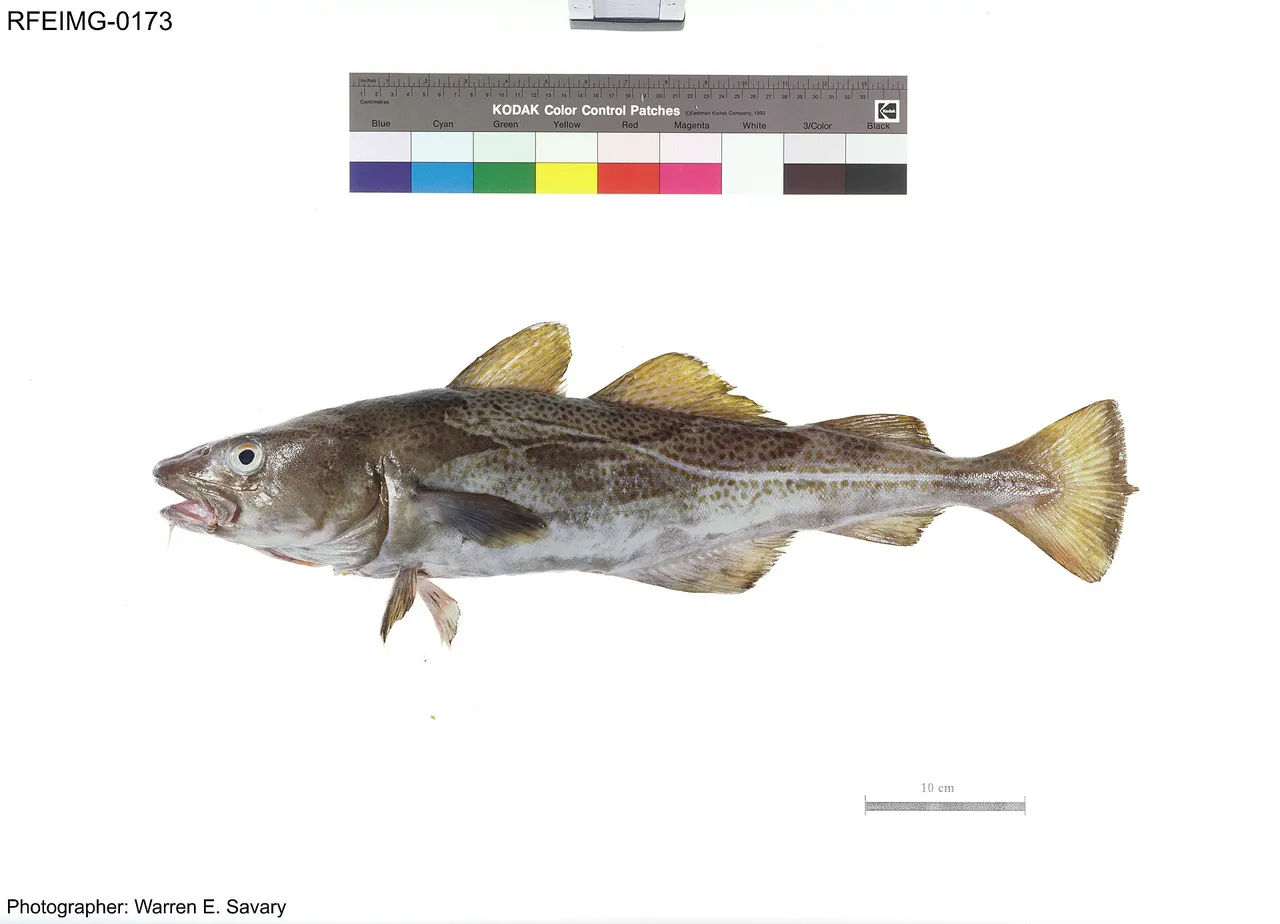
How this was identified, and who took it
Identified by: Three separate dorsal fins, two anal fins, a single chin barbel, and the pale lateral line curving above the pectoral fin. A scientific voucher photograph with colour calibration, which is the strongest identification basis in this manifest.The U.S. Food and Drug Administration, Public domain, via Wikimedia Commons — source, licenceWhat is known about how it feeds
Almost everything unusual about how a cod feeds follows from cold water. Feeding activity rises as temperature falls across most of the range, which is the reverse of nearly every other fish an angler meets, and it is why the North Atlantic cod fisheries are winter fisheries rather than a summer inconvenience.
The animal is built for finding food it cannot see. The chin barbel is a chemosensory organ, the lateral line reads movement close to the bottom, and vision does the last metre. A cod working rough ground at night in coloured water is not handicapped in the way a visual hunter would be.
Diet composition shifts twice over a lifetime. Small cod take crustaceans, worms and small molluscs; as gape allows, fish become the dominant item, and large cod are substantially piscivorous. FishingHQ holds three verified prey relationships and all three are shoaling forage fish — sandeel, capelin and herring — which is the diet of an adult rather than of the whole species.
The geography of that is worth stating. Sandeel dominates in the North Sea, capelin in the Barents Sea and off Iceland and Greenland, herring wherever a herring stock persists. Cod condition in a given year tracks the abundance of whichever of those is local, and the collapse of a forage stock shows up in cod growth before it shows up anywhere else.
The food
Prey with a verified dietary link to this fish. Each entry carries its own evidence, and each is written at the precision the source actually used: a named species where the source named one, a group or food category where it said “polychaetes”, “crustaceans” or “detritus” and meant it. That is why this list is shorter than the animal’s real diet rather than longer.
- Lesser sandeel — Ammodytes marinus
Sandeel is a dominant item in North Sea cod diets during the months when the sandeels are out of the sand and in the water column, and cod distribution over sandy ground reflects it.
- Capelin — Mallotus villosus
In the northern part of the range capelin replaces sandeel as the principal prey, and the inshore capelin spawning migration draws cod with it.
- Atlantic herring — Clupea harengus
Larger cod take herring where the shoals are available, which is one of the reasons cod condition varies so much between areas with and without a herring stock.
Food with no page of its own here yet
These are real components of the diet, listed as plain text because FishingHQ has no page for them yet. Inventing pages to make the list look fuller would be the fabrication this whole approach exists to prevent.
- brittlestars and other echinoderms
- swimming crabs and hermit crabs
- Norway pout and other small gadoids
- squid
- juvenile cod (cannibalism)
What anglers do with this
Everything below is interpretation, not finding. It is what experienced anglers conclude from the biology above, and the reasoning is usually sound and almost never tested. It is separated from the biology deliberately.
Anglers read the temperature relationship as the single most useful fact about the species, and it is the one piece of the biology above that transfers directly into a decision: cold water means feeding cod, and the season runs the opposite way to most sea fishing.
The scent-led sensory profile is used to argue for oily, strongly scented baits fished hard on the bottom, and for the observation that a cod will find a bait in conditions where a visual predator would not. That reasoning is widely and independently held across the northern European sea angling tradition and is convention rather than a tested result.
The shift towards fish prey with size is used to argue for larger baits where large cod are the target. It is a plausible inference from gape and from the recorded diet, and it is not evidence that a large bait selects for large fish — smaller cod take large baits routinely.
What this does not establish
Three verified prey relationships describe an adult cod in the northern part of the range and understate both the invertebrate component and the regional variation. Diet composition differs between the North Sea, the Barents Sea, Icelandic waters and the western Atlantic, and between seasons in all of them. Nothing here establishes what any cod is eating in any particular week, and the temperature relationship describes a tendency across a stock rather than a rule about an individual fish.
Where this connects
These are the baits, lures, methods and explainers FishingHQ already joins to this fish — which is why the list is sometimes short. They are not chosen for this page, and a link here means an evidenced relationship exists, not that it follows from the diet.
Baits recorded for this species
Lures recorded for this species
Methods used for it
Where it lives
The science behind the feeding
This page covers feeding. The Atlantic cod record covers identification, lifecycle, seasonal behaviour, handling and the sources behind all of it.
Reviewed 2026-08-12.