Pollock and pollack
Explainer · Last reviewed 2026-08-15
Two spellings, at least three fish and a set of commercial names that cross over each other — and the fish a reader means depends on which side of the Atlantic they are standing.
The spellings do not distinguish the species. Both are used for both fish in different places, and the commercial trade adds a third layer of names on top.
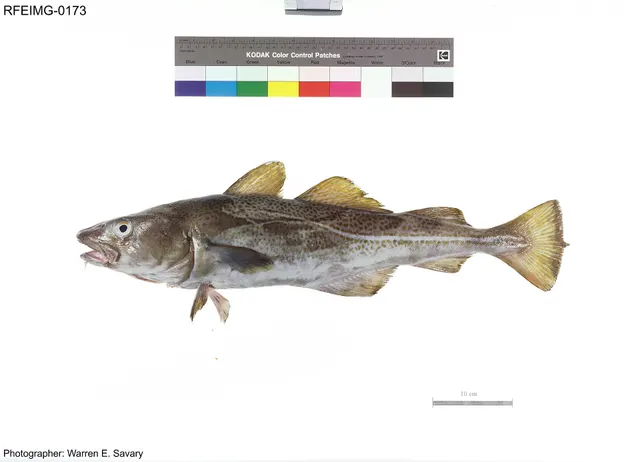
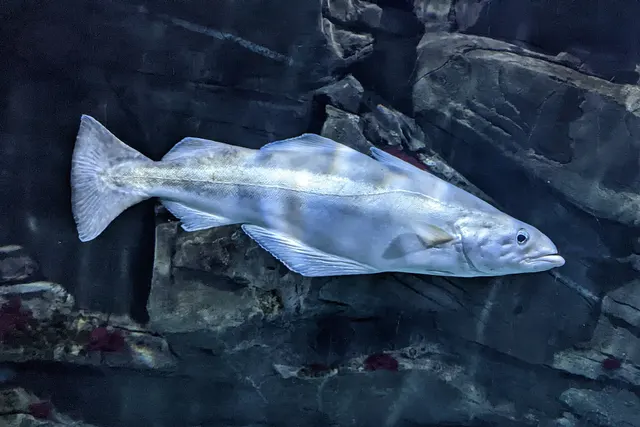
POLLACK (Pollachius pollachius) is the fish a British or Irish angler means: a rocky-ground and wreck predator with a protruding lower jaw and a lateral line that curves sharply over the pectoral fin. It is also called lythe in Scotland.
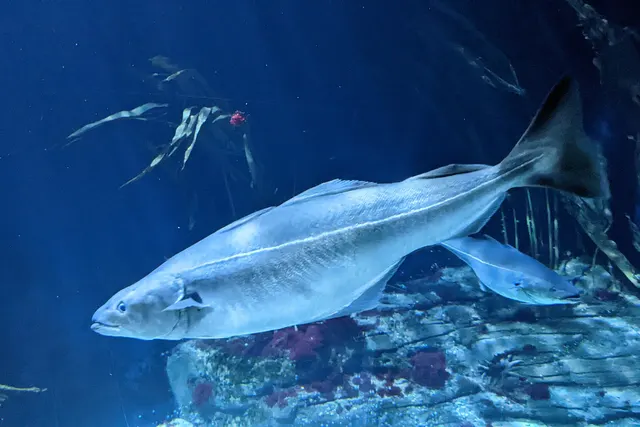
SAITHE (Pollachius virens) is the same genus and a different fish: straighter, paler lateral line, a jaw that does not protrude, and a small chin barbel on juveniles. In Britain it is saithe or coalfish; in North America it is called POLLOCK, spelled that way, and sold as Boston bluefish.
So an American recipe for pollock is a recipe for the fish a British angler calls coalfish, and a British angler's pollack is a fish an American reader may never have encountered under any spelling.
Alaska pollock (Gadus chalcogrammus) is a fourth fish again — a different genus entirely, the species behind most commercial whitefish products, and not either of the Pollachius.
Telling the two Pollachius apart, which is the useful part
The lateral line settles it and colour does not. On a pollack the line curves in a strong arc above the pectoral fin; on a saithe it runs nearly straight and appears paler against the flank.
The jaw is the second check. A pollack's lower jaw projects noticeably beyond the upper, giving it an undershot look; a saithe's jaws are close to level.
Neither fish is reliably separated by colour — both vary from bronze-green to near-black depending on the ground they have been over — and the identification pages for both rank the lateral line first for exactly that reason.
Why the commercial names diverge from the angling ones
Fish are named for markets rather than for anglers, and a name that sells is retained. Boston bluefish is not a bluefish; Alaska pollock is not a Pollachius; and neither name was chosen to help anybody identify anything.
The practical consequence is for a reader following recipes, sustainability advice or catch statistics across countries. A pollock quota in the North Pacific and a pollack season in the Celtic Sea concern different animals with different assessments, and the words give no indication of it.
Where it matters, the binomial is the only reliable identifier — which is the same conclusion the bass page reaches from a different direction.
Where to go next
Fish this applies to
More explainers
Not related to this page — just the rest of the section. There is little else joined to this subject yet, and a short page should still lead somewhere.
Sources and evidence
- FishBase: a global information system on fishes — Froese, R. and D. Pauly, eds. — FishBase Consortium (Scientific institute)Relied on for: Distribution, morphology and nomenclature for Pollachius pollachius, Pollachius virens and Gadus chalcogrammus.States this directlyPassage read and verified
- The Fishes of the British Isles and North-West Europe — Macmillan, 1969 (Reference work)Relied on for: Regional common names and the diagnostic separation of Pollachius pollachius from Pollachius virens.States this directlyCitation checked — the work exists and is described correctly
Why the 3 connections on this page are here, and the sources
Fish this applies to
Backed by research — 3 connections
Supported by peer-reviewed research or fisheries science. The sources are listed and can be checked.
Atlantic cod
The fourth fish in the collision sits in this genus.
- FishBase: a global information system on fishes — Froese, R. and D. Pauly, eds. — FishBase Consortium (Scientific institute)Relied on for: Distribution, morphology and nomenclature for Pollachius pollachius, Pollachius virens and Gadus chalcogrammus.States this directlyPassage read and verified
Pollack
The spellings do not distinguish the species and the commercial names cross over.
- FishBase: a global information system on fishes — Froese, R. and D. Pauly, eds. — FishBase Consortium (Scientific institute)Relied on for: Distribution, morphology and nomenclature for Pollachius pollachius, Pollachius virens and Gadus chalcogrammus.States this directlyPassage read and verified
Saithe
The fish most affected by the naming crossover.
- FishBase: a global information system on fishes — Froese, R. and D. Pauly, eds. — FishBase Consortium (Scientific institute)Relied on for: Distribution, morphology and nomenclature for Pollachius pollachius, Pollachius virens and Gadus chalcogrammus.States this directlyPassage read and verified
How FishingHQ labels evidence is explained in the evidence policy.