Saithe
Fish · Last reviewed 2026-08-10
A fast, hard-fighting shoaling gadoid of northern rock and wreck — routinely confused with pollack, and a completely different fish once you know the lateral line.
Safety: cliffs and rock platforms — can cause serious injury or death. 5 more points apply here.
Barotrauma and pressure injury — Can cause injury needing treatment
Fish taken from deep wrecks and reefs suffer swim bladder expansion and cannot return unaided.
What reduces it: Where release matters, fish shallower ground and retrieve at a moderate rate. Return fish promptly. Use a descending device where appropriate.
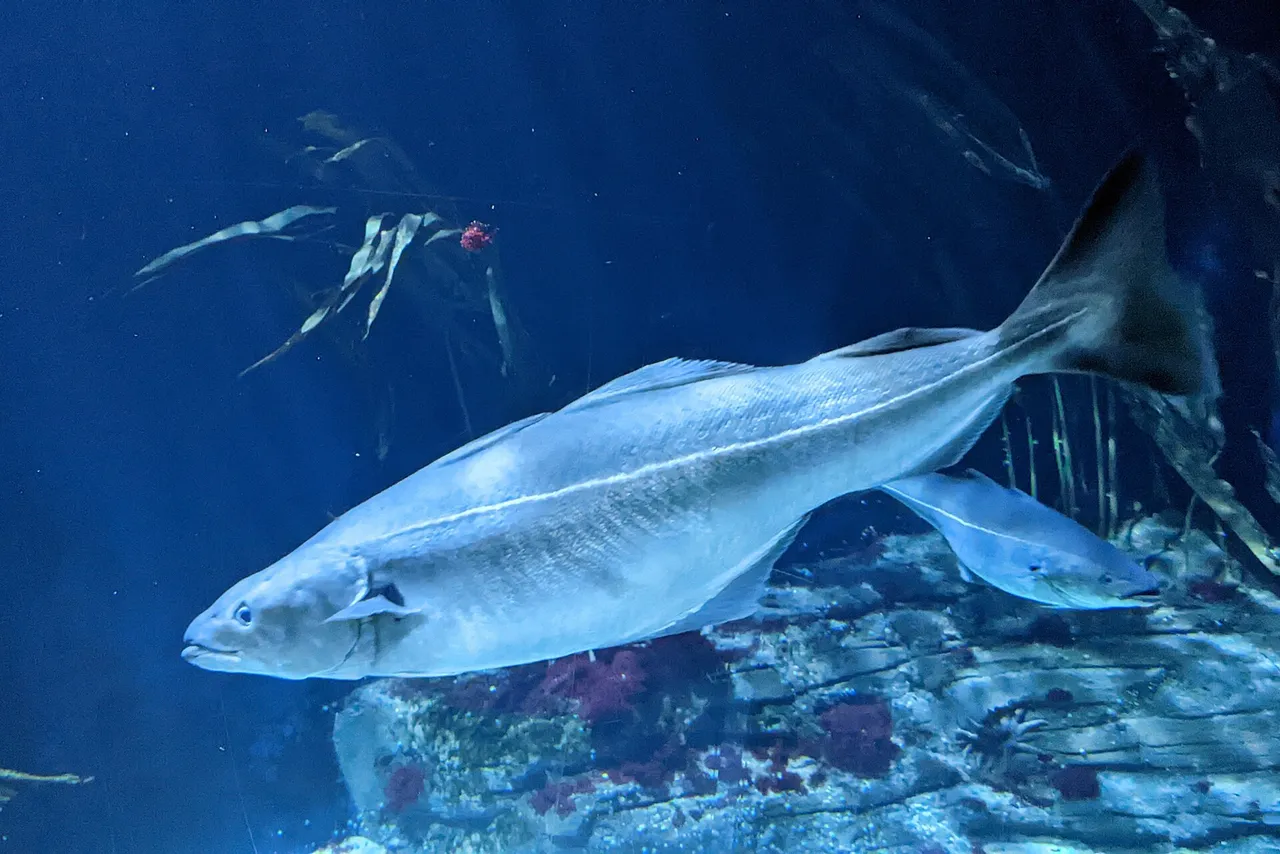
How this was identified, and who took it
Identified by: Full lateral view showing the straight pale lateral line running almost level from head to tail. That is precisely the character the saithe-versus-pollack comparison rests on, and it could not be clearer. Photographed in an aquarium.Wilhelm Thomas Fiege — CC BY-SA 4.0, via Wikimedia Commons — source, licence.jpg)
Catching Saithe
Everything here on fishing for it. Each entry opens the page behind it.
- When
- Somewhere documents it in almost every month, so there is no season for the species as a whole — the season is a property of the ground, and each place states its own.
- Where
- 113 places FishingHQ documents — strongest claim anywhere: regular local target · From the shore, From a kayak, From a boat, On a charter
The saithe is one of the most confusing fish in the north-east Atlantic for a reason that has nothing to do with the fish: it is called coalfish in much of Britain, saithe in Scotland and Scandinavia, and pollock in North America — where that same word means an entirely different species. FishingHQ uses saithe as the headword for exactly this reason.
It is separated from the true pollack, Pollachius pollachius, by two reliable characters. The saithe's lateral line is STRAIGHT and pale; the pollack's curves noticeably over the pectoral fin. And the saithe's lower jaw projects only slightly, where the pollack's is markedly undershot.
As a target it is fast, powerful and shoaling — a saithe hits a lure hard and dives, and a shoal of them over a wreck produces a fish a drop. That reliability makes it the mainstay of a great deal of northern boat and shore fishing, and its willingness to take lures at speed makes it a natural target for jigging and spinning.
Commercially it is a major species across the North Atlantic and forms the bulk of what is sold in much of Europe as a cheaper white fish.
How it is caught
- Feathering and multi-lure tracesYoung saithe are taken in numbers on feathers from pier and rock across the northern part of the range, where they are a traditional food fish rather than merely a sport one.
- JiggingA fast midwater shoaling hunter that chases, which is why jigs and feathers worked at speed over wrecks produce a fish a drop when a shoal is found.
Gear for this fish
- Crab and shellfishA Wicklow directory rates mussel far above the alternatives for the coalfish of one named beach, and draws the inference itself: mussel working that well suggests offshore mussel beds, which suggests plaice.
- Metal jigsFast, shoaling and willing to chase, which makes saithe among the most reliable species on a jig worked at speed over a wreck.
- Sand eelA midwater hunter of small shoaling fish, taken on whole sand eels fished on a flowing trace or on artificial eels worked at speed.
- Soft plasticsSaithe feed higher in the water than cod over the same ground and chase harder, so a shad retrieved briskly up through the column is more effective on them than anything worked along the bottom.
Where Saithe is documented
Places where public sources describe this species as fished, with how it is fished and how strongly the evidence supports it. This is not a range map and it is not a recommendation — it is what has been written down about a fishery rather than a record of any individual catch, and being listed is never permission to fish.
The north-east England coast
15 documented places
Pier
Regular local target
From the shore
Rock mark
Regular local target
From the shore
Beach
Regular local target
From the shore
Island
Recorded here
From the shore
Rock mark
Regular local target
From the shore
Bay
Seasonal
From the shore
Around Jun, Jul, Aug, Sept
Rock mark
Seasonal
From the shore
Around Jun, Jul, Aug, Sept
Rock mark
Regular local target
From the shore
River reach
Regular local target
From the shore
The Causeway and Antrim coast
11 documented places
Bay
Regular local target
From the shore
Harbour wall
Regular local target
From the shore
Headland
Regular local target
From the shore
Harbour wall
Regular local target
From the shore
Harbour wall
Regular local target
From the shore
Rock mark
Regular local target
From the shore
Beach
Regular local target
From the shore
Rock mark
Regular local target
From the shore
Harbour wall
Regular local target
From the shore
The Yorkshire coast
8 documented places
Bay
Recorded here
From the shore
Promenade
Seasonal
From the shore
Around Jun, Jul, Aug, Sept
Pier
Seasonal
From the shore
Around Jun, Jul, Aug, Sept
Bay
Seasonal
From the shore
Around Oct, Nov, Dec, Jan, Feb, Mar
Pier
Recorded here
From the shore
Pier
Seasonal
From the shore
Around Jun, Jul, Aug, Sept
Jetty
Regular local target
From the shore
Jetty
Regular local target
From the shore
The Donegal coast and its sea loughs
6 documented places
Headland
Regular local target
From the shore
Headland
Regular local target
From the shore
Beach
Regular local target
From the shore
Pier
Recorded here
From the shore
Pier
Regular local target
From the shore
Estuary
Regular local target
From the shore
East Lothian and the Firth of Forth coast
5 documented places
Headland
Regular local target
From the shore
Harbour wall
Regular local target
From the shore
Harbour wall
Regular local target
From the shore
Pier
Regular local target
From the shore
Breakwater
Regular local target
From the shore
Dublin Bay and the Wicklow coast
5 documented places
Pier
Regular local target
From the shore
Greystones North Beach and Pier
Pier
Regular local target
From the shore
Around Sept, Oct, Nov, Dec
Rock mark
Regular local target
From the shore
Surf beach
Recorded here
From the shore
Pier
Regular local target
From the shore
The Moray Firth
4 documented places
Rock mark
Regular local target
From the shore
Harbour wall
Regular local target
From the shore
Wick
Harbour wall
Regular local target
From the shore
Rock mark
Seasonal
From the shore
Around Jun, Jul, Aug, Sept
Belfast Lough and the north Down shore
4 documented places
Bay
Regular local target
From the shore
Harbour wall
Regular local target
From the shore
Harbour wall
Regular local target
From the shore
Headland
Regular local target
From the shore
Also documented on 26 more coasts
Fewer places each, or less strongly supported. Each one names its own marks.
The Firth of Clyde (4) · The Fife, Angus and Mearns coast (4) · Clew Bay and Achill (4) · Cork Harbour and the east Cork coast (3) · The Waterford coast (3) · The Lecale coast and Dundrum Bay (2) · The Cornish and Devon coasts (2) · The Isle of Man (2) · The Clare coast and the Shannon estuary (2) · The Wexford coast (2) · Strangford Lough and the Ards coast (1) · The East Antrim coast (1) · Caithness and the north coast (1) · West Cork (1) · Connemara and Galway Bay (1) · The Sligo and Leitrim coast (1) · The Louth and Meath coast (1) · The Solway Firth (3) · Anglesey (2) · Skye and the Inner Hebrides (2) · Scottish sea lochs (2) · The outer Ards coast (1) · Norway and the Nordic coast (6) · Shetland (1) · The Kerry coast (2) · Pembrokeshire and the south-west Wales coast (1)
What these strengths mean
- Regular local target
- Fishing sources describe this as a normal local target here, not merely as caught.
- Recorded here
- At least one credible public account of this species being caught here. That is all it means.
- Seasonal
- Well supported, and concentrated in part of the year rather than spread through it.
- Repeatedly reported
- Several independent public accounts. Enough to say it happens more than once; not enough to call it a fishery.
When to fish for saithe
Where the places here state a season for saithe, it clusters in Jun–Sep. This is a count of how many documented places name each month — evidence about when people fish for it, not a prediction of what any particular day will produce.
| Jan | Feb | Mar | Apr | May | Jun | Jul | Aug | Sep | Oct | Nov | Dec |
|---|---|---|---|---|---|---|---|---|---|---|---|
| January: 4 places name this month — few places. | February: 4 places name this month — few places. | March: 2 places name this month — few places. | April: 1 place names this month — few places. | May: 3 places name this month — few places. | June: 15 places name this month — most places. | July: 15 places name this month — most places. | August: 15 places name this month — most places. | September: 16 places name this month — most places. | October: 4 places name this month — few places. | November: 6 places name this month — some places. | December: 6 places name this month — some places. |
23 of the 112 places that record catches of saithe state which months. The other 89 name no season, so they are counted in neither direction: the shape above is what the dated records say, not the whole picture. The dated records span 11 separate areas.
Identification
- Scientific name
- Pollachius virens
- Family
- Gadidae
- Water
- Saltwater
- Conservation status
- Not assessed
- Regions
- Northern Europe, Britain & Ireland, Arctic & Subarctic, Western Europe, North America
- A STRAIGHT, pale lateral line — the reliable separation from pollack, whose lateral line curves distinctly over the pectoral fin.
- Lower jaw projecting only slightly; the pollack's is markedly undershot.
- Dark greenish-brown to almost black above with a silvery flank, giving the name coalfish; a small chin barbel is present in young fish and lost in adults.
- Three dorsal fins and two anal fins — the gadoid family character.
- Deeply forked tail, more so than cod. Colour alone is unreliable; use the lateral line.
Size
- Typical
- 1–3 kg (2–6.6 lb)
- Large
- 5–9 kg (11–20 lb)
Exceptional: Over 14 kg (31 lb); maximum published weight 32 kg
Fast water over hard ground, and a gadoid that hunts in the column
Saithe occupy cold north-east Atlantic shelf waters, and they use the water column far more than the bottom-oriented gadoids they are grouped with.
THEY ARE SEMI-PELAGIC. Unlike cod, which relates closely to the bottom, saithe form fast-moving shoals that hunt through the water column, frequently well off the seabed and at times right at the surface. That is why they are taken on feathers and lures at all depths and why a sounder shows them as midwater marks.
HARD GROUND AND STRUCTURE CONCENTRATE THEM — reefs, wrecks, pinnacles, rocky coasts and the edges of banks — and tidal flow over that structure is what holds them there.
CURRENT IS PART OF THE HABITAT. Saithe hold in and around fast water, using the flow to intercept prey, and marks fish on a tide.
DEPTH RANGES FROM THE SHALLOW ROCKY SHORE TO SEVERAL HUNDRED METRES, and it is size-structured: small saithe are an inshore, shallow, harbour-and-rock fish, while large adults occupy deeper offshore ground.
JUVENILES ARE HEAVILY INSHORE, in kelp, around piers and along rocky coasts in numbers, where they are a familiar shore fish and an important forage species.
COLD WATER IS THE REQUIREMENT — saithe are a boreal species, most abundant in the northern part of the north-east Atlantic and scarce at the southern edge.
AND THE INSHORE AND OFFSHORE FISH ARE PRACTICALLY DIFFERENT ANIMALS: a shore angler taking small saithe from a pier and a boat angler taking large ones over a deep wreck are fishing the same species in habitats that barely overlap.
Backed by research — why, and the sources (2)
Supported by peer-reviewed research or fisheries science. The sources are listed and can be checked.
- The Fishes of the British Isles and North-West Europe — Macmillan, 1969 (Reference work)Relied on for: Distribution, habitat association, depth, ground preference and biology of fishes in British and north-west European waters.States this directlyCitation checked — the work exists and is described correctly
- ICES Advice on fishing opportunities, catch and effort — International Council for the Exploration of the Sea (Scientific institute)Relied on for: Stock assessment, the environmental drivers of stock distribution and abundance, and the scientific basis for advice in the sea areas concerned.States this directlyCitation checked — the work exists and is described correctly
The same story as kahawai, on the other side of the world
Saithe present no hazard worth writing about — no meaningful spines, no dentition, a hand and a wet cloth handle any of them — and two genuine handling problems that have nothing to do with grip.
THE FIRST IS DEPTH. Saithe come off deep wrecks and hard ground in numbers, and a fish brought up quickly from that depth arrives with an expanded swim bladder that it cannot deflate fast enough to swim back down. It floats. Where release matters — and on a species caught in the quantities saithe are caught in, it matters — the honest answers are to fish shallower ground or to return fish immediately rather than after they have been through a bucket and a photograph. A fish that has been on deck for two minutes with an expanded bladder is not going anywhere when it goes over the side.
THE SECOND IS THAT SAITHE HAVE A REPUTATION AS POOR FOOD THAT IS LARGELY MANUFACTURED BY HANDLING. The flesh is greyer than cod's, which is a fact about the fish, and it goes soft and strong-tasting quickly, which is a fact about what usually happens to it. Saithe are typically caught in numbers, piled in a fish box, left in the sun and dealt with hours later. Treated that way, any fish would be disappointing and this one is worse than most because the flesh is comparatively soft to begin with.
BLED AT ONCE AND CHILLED IMMEDIATELY, saithe is a perfectly good fish — firm, clean and well regarded in Norway and Iceland, where the handling has always been better because the fishery is commercial and the incentive is direct. The greyness cooks white.
SO THE PRACTICAL SUMMARY IS THE SAME AS FOR EVERY FAST-GROWING SHOALING PREDATOR: decide at once whether each fish is being kept or returned, act on that decision immediately, and never allow a third state in which a fish is neither being cared for nor being sent back.
What experienced anglers do — why, and the sources (4)
Widely and independently recommended by experienced anglers and specialist sources. This is real angling knowledge, not proof: controlled evidence for it is limited, and FishingHQ records it as convention rather than as a demonstrated effect.
- Sea Angler — Bauer Media (Specialist angling publication)Relied on for: Established boat and shore practice for handling and returning the species.States this directlyCitation checked — the work exists and is described correctly
- IGFA International Angling Rules and World Record Requirements — International Game Fish Association (Angling or fisheries organisation)Relied on for: Handling, release and tackle conventions in recognised sport fisheries for the species.Background and mechanism onlyPassage read and verified
- Fish and Fishery Products Hazards and Controls Guidance — US Food and Drug Administration, Center for Food Safety and Applied Nutrition, 2022 (Standards body)Relied on for: That histamine formation in scombroid and other dark-fleshed fish is driven by time and temperature after capture, and that prompt chilling is the control.States this directlyPassage read and verified
- FishBase: a global information system on fishes — Froese, R. and D. Pauly, eds. — FishBase Consortium (Scientific institute)Relied on for: Flesh characteristics and commercial handling of the species.Background and mechanism onlyPassage read and verified
Two fisheries for one species: small fish inshore, big fish on structure
Saithe present a seasonal picture that only makes sense once it is understood as two different fisheries for two different life stages of the same fish.
THE JUVENILE INSHORE FISHERY. Young saithe — the fish a Scottish or Norwegian shore angler catches in numbers — live in shallow water close to shore, around rock, weed and harbour structure, and they are available for much of the year in the north. They are shoaling, aggressive, and easy to catch, and they are the fish most people mean when they talk about saithe.
THE ADULT OFFSHORE FISHERY IS A DIFFERENT ANIMAL IN A DIFFERENT PLACE. As saithe grow they move offshore and deeper, onto wrecks, reefs and hard ground, and the fish taken there are an order of magnitude larger. That ontogenetic movement — a shift with age rather than with season — is the main structure of the species' distribution, and it is easy to mistake for a seasonal migration because the inshore fish do also move deeper in winter.
THE SEASONAL COMPONENT ON TOP OF IT IS ORDINARY. Inshore in warmer months, deeper and offshore as water cools, with spawning in deep water in the colder half of the year. It is the standard north-east Atlantic gadid pattern and it is driven by temperature and by the spawning requirement rather than by anything peculiar to the species.
TIDE, NOT SEASON, DECIDES THE ADULT FISHING. Saithe on a wreck or a reef hold in the current on the down-tide side and feed on what the flow brings past them. That is a feeding strategy that only works while water is moving, so the fish switch on and off with the tidal cycle in a way that is far more pronounced than any monthly pattern. A mark that is alive on a running tide is dead at slack water, twice a day, all year.
Which means the honest answer to when to fish for saithe is a statement about tidal state and about which fish is wanted, and the calendar is the least useful of the three.
What experienced anglers do — why, and the sources (4)
Widely and independently recommended by experienced anglers and specialist sources. This is real angling knowledge, not proof: controlled evidence for it is limited, and FishingHQ records it as convention rather than as a demonstrated effect.
- FishBase: a global information system on fishes — Froese, R. and D. Pauly, eds. — FishBase Consortium (Scientific institute)Relied on for: Depth range, migration, spawning season and temperature association recorded for the species.States this directlyPassage read and verified
- ICES Advice on fishing opportunities, catch and effort — International Council for the Exploration of the Sea (Scientific institute)Relied on for: Stock distribution, seasonal movement between spawning and feeding grounds, and the assessment basis for the stock.States this directlyCitation checked — the work exists and is described correctly
- The Fishes of the British Isles and North-West Europe — Macmillan, 1969 (Reference work)Relied on for: Seasonal distribution and inshore–offshore movement of fishes in British and north-west European waters.States this directlyCitation checked — the work exists and is described correctly
- Sea Angler — Bauer Media (Specialist angling publication)Relied on for: Established seasonal practice in the British and Irish shore and boat fisheries.Background and mechanism onlyCitation checked — the work exists and is described correctly
A shoal fish that spawns deep and offshore, and a juvenile stage that happens in the kelp
Saithe reproduction has a geographical separation in it that most anglers never see, and it explains why the small fish and the large ones are caught in completely different places.
SPAWNING IS DEEP, OFFSHORE AND IN THE COLD MONTHS. Mature saithe gather on offshore banks and deeper shelf ground in late winter and early spring, and spawn as a broadcast event, releasing buoyant eggs into the water column. This is a cold-water, northern, shelf-scale event, and it takes place well away from the inshore rock and pier ground where the species is most familiar to shore anglers.
THE LARVAE DRIFT INSHORE AND SETTLE INTO SHALLOW WATER. After a planktonic period the young fish arrive in coastal shallows and settle into kelp, rock and shallow rough ground, where they spend their first years in dense shoals. That is the ubiquitous small saithe of harbour walls, piers and rock marks throughout the northern part of the range — an entire life stage occupying inshore habitat.
AND THEN THEY LEAVE. As they grow, saithe move progressively offshore and deeper, joining the adult shoals on the banks. So the fish a shore angler catches by the dozen and the fish a boat catches over a deep wreck are the same species at two ends of an ontogenetic migration, and there is very little overlap between them.
WHICH MAKES THE INSHORE NURSERY HABITAT A RECRUITMENT ISSUE that offshore stock management does not automatically address. Kelp and shallow rough ground condition matters to a stock that is fished a hundred miles away.
GROWTH IS FAST AND MATURITY IS REACHED WITHIN A FEW YEARS, which makes saithe more resilient than the slower northern gadoids, and shoaling behaviour makes them efficient to catch — a combination that produces a fishery capable of large landings and of rapid local depletion.
RECRUITMENT VARIES SUBSTANTIALLY BETWEEN YEARS with plankton and transport conditions, in the usual broadcast-spawner pattern, so year-class strength rather than adult abundance frequently drives what a fishery sees.
AND MANAGEMENT IS BY STOCK AREA AND IS REVISED ANNUALLY. Nothing above indicates any current limit; the competent authority does.
Backed by research — why, and the sources (2)
Supported by peer-reviewed research or fisheries science. The sources are listed and can be checked.
- ICES Advice on fishing opportunities, catch and effort — International Council for the Exploration of the Sea (Scientific institute)Relied on for: Stock assessment and advice, including spawning stock biomass, recruitment and the reproductive parameters the assessment rests on.States this directlyCitation checked — the work exists and is described correctly
- FishBase: a global information system on fishes — Froese, R. and D. Pauly, eds. — FishBase Consortium (Scientific institute)Relied on for: Spawning season, fecundity, maturity and larval development for the species.Background and mechanism onlyPassage read and verified
The same downward run as a pollack, from a fish that keeps going
Saithe tackle is close enough to pollack tackle that the differences are the useful part, and there are three of them.
THE FIRST RUN IS LONGER AND MORE SUSTAINED. A pollack dives hard and briefly; a saithe dives hard and keeps swimming, and it does so with a broader tail and more stamina. That changes the drag requirement from surviving a short violent surge to controlling a longer withdrawal, and it means line capacity matters here in a way it does not for pollack in the same depth.
THE FISH ARE FREQUENTLY DEEPER AND MORE NORTHERLY, which drives the outfit up a class. Saithe on offshore banks and deep wrecks require more weight, more line and more lifting capacity simply to operate at the depth, and the shore fishery in the north is largely for the smaller inshore stage of the same species — a different and much lighter proposition, as the record's spawning section explains.
THEY SHOAL, AND SHOALING CHANGES THE TACKLE LOGIC. Saithe are taken in numbers on multi-hook traces and on jigs, and a trace holding several hooked fish applies loads that a single fish never would. Traces, swivels and knots fail in this fishery for that reason rather than because any individual fish was large.
BEYOND THAT THE PRINCIPLES ARE THE POLLACK ONES. Low-stretch line to reach the fish at depth, a leader doing mechanical shock absorption rather than concealment, enough lead for the tide and no more, and a drag set before the drop.
SAITHE ARE ALSO AN EXCELLENT LIGHT-TACKLE FISH INSHORE and are routinely under-fished as one. Small shoaling saithe over rock and kelp in the north are as good a light spinning or fly target as a temperate coast offers, and the heavy-gear reputation attaches to the offshore adults rather than to the species.
AND THEY SPOIL QUICKLY, which is a tackle-adjacent point worth making: saithe kept for the table need killing and chilling at once, and the difference between a fish handled properly and one left in a warm box is the whole of the species' reputation as food.
What experienced anglers do — why, and the sources (2)
Widely and independently recommended by experienced anglers and specialist sources. This is real angling knowledge, not proof: controlled evidence for it is limited, and FishingHQ records it as convention rather than as a demonstrated effect.
- Sea Angler — Bauer Media (Specialist angling publication)Relied on for: Established shore and boat angling practice, including tackle selection and the reasoning behind it.States this directlyCitation checked — the work exists and is described correctly
- General angling website restatements of established technique — Various (Credible secondary source)Relied on for: The widely restated tackle practice for this species, recorded as a consensus position rather than as an original observation.States this directlyCitation checked — the work exists and is described correctly
Lifecycle and reproduction
Grows fast, matures at four to six years and lives up to around twenty-five. Spawns in deeper water in late winter and spring, with pelagic eggs and larvae. Juveniles shoal in very shallow inshore water, including harbours and rock pools, before moving progressively deeper as they grow — which is why small saithe are the fish that so many children in northern Europe catch first.
Broadcast spawning in deep water in late winter and spring, with pelagic eggs and larvae drifting inshore. Juveniles use extremely shallow inshore habitat including harbours and rocky shores, then move deeper year by year. That ontogenetic depth shift means a shore angler and a wreck angler are catching different age classes of the same stock.
Feeding and senses
An active shoaling predator taking small fish — sand eels, herring, sprat — along with crustaceans and cephalopods, hunting in midwater and near structure rather than on the bottom. The pursuit habit and midwater feeding are why saithe respond so well to fast-retrieved lures and to jigs worked at speed, and why they are caught well off the seabed over wrecks.
Sight-dominant when hunting fast-moving prey in midwater, with the lateral line supporting in low light and at depth. Saithe respond strongly to speed and flash, which is why they are among the most reliable species on a fast-worked lure and why they will chase down a jig that a bottom-feeding gadoid would ignore.
Through the year
Moves inshore in the warmer months and offshore and deeper in winter, with spawning in deep water in late winter and spring. Small fish are available from the shore for much of the year in the north. Tidal state governs the fishing on wrecks and reefs, where the fish hold in the current and feed on what is swept past.
Distribution
North Atlantic: on the European side from the Barents Sea and Iceland south to the Bay of Biscay, and on the western side from Greenland and Labrador south to North Carolina. A shoaling demersal and pelagic species associated with rock, wreck and open water.
This is a biological range — where the species occurs, not a prediction that you will catch one. To browse the fishing geography FishingHQ holds, start at fishing places.
Why anglers care
A mainstay of northern European boat and shore fishing, taken on jigs, spinners, feathers, lures and bait over wrecks, reefs and rock. Very hard-fighting for its size and extremely reliable, which makes it the species that keeps a session going when others are quiet. Small fish from harbours and rocks introduce a great many people to sea fishing.
Handling and returning
No dangerous spines or teeth. Wet hands and support the body. Fish taken from deep wrecks suffer barotrauma; where release matters, fish shallower or return fish promptly. Saithe deteriorate quickly as food and are best bled and chilled immediately if retained, which is a large part of the species' undeserved reputation for poor eating.
Going further
- What does saithe eat? — feeding biology, kept separate from what anglers infer from it.
- Saithe vs Atlantic cod — how to tell them apart.
- Saithe vs Pollack — how to tell them apart.
Safety
Barotrauma and pressure injury is set out at the top of this page, where it cannot be missed.
Cliffs and rock platforms — Can cause serious injury or death
A great deal of shore fishing for this species is from rock, where swell sweeps anglers off and the escape route is slow.
What reduces it: Never fish rock marks alone. Watch the mark for a full set cycle before committing. Wear a buoyancy aid, wear footwear with grip on wet rock, and plan the escape before starting.
Precautions that always apply here
- Wear a buoyancy aid or lifejacket. Cold water incapacitates strong swimmers within a minute, long before swimming ability matters.
- Check the tide before you go and know your exit route. Being cut off is the commonest way a shore session becomes a rescue.
- Tell somebody where you are going and when you expect to be back.
- Carry a charged phone in a waterproof case, or another means of calling for help.
Check the rules before you fish
Fishing laws, bylaws, access rules, seasons, bait restrictions and permitted methods vary by location and can change. Check the current rules from the relevant authority and the water you intend to fish before fishing.
Check with:
- Current national or regional law for where you are fishing
- Current local bylaws
- The relevant fisheries authority
- The landowner, club or fishery whose water it is
- Any restrictions specific to the species or the method you intend to use
Where to go next
Similar and related fish
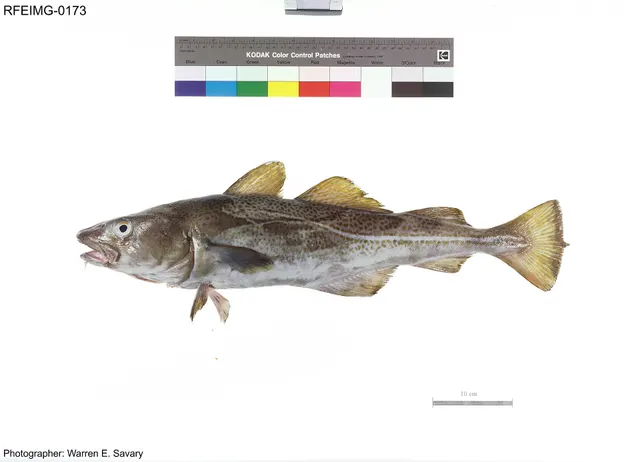 Atlantic codGadoids of the same family. Saithe is separated from the true pollack by a straight pale lateral line where the pollack's curves, and from cod by body form and the forked tail.
- Lesser sandeelSaithe feed on sandeel in mid water in dense fast-moving shoals, a very different hunting pattern from the cod working the same ground below them.
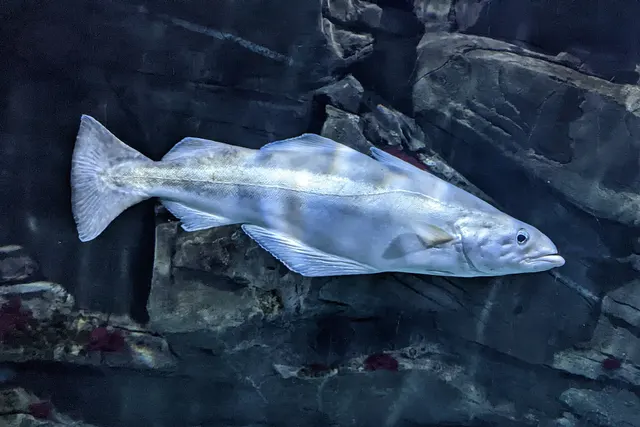 PollackCongeners in Pollachius, taken over the same ground on the same tactics and confused constantly. The lateral line separates them: straight and pale in saithe, dark and arched over the pectoral in pollack. The lower jaw projects clearly in pollack and barely in saithe.
Where you will find it
- Caithness and the north coastFlagstone platforms with very deep water immediately off them put a species that is a boat fish further south within reach of somebody standing on the rock, which is the defining characteristic of shore fishing at this latitude.
- East Lothian and the Firth of Forth coastSaithe hold on the reef and around structure here and are taken from rock and harbour in numbers as young fish, which is a long-standing local food fishery as well as a sport one.
- Scottish sea lochsAbundant along loch sides, around piers and at the narrows, and the species most likely to be caught by anybody fishing a sea loch for the first time.
- ShetlandAbundant around the rock and in the voes at all sizes, and young coalfish were a genuine food fish taken in quantity from rock and pier.
- Skye and the Inner HebridesAbundant as small inshore fish over kelp and rock throughout the islands, with the larger adults offshore on deeper ground.
- Strangford Lough and the Ards coastAround the narrows, the pladdies and the harbour structures, in numbers, and the fish most casual shore sessions on this lough encounter.
- The Moray FirthAbundant over the rock, harbour walls and kelp of the whole coast, and the fish most young anglers on this coast start on — a northern signature that anglers further south encounter only incidentally.
- The north-east England coastAbundant over the rough ground, harbours and piers of this coast, and frequently the first fish anybody catches here. Small inshore fish dominate the shore catch.
Understanding this fish
- Krill and planktonic crustaceans as preySmaller saithe feed heavily on planktonic crustaceans before becoming piscivorous, which is why juvenile and adult saithe are found in different places doing different things.
- Pollock and pollackCalled pollock in North America and sold as Boston bluefish, which is neither.
Sources and evidence
- FishBase: a global information system on fishes — Froese, R. and D. Pauly, eds. — FishBase Consortium (Scientific institute)Relied on for: Scientific name, family placement in the Gadidae, a maximum length of 130 cm TL, a maximum published weight of 32.0 kg, a maximum reported age of 25 years.States this directlyPassage read and verified
- FishBase: a global information system on fishes — Froese, R. and D. Pauly, eds. — FishBase Consortium (Scientific institute)Relied on for: Environment, climate zone and depth range as recorded: Marine; demersal; oceanodromous ; depth range 37 - 364 m . Temperate; 77°N - 33°N, 76°W - 35°EStates this directlyPassage read and verified
- ICES Advice on fishing opportunities, catch and effort — International Council for the Exploration of the Sea (Scientific institute)Relied on for: That North East Atlantic gadoid stocks including saithe are assessed through international scientific advice feeding management.States this directlyCitation checked — the work exists and is described correctly
- RNLI water safety guidance: cold water shock and Float to Live — Royal National Lifeboat Institution (Water-safety or diver-training authority)Relied on for: The mechanism by which anglers are swept from coastal rock and the value of a buoyancy aid and an escape plan.FishingHQ's interpretation of what it saysPassage read and verified
Why the 19 connections on this page are here, and the sources
Similar and related fish
Backed by research — 3 connections
Supported by peer-reviewed research or fisheries science. The sources are listed and can be checked.
Atlantic cod
An identification comparison naming both binomials, addressing one of the worst naming collisions in sea angling.
- FishBase: a global information system on fishes — Froese, R. and D. Pauly, eds. — FishBase Consortium (Scientific institute)Relied on for: That Pollachius virens and Gadus morhua are both Gadidae of the North Atlantic with overlapping distributions.States this directlyPassage read and verified
- The Fishes of the British Isles and North-West Europe — Macmillan, 1969 (Reference work)Relied on for: The morphological separation of Pollachius virens from Pollachius pollachius by lateral line form and jaw projection.States this directlyCitation checked — the work exists and is described correctly
Lesser sandeel
Recorded diet evidence identifies Ammodytes marinus as a food item of this predator at species level. The edge is written at that granularity and no further.
- FishBase: a global information system on fishes — Froese, R. and D. Pauly, eds. — FishBase Consortium (Scientific institute)Relied on for: Food items recorded for this predator, including Ammodytes marinus.States this directlyPassage read and verified
- FAO Species Identification Guides for Fishery Purposes and the FAO Species Catalogues — Food and Agriculture Organization of the United Nations (Scientific institute)Relied on for: Species account describing the diet of this predator in the region where Ammodytes marinus occurs.Background and mechanism onlyCitation checked — the work exists and is described correctly
Pollack
A congeneric identification comparison naming both binomials, resolving the naming collision that gives both species the name 'pollock' in different English-speaking regions.
- FishBase: a global information system on fishes — Froese, R. and D. Pauly, eds. — FishBase Consortium (Scientific institute)Relied on for: That Pollachius virens and Pollachius pollachius are congeners of the North-East Atlantic with overlapping distributions and depth ranges.States this directlyPassage read and verified
- The Fishes of the British Isles and North-West Europe — Macmillan, 1969 (Reference work)Relied on for: The morphological separation of Pollachius virens from Pollachius pollachius by lateral line form and by the degree of lower-jaw projection.States this directlyCitation checked — the work exists and is described correctly
How it is caught
What experienced anglers do — 2 connections
Widely and independently recommended by experienced anglers and specialist sources. This is real angling knowledge, not proof: controlled evidence for it is limited, and FishingHQ records it as convention rather than as a demonstrated effect.
Feathering and multi-lure traces
An established way this species is taken recreationally in north-west European waters.
- Sea Angler — Bauer Media (Specialist angling publication)Relied on for: Shore and boat practice in north-west European sea angling for the species and method described, presented across multiple independent contributors.States this directlyCitation checked — the work exists and is described correctly
- General angling website restatements of established technique — Various (Credible secondary source)Relied on for: Widely restated practice connecting this species to this method, recorded as practitioner consensus rather than as tested fact.Background and mechanism onlyCitation checked — the work exists and is described correctly
Jigging
A practitioner claim following from the species' verified pelagic feeding.
- Sea Angler — Bauer Media (Specialist angling publication)Relied on for: Practitioner treatment of jigging and feathering for saithe and other midwater gadoids over wrecks.Citation checked — the work exists and is described correctly
- General angling website restatements of established technique — Various (Credible secondary source)Relied on for: Widely restated practitioner accounts of fast retrieves for saithe.Citation checked — the work exists and is described correctly
Gear for this fish
What experienced anglers do — 4 connections
Widely and independently recommended by experienced anglers and specialist sources. This is real angling knowledge, not proof: controlled evidence for it is limited, and FishingHQ records it as convention rather than as a demonstrated effect.
Crab and shellfish
Two independent county pages naming mussel on two different coasts, one of them explaining what the bait's effectiveness implies about the ground.
- Sea Angling in Ireland: the shore marks of Wicklow, Dublin, Louth and Meath — Sea Angling Ireland (Credible secondary source)Relied on for: A county directory rating mussel far above the alternatives for coalfish at a named beach, and reasoning from it to the ground offshore.Passage read and verified
- Sea Angling in Ireland: the shore marks of Cork — Sea Angling Ireland (Credible secondary source)Relied on for: A county directory naming mussel as the local bait at a named deepwater quay where coalfish are taken year round.Passage read and verified
Metal jigs
A practitioner claim about a lure-species pairing.
- Sea Angler — Bauer Media (Specialist angling publication)Relied on for: Practitioner treatment of jigging and pirking for midwater gadoids over wrecks.Citation checked — the work exists and is described correctly
- General angling website restatements of established technique — Various (Credible secondary source)Relied on for: Widely restated practitioner accounts of fast jig retrieves for saithe.Citation checked — the work exists and is described correctly
Sand eel
A practitioner claim about a bait-species pairing.
- Sea Angler — Bauer Media (Specialist angling publication)Relied on for: Practitioner treatment of sand eel presentation for midwater gadoids over wrecks and reefs.Citation checked — the work exists and is described correctly
- General angling website restatements of established technique — Various (Credible secondary source)Relied on for: Widely restated practitioner guidance on flowing traces and artificial sand eels.Citation checked — the work exists and is described correctly
Soft plastics
A practitioner claim about which lure family answers this species' feeding or holding behaviour.
- Sea Angler — Bauer Media (Specialist angling publication)Relied on for: Established shore and boat lure practice for the species in north-west European seas.States this directlyCitation checked — the work exists and is described correctly
- General angling website restatements of established technique — Various (Credible secondary source)Relied on for: Widely restated lure selection for this species, recorded as practitioner consensus rather than as tested fact.Background and mechanism onlyCitation checked — the work exists and is described correctly
Where you will find it
Backed by research — 8 connections
Supported by peer-reviewed research or fisheries science. The sources are listed and can be checked.
Caithness and the north coast
A claim that a coast or region contains the ground and conditions this species is associated with. It is a distributional statement about the world, it rests on the reference literature and on the institute that surveyed it, and it deliberately asserts nothing about access, permission or catch.
- The Fishes of the British Isles and North-West Europe — Macmillan, 1969 (Reference work)Relied on for: Distribution and habitat association of the marine fishes of the British Isles and north-west Europe, including which coasts and ground types a species occupies.States this directlyCitation checked — the work exists and is described correctly
- FishBase: a global information system on fishes — Froese, R. and D. Pauly, eds. — FishBase Consortium (Scientific institute)Relied on for: Recorded distribution, depth range and habitat association for the species named.States this directlyPassage read and verified
East Lothian and the Firth of Forth coast
A distributional claim about where a species occurs, taken from reference works on the fishes of the region rather than from angling report. It states presence and habitat association and asserts nothing about a fishery.
- FishBase: a global information system on fishes — Froese, R. and D. Pauly, eds. — FishBase Consortium (Scientific institute)Relied on for: Distribution, habitat association, depth range and feeding behaviour recorded for the species concerned.States this directlyPassage read and verified
- The Fishes of the British Isles and North-West Europe — Macmillan, 1969 (Reference work)Relied on for: Distribution, habitat and biology of the fishes of the British Isles and north-west Europe.States this directlyCitation checked — the work exists and is described correctly
Scottish sea lochs
A claim that a place contains the ground and conditions the species is associated with. It is a distributional statement about the world, it rests on the regional reference literature, and it deliberately asserts nothing about access, permission or catch.
- The Fishes of the British Isles and North-West Europe — Macmillan, 1969 (Reference work)Relied on for: Distribution and habitat association of the marine and estuarine fishes of the British Isles, including which coasts and ground types a species occupies.States this directlyCitation checked — the work exists and is described correctly
- FishBase: a global information system on fishes — Froese, R. and D. Pauly, eds. — FishBase Consortium (Scientific institute)Relied on for: Recorded distribution, depth range and habitat association for the species named.States this directlyPassage read and verified
Shetland
A distribution association between an animal and a kind of water, rather than a claim about any named mark.
- The Fishes of the British Isles and North-West Europe — Macmillan, 1969 (Reference work)Relied on for: Distribution, habitat association, depth and ground preference of fishes in British and north-west European waters.States this directlyCitation checked — the work exists and is described correctly
- FishBase: a global information system on fishes — Froese, R. and D. Pauly, eds. — FishBase Consortium (Scientific institute)Relied on for: Distribution, habitat association and depth range recorded for the species.Background and mechanism onlyPassage read and verified
Skye and the Inner Hebrides
A distribution association between an animal and a kind of water, rather than a claim about any named mark.
- The Fishes of the British Isles and North-West Europe — Macmillan, 1969 (Reference work)Relied on for: Distribution, habitat association and ground type of fishes in British and north-west European waters.States this directlyCitation checked — the work exists and is described correctly
- FishBase: a global information system on fishes — Froese, R. and D. Pauly, eds. — FishBase Consortium (Scientific institute)Relied on for: Distribution, habitat association and depth range recorded for the species.Background and mechanism onlyPassage read and verified
Strangford Lough and the Ards coast
A claim that a place contains the ground, water and seasonal conditions the species is associated with. It is a distributional statement about the world, it rests on the regional reference literature, and it deliberately asserts nothing about access, permission or catch.
- The Fishes of the British Isles and North-West Europe — Macmillan, 1969 (Reference work)Relied on for: Distribution and habitat association of the marine, estuarine and freshwater fishes of the British Isles, including which coasts, estuaries and ground types a species occupies.States this directlyCitation checked — the work exists and is described correctly
- FishBase: a global information system on fishes — Froese, R. and D. Pauly, eds. — FishBase Consortium (Scientific institute)Relied on for: Recorded distribution, depth range and habitat association for the species named.States this directlyPassage read and verified
The Moray Firth
A claim that a place contains the ground, water and seasonal conditions the species is associated with. It is a distributional statement about the world, it rests on the regional reference literature, and it deliberately asserts nothing about access, permission or catch.
- The Fishes of the British Isles and North-West Europe — Macmillan, 1969 (Reference work)Relied on for: Distribution and habitat association of the marine, estuarine and freshwater fishes of the British Isles, including which coasts, estuaries and ground types a species occupies.States this directlyCitation checked — the work exists and is described correctly
- FishBase: a global information system on fishes — Froese, R. and D. Pauly, eds. — FishBase Consortium (Scientific institute)Relied on for: Recorded distribution, depth range and habitat association for the species named.States this directlyPassage read and verified
The north-east England coast
A claim that a place contains the ground and conditions the species is associated with. It is a distributional statement about the world, it rests on the regional reference literature, and it deliberately asserts nothing about access, permission or catch.
- The Fishes of the British Isles and North-West Europe — Macmillan, 1969 (Reference work)Relied on for: Distribution and habitat association of the marine and estuarine fishes of the British Isles, including which coasts and ground types a species occupies.States this directlyCitation checked — the work exists and is described correctly
- FishBase: a global information system on fishes — Froese, R. and D. Pauly, eds. — FishBase Consortium (Scientific institute)Relied on for: Recorded distribution, depth range and habitat association for the species named.States this directlyPassage read and verified
Understanding this fish
Backed by research — 2 connections
Supported by peer-reviewed research or fisheries science. The sources are listed and can be checked.
Krill and planktonic crustaceans as prey
Recorded diet evidence identifies euphausiids and planktonic crustaceans as a food item of this predator at group level rather than to species. The edge points at the taxon record for that reason, and encoding it as a species-level claim would assert something the source does not.
- FishBase: a global information system on fishes — Froese, R. and D. Pauly, eds. — FishBase Consortium (Scientific institute)Relied on for: Food items recorded for this predator, given as euphausiids and planktonic crustaceans.States this directlyPassage read and verified
- FAO Species Identification Guides for Fishery Purposes and the FAO Species Catalogues — Food and Agriculture Organization of the United Nations (Scientific institute)Relied on for: Species account describing this predator's diet, recorded at the level of euphausiids and planktonic crustaceans.Background and mechanism onlyCitation checked — the work exists and is described correctly
Pollock and pollack
The fish most affected by the naming crossover.
- FishBase: a global information system on fishes — Froese, R. and D. Pauly, eds. — FishBase Consortium (Scientific institute)Relied on for: Distribution, morphology and nomenclature for Pollachius pollachius, Pollachius virens and Gadus chalcogrammus.States this directlyPassage read and verified
How FishingHQ labels evidence is explained in the evidence policy.