How to identify saithe
Pollachius virens · Gadidae
The characters that identify saithe, ranked by how far each one can be trusted on its own.
Safety: cliffs and rock platforms — can cause serious injury or death. One more point applies here.
How this was identified, and who took it
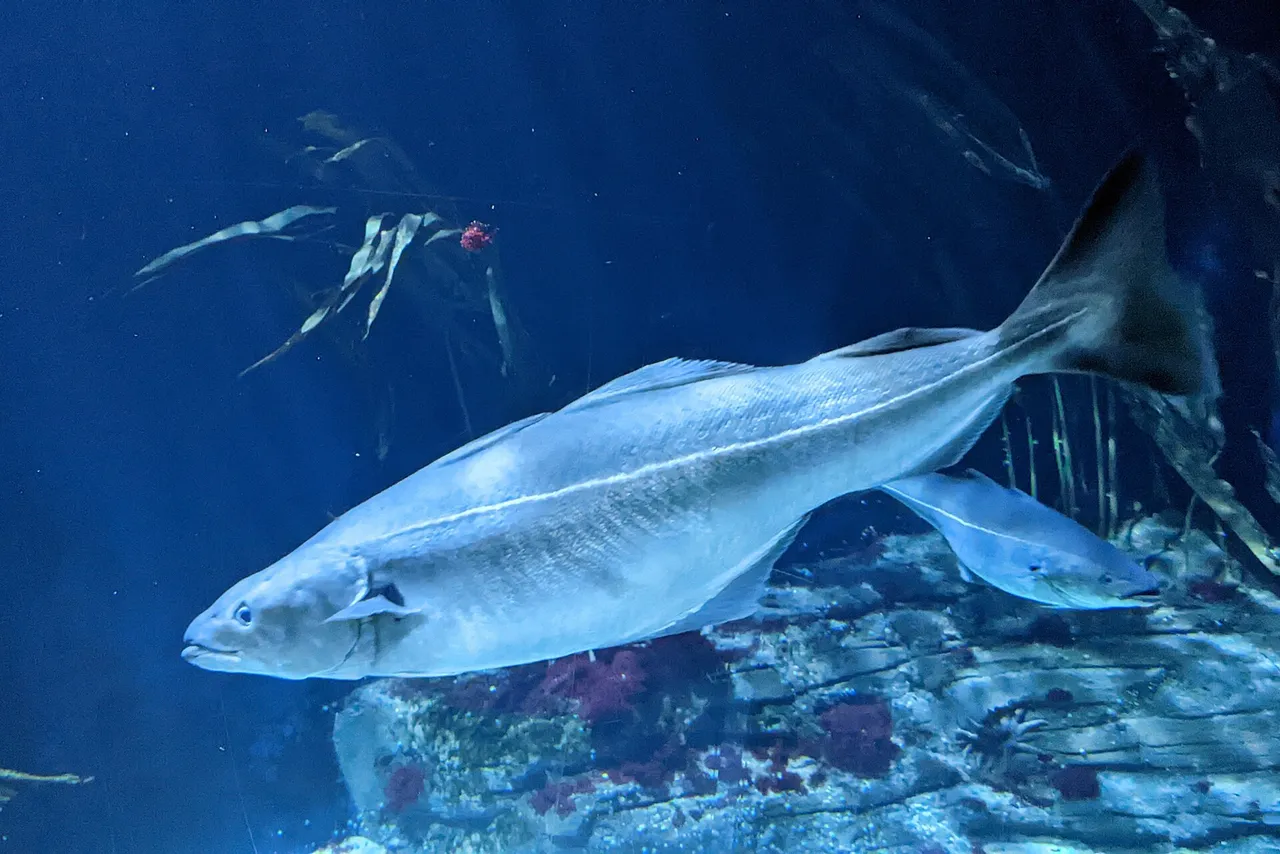
Identified by: Full lateral view showing the straight pale lateral line running almost level from head to tail. That is precisely the character the saithe-versus-pollack comparison rests on, and it could not be clearer. Photographed in an aquarium.Wilhelm Thomas Fiege — CC BY-SA 4.0, via Wikimedia Commons — source, licenceLook at this first
Run your eye along the lateral line. If it is pale and close to straight the whole way, it is a saithe. If it is dark and lifts sharply over the pectoral fin, it is a pollack. Everything else about these two overlaps enough to mislead.
Diagnostic — settles it on its own
Each of these settles the identification on its own. If one is clear, you have your answer.
A pale, nearly straight lateral line
Light against the flank and running almost level from gill cover to tail. This is the reliable separation from pollack, whose line is darker and distinctly arched over the pectoral, and it holds at every size.
No chin barbel in adults
Rules out cod, haddock and whiting at once. Young saithe carry a small barbel that is lost with age, so a very small fish with a trace of one is not necessarily a cod — check the lateral line before concluding.
Supporting — use with other characters
Real characters that are not conclusive by themselves. Use two or three together.
A dark mark at the base of the pectoral fin
A small dark spot where the pectoral meets the body, which pollack lacks. Present in most fish and useful as a confirmation, though it can be lost to handling damage.
A barely undershot jaw
The lower jaw projects only slightly. Beside a pollack, whose chin juts noticeably, the difference is clear; on a single fish it takes practice.
Suggestive only — varies with condition
Hints only. These vary with condition, season, water and how long the fish has been out of it, and a fish that contradicts them is still the same species.
Very dark back over silver flanks
The near-black back is where the name coalfish comes from and it is the impression most anglers carry. It is also the character most likely to mislead, because pollack from deep water can look just as dark.
What it gets confused with
- Pollack, constantly. The lateral line is the answer and the colour is the trap.
- Cod, in small fish where a juvenile saithe still has a trace of barbel.
Side by side: Saithe vs Atlantic cod, Saithe vs Pollack.
Where this stops working
The whole identification rests on one character, so a fish whose flank has been damaged in the net or on the deck becomes genuinely hard. The pectoral spot is the fallback and it is easily scuffed off. Nothing here depends on colour, which is deliberate: saithe and pollack overlap in colour completely and the shared reputation for looking different is a product of seeing each in its usual habitat rather than of the fish themselves.
The full record
This page covers identification only. The Saithe record covers behaviour, lifecycle, distribution, handling and the sources behind all of it.
Reviewed 2026-08-13.
More about this fish
Telling it apart is one question. Here are the others.
Similar and related fish
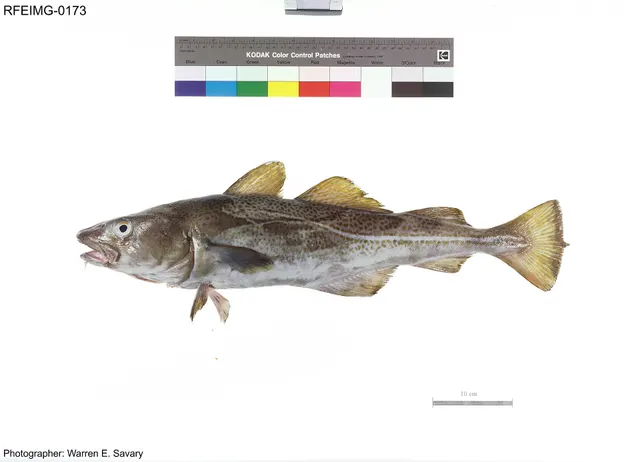 Atlantic codGadoids of the same family. Saithe is separated from the true pollack by a straight pale lateral line where the pollack's curves, and from cod by body form and the forked tail.
- Lesser sandeelSaithe feed on sandeel in mid water in dense fast-moving shoals, a very different hunting pattern from the cod working the same ground below them.
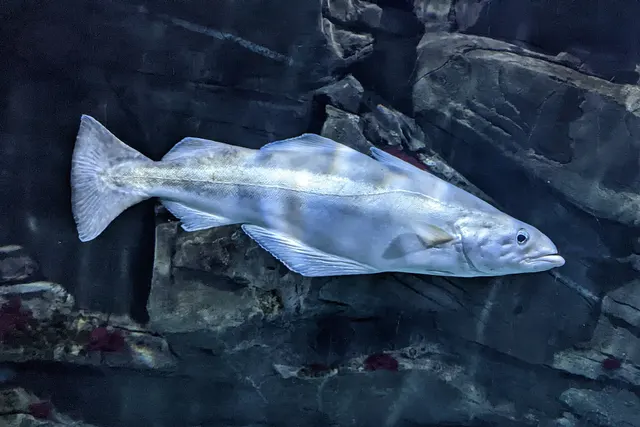 PollackCongeners in Pollachius, taken over the same ground on the same tactics and confused constantly. The lateral line separates them: straight and pale in saithe, dark and arched over the pectoral in pollack. The lower jaw projects clearly in pollack and barely in saithe.
How it is caught
- Feathering and multi-lure tracesYoung saithe are taken in numbers on feathers from pier and rock across the northern part of the range, where they are a traditional food fish rather than merely a sport one.
- JiggingA fast midwater shoaling hunter that chases, which is why jigs and feathers worked at speed over wrecks produce a fish a drop when a shoal is found.
Where you will find it
- Caithness and the north coastFlagstone platforms with very deep water immediately off them put a species that is a boat fish further south within reach of somebody standing on the rock, which is the defining characteristic of shore fishing at this latitude.
- East Lothian and the Firth of Forth coastSaithe hold on the reef and around structure here and are taken from rock and harbour in numbers as young fish, which is a long-standing local food fishery as well as a sport one.
- Scottish sea lochsAbundant along loch sides, around piers and at the narrows, and the species most likely to be caught by anybody fishing a sea loch for the first time.
- ShetlandAbundant around the rock and in the voes at all sizes, and young coalfish were a genuine food fish taken in quantity from rock and pier.
- Skye and the Inner HebridesAbundant as small inshore fish over kelp and rock throughout the islands, with the larger adults offshore on deeper ground.
- Strangford Lough and the Ards coastAround the narrows, the pladdies and the harbour structures, in numbers, and the fish most casual shore sessions on this lough encounter.
- The Moray FirthAbundant over the rock, harbour walls and kelp of the whole coast, and the fish most young anglers on this coast start on — a northern signature that anglers further south encounter only incidentally.
- The north-east England coastAbundant over the rough ground, harbours and piers of this coast, and frequently the first fish anybody catches here. Small inshore fish dominate the shore catch.
Why the 13 connections on this page are here, and the sources
Similar and related fish
Backed by research — 3 connections
Supported by peer-reviewed research or fisheries science. The sources are listed and can be checked.
Atlantic cod
An identification comparison naming both binomials, addressing one of the worst naming collisions in sea angling.
- FishBase: a global information system on fishes — Froese, R. and D. Pauly, eds. — FishBase Consortium (Scientific institute)Relied on for: That Pollachius virens and Gadus morhua are both Gadidae of the North Atlantic with overlapping distributions.States this directlyPassage read and verified
- The Fishes of the British Isles and North-West Europe — Macmillan, 1969 (Reference work)Relied on for: The morphological separation of Pollachius virens from Pollachius pollachius by lateral line form and jaw projection.States this directlyCitation checked — the work exists and is described correctly
Lesser sandeel
Recorded diet evidence identifies Ammodytes marinus as a food item of this predator at species level. The edge is written at that granularity and no further.
- FishBase: a global information system on fishes — Froese, R. and D. Pauly, eds. — FishBase Consortium (Scientific institute)Relied on for: Food items recorded for this predator, including Ammodytes marinus.States this directlyPassage read and verified
- FAO Species Identification Guides for Fishery Purposes and the FAO Species Catalogues — Food and Agriculture Organization of the United Nations (Scientific institute)Relied on for: Species account describing the diet of this predator in the region where Ammodytes marinus occurs.Background and mechanism onlyCitation checked — the work exists and is described correctly
Pollack
A congeneric identification comparison naming both binomials, resolving the naming collision that gives both species the name 'pollock' in different English-speaking regions.
- FishBase: a global information system on fishes — Froese, R. and D. Pauly, eds. — FishBase Consortium (Scientific institute)Relied on for: That Pollachius virens and Pollachius pollachius are congeners of the North-East Atlantic with overlapping distributions and depth ranges.States this directlyPassage read and verified
- The Fishes of the British Isles and North-West Europe — Macmillan, 1969 (Reference work)Relied on for: The morphological separation of Pollachius virens from Pollachius pollachius by lateral line form and by the degree of lower-jaw projection.States this directlyCitation checked — the work exists and is described correctly
How it is caught
What experienced anglers do — 2 connections
Widely and independently recommended by experienced anglers and specialist sources. This is real angling knowledge, not proof: controlled evidence for it is limited, and FishingHQ records it as convention rather than as a demonstrated effect.
Feathering and multi-lure traces
An established way this species is taken recreationally in north-west European waters.
- Sea Angler — Bauer Media (Specialist angling publication)Relied on for: Shore and boat practice in north-west European sea angling for the species and method described, presented across multiple independent contributors.States this directlyCitation checked — the work exists and is described correctly
- General angling website restatements of established technique — Various (Credible secondary source)Relied on for: Widely restated practice connecting this species to this method, recorded as practitioner consensus rather than as tested fact.Background and mechanism onlyCitation checked — the work exists and is described correctly
Jigging
A practitioner claim following from the species' verified pelagic feeding.
- Sea Angler — Bauer Media (Specialist angling publication)Relied on for: Practitioner treatment of jigging and feathering for saithe and other midwater gadoids over wrecks.Citation checked — the work exists and is described correctly
- General angling website restatements of established technique — Various (Credible secondary source)Relied on for: Widely restated practitioner accounts of fast retrieves for saithe.Citation checked — the work exists and is described correctly
Where you will find it
Backed by research — 8 connections
Supported by peer-reviewed research or fisheries science. The sources are listed and can be checked.
Caithness and the north coast
A claim that a coast or region contains the ground and conditions this species is associated with. It is a distributional statement about the world, it rests on the reference literature and on the institute that surveyed it, and it deliberately asserts nothing about access, permission or catch.
- The Fishes of the British Isles and North-West Europe — Macmillan, 1969 (Reference work)Relied on for: Distribution and habitat association of the marine fishes of the British Isles and north-west Europe, including which coasts and ground types a species occupies.States this directlyCitation checked — the work exists and is described correctly
- FishBase: a global information system on fishes — Froese, R. and D. Pauly, eds. — FishBase Consortium (Scientific institute)Relied on for: Recorded distribution, depth range and habitat association for the species named.States this directlyPassage read and verified
East Lothian and the Firth of Forth coast
A distributional claim about where a species occurs, taken from reference works on the fishes of the region rather than from angling report. It states presence and habitat association and asserts nothing about a fishery.
- FishBase: a global information system on fishes — Froese, R. and D. Pauly, eds. — FishBase Consortium (Scientific institute)Relied on for: Distribution, habitat association, depth range and feeding behaviour recorded for the species concerned.States this directlyPassage read and verified
- The Fishes of the British Isles and North-West Europe — Macmillan, 1969 (Reference work)Relied on for: Distribution, habitat and biology of the fishes of the British Isles and north-west Europe.States this directlyCitation checked — the work exists and is described correctly
Scottish sea lochs
A claim that a place contains the ground and conditions the species is associated with. It is a distributional statement about the world, it rests on the regional reference literature, and it deliberately asserts nothing about access, permission or catch.
- The Fishes of the British Isles and North-West Europe — Macmillan, 1969 (Reference work)Relied on for: Distribution and habitat association of the marine and estuarine fishes of the British Isles, including which coasts and ground types a species occupies.States this directlyCitation checked — the work exists and is described correctly
- FishBase: a global information system on fishes — Froese, R. and D. Pauly, eds. — FishBase Consortium (Scientific institute)Relied on for: Recorded distribution, depth range and habitat association for the species named.States this directlyPassage read and verified
Shetland
A distribution association between an animal and a kind of water, rather than a claim about any named mark.
- The Fishes of the British Isles and North-West Europe — Macmillan, 1969 (Reference work)Relied on for: Distribution, habitat association, depth and ground preference of fishes in British and north-west European waters.States this directlyCitation checked — the work exists and is described correctly
- FishBase: a global information system on fishes — Froese, R. and D. Pauly, eds. — FishBase Consortium (Scientific institute)Relied on for: Distribution, habitat association and depth range recorded for the species.Background and mechanism onlyPassage read and verified
Skye and the Inner Hebrides
A distribution association between an animal and a kind of water, rather than a claim about any named mark.
- The Fishes of the British Isles and North-West Europe — Macmillan, 1969 (Reference work)Relied on for: Distribution, habitat association and ground type of fishes in British and north-west European waters.States this directlyCitation checked — the work exists and is described correctly
- FishBase: a global information system on fishes — Froese, R. and D. Pauly, eds. — FishBase Consortium (Scientific institute)Relied on for: Distribution, habitat association and depth range recorded for the species.Background and mechanism onlyPassage read and verified
Strangford Lough and the Ards coast
A claim that a place contains the ground, water and seasonal conditions the species is associated with. It is a distributional statement about the world, it rests on the regional reference literature, and it deliberately asserts nothing about access, permission or catch.
- The Fishes of the British Isles and North-West Europe — Macmillan, 1969 (Reference work)Relied on for: Distribution and habitat association of the marine, estuarine and freshwater fishes of the British Isles, including which coasts, estuaries and ground types a species occupies.States this directlyCitation checked — the work exists and is described correctly
- FishBase: a global information system on fishes — Froese, R. and D. Pauly, eds. — FishBase Consortium (Scientific institute)Relied on for: Recorded distribution, depth range and habitat association for the species named.States this directlyPassage read and verified
The Moray Firth
A claim that a place contains the ground, water and seasonal conditions the species is associated with. It is a distributional statement about the world, it rests on the regional reference literature, and it deliberately asserts nothing about access, permission or catch.
- The Fishes of the British Isles and North-West Europe — Macmillan, 1969 (Reference work)Relied on for: Distribution and habitat association of the marine, estuarine and freshwater fishes of the British Isles, including which coasts, estuaries and ground types a species occupies.States this directlyCitation checked — the work exists and is described correctly
- FishBase: a global information system on fishes — Froese, R. and D. Pauly, eds. — FishBase Consortium (Scientific institute)Relied on for: Recorded distribution, depth range and habitat association for the species named.States this directlyPassage read and verified
The north-east England coast
A claim that a place contains the ground and conditions the species is associated with. It is a distributional statement about the world, it rests on the regional reference literature, and it deliberately asserts nothing about access, permission or catch.
- The Fishes of the British Isles and North-West Europe — Macmillan, 1969 (Reference work)Relied on for: Distribution and habitat association of the marine and estuarine fishes of the British Isles, including which coasts and ground types a species occupies.States this directlyCitation checked — the work exists and is described correctly
- FishBase: a global information system on fishes — Froese, R. and D. Pauly, eds. — FishBase Consortium (Scientific institute)Relied on for: Recorded distribution, depth range and habitat association for the species named.States this directlyPassage read and verified
Safety
Barotrauma and pressure injury is set out at the top of this page, where it cannot be missed.
Cliffs and rock platforms — Can cause serious injury or death
A great deal of shore fishing for this species is from rock, where swell sweeps anglers off and the escape route is slow.
What reduces it: Never fish rock marks alone. Watch the mark for a full set cycle before committing. Wear a buoyancy aid, wear footwear with grip on wet rock, and plan the escape before starting.