Pollack
Fish · Last reviewed 2026-08-10
A fast gadoid that hunts up off reefs and wrecks and takes a lure on the drop — and the sea fish most likely to convert a bait angler to lure fishing.
Safety: barotrauma and pressure injury — can cause injury needing treatment. 3 more points apply here.
Barotrauma and pressure injury — Can cause injury needing treatment
Pollack are taken from 40 metres and deeper. A fish brought up quickly cannot vent its expanding swimbladder, arrives bloated, and cannot swim back down if released — so it floats and dies.
What reduces it: Retrieve more slowly from depth, use a weighted descending device to return fish that are to be released, and treat a run of fish that cannot swim down as a reason to move to shallower ground rather than to continue.
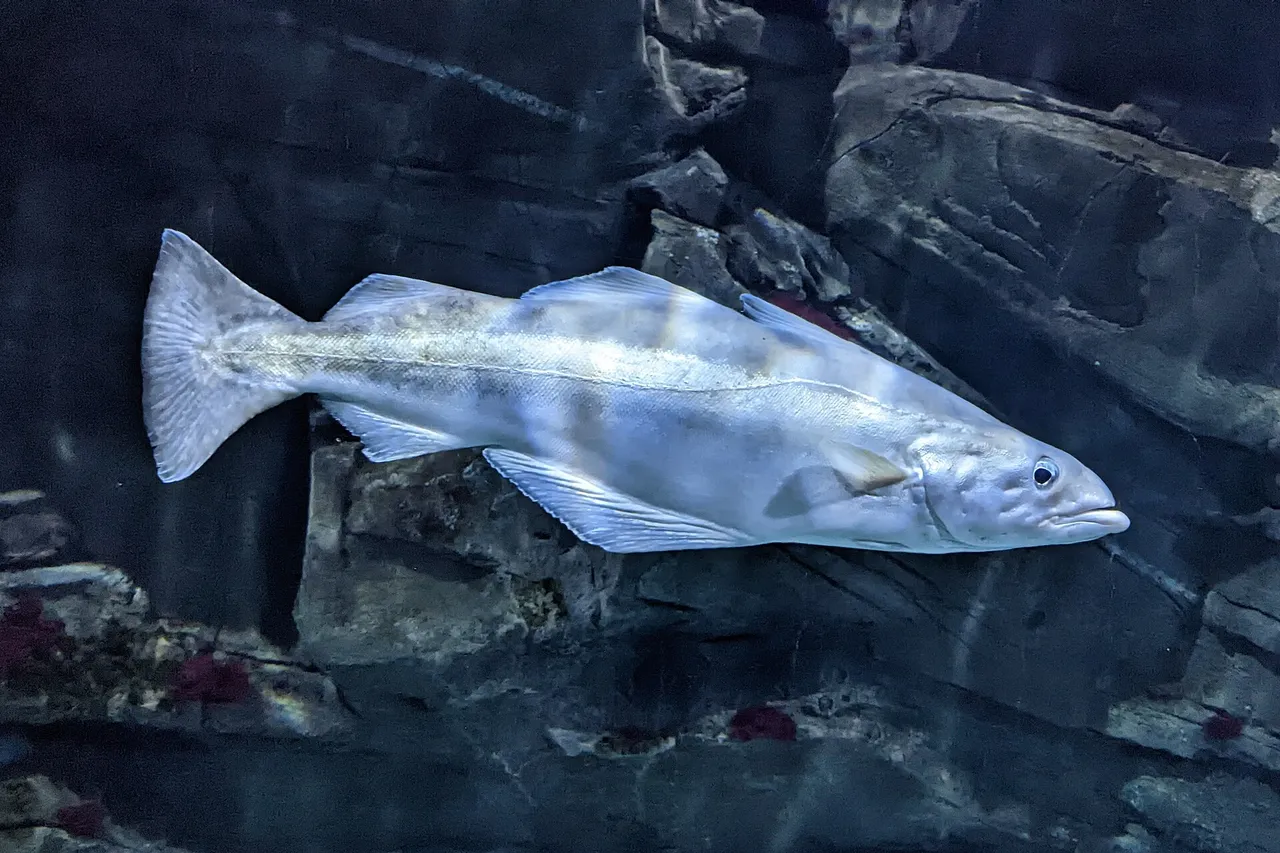
How this was identified, and who took it
Identified by: The projecting lower jaw, absent chin barbel and strongly arched lateral line are all visible in one frame. Those three together are exactly what separates pollack from saithe and from cod.Wilhelm Thomas Fiege — CC BY-SA 4.0, via Wikimedia Commons — source, licence.jpg)
Catching Pollack
Everything here on fishing for it. Each entry opens the page behind it.
- Ground
- When
- Somewhere documents it in almost every month, so there is no season for the species as a whole — the season is a property of the ground, and each place states its own.
- Where
- 204 places FishingHQ documents — strongest claim anywhere: regular local target · From the shore, From a kayak, From a boat, Fly fishing, On a charter, Spearfishing
Pollack are cod-family fish that behave nothing like cod. Where cod work the bottom, pollack hold above structure and rise into the water column to intercept prey, then turn and drive back down hard when hooked — a first run towards the reef that has cost a great many anglers a great deal of tackle.
That vertical hunting is what makes them such a good lure species. A pollack will follow a sinking lure down and take it on the drop, which means the productive presentation is often a slow flutter rather than a retrieve, and the take registers as the line simply stopping.
They are frequently confused with saithe, and the separation is straightforward once known: a pollack has no chin barbel and a dark lateral line that curves sharply over the pectoral fin, with no dark spot at the pectoral base.
Straight answers
For somebody who is already standing on the mark. Everything below this expands on it.
- Where are they?
- Near structure — rock, reef, kelp, a wreck — and usually low in the water rather than at the surface. Inshore and down to around 200 m, on hard ground rather than sand.
- What is the one thing that matters?
- Depth. Getting the lure into the layer the fish are holding in, which is a counted number of seconds rather than a guess. Most blank pollack sessions are the right lure at the wrong depth.
- How do I retrieve?
- Down, then a slow lift. Pollack attack upward from below, so the take almost always comes as the lure rises. A flat fast retrieve at one depth crosses their attack path once, briefly, if at all.
- Can I keep them?
- In Ireland, three per angler per day since 1 June 2026, then catch and release. In the UK, no statutory limit was in force when this was checked, and the voluntary Pollack Pact asks for five, with everything under 50 cm returned.
- How do I put one back?
- If it came from deeper than about 20 m, at depth rather than at the surface. Surface release measured 56 per cent successful; returning the fish near its catch depth exceeded 80 per cent.
Where you are fishing from
The same fish, and genuinely different fishing. Open the one you are standing on.
Rock marks
Depth close in, and the edge fish hunt along
Deep-water rock marks — the shore fishery, and the one without the barotrauma problem
- Mid water
- Deep water
- On or near the bottom
Methods: Spinning, Light rock fishing
How this mark actually fishes
Why fish are here
A rock mark with deep water and kelp at the foot of it is pollack habitat in miniature: hard ground, cover, current running along the ledge, and small fish held against it. Pollack sit close in on such marks far more often than anglers expect, which is why a lure dropped down the face frequently beats one cast fifty yards.
How to fish it
Cast along the ledge rather than out from it, count the lure down, and lift slowly. Work three counts before changing anything. Fish the states of tide when water is moving across the face, and fish the last hour of light: a rock mark at dusk is the shore angler's best chance of a pollack the size a boat produces.
What to look at on arrival
- The kelp line, and the depth at which the lure starts touching it — that is the bottom of the layer you can fish cleanly.
- Current running along the face rather than into it.
- Takes coming shallower as the light goes.
What goes wrong here
- Casting out to sea instead of along the structure. The fish are on the ledge you are standing on.
- Retrieving flat and fast, which never crosses the upward attack path.
Deep water close in means a ledge that swell reaches without warning, and wet kelp is as slippery as ice. The marks that fish best for pollack are the ones with the least margin.
What experienced anglers do — why, and the sources
Widely and independently recommended by experienced anglers and specialist sources. This is real angling knowledge, not proof: controlled evidence for it is limited, and FishingHQ records it as convention rather than as a demonstrated effect.
How rock marks marks fish for this species, from the evidence named here.
Reef and rough ground
Broken ground, weed and the fish that live in it
Wrecks and reef — where the fish are biggest and the release problem starts
- Mid water
- Deep water
- On or near the bottom
Methods: Drift fishing, Jigging
How this mark actually fishes
Why fish are here
A wreck is a permanent piece of hard structure standing proud in current, holding small fish and giving an ambush predator everything it needs in one place. Wreck pollack run larger than inshore fish and hold in numbers no rock mark produces. They also, decisively, come from depth.
How to fish it
Drop on the up-tide approach, let the lure sink to the structure and lift slowly through the layer above it. The take is on the lift. Then — and this is the part specific to this venue — plan the release before the drift starts: a fish from a wreck at forty metres has a barotrauma problem that a fish from a rock ledge does not.
What to look at on arrival
- The sounder showing fish stacked off the up-tide face rather than over the wreck itself.
- A fish that surfaces with distended belly or protruding stomach: it needs returning at depth, not at the surface.
What goes wrong here
- Fishing the whole drift instead of the productive pass over the structure.
- Releasing a deep-caught fish at the surface because it swam off. Measured surface release success is 56 per cent, and a fish that swims off at the surface is not thereby a fish that survived.
Backed by research — why, and the sources (1)
Supported by peer-reviewed research or fisheries science. The sources are listed and can be checked.
How reef and rough ground marks fish for this species, from the evidence named here.
- Recompression improves release success in pollack (Pollachius pollachius) — Fisheries Management and Ecology (Wiley), with the University of Plymouth, 2026 (Scientific literature)Relied on for: Surface release success of 56 per cent for pollack taken from depth.States this directlyPassage read and verified
Boat
Your own hull, and the freedom to move
Under your own power, and able to find the layer
- Upper water
- Mid water
- Deep water
- On or near the bottom
Methods: Drift fishing, Jigging, Trolling
How this mark actually fishes
Why fish are here
A boat lets you fish structure that no cast reaches, and — more importantly for this species — lets you work systematically down through the water column over the same piece of ground until you find the layer. From the shore you get one angle on one depth range; from a boat you get all of them.
How to fish it
Vary the countdown methodically rather than the lure. Drift over the ground, drop, count, lift, drop back. When a count produces, hold it. Keep the drift speed in mind: a fast drift changes what a given count means and is the commonest reason a technique that worked yesterday fails today.
What to look at on arrival
- Drift speed, which silently changes your depth at a fixed count.
- Fish marking at a consistent depth across several drifts, which is the layer to fish.
What goes wrong here
- Changing the lure when the depth was the problem. Nine times in ten it is the depth.
- Not carrying a descending device on a boat trip that will fish deep ground.
What experienced anglers do — why, and the sources
Widely and independently recommended by experienced anglers and specialist sources. This is real angling knowledge, not proof: controlled evidence for it is limited, and FishingHQ records it as convention rather than as a demonstrated effect.
How boat marks fish for this species, from the evidence named here.
Kayak
Mobility, silence, and very little room
Boat access to inshore reef, at shore-fishing depths
- Mid water
- Deep water
- On or near the bottom
Methods: Kayak fishing, Drift fishing
How this mark actually fishes
Why fish are here
A kayak reaches the inshore reef and kelp edges that hold pollack a short way beyond casting range from the rocks — often in ten to twenty-five metres rather than forty. That depth band is the interesting one: deep enough to hold decent fish, shallow enough that the barotrauma problem is at its margin rather than at its centre.
How to fish it
Drift the reef edge, drop and lift as from a boat, but expect shorter counts. A kayak's slow drift is an advantage here — it holds a countdown honest in a way a fast boat drift does not.
What to look at on arrival
- Depth on the sounder against the count you are fishing.
- Wind against tide, which turns a manageable drift into an uncontrollable one.
What goes wrong here
- Treating a kayak as a small boat for tackle purposes. There is no room to fight a fish standing up and nowhere to put a large landing net.
Reef and kelp edges in swell are the worst place on the coast to be in a kayak. Wind against tide over structure builds a short steep sea very quickly.
What experienced anglers do — why, and the sources
Widely and independently recommended by experienced anglers and specialist sources. This is real angling knowledge, not proof: controlled evidence for it is limited, and FishingHQ records it as convention rather than as a demonstrated effect.
How kayak marks fish for this species, from the evidence named here.
Breakwater
A wall built across moving water
Deep water and structure, without leaving the harbour
- Mid water
- Deep water
Methods: Spinning, Light rock fishing
How this mark actually fishes
Why fish are here
The outer arm of a breakwater has the two things pollack want — hard structure and current running along and around the head of it — with deep water immediately at the foot. The head of the arm, where tide accelerates around it, is usually the whole mark.
How to fish it
Work the outer face and the head. Cast along the wall, count down, lift. Fish it at the states of tide when water is running past the head rather than at slack.
What to look at on arrival
- The tide accelerating around the head, and the eddy behind it.
- Small fish held against the wall, which is what the pollack are under.
What goes wrong here
- Fishing the sheltered inner side, which has the structure but not the current.
What experienced anglers do — why, and the sources
Widely and independently recommended by experienced anglers and specialist sources. This is real angling knowledge, not proof: controlled evidence for it is limited, and FishingHQ records it as convention rather than as a demonstrated effect.
How breakwater marks fish for this species, from the evidence named here.
Pier and jetty
Deep water without a boat
The accessible version, usually of smaller fish
- Mid water
- Deep water
Methods: Light rock fishing, Spinning
How this mark actually fishes
Why fish are here
Piles break the tide and hold weed and small fish, and pollack — often small ones — sit among them. A pier is the easiest place to learn the retrieve on fish that are willing, at depths where nothing needs to be returned at depth.
How to fish it
Small soft plastics down the side, worked in the same down-and-lift pattern as everywhere else. This is where light rock fishing meets pollack, and where most anglers first feel the take-on-the-lift that defines the species.
What to look at on arrival
- Weed and small fish around the piles, and pollack sitting just below them.
What goes wrong here
- Using tackle heavy enough for a wreck fish. Pier pollack are usually small and the fishing is better light.
What experienced anglers do — why, and the sources
Widely and independently recommended by experienced anglers and specialist sources. This is real angling knowledge, not proof: controlled evidence for it is limited, and FishingHQ records it as convention rather than as a demonstrated effect.
How pier and jetty marks fish for this species, from the evidence named here.
Where pollack sit, and why depth decides everything
Each of these is a piece of biology or hydrography, what it looks like from where you are standing, and what you can try as a result.
They hunt upward, and the whole technique follows from it
- What you may see
- Small fish held above ground or structure — over a reef edge, a kelp line, the up-tide face of a wreck. And on the rod, a take that comes as a solid weight during the lift rather than a snatch during the wind.
- What to try
- Fish down and then lift. Let the lure sink to the layer you want, raise it slowly with the rod, and expect the take on the way up. Then drop it back and repeat rather than winding it in.
- Where this breaks down
- This describes a fish holding on ground. Pollack chasing bait in open water near the surface — which happens, particularly at dusk in summer — behave more like any other predator and the vertical rule loosens.
Why this happens
A pollack hunts singly or in small groups by lying close to the sea bed beneath a shoal of small fish, watching it, then darting up to take one and dropping back down to let the shoal reform. That is a specific and unusual pattern: the fish is not cruising through prey, it is holding station below prey and striking vertically. Two consequences follow immediately. The strike comes from underneath and travels upward, so a lure that is rising is crossing the attack path and a lure travelling flat is not. And the fish is committed to a position near structure rather than searching, so finding pollack is about finding the structure they are holding on rather than about covering water.
Official guidance — why, and the sources (1)
Stated by a fisheries authority, scientific institute or recognised angling body. Authoritative, but summarising rather than demonstrating.
The mechanism above, and what it rests on.
- Pollack (Pollachius pollachius) — MarLIN species record — The Marine Life Information Network, Marine Biological Association of the United Kingdom (Scientific institute)Relied on for: The ambush pattern of holding close to the sea bed below a shoal, rising to take a fish and returning to position.States this directlyCitation checked — the work exists and is described correctly
The water column is the variable, and it is countable
- What you may see
- The count at which you got a take, a follow, or a touch of weed or ground. All three are information about where the bottom and the fish are.
- What to try
- Fish the same lure at three different counts before you change the lure. When one produces, repeat that count exactly rather than trying to remember roughly how long it was.
- Where this breaks down
- A countdown is only reliable while the head weight, the current and the boat's drift are constant. Change any of the three and the count is a different depth.
Why this happens
Pollack sit at a depth rather than at a place, and that depth changes with light, tide and season. Because the fish is holding rather than roaming, a lure two metres above it may as well be on land. The practical form of this is the countdown: a soft plastic on a known head weight sinks at a roughly known rate, so counting the seconds before you start the retrieve is choosing a layer to fish. Count ten and get nothing, count fifteen, count twenty. This converts the most important variable in pollack fishing from an intuition into an experiment you can repeat once it works — which is why the countdown, and not the lure, is what experienced pollack anglers actually talk about.
What experienced anglers do — why, and the sources
Widely and independently recommended by experienced anglers and specialist sources. This is real angling knowledge, not proof: controlled evidence for it is limited, and FishingHQ records it as convention rather than as a demonstrated effect.
The mechanism above, and what it rests on.
Structure plus current is the address; either alone is not
- What you may see
- Where the tide breaks around the feature: standing water, a slick, a line of disturbance downtide. On a boat, the sounder showing fish sitting just off the structure rather than on it.
- What to try
- Fish the up-tide side and let the lure be carried down onto the structure rather than casting past it. On a shore mark, fish the states of tide when the water is moving across the ledge, not the slack in between.
Why this happens
Pollack live over hard ground — rock, reef, kelp forest and wreck — from close inshore down to around two hundred metres. But structure without moving water holds far fewer fish than structure with it, because current is what brings food past a stationary ambush predator and lets it eat without hunting. The productive part of a mark is therefore usually the up-tide face of the structure and the eddy immediately behind it, and the productive part of the day is when the tide is running across it. A wreck at slack water is frequently the same wreck without the fish switched on.
Official guidance — why, and the sources (1)
Stated by a fisheries authority, scientific institute or recognised angling body. Authoritative, but summarising rather than demonstrating.
The mechanism above, and what it rests on.
- Pollack (Pollachius pollachius) — MarLIN species record — The Marine Life Information Network, Marine Biological Association of the United Kingdom (Scientific institute)Relied on for: Pollack occurring on hard bottoms around rocks, wrecks and kelp, inshore and to around 200 m.States this directlyCitation checked — the work exists and is described correctly
A pollack from depth is injured by the ascent, and it is fixable
- What you may see
- A fish that comes up with its eyes bulging, its belly distended or its stomach protruding from its mouth, and that cannot right itself or swim down when released.
- What to try
- Return it at depth rather than at the surface, using a descending device or a weighted release rig. Do not vent it with a needle unless you know exactly what you are doing; the study's finding is about recompression, not puncture.
- Where this breaks down
- THE DEPTH IS THE CONDITION. This is about fish taken from deeper than roughly twenty metres. A pollack from a shore ledge in five metres of water does not have this problem and does not need this equipment, and pretending otherwise blunts the message for the people it is actually for.
Why this happens
Pollack are highly sensitive to barotrauma. Brought up from depth, the gas in the swim bladder expands and cannot be vented fast enough; it distends the peritoneal cavity, can force the stomach into the mouth, and leaves the fish unable to swim down even when it is otherwise unhurt. A fish released at the surface in that state floats, is taken by gulls, or dies slowly. Recompression reverses the mechanism: returned to a depth where the gas recompresses, the fish recovers its reflexes and swims off. The 2026 Plymouth work measured the difference for pollack caught deeper than about twenty metres — 56 per cent successful release at the surface, more than 80 per cent when returned near catch depth, with reflexes recovering within one to four minutes back in the water.
Backed by research — why, and the sources (1)
Supported by peer-reviewed research or fisheries science. The sources are listed and can be checked.
The mechanism above, and what it rests on.
- Recompression improves release success in pollack (Pollachius pollachius) — Fisheries Management and Ecology (Wiley), with the University of Plymouth, 2026 (Scientific literature)Relied on for: Successful release of 56 per cent for surface-released pollack against more than 80 per cent for fish returned near catch depth, for fish taken from deeper than about 20 m, with reflexes recovering in one to four minutes.States this directlyPassage read and verified
From 2026, releasing pollack is the normal end of a good day
- What you may see
- Your own count, and which jurisdiction you are fishing. Those are the two facts that decide what happens to the next fish.
- What to try
- Carry a descending device before you need it, know your jurisdiction's current position before you fish rather than after, and treat the 50 cm figure as the more demanding of the two British numbers.
- Where this breaks down
- The UK number is voluntary and the Irish number is law, and this profile never blurs the two. A voluntary code is not enforceable and it is also, in the 50 cm release, stricter than any bag limit in the way that matters most to a stock.
Why this happens
Two things changed at once. ICES advised zero catch for pollack in divisions 6 and 7 for 2025 and, for 2026, that total removals should not exceed 3,310 tonnes counting commercial and recreational catch together and accounting for the survival of released fish. Ireland then made a three-fish daily bag limit for recreational anglers, in force from 1 June 2026, with fishing permitted to continue on a catch-and-release basis after that. The UK agreed the same number and, as at the last check, had not enacted it — leaving the voluntary Pollack Pact, which asks for five fish, the release of everything under 50 cm, and the use of descending devices. Whichever side of the Irish Sea you are on, the fourth good pollack of the day is going back, and the advice clause in the ICES figure means how it goes back counts towards the stock rather than only towards the fish.
Official guidance — why, and the sources (2)
Stated by a fisheries authority, scientific institute or recognised angling body. Authoritative, but summarising rather than demonstrating.
The mechanism above, and what it rests on.
- Conservation measures for recreational pollack fishing — Bye-Law No. 1028 of 2026 — Inland Fisheries Ireland, for the Minister of State at the Department of Climate, Energy and the Environment, 2026 (Government fisheries body)Relied on for: A three-pollack daily bag limit in force in Ireland from 1 June 2026 under Bye-Law 1028 of 2026, with catch and release permitted thereafter.States this directlyPassage read and verified
- The pollack bag limit, the Pollack Pact, and the instrument that is not yet made — Angling Trust — the representative body for angling in England, 2026 (Angling or fisheries organisation)Relied on for: The agreed but unenacted UK three-fish limit, the voluntary Pollack Pact's five-fish and 50 cm measures, and the ICES advice accounting for the survival of released fish.States this directlyCitation checked — the work exists and is described correctly
Low light moves them up, and it is the shore angler's window
- What you may see
- The last hour before dark, particularly in summer, and fish showing or swirling closer to the surface than they were an hour earlier.
- What to try
- Fish dusk from the rocks, shorten the countdown as the light goes, and be prepared for takes much higher in the water than the same mark gives at midday.
Why this happens
An ambush predator that hunts by looking up at silhouettes against the surface depends on light, and a moderate amount of it works in the fish's favour: too bright and its prey can see it coming, too dark and it cannot see the prey. The practical consequence is that pollack become far more catchable in the first and last hour of daylight, and that they come shallower in low light than they hold in the middle of a bright day. For a shore angler this is decisive, because shallow-and-low-light is the only condition in which a rock mark competes with a boat over a wreck.
What experienced anglers do — why, and the sources
Widely and independently recommended by experienced anglers and specialist sources. This is real angling knowledge, not proof: controlled evidence for it is limited, and FishingHQ records it as convention rather than as a demonstrated effect.
The mechanism above, and what it rests on.
Finding them
What to look for, what it means, and how much it is worth. None of these guarantees a fish — the third column says how far each one is worth trusting.
7 things to look for
A take that arrives as solid weight during the lift
Usually worth acting onThe fish attacked upward and took the lure as it rose, which is the normal pollack take and is the direct signature of ambush from below.
What to do: Keep lifting into it rather than striking. Then note the count at which it happened and repeat it exactly.
Official guidance — why, and the sources (1)
Stated by a fisheries authority, scientific institute or recognised angling body. Authoritative, but summarising rather than demonstrating.
What this sign rests on.
- Pollack (Pollachius pollachius) — MarLIN species record — The Marine Life Information Network, Marine Biological Association of the United Kingdom (Scientific institute)Relied on for: Pollack rising from below to take prey and returning to position.States this directlyCitation checked — the work exists and is described correctly
A hard first run straight downward
Usually worth acting onA hooked pollack dives for the structure it was holding on. It is the strongest run the fish makes and it happens immediately.
What to do: Have the clutch set before you cast, and do not try to stop the first run over a wreck by clamping down — that is how the trace ends up in the structure.
What experienced anglers do — why, and the sources
Widely and independently recommended by experienced anglers and specialist sources. This is real angling knowledge, not proof: controlled evidence for it is limited, and FishingHQ records it as convention rather than as a demonstrated effect.
What this sign rests on.
The lure touching weed or ground at a repeatable count
Usually worth acting onYou have found the bottom of the fishable layer, which calibrates every other count.
What to do: Work upward from there in two-second steps rather than starting again from the surface.
What experienced anglers do — why, and the sources
Widely and independently recommended by experienced anglers and specialist sources. This is real angling knowledge, not proof: controlled evidence for it is limited, and FishingHQ records it as convention rather than as a demonstrated effect.
What this sign rests on.
Takes coming shallower as the light drops
Often worth acting onLow light is moving the fish up. An ambush predator working against a bright surface has a narrower window than one working at dusk.
What to do: Shorten the countdown through the last hour of daylight rather than persisting with the count that worked at noon.
What experienced anglers do — why, and the sources
Widely and independently recommended by experienced anglers and specialist sources. This is real angling knowledge, not proof: controlled evidence for it is limited, and FishingHQ records it as convention rather than as a demonstrated effect.
What this sign rests on.
A fish surfacing with distended belly, bulging eyes or a protruding stomach
Usually worth acting onBarotrauma. The swim bladder gas has expanded on the way up and the fish cannot swim down under its own power, however lively it looks in the water.
What to do: Return it at depth using a descending device rather than over the side. A fish in this state released at the surface has a measured 56 per cent chance against more than 80 per cent when recompressed.
Backed by research — why, and the sources (1)
Supported by peer-reviewed research or fisheries science. The sources are listed and can be checked.
What this sign rests on.
- Recompression improves release success in pollack (Pollachius pollachius) — Fisheries Management and Ecology (Wiley), with the University of Plymouth, 2026 (Scientific literature)Relied on for: Barotrauma signs in pollack from depth, and the release-success figures for surface versus depth release.States this directlyPassage read and verified
A wreck marking fish but producing nothing at slack water
Often worth acting onStructure without current. An ambush predator has nothing being delivered to it, and frequently switches off entirely.
What to do: Fish the run of tide either side rather than the slack, and use the slack to move or to eat.
What experienced anglers do — why, and the sources
Widely and independently recommended by experienced anglers and specialist sources. This is real angling knowledge, not proof: controlled evidence for it is limited, and FishingHQ records it as convention rather than as a demonstrated effect.
What this sign rests on.
Small fish held tight against a wall or a kelp line
Often worth acting onThe prey shoal an ambush fish would be sitting beneath.
What to do: Fish below them, not among them. The pollack is under the bait rather than in it.
Official guidance — why, and the sources (1)
Stated by a fisheries authority, scientific institute or recognised angling body. Authoritative, but summarising rather than demonstrating.
What this sign rests on.
- Pollack (Pollachius pollachius) — MarLIN species record — The Marine Life Information Network, Marine Biological Association of the United Kingdom (Scientific institute)Relied on for: Pollack lying close to the bottom watching sandeel shoaling above them.States this directlyCitation checked — the work exists and is described correctly
How to fish for them
Soft plastic on a jig head, counted down and lifted
When: The default method everywhere pollack are fished, from rock ledges and breakwaters to wrecks. Any time of year, and best in the last hour of light from the shore.
Why it works, how to do it, and what it will not do
Why it works
It solves the two problems the species presents at once. The jig head's weight sets a known sink rate, which turns depth into a countable variable; and a slow lift presents the lure rising through the water, which is where the take comes from. Nothing else does both as simply.
How to fish it
Cast or drop, count in seconds, then lift the rod slowly through about a metre and let the lure drop back on a controlled line. Repeat. Change the count before you change the lure — three counts, then a different lure only if none produced. When one works, repeat it precisely.
Tackle
A 7-to-9-foot lure rod rated around 10 to 40 g from the shore, or a shorter heavier rod from a boat, a 3000-to-4000-size fixed spool, 15 to 20 lb braid and a 20 lb fluorocarbon leader. Braid because the take on the lift is felt rather than seen, and stretch removes it.
What it will not do
- Very snaggy over kelp and wreck, and losses are in lures rather than in leads.
- The countdown is only meaningful while head weight, current and drift are constant.
- Useless if the fish are not near structure, which is most of the sea.
What experienced anglers do — why, and the sources
Widely and independently recommended by experienced anglers and specialist sources. This is real angling knowledge, not proof: controlled evidence for it is limited, and FishingHQ records it as convention rather than as a demonstrated effect.
What this account of the method rests on.
Vertical jigging over a wreck
When: Boat fishing over wrecks and deep reef, where the drift is short and the ground is deep.
Why it works, how to do it, and what it will not do
Why it works
It gets down fast, covers the layer above the structure quickly, and works the lure in exactly the vertical plane the fish attacks in. On a ninety-second pass over a wreck, deployment speed is most of the method.
How to fish it
Drop to contact, then work the jig in long lifts with controlled drops, staying in touch on the fall. Come up through the layer above the wreck rather than dragging along it. Be ready for the take on the lift and for the fish to dive immediately.
Tackle
A jigging rod, a small strong multiplier or a 5000-size spinning reel, 30 lb braid and a 40 lb leader, with jigs from 60 to 200 g set by depth and tide. Lighter than a cod pirk set-up because pollack are usually taken in the layer above the structure rather than hard on it.
What it will not do
- Expensive over rough ground, and a snagged jig is a lost jig.
- Tiring over a long day in deep water.
- Loses to a slowly worked shad when fish are inactive.
What experienced anglers do — why, and the sources
Widely and independently recommended by experienced anglers and specialist sources. This is real angling knowledge, not proof: controlled evidence for it is limited, and FishingHQ records it as convention rather than as a demonstrated effect.
What this account of the method rests on.
Drifting a wreck with a long flowing trace
When: Classic wreck pollack fishing, particularly in the west of Britain and Ireland.
Why it works, how to do it, and what it will not do
Why it works
A long trace behind a lead lets a lure work several metres above the structure while the weight keeps contact with the depth, and the fish takes the lure well clear of the wreck it would otherwise dive into. It is a way of fishing the killing layer without fishing the snag.
How to fish it
Lead down to the wreck, then wind up slowly and steadily so the trailing lure rises through the layer. The take comes during that wind-up. Then drop back and repeat on the next part of the drift.
Tackle
A 12-to-20 lb class boat rod, a multiplier with 30 lb braid, a lead of 6 to 12 oz on a boom, and a trace of 15 to 20 feet of fluorocarbon to a shad or a redgill-type eel. The long trace is the whole method and shortening it defeats it.
What it will not do
- Awkward to handle: a fifteen-foot trace is difficult to land a fish on without help.
- Needs a boat and a skipper who will set the drift properly.
What experienced anglers do — why, and the sources
Widely and independently recommended by experienced anglers and specialist sources. This is real angling knowledge, not proof: controlled evidence for it is limited, and FishingHQ records it as convention rather than as a demonstrated effect.
What this account of the method rests on.
Light rock fishing for small pollack
When: From piers, harbour walls and accessible rock, on small fish, all year and especially in summer.
Why it works, how to do it, and what it will not do
Why it works
Pollack are one of the most willing light-rock species and take a small soft plastic readily. The technique is the same down-and-lift as everywhere else, at a scale that makes it enjoyable rather than merely effective, and it is the best way to learn the take.
How to fish it
Small jig heads of 3 to 10 g with two-to-three-inch soft plastics, worked down the side of structure with the same count-and-lift. Short casts. Everything about it is a scaled-down version of the wreck method.
Tackle
A 7-foot rod rated 1 to 10 g, a 2000-size reel, 10 lb braid and an 8 lb fluorocarbon leader. Light enough that a 30 cm fish is genuinely good sport, which is the point of fishing this way.
What it will not do
- Selects for small fish. A specimen pollack on this tackle over structure will not be landed.
- Snags cheaply but frequently.
What experienced anglers do — why, and the sources
Widely and independently recommended by experienced anglers and specialist sources. This is real angling knowledge, not proof: controlled evidence for it is limited, and FishingHQ records it as convention rather than as a demonstrated effect.
What this account of the method rests on.
Returning a deep-caught fish at depth
When: Every time a pollack from deeper than about twenty metres has to go back — which, under a three-fish bag limit, is most of a good day's fish.
Why it works, how to do it, and what it will not do
Why it works
Because it is measurably the difference between the fish surviving and not. Surface-released pollack from depth showed 56 per cent successful release; fish returned near their catch depth exceeded 80 per cent, recovering their reflexes within one to four minutes back in the water. The ICES advice underpinning the bag limit explicitly accounts for the survival of released fish, so this is a stock measure as well as a welfare one.
How to fish it
Attach the fish to a descending device — a weighted, pressure- or lip-release clip — and lower it to near the depth it came from, then release. Do it quickly and keep the fish in the water as much of the time as possible. Do not substitute a needle for a descender; the measured result here is about recompression rather than venting.
Tackle
A commercially available descending device and a dedicated line and weight, kept rigged and to hand rather than stowed. The Plymouth authors describe such devices as a viable and low-cost measure that could become part of normal fishing procedure, which is exactly how it has to be carried to be used at all.
What it will not do
- Only relevant below about twenty metres. A shore-caught pollack from a rock ledge does not need it.
- Takes time on a drift, which is why it has to be rigged in advance rather than assembled when a fish is on the deck.
- The measured figures are for pollack specifically and should not be assumed for other species without their own evidence.
Backed by research — why, and the sources (2)
Supported by peer-reviewed research or fisheries science. The sources are listed and can be checked.
What this account of the method rests on.
- Recompression improves release success in pollack (Pollachius pollachius) — Fisheries Management and Ecology (Wiley), with the University of Plymouth, 2026 (Scientific literature)Relied on for: The 56 per cent against more than 80 per cent release-success figures, one-to-four-minute reflex recovery, and descending devices as a viable low-cost measure.States this directlyPassage read and verified
- The pollack bag limit, the Pollack Pact, and the instrument that is not yet made — Angling Trust — the representative body for angling in England, 2026 (Angling or fisheries organisation)Relied on for: The ICES 2026 advice accounting for the survival of released fish, and the Pollack Pact's recommendation of descending devices.States this directlyCitation checked — the work exists and is described correctly
Lures
Chosen by weight, sink rate, depth and retrieve, because those are what decide whether a lure is in front of a fish. There is no best one, and no best colour.
Paddle-tail soft plastics on jig heads
A three-to-six-inch paddle-tail shad on an exposed jig head, in white, pearl, black or natural fish colours.
- Weight
- 10 g to 60 g of head inshore; 60 g to 150 g over deep wrecks
- Depth it fishes
- Whatever the count puts it at. That is the point of the lure rather than a property of it.
- Sink rate
- Roughly constant for a given head weight, which is exactly why this is the pollack lure: a predictable sink rate is what makes a countdown mean a depth.
- Retrieve
- Sink on a controlled line, then a slow lift of about a metre with the rod, then drop back. The take is on the lift.
When it works, and when it does not
Everywhere and almost always. It is the default for a reason: the head weight sets the sink rate, the tail works at the very slow speeds a lifting retrieve produces, and the profile suits a fish that eats small fish. From a pier at 10 g to a wreck at 150 g it is the same lure and the same retrieve at different scales.
Limitation: Snags readily over kelp and wreck, and the exposed hook that makes it hook well is the reason. Weedless rigging trades hook-ups for survivability and is a real decision rather than an obvious improvement.
- Rock marks
- Reef and rough ground
- Boat
- Kayak
- Breakwater
- Pier and jetty
What experienced anglers do — why, and the sources
Widely and independently recommended by experienced anglers and specialist sources. This is real angling knowledge, not proof: controlled evidence for it is limited, and FishingHQ records it as convention rather than as a demonstrated effect.
What this lure guidance rests on.
Slim eel-type rubber lures on a long trace
A long, thin, soft rubber eel or worm with a fine whipping tail, fished on a long flowing trace behind a lead rather than on a jig head.
- Weight
- Unweighted; the lead on the boom is 6 to 12 oz
- Depth it fishes
- Several metres above the structure, held there by the lead below while the trace streams behind.
- Retrieve
- A slow steady wind-up from the wreck, so the lure rises through the layer.
When it works, and when it does not
The classic west-country and Irish wreck pollack lure, and still among the most effective things ever tied to a trace. It works because it does the rising presentation without the lure ever being near the snag: the lead finds the wreck and the lure fishes above it.
Limitation: Needs a long trace and therefore a boat and space to handle it. Unusable from the shore, and awkward to land a fish on single-handed.
- Reef and rough ground
- Boat
What experienced anglers do — why, and the sources
Widely and independently recommended by experienced anglers and specialist sources. This is real angling knowledge, not proof: controlled evidence for it is limited, and FishingHQ records it as convention rather than as a demonstrated effect.
What this lure guidance rests on.
Metal jigs
A compact, dense, asymmetric metal jig that flutters on the drop rather than dropping straight.
- Weight
- 60 g to 200 g, set by depth and tide
- Depth it fishes
- Bottom and the layer immediately above the structure.
- Sink rate
- Fast, and less predictable than a jig head because the flutter is deliberate — a jig is not the tool for a precise countdown.
- Retrieve
- Long lifts with controlled drops, staying in contact on the fall.
When it works, and when it does not
Deep water, running tide, and short drifts where a lighter lure would never reach the fish in the time available. Also on active fish that will chase, where speed of presentation beats subtlety.
Limitation: Poor at slow speeds, expensive to lose over a wreck, and it forfeits the countdown precision that is the main advantage of a jig head.
- Reef and rough ground
- Boat
- Kayak
What experienced anglers do — why, and the sources
Widely and independently recommended by experienced anglers and specialist sources. This is real angling knowledge, not proof: controlled evidence for it is limited, and FishingHQ records it as convention rather than as a demonstrated effect.
What this lure guidance rests on.
Small soft plastics for light rock fishing
Two-to-three-inch soft plastics — small shads, grubs and slim minnows — on 3 to 10 g heads.
- Weight
- 3 g to 10 g
- Depth it fishes
- The first few metres down the side of a wall or a ledge.
- Sink rate
- Slow, which suits shallow structure and lets a short countdown be meaningful.
- Retrieve
- The same lift and drop, scaled down and shortened.
When it works, and when it does not
Piers, harbour walls and accessible rock, on the small pollack that live around structure everywhere. It is the best way to learn the take-on-the-lift, because the fish are willing and the tackle transmits everything.
Limitation: Selects small fish, and a good pollack hooked on it over structure is unlikely to be landed.
- Pier and jetty
- Breakwater
- Rock marks
What experienced anglers do — why, and the sources
Widely and independently recommended by experienced anglers and specialist sources. This is real angling knowledge, not proof: controlled evidence for it is limited, and FishingHQ records it as convention rather than as a demonstrated effect.
What this lure guidance rests on.
Hard minnow plugs
A shallow-to-medium-diving hard minnow, 90 to 130 mm, in natural baitfish patterns.
- Weight
- 10 g to 30 g
- Depth it fishes
- Upper water, and only where fish have come up.
- Sink rate
- Floating or slow-sinking, so the depth is set by the dive of the lip rather than by a countdown — a different tool for a different situation.
- Retrieve
- Steady, with pauses. The pause is when a following fish commits.
When it works, and when it does not
At dusk in summer, from rocks and breakwaters, when low light has brought pollack up into the top few metres. In that specific window it out-fishes a jig head, because the fish are hunting near the surface and a bottom-referenced technique is fishing beneath them.
Limitation: Almost useless in the middle of a bright day, when the fish are deep. A plug is a low-light and shallow-water lure for this species and pretending otherwise wastes sessions.
- Rock marks
- Breakwater
What experienced anglers do — why, and the sources
Widely and independently recommended by experienced anglers and specialist sources. This is real angling knowledge, not proof: controlled evidence for it is limited, and FishingHQ records it as convention rather than as a demonstrated effect.
What this lure guidance rests on.
Trolled lures behind a boat or kayak
A diving plug or a weighted soft plastic towed at low speed along a reef edge.
- Weight
- Whatever holds the running depth at the speed being towed
- Depth it fishes
- Set by the lure's dive and the speed, and held constant along the contour.
- Retrieve
- None — the boat provides it. Speed is the only control.
When it works, and when it does not
As a way of FINDING fish along a reef edge or a kelp line rather than as a way of catching them efficiently once found. Trolling a contour locates the productive stretch, and then the boat comes back and drifts it properly.
Limitation: Covers water rather than the column, so it misses fish sitting deeper than the lure runs — which, in daylight, is most of them.
- Boat
- Kayak
What experienced anglers do — why, and the sources
Widely and independently recommended by experienced anglers and specialist sources. This is real angling knowledge, not proof: controlled evidence for it is limited, and FishingHQ records it as convention rather than as a demonstrated effect.
What this lure guidance rests on.
Baits
Live and fresh dead small fish
Why it works, and how to present it
Pollack ambush small fish, and a live or fresh sandeel, launce or small pouting presented near structure is the thing itself rather than an imitation of it. On days when a lure is refused — bright flat calm, hard-fished marks, very large fish — a natural bait is frequently the only thing that produces.
Presentation: Fished on a long flowing trace so the bait works naturally above the structure, on a single hook through the nose or the upper lip. Weight goes on a boom well up the trace so the bait is not dragged. From the shore, a float can hold a live bait at a set depth over a kelp edge, which is a countdown by another means.
Limitation: Availability, and time. Catching bait is a session in itself, and the method is far slower to fish than a lure, which is why almost all modern pollack fishing is lure fishing. This is the only bait entry in the profile, and that is a description of the fishery rather than a gap in the research.
- Reef and rough ground
- Boat
- Rock marks
What experienced anglers do — why, and the sources
Widely and independently recommended by experienced anglers and specialist sources. This is real angling knowledge, not proof: controlled evidence for it is limited, and FishingHQ records it as convention rather than as a demonstrated effect.
What this bait guidance rests on.
Conditions
What each of these changes, why that matters to the fish, and what it is worth trying. None of it is a rule — fishing does not have any.
5 conditions, and what each one changes
Current
Moving water brings food past a stationary ambush predator and creates the eddies behind structure where it can hold without swimming.
Why it matters, and what to try
It is the difference between a wreck that holds fish and a wreck that holds fish which are switched off. Pollack are not chasing food down; they are waiting for it to arrive, and at slack water nothing arrives. This is the strongest single condition in pollack fishing and it outranks weather entirely.
What to try: Fish the run of tide and use the slack to move, eat or rig. On a shore mark, learn which states put water across the ledge and fish only those.
Official guidance — why, and the sources (1)
Stated by a fisheries authority, scientific institute or recognised angling body. Authoritative, but summarising rather than demonstrating.
What this rests on.
- Pollack (Pollachius pollachius) — MarLIN species record — The Marine Life Information Network, Marine Biological Association of the United Kingdom (Scientific institute)Relied on for: Pollack occupying hard bottom around rock, wreck and kelp where they ambush passing prey.States this directlyCitation checked — the work exists and is described correctly
Light
Low light brings pollack up in the water and makes them markedly more willing. Bright midday light pushes them down and makes them harder.
Why it matters, and what to try
For a fish that hunts by looking up at silhouettes, light is the whole hunting condition — and for a shore angler it is decisive, because dusk is the only time a rock mark reliably produces the size of fish a boat gets over a wreck.
What to try: Fish the last hour of light from the shore, and shorten the countdown as it goes. In the middle of a bright day, lengthen it or go deeper.
What experienced anglers do — why, and the sources
Widely and independently recommended by experienced anglers and specialist sources. This is real angling knowledge, not proof: controlled evidence for it is limited, and FishingHQ records it as convention rather than as a demonstrated effect.
What this rests on.
Season
Inshore marks fish best from spring through autumn; through the coldest months the fish are generally deeper and further out, which shifts the fishery towards boats.
Why it matters, and what to try
It sets who can fish for them. The shore pollack season and the wreck pollack season are not the same season, and a shore angler's blank in February is frequently a fact about depth rather than about technique.
What to try: Fish inshore rock and kelp through the warmer half of the year, and expect to need a boat and deeper ground in midwinter.
What experienced anglers do — why, and the sources
Widely and independently recommended by experienced anglers and specialist sources. This is real angling knowledge, not proof: controlled evidence for it is limited, and FishingHQ records it as convention rather than as a demonstrated effect.
What this rests on.
Swell and sea state
Swell over reef and kelp makes shore marks unfishable and dangerous long before it makes them unproductive, and turns a kayak drift over structure into a serious problem.
Why it matters, and what to try
Unlike cod fishing, where a big sea is the condition that makes the fishing, swell for pollack is almost purely a constraint. The fish are on structure that swell breaks over, and the marks that fish best are the ones with the least margin.
What to try: Check the swell forecast rather than only the wind, and pick a sheltered aspect. A pollack mark is rarely worth the risk that a cod mark sometimes is.
What experienced anglers do — why, and the sources
Widely and independently recommended by experienced anglers and specialist sources. This is real angling knowledge, not proof: controlled evidence for it is limited, and FishingHQ records it as convention rather than as a demonstrated effect.
What this rests on.
Wind
Wind against tide over structure builds a short steep sea quickly, and from a boat or kayak it also changes the drift speed, which silently changes what a given countdown means.
Why it matters, and what to try
The second half is the part anglers miss. A technique that worked yesterday failing today is very often a drift-speed problem wearing a lure problem's clothes.
What to try: Recalibrate the countdown whenever the drift changes, and treat wind-over-tide over a reef as a reason to be somewhere else.
What experienced anglers do — why, and the sources
Widely and independently recommended by experienced anglers and specialist sources. This is real angling knowledge, not proof: controlled evidence for it is limited, and FishingHQ records it as convention rather than as a demonstrated effect.
What this rests on.
Tackle
Each of these says why it is the size it is. Where a heavier outfit is suggested it is almost always about casting range or holding bottom, not about the strength needed to land the fish.
4 outfits, and why each is the size it is
Shore lure set-up
- Rock marks
- Breakwater
- Pier and jetty
- Rod
- 7 to 9 feet, rated around 10 to 40 g, with a tip soft enough to feel a take on the lift and a butt firm enough to turn a fish off kelp.
- Reel
- A 3000-to-4000-size fixed spool with a smooth clutch — the first run is straight down and immediate.
- Line
- 15 to 20 lb braid, because the take on the lift is felt and monofilament stretch removes exactly that information.
- Leader
- A rod-length of 20 lb fluorocarbon for abrasion against rock and kelp.
- Terminal
- Jig heads from 10 to 60 g with three-to-six-inch soft plastics. Head weight is chosen for the depth being fished rather than for casting distance.
The head weight is the only setting that really matters and it is chosen for sink rate, not for range. Everything else here is sized to feel a soft take at depth and then stop a fish diving into kelp — which is a much shorter, harder problem than fighting a fish in open water, and is why the rod is stiffer in the butt than its casting rating suggests.
What experienced anglers do — why, and the sources
Widely and independently recommended by experienced anglers and specialist sources. This is real angling knowledge, not proof: controlled evidence for it is limited, and FishingHQ records it as convention rather than as a demonstrated effect.
What this tackle guidance rests on.
Wreck and deep-reef set-up
- Reef and rough ground
- Boat
- Rod
- A 12-to-20 lb class boat rod or a dedicated jigging rod, short enough to work a lure vertically all day.
- Reel
- A multiplier or a 5000-size spinning reel holding 250 yards of 30 lb braid.
- Line
- 30 lb braid. Feeling a take forty metres down through a moving drift is the method, and stretch is the enemy of it.
- Leader
- 15 to 20 feet of 20 to 30 lb fluorocarbon on the flowing-trace method; a rod-length on jigs.
- Terminal
- 6 to 12 oz on a boom for the trace method, or 60 to 200 g jigs and jig heads for the vertical methods.
Lighter than the equivalent cod set-up on purpose. Pollack are usually taken in the layer ABOVE the structure rather than hard on it, so the tackle is sized to present a lure in that layer and absorb a fast downward run, not to winch a fish off the bottom. Over-gunning here costs takes.
What experienced anglers do — why, and the sources
Widely and independently recommended by experienced anglers and specialist sources. This is real angling knowledge, not proof: controlled evidence for it is limited, and FishingHQ records it as convention rather than as a demonstrated effect.
What this tackle guidance rests on.
Light rock set-up
- Pier and jetty
- Breakwater
- Rock marks
- Rod
- 7 feet, rated 1 to 10 g.
- Reel
- A 2000-size fixed spool.
- Line
- 10 lb braid.
- Leader
- 8 lb fluorocarbon.
- Terminal
- 3 to 10 g jig heads with two-to-three-inch soft plastics.
Sized so that a 30 cm fish is genuinely good sport, which is the entire justification: the pollack this catches are small, and catching them on tackle built for a wreck fish would be pointless. It is also the best tackle on which to learn the take, because it transmits everything.
What experienced anglers do — why, and the sources
Widely and independently recommended by experienced anglers and specialist sources. This is real angling knowledge, not proof: controlled evidence for it is limited, and FishingHQ records it as convention rather than as a demonstrated effect.
What this tackle guidance rests on.
The release kit
- Reef and rough ground
- Boat
- Kayak
- Rod
- Not applicable — this is deck equipment, and it is listed as tackle because it is now part of the set-up rather than an accessory.
- Reel
- A dedicated hand line or small reel holding enough line to reach the fishing depth.
- Line
- Braid or cord, marked at intervals so the release depth is known rather than guessed.
- Leader
- None required.
- Terminal
- A commercially available descending device and a weight sufficient to take a fish down against its own buoyancy.
It is on the tackle list because under a three-fish bag limit most of a good day's pollack are going back, and a descending device that lives in a hatch is a device that does not get used. The measured difference is 56 per cent surviving surface release against more than 80 per cent recompressed, for fish from deeper than about twenty metres — which is the ground this set-up is used on, and only that ground.
Backed by research — why, and the sources (1)
Supported by peer-reviewed research or fisheries science. The sources are listed and can be checked.
What this tackle guidance rests on.
- Recompression improves release success in pollack (Pollachius pollachius) — Fisheries Management and Ecology (Wiley), with the University of Plymouth, 2026 (Scientific literature)Relied on for: Release-success figures for surface versus depth release, and descending devices as a viable low-cost measure.States this directlyPassage read and verified
Things that actually help
8 things that actually help
Change the count before you change the lure
Depth is the variable that decides pollack fishing and lure choice is a distant second. Three different counts with the same lure tests the thing that is actually wrong; three different lures at the same count tests the thing that usually is not.
What experienced anglers do — why, and the sources
Widely and independently recommended by experienced anglers and specialist sources. This is real angling knowledge, not proof: controlled evidence for it is limited, and FishingHQ records it as convention rather than as a demonstrated effect.
What this rests on.
Write the count down when it works
The whole value of a countdown is that it is repeatable, and a number you are trying to remember while playing a fish is a number you will lose. Anglers who consistently catch pollack know what count is working on a given mark and tide; anglers who do not are estimating each cast.
What experienced anglers do — why, and the sources
Widely and independently recommended by experienced anglers and specialist sources. This is real angling knowledge, not proof: controlled evidence for it is limited, and FishingHQ records it as convention rather than as a demonstrated effect.
What this rests on.
Set the clutch before you cast, not after the take
A hooked pollack's first run is straight down towards the structure it was holding on, it happens instantly, and it is the strongest thing the fish does. A clutch adjusted after that run has started is a clutch adjusted after the trace is already in the kelp.
What experienced anglers do — why, and the sources
Widely and independently recommended by experienced anglers and specialist sources. This is real angling knowledge, not proof: controlled evidence for it is limited, and FishingHQ records it as convention rather than as a demonstrated effect.
What this rests on.
Carry the descending device rigged, not stowed
Under a three-fish limit, most of a good day's fish go back. A device that has to be found and assembled while a fish lies on the deck will not be used, and the measured gap it closes is large: 56 per cent successful release at the surface against more than 80 per cent returned near catch depth.
Backed by research — why, and the sources (1)
Supported by peer-reviewed research or fisheries science. The sources are listed and can be checked.
What this rests on.
- Recompression improves release success in pollack (Pollachius pollachius) — Fisheries Management and Ecology (Wiley), with the University of Plymouth, 2026 (Scientific literature)Relied on for: Surface versus depth release success for pollack from deeper than about 20 m.States this directlyPassage read and verified
A fish that swims off at the surface has not necessarily survived
This is the intuition the study overturns. Barotrauma injury is internal and delayed, and the 56 per cent figure is measured on fish that were released and looked fine. Judging release success by whether the fish swam away is exactly the observation that made the problem invisible for so long.
Backed by research — why, and the sources (1)
Supported by peer-reviewed research or fisheries science. The sources are listed and can be checked.
What this rests on.
- Recompression improves release success in pollack (Pollachius pollachius) — Fisheries Management and Ecology (Wiley), with the University of Plymouth, 2026 (Scientific literature)Relied on for: Measured release success of 56 per cent for surface-released pollack from depth.States this directlyPassage read and verified
Know which side of the Irish Sea you are on before you count fish
Ireland's three-fish daily limit has been law since 1 June 2026. The UK agreed the same number and had not enacted it when this was checked, leaving a voluntary code asking for five — and, more demandingly, for the release of everything under 50 cm. Assuming one jurisdiction's position in the other is wrong in both directions.
Official guidance — why, and the sources (2)
Stated by a fisheries authority, scientific institute or recognised angling body. Authoritative, but summarising rather than demonstrating.
What this rests on.
- Conservation measures for recreational pollack fishing — Bye-Law No. 1028 of 2026 — Inland Fisheries Ireland, for the Minister of State at the Department of Climate, Energy and the Environment, 2026 (Government fisheries body)Relied on for: The Irish three-fish daily bag limit in force from 1 June 2026.States this directlyPassage read and verified
- The pollack bag limit, the Pollack Pact, and the instrument that is not yet made — Angling Trust — the representative body for angling in England, 2026 (Angling or fisheries organisation)Relied on for: The unenacted UK limit and the voluntary Pollack Pact's five-fish and 50 cm measures.States this directlyCitation checked — the work exists and is described correctly
Fish below the bait, not in it
A pollack sits beneath a shoal and looks up. A lure worked through the middle of the small fish is in the wrong place; a lure worked underneath them and lifted is crossing the fish's line of attack.
Official guidance — why, and the sources (1)
Stated by a fisheries authority, scientific institute or recognised angling body. Authoritative, but summarising rather than demonstrating.
What this rests on.
- Pollack (Pollachius pollachius) — MarLIN species record — The Marine Life Information Network, Marine Biological Association of the United Kingdom (Scientific institute)Relied on for: Pollack holding close to the bottom below shoaling prey and rising to take it.States this directlyCitation checked — the work exists and is described correctly
Fish the dusk from the shore and the tide from the boat
Two different limiting conditions. From the rocks, light is what brings the fish into range, so the last hour decides the session. Over a wreck, depth removes the light problem and current becomes the limit, so the run of tide decides it.
What experienced anglers do — why, and the sources
Widely and independently recommended by experienced anglers and specialist sources. This is real angling knowledge, not proof: controlled evidence for it is limited, and FishingHQ records it as convention rather than as a demonstrated effect.
What this rests on.
What they are feeding on
What the evidence says they eat, and — separately — what that does or does not imply for what you tie on. Some of the most important prey has no angling consequence at all.
4 prey items, and what each implies
Sandeel and launce
The prey the ambush behaviour is described around: pollack lying near the bottom watching sandeel shoaling above them, rising to take one and dropping back. Where sandeel are present in numbers, they are frequently the whole local diet.
What that means for fishing: It is the direct justification for a slim lure worked upward, and for the eel-type rubber lures that have dominated wreck pollack fishing for fifty years.
Official guidance — why, and the sources (1)
Stated by a fisheries authority, scientific institute or recognised angling body. Authoritative, but summarising rather than demonstrating.
What this rests on.
- Pollack (Pollachius pollachius) — MarLIN species record — The Marine Life Information Network, Marine Biological Association of the United Kingdom (Scientific institute)Relied on for: Pollack watching sandeel shoaling above them and darting up to take them.States this directlyCitation checked — the work exists and is described correctly
Sprat, herring and other small shoaling fish
Pollack take herring, sprat and capelin among other open-water fish. A pollack's diet is fish-dominated in a way that a small cod's is not, which is why the lure fishery is so much stronger for this species.
What that means for fishing: A fish-profile lure is the default rather than an alternative. This is the single clearest difference between fishing for pollack and fishing for cod over the same wreck.
Official guidance — why, and the sources (1)
Stated by a fisheries authority, scientific institute or recognised angling body. Authoritative, but summarising rather than demonstrating.
What this rests on.
- Pollack (Pollachius pollachius) — MarLIN species record — The Marine Life Information Network, Marine Biological Association of the United Kingdom (Scientific institute)Relied on for: Pollack feeding on herrings, sand eels, sprats, capelin and other open-water fish.States this directlyCitation checked — the work exists and is described correctly
Deep-water prawns and larger crustaceans
Pollack also take deep-sea prawns and large pelagic crustaceans such as hyperiid amphipods, which broadens the picture from pure piscivory without changing its centre.
What that means for fishing: Little directly, and it is recorded because a diet list that mentions only fish would be tidier than the truth. It also helps explain why pollack take small lures that resemble nothing in particular.
Official guidance — why, and the sources (1)
Stated by a fisheries authority, scientific institute or recognised angling body. Authoritative, but summarising rather than demonstrating.
What this rests on.
- Pollack (Pollachius pollachius) — MarLIN species record — The Marine Life Information Network, Marine Biological Association of the United Kingdom (Scientific institute)Relied on for: Pollack feeding on deep-sea prawns and pelagic crustaceans including hyperiid amphipods.States this directlyCitation checked — the work exists and is described correctly
Small pouting, poor cod and other gadoids around structure
The small fish that live permanently around a wreck or a reef, and that a resident pollack has continuous access to. Not from the reference literature but from what wreck anglers find and use.
What that means for fishing: It is why a live small pouting is such an effective bait on hard-fished wrecks: it is the resident prey rather than a visitor.
What experienced anglers do — why, and the sources
Widely and independently recommended by experienced anglers and specialist sources. This is real angling knowledge, not proof: controlled evidence for it is limited, and FishingHQ records it as convention rather than as a demonstrated effect.
What this rests on.
When, and where
Not one season. These are different coasts with genuinely different windows, and the boundaries move between years — they follow water temperature rather than the calendar.
| Where | JJan | FFeb | MMar | AApr | MMay | JJun | JJul | AAug | SSep | OOct | NNov | DDec |
|---|---|---|---|---|---|---|---|---|---|---|---|---|
| South-west England, Wales and the Irish Sea — shore marks | Jan: not expected | Feb: not expected | Mar: not expected | Apr: present inshore | May: present inshore | Jun: present inshore | Jul: present inshore | Aug: present inshore | Sep: present inshore | Oct: present inshore | Nov: present inshore | Dec: not expected |
| The Atlantic coast of Ireland | Jan: not expected | Feb: not expected | Mar: not expected | Apr: present inshore | May: present inshore | Jun: present inshore | Jul: present inshore | Aug: present inshore | Sep: present inshore | Oct: present inshore | Nov: present inshore | Dec: not expected |
| Wrecks and deep reef, western Britain and Ireland | Jan: present inshore | Feb: present inshore | Mar: present inshore | Apr: present inshore | May: present inshore | Jun: present inshore | Jul: present inshore | Aug: present inshore | Sep: present inshore | Oct: present inshore | Nov: present inshore | Dec: present inshore |
| Scotland and the northern isles | Jan: not expected | Feb: not expected | Mar: not expected | Apr: not expected | May: present inshore | Jun: present inshore | Jul: present inshore | Aug: present inshore | Sep: present inshore | Oct: present inshore | Nov: not expected | Dec: not expected |
What each of these 4 regions actually looks like
South-west England, Wales and the Irish Sea — shore marks
Inshore rock, kelp and breakwater fishing through the warmer half of the year. This is the shore fishery and it is a light-and-tide fishery rather than a weather one: the season is long, the productive window within each day is short.
Peak: May to October, and heavily weighted towards the last hour of daylight.
What experienced anglers do — why, and the sources
Widely and independently recommended by experienced anglers and specialist sources. This is real angling knowledge, not proof: controlled evidence for it is limited, and FishingHQ records it as convention rather than as a demonstrated effect.
What this seasonal window rests on.
The Atlantic coast of Ireland
The same inshore season, on a coast where the ground falls away steeply enough that a rock mark can offer wreck-fishing depths. It is the one place in these islands where the shore and boat fisheries genuinely overlap in the size of fish they produce.
Peak: Deep water close to shore extends both the season and the size of shore-caught fish.
What experienced anglers do — why, and the sources
Widely and independently recommended by experienced anglers and specialist sources. This is real angling knowledge, not proof: controlled evidence for it is limited, and FishingHQ records it as convention rather than as a demonstrated effect.
What this seasonal window rests on.
Wrecks and deep reef, western Britain and Ireland
Deep ground holds pollack through the year, which is why the boat fishery has a season roughly twice as long as the shore fishery on the same coast. The limit offshore is weather that lets a boat out, and — since 2026 — a bag limit that makes most of the day's fish releases.
Peak: Spring and early summer are traditionally strongest, but depth removes the constraint that closes the shore season.
What experienced anglers do — why, and the sources
Widely and independently recommended by experienced anglers and specialist sources. This is real angling knowledge, not proof: controlled evidence for it is limited, and FishingHQ records it as convention rather than as a demonstrated effect.
What this seasonal window rests on.
Scotland and the northern isles
The same fishery on a colder coast, compressed at both ends. Deep water close inshore on much of the west coast partly compensates, and the long northern daylight lengthens the low-light window that matters most from the shore.
Peak: A shorter inshore window than further south, and later to start.
What experienced anglers do — why, and the sources
Widely and independently recommended by experienced anglers and specialist sources. This is real angling knowledge, not proof: controlled evidence for it is limited, and FishingHQ records it as convention rather than as a demonstrated effect.
What this seasonal window rests on.
Why people blank
6 common mistakes, and what to do instead
Retrieving flat and fast at a single depth
A pollack attacks upward from below. A lure travelling horizontally at a constant depth crosses that attack path briefly if at all, and the retrieve that feels most like fishing is the one least suited to the fish.
Instead: Sink, then lift slowly, then drop back. Expect the take on the lift and let the fish load the rod rather than striking at it.
Official guidance — why, and the sources (1)
Stated by a fisheries authority, scientific institute or recognised angling body. Authoritative, but summarising rather than demonstrating.
What this rests on.
- Pollack (Pollachius pollachius) — MarLIN species record — The Marine Life Information Network, Marine Biological Association of the United Kingdom (Scientific institute)Relied on for: The rise-and-return ambush pattern.States this directlyCitation checked — the work exists and is described correctly
Changing lures when the depth was wrong
Depth decides pollack fishing and colour barely registers. Cycling through a lure box at the same countdown is the commonest way to spend a session testing the wrong variable.
Instead: Fish three counts with one lure before touching the box.
What experienced anglers do — why, and the sources
Widely and independently recommended by experienced anglers and specialist sources. This is real angling knowledge, not proof: controlled evidence for it is limited, and FishingHQ records it as convention rather than as a demonstrated effect.
What this rests on.
Releasing a deep-caught pollack over the side because it looked lively
Barotrauma injury is internal and its consequences are delayed, so a fish that swims off vigorously may still be one of the 44 per cent that does not make it. That is exactly why the problem went unmeasured for so long.
Instead: For any fish from deeper than about twenty metres, use a descending device and return it near its catch depth — a measured 56 per cent against more than 80 per cent.
Backed by research — why, and the sources (1)
Supported by peer-reviewed research or fisheries science. The sources are listed and can be checked.
What this rests on.
- Recompression improves release success in pollack (Pollachius pollachius) — Fisheries Management and Ecology (Wiley), with the University of Plymouth, 2026 (Scientific literature)Relied on for: Measured release success for surface versus depth release in pollack.States this directlyPassage read and verified
Assuming the UK and Ireland have the same pollack rules because they agreed the same number
Ireland made the bye-law and it is in force. The UK had not laid the instrument when this was checked, so a British angler is under a voluntary code with different numbers — five rather than three, plus a 50 cm release the law does not require.
Instead: Check your own jurisdiction's current position each season, from the regulator rather than from an angling publication, and treat the 50 cm figure as the more demanding measure whichever side you are on.
Official guidance — why, and the sources (2)
Stated by a fisheries authority, scientific institute or recognised angling body. Authoritative, but summarising rather than demonstrating.
What this rests on.
- Conservation measures for recreational pollack fishing — Bye-Law No. 1028 of 2026 — Inland Fisheries Ireland, for the Minister of State at the Department of Climate, Energy and the Environment, 2026 (Government fisheries body)Relied on for: Ireland's bye-law in force from 1 June 2026.States this directlyPassage read and verified
- The pollack bag limit, the Pollack Pact, and the instrument that is not yet made — Angling Trust — the representative body for angling in England, 2026 (Angling or fisheries organisation)Relied on for: The UK instrument not being in place, and the voluntary code standing in its stead.States this directlyCitation checked — the work exists and is described correctly
Fishing a wreck at slack water and concluding it is empty
An ambush predator waiting for current to bring food has nothing to wait for at slack. The fish are frequently still there and simply not feeding, which reads exactly like an empty mark.
Instead: Fish the run of tide either side, and use the slack to move, eat or re-rig.
What experienced anglers do — why, and the sources
Widely and independently recommended by experienced anglers and specialist sources. This is real angling knowledge, not proof: controlled evidence for it is limited, and FishingHQ records it as convention rather than as a demonstrated effect.
What this rests on.
Taking wreck tackle to a rock ledge, or rock tackle to a wreck
The two fisheries differ by depth and by what the fish does when hooked, not by species. Heavy gear inshore costs takes on a fish that feels resistance on the lift; light gear over a wreck loses a good fish into the structure on the first run.
Instead: Match the head weight and the line to the depth being fished, and accept that pollack fishing needs two set-ups rather than one compromise.
What experienced anglers do — why, and the sources
Widely and independently recommended by experienced anglers and specialist sources. This is real angling knowledge, not proof: controlled evidence for it is limited, and FishingHQ records it as convention rather than as a demonstrated effect.
What this rests on.
How it is caught
- Saltwater fly fishingThe other British shore fly-fishing target and the opposite problem: deeper water over structure, a counted-down sinking line, and a fish that dives for kelp the moment it is hooked.
- Drift fishingThe standard boat approach over wreck and reef, presenting a lure or bait on a long trace as the boat passes the structure.
- JiggingWorked vertically over wreck and reef, exploiting the upward strike and the fish's habit of holding above the structure it relates to.
- Kayak fishingInshore reef and kelp edges hold pollack within a short paddle of many launches, and a kayak drifts slowly enough over them to fish a lure vertically without power.
- SpinningFrom rock and pier for the shallower inshore fish, which are the juveniles and sub-adults rather than the deep-water adults.
Gear for this fish
- Jigs and jig headsThe jighead is doing the fishing, not the tail. Pollack hold at a depth set by light and tide, and the weight is chosen to reach that band and hold it against the drift — which is why the same shad on the wrong head catches nothing.
- Metal jigsWhere tide runs hard over a wreck a metal jig gets down when a jighead will not, and the erratic flutter on the drop is taken on the fall rather than on the retrieve.
- RagwormThe bait that fills the gap in the pollack answer. A Wicklow contributor describes masses of pollack sweeping in on the evening flood under the pier and taking ragworm fished just under the surface on 2/0 hooks — which is bait fishing for a fish more often taken on lures.
- Sand eelWhere pollack are taken on bait rather than on lures, sandeel is what the sources name — the Mayo directory is explicit that the pollack and coalfish from a named pier prefer fresh or frozen sandeel, with squid, lugworm and lures as backups.
- Soft plasticsA soft shad on a jighead, counted down and retrieved slowly upward, is the defining pollack presentation. It works because a pollack holds hard against reef or wreck and lifts to intercept prey rising above it — so the lure has to leave the structure the fish is sitting in rather than swim past it.
Where Pollack is documented
Places where public sources describe this species as fished, with how it is fished and how strongly the evidence supports it. This is not a range map and it is not a recommendation — it is what has been written down about a fishery rather than a record of any individual catch, and being listed is never permission to fish.
The Cornish and Devon coasts
39 documented places
Breakwater
Recorded here
From the shore
Breakwater
Recorded here
From the shore
Headland
Repeatedly reported
From a kayak
Headland
Repeatedly reported
From the shore
Headland
Repeatedly reported
From the shore
Breakwater
Recorded here
From the shore
Estuary mark
Repeatedly reported
From a kayak
Harbour wall
Recorded here
From the shore
Beach section
Repeatedly reported
From a kayak
The Causeway and Antrim coast
12 documented places
Headland
Regular local target
From the shore
Around May, Jun, Jul, Aug, Sept, Oct
Island
Regular local target
From the shore
Bay
Regular local target
From the shore
Harbour wall
Seasonal
From a boat
Around Jun, Jul, Aug, Sept
Harbour wall
Regular local target
From the shore
Bay
Regular local target
From the shore
Rock mark
Regular local target
From the shore · Spearfishing
Around May, Jun, Jul, Aug, Sept
Beach
Regular local target
From the shore
Rock mark
Regular local target
From the shore · Spearfishing
The Donegal coast and its sea loughs
10 documented places
Headland
Regular local target
From the shore
Harbour wall
Recorded here
From the shore
Headland
Regular local target
From the shore
Pier
Regular local target
From the shore
Headland
Regular local target
From the shore
Beach
Regular local target
From the shore
Beach
Regular local target
From the shore
Pier
Regular local target
From the shore
Beach
Regular local target
From the shore
Clew Bay and Achill
8 documented places
Bay
Recorded here
From a boat
Bay
Recorded here
From a boat
Around Aug
Observed August 2026
Sea loch
Regular local target
From the shore
Pier
Regular local target
From the shore
Pier
Regular local target
From the shore
Headland
Regular local target
From the shore
Harbour wall
Regular local target
From the shore
Harbour wall
Regular local target
From the shore
West Cork
8 documented places
Bay
Regular local target
From the shore
Harbour wall
Regular local target
From the shore
Harbour wall
Recorded here
From the shore
Sound or strait
Regular local target
From the shore
Headland
Regular local target
From the shore
Pier
Regular local target
From the shore
Harbour wall
Recorded here
From the shore
Headland
Regular local target
From the shore
East Lothian and the Firth of Forth coast
7 documented places
Headland
Regular local target
From the shore
Around May, Jun, Jul, Aug, Sept, Oct
North Berwick and the Bass Rock
Island
Regular local target
From the shore
Around May, Jun, Jul, Aug, Sept, Oct
Headland
Regular local target
From the shore
Harbour wall
Regular local target
From the shore
Harbour wall
Regular local target
From the shore
Pier
Seasonal
From the shore
Around Jun, Jul, Aug, Sept
Breakwater
Seasonal
From the shore
Around Jun, Jul, Aug, Sept
Anglesey
7 documented places
Breakwater
Regular local target
From the shore
Around May, Jun, Jul, Aug, Sept, Oct
Rock mark
Regular local target
From the shore
Bay
Regular local target
From the shore
Headland
Regular local target
From the shore
Rock mark
Regular local target
From the shore
Pier
Regular local target
From the shore
Surf beach
Seasonal
From the shore
Around Jun, Jul, Aug, Sept
Scottish sea lochs
6 documented places
Sea loch
Regular local target
From the shore
Around May, Jun, Jul, Aug, Sept, Oct
Sea loch
Seasonal
From a kayak
Around Dec, Jan, Feb, Mar
Sea loch
Repeatedly reported
From the shore
Around Aug
Observed in 2026
Sea loch
Repeatedly reported
From the shore
Around May
Observed May 2026
Headland
Seasonal
From the shore
Around Jun, Jul, Aug, Sept
Sea loch
Repeatedly reported
From a kayak
Around May
Observed May 2023
Also documented on 35 more coasts
Fewer places each, or less strongly supported. Each one names its own marks.
The Clare coast and the Shannon estuary (6) · Dublin Bay and the Wicklow coast (6) · Pembrokeshire and the south-west Wales coast (5) · The Kerry coast (5) · Connemara and Galway Bay (5) · Cardigan Bay and the sarnau (4) · Belfast Lough and the north Down shore (4) · The Yorkshire coast (4) · The Firth of Clyde (4) · Weymouth Bay (4) · The Isles of Scilly (4) · The Fife, Angus and Mearns coast (3) · The Wexford coast (3) · Brittany and the French Atlantic coast (3) · Outer Hebrides (3) · The outer Ards coast (2) · The Lecale coast and Dundrum Bay (2) · The Mourne coast and Carlingford Lough (2) · Cork Harbour and the east Cork coast (2) · The Waterford coast (2) · The Gower and Carmarthen Bay (2) · The Isle of Man (2) · The Purbeck coast and Poole Bay (2) · The Sligo and Leitrim coast (2) · Strangford Lough and the Ards coast (1) · The Channel shingle coasts (1) · The Welsh coast and Anglesey (1) · The East Antrim coast (1) · Morecambe Bay and the north-west England coast (1) · Portland Bill and the Portland Race (1) · The Louth and Meath coast (1) · The north-east England coast (10) · The Solway Firth (6) · Skye and the Inner Hebrides (2) · The Moray Firth (1)
What these strengths mean
- Recorded here
- At least one credible public account of this species being caught here. That is all it means.
- Repeatedly reported
- Several independent public accounts. Enough to say it happens more than once; not enough to call it a fishery.
- Regular local target
- Fishing sources describe this as a normal local target here, not merely as caught.
- Seasonal
- Well supported, and concentrated in part of the year rather than spread through it.
- Occasional
- Caught here, and described as unusual rather than normal. Do not plan a session around it.
When to fish for pollack
Where the places here state a season for pollack, it clusters in Jun–Sep. This is a count of how many documented places name each month — evidence about when people fish for it, not a prediction of what any particular day will produce.
| Jan | Feb | Mar | Apr | May | Jun | Jul | Aug | Sep | Oct | Nov | Dec |
|---|---|---|---|---|---|---|---|---|---|---|---|
| January: 1 place names this month — few places. | February: 1 place names this month — few places. | March: 1 place names this month — few places. | April: 1 place names this month — few places. | May: 19 places name this month — some places. | June: 44 places name this month — most places. | July: 44 places name this month — most places. | August: 46 places name this month — most places. | September: 44 places name this month — most places. | October: 13 places name this month — few places. | November: 1 place names this month — few places. | December: 1 place names this month — few places. |
50 of the 202 places that record catches of pollack state which months. The other 152 name no season, so they are counted in neither direction: the shape above is what the dated records say, not the whole picture. The dated records span 20 separate areas.
Rules, seasons and limits
The 2026 season, set out separately for each jurisdiction because the rules genuinely differ between them — and for this species, in this year, two of them do. This describes each regime as the fisheries authority publishes it. It is not permission, it is not advice, and it cannot tell you whether you personally may fish — the authority named on each card can.
Republic of Ireland
Open, with limits · 2026 season
No permit is needed here. What the authority sets instead is a daily limit, a size below which fish must be returned, and periods when fish may be caught but not kept — and all three are set for a named year.
- Where it applies
- The Republic of Ireland's recreational sea fishery. The stock the measure responds to is the Celtic Seas pollack stock, which ICES assesses across divisions 6 and 7 and which does not stop at a national boundary.
- Permitted method
- Recreational rod and line. The announcement read did not distinguish shore fishing from boat fishing.
- Retention
- Three pollack per angler per day. Once the limit is reached, fishing may continue on a catch-and-release basis. In force from 1 June 2026 under the Pollack Fishing Conservation Bye-Law (No. 1028 of 2026), implementing EU Regulation 2026/249.
- Daily limit
- 3 fish per angler per day.
- Catch and release only
- After the third fish. The bye-law permits fishing to continue once the daily limit is reached, on the condition that further fish are released. That makes release the normal end of a good pollack day rather than an exception, which is why the welfare notes below are part of the rule rather than an afterthought.
- Welfare and release
- A pollack taken from deeper than about 20 m suffers barotrauma on the way up, and returning it at the surface is measurably worse than returning it near its catch depth: 56 per cent against more than 80 per cent in the 2026 Plymouth work. A descending device is what closes that gap.
- Fish returned at depth in that study recovered their reflexes within one to four minutes. A pollack that looks dead at the surface is often not, and the answer is depth rather than time.
- Not established
- No minimum size and no closed season were stated in the announcement read. That is an absence in this reading rather than a finding that none exists in the bye-law.
- Whether the bye-law applies to shore anglers on the same terms as boat anglers was not established.
- ICES advised zero catch for pollack in divisions 6 and 7 — the Celtic Seas and the English Channel — for 2025, and for 2026 advised that total removals should not exceed 3,310 tonnes, counting commercial and recreational catch together and accounting for the survival of released fish. That last clause is why how a fish is returned is a question about the stock and not only about the fish.
- Authority
- Inland Fisheries Ireland, for the Minister of State at the Department of Climate, Energy and the Environment — the body that publishes these rules, and the one to ask. Read on 29 August 2026.
United Kingdom
Open, with limits · 2026 season
No permit is needed here. What the authority sets instead is a daily limit, a size below which fish must be returned, and periods when fish may be caught but not kept — and all three are set for a named year.
- Where it applies
- UK waters within ICES divisions 6 and 7, which is where the stock under advice sits: the Celtic Sea, the Irish Sea, the western approaches and the English Channel. The measure was agreed UK-wide in negotiation rather than by administration.
- Permitted method
- Recreational rod and line.
- Retention
- NO STATUTORY RECREATIONAL BAG LIMIT FOR POLLACK WAS IN FORCE IN THE UK AT THE DATE THIS WAS CHECKED. A three-fish limit was agreed with the EU for implementation no later than 1 June 2026, and the instrument to make it had not been laid as of July 2026. What stands meanwhile is the voluntary Pollack Pact: five fish per angler per day, release of every fish under 50 cm, and a descending device for fish taken from depth.
- Daily limit
- 5 fish per angler per day, voluntarily.THIS NUMBER IS NOT LAW. Five is what the voluntary Pollack Pact asks; three is what the UK agreed with the EU and has not yet enacted. An angler following the pact is doing more than the law currently requires and less than the law is expected shortly to require, and both halves of that sentence matter.
- Catch and release only
- Every fish under 50 cm, voluntarily. The Pollack Pact asks for the release of fish below 50 cm so that they reach maturity. That is a stricter conservation measure than any bag limit — it protects the fish that have not spawned rather than capping the number taken — and it is asked for rather than required.
- Welfare and release
- A pollack taken from deeper than about 20 m suffers barotrauma on the way up, and returning it at the surface is measurably worse than returning it near its catch depth: 56 per cent against more than 80 per cent in the 2026 Plymouth work. A descending device is what closes that gap.
- Fish returned at depth in that study recovered their reflexes within one to four minutes. A pollack that looks dead at the surface is often not, and the answer is depth rather than time.
- Not established
- Whether the UK statutory instrument has been laid since the July 2026 statement read here. Nothing in this reading establishes what happened next.
- Whether Scotland, Wales and Northern Ireland will implement separately or under one instrument was not established, and the bass precedent says the answer is not obvious.
- ICES advised zero catch for pollack in divisions 6 and 7 — the Celtic Seas and the English Channel — for 2025, and for 2026 advised that total removals should not exceed 3,310 tonnes, counting commercial and recreational catch together and accounting for the survival of released fish. That last clause is why how a fish is returned is a question about the stock and not only about the fish.
- Authority
- Defra and the Marine Management Organisation, reported by the Angling Trust — the body that publishes these rules, and the one to ask. Read on 29 August 2026.
Identification
- Scientific name
- Pollachius pollachius
- Family
- Gadidae
- Water
- Saltwater
- Conservation status
- Least Concern
- Regions
- Britain & Ireland, Northern Europe, Western Europe
- NO chin barbel — which separates it immediately from cod, and is shared with saithe.
- A dark lateral line that curves sharply UP and over the pectoral fin, then runs back straight.
- No dark spot at the base of the pectoral fin, which saithe has.
- Projecting lower jaw, giving an undershot profile — cod's upper jaw projects instead.
- Three dorsal fins and two anal fins, the gadoid arrangement.
Size
- Typical
- 40–65 cm and 1–3 kg for most rod-caught fish.
- Large
- Over 80 cm and 6 kg.
Exceptional: FishBase records a maximum of 130 cm and 18.1 kg. Fish of that size are exceptional and associated with deep offshore wrecks rather than inshore reef.
Structure, depth and why shore pollack and boat pollack are different fish
Read this in full
Pollack are a mid-water ambush predator tied to vertical structure, and the single most useful thing to understand about them is that the fish an angler meets from the shore and the fish met over a wreck are the same species at different life stages in different water.
THEY HOLD ABOVE AND BESIDE STRUCTURE RATHER THAN ON IT. Reef, pinnacle, wreck, kelp edge and steep rock all work the same way: the structure interrupts current, prey is carried past it, and pollack sit off the structure facing into the flow and rise to intercept. They are not a bottom-feeding fish in the way cod are, and a bait or lure fished hard on the bottom is frequently below them.
THE UPWARD STRIKE IS THE DEFINING BEHAVIOUR. A pollack takes from below and turns down hard immediately afterwards, driving for the structure it came from. That is why the fight is characteristic, why the first run is the one that costs tackle, and why fishing too close to a reef loses fish that fishing a rod length off it would land.
DEPTH SEPARATES THE FISHERIES. The species occupies roughly forty to two hundred metres, typically forty to one hundred, so shore-caught pollack are the shallow fringe of a much deeper distribution. Juveniles use shallow inshore ground, weed and rock, and move to deeper reef and wreck as they grow. That is the whole explanation for why small pollack are a shore fish and large ones are a boat fish, and it is not a statement about angler skill.
LIGHT MATTERS. Pollack feed most confidently in low light and coloured water and are noticeably harder to deceive in bright clear conditions, which is consistent with an ambush predator relying on prey not seeing it coming.
AND ONE MANAGEMENT NOTE. Measures for pollack in some areas have tightened considerably in recent years, and the older conservation assessment for the species does not reflect that. Check the current position for the area you are fishing.
Backed by research — why, and the sources (3)
Supported by peer-reviewed research or fisheries science. The sources are listed and can be checked.
- FishBase: a global information system on fishes — Froese, R. and D. Pauly, eds. — FishBase Consortium (Scientific institute)Relied on for: Depth range, habitat association, distribution, spawning mode and recorded maximum size for the species.States this directlyPassage read and verified
- The Fishes of the British Isles and North-West Europe — Macmillan, 1969 (Reference work)Relied on for: Habitat, life history and seasonal occurrence of the species in north-west European waters.States this directlyCitation checked — the work exists and is described correctly
- ICES Advice on fishing opportunities, catch and effort — International Council for the Exploration of the Sea (Scientific institute)Relied on for: That management advice for these species is issued per stock rather than per species, and that stock status differs between areas.Background and mechanism onlyCitation checked — the work exists and is described correctly
The pollack year, and the depth they move through
Read this in full
Pollack do not disappear in winter; they move down, and the seasonality of the fishery is mostly a statement about how deep the angler can reach.
THE PATTERN. Inshore reef holds pollack through spring, summer and autumn, with fish moving into deeper water in winter. The shore fishery therefore has a season and the deep-water boat fishery has much less of one, because the fish have moved into the depth the boats were already fishing.
SPAWNING PULLS THEM DEEPER STILL. Pollack spawn in late winter and spring in deeper water, so the coldest part of the year combines the seasonal depth movement with a spawning one. Fish are in poorer condition after spawning and improve through the feeding period that follows.
WHICH MAKES LATE SUMMER AND AUTUMN THE PEAK for shore and shallow-reef fishing: the fish are inshore, they are feeding hard, and they are in their best condition of the year.
WITHIN THE SEASON, LIGHT DOMINATES THE DAY. Dawn, dusk and overcast or coloured conditions consistently outfish bright still middays on the same ground. That is widely observed and it fits an ambush predator that hunts upward against the light.
WHAT NOT TO GENERALISE. The months. This pattern is driven by water temperature and by the timing of spawning, both of which shift with latitude across a range running from Iceland to Biscay. The transferable statement is: shallow when the water is warm, deep when it is cold, deeper still around spawning.
AND A NOTE ON PRESSURE. Pollack are strongly associated with specific pieces of structure and do not disperse readily from them, which means a small area can be fished down and does not repopulate quickly. Rotating marks matters more for this species than for a mobile one.
Backed by research — why, and the sources (3)
Supported by peer-reviewed research or fisheries science. The sources are listed and can be checked.
- FishBase: a global information system on fishes — Froese, R. and D. Pauly, eds. — FishBase Consortium (Scientific institute)Relied on for: Depth range, habitat association, distribution, spawning mode and recorded maximum size for the species.States this directlyPassage read and verified
- The Fishes of the British Isles and North-West Europe — Macmillan, 1969 (Reference work)Relied on for: Habitat, life history and seasonal occurrence of the species in north-west European waters.States this directlyCitation checked — the work exists and is described correctly
- ICES Advice on fishing opportunities, catch and effort — International Council for the Exploration of the Sea (Scientific institute)Relied on for: That management advice for these species is issued per stock rather than per species, and that stock status differs between areas.Background and mechanism onlyCitation checked — the work exists and is described correctly
How pollack spawn, and why the juveniles are somewhere else entirely
Read this in full
Pollack reproduction is straightforward in mechanism and consequential in one specific way: it separates the young fish from the adults completely.
THE STRATEGY. Spawning takes place in late winter and spring in deeper water, with pelagic eggs released into the water column. There is no nest and no parental care. Eggs and larvae drift, and the survivors settle into shallow inshore ground.
AND THE NURSERY IS THE SHALLOWS. Juvenile pollack use shallow rock, weed and kelp — the ground shore anglers fish — and move progressively to deeper reef and wreck as they grow. That ontogenetic movement is why the size of pollack an angler catches is largely a function of the depth being fished, and it means the shallow inshore ground is nursery habitat rather than merely small-fish habitat.
WHICH GIVES THE INSHORE FISHERY A DIFFERENT CHARACTER FROM THE OFFSHORE ONE. An angler catching numbers of small pollack from the rocks is fishing a nursery, and returning those fish has a value that returning an adult from a wreck does not exactly duplicate.
MATURITY COMES AT A SIZE, NOT AN AGE, and varies with growth conditions. A fish's contribution to the next generation begins only once it has moved out to the deeper ground, which is a reason to treat the inshore small fish carefully rather than as an inexhaustible nuisance.
WHAT THIS SECTION DOES NOT DO. It does not identify spawning concentrations. Deep-water spawning aggregations of any gadoid are the point at which a stock is most exposed, and describing how to find them is not intelligence this platform provides.
Backed by research — why, and the sources (3)
Supported by peer-reviewed research or fisheries science. The sources are listed and can be checked.
- FishBase: a global information system on fishes — Froese, R. and D. Pauly, eds. — FishBase Consortium (Scientific institute)Relied on for: Depth range, habitat association, distribution, spawning mode and recorded maximum size for the species.States this directlyPassage read and verified
- The Fishes of the British Isles and North-West Europe — Macmillan, 1969 (Reference work)Relied on for: Habitat, life history and seasonal occurrence of the species in north-west European waters.States this directlyCitation checked — the work exists and is described correctly
- ICES Advice on fishing opportunities, catch and effort — International Council for the Exploration of the Sea (Scientific institute)Relied on for: That management advice for these species is issued per stock rather than per species, and that stock status differs between areas.Background and mechanism onlyCitation checked — the work exists and is described correctly
How big pollack get, and where the big ones actually are
Read this in full
Pollack size figures are unusually misleading unless the depth is attached to them, because the size distribution of this species is a depth distribution.
THE ORDINARY FISH is forty to sixty-five centimetres and one to three kilograms. That covers most rod-caught pollack and nearly all shore-caught ones.
A GOOD FISH is over eighty centimetres and around six kilograms. From the shore that is exceptional; from a deep offshore wreck it is a good day rather than a remarkable one, and the difference is the ground rather than the angler.
THE RECORDED MAXIMUM is 130 centimetres and 18.1 kilograms in FishBase. Fish approaching that are associated with deep offshore wrecks and are genuinely rare. Quoting the maximum beside a shore fishery describes two different populations as though they were one.
SO THE USEFUL VERSION OF THE QUESTION IS "how big do pollack get where I am fishing", and the answer is set by depth and structure. A shallow inshore reef holds juveniles and sub-adults; a deep wreck holds the large fish, because that is where they have moved to.
GROWTH IS MODERATE AND THE LARGE FISH ARE OLD, which combined with strong site attachment means a wreck that has produced several big pollack can stop doing so, and will not replace them quickly.
AND THE MANAGEMENT POSITION HAS CHANGED for this species in some areas within the last few years, which is unusual for a fish long treated as unproblematic. Check the current rules rather than relying on a remembered position or an older assessment.
Backed by research — why, and the sources (3)
Supported by peer-reviewed research or fisheries science. The sources are listed and can be checked.
- FishBase: a global information system on fishes — Froese, R. and D. Pauly, eds. — FishBase Consortium (Scientific institute)Relied on for: Depth range, habitat association, distribution, spawning mode and recorded maximum size for the species.States this directlyPassage read and verified
- The Fishes of the British Isles and North-West Europe — Macmillan, 1969 (Reference work)Relied on for: Habitat, life history and seasonal occurrence of the species in north-west European waters.States this directlyCitation checked — the work exists and is described correctly
- ICES Advice on fishing opportunities, catch and effort — International Council for the Exploration of the Sea (Scientific institute)Relied on for: That management advice for these species is issued per stock rather than per species, and that stock status differs between areas.Background and mechanism onlyCitation checked — the work exists and is described correctly
Unhooking a pollack, and the injury that happens on the way up
Read this in full
Pollack are not a dangerous fish to hold, and most of the harm done to them happens before anybody touches them.
THE BAROTRAUMA IS THE REAL PROBLEM. Pollack have a closed swim bladder and are frequently taken from forty metres or more. Brought up quickly, the gas expands, and a fish arriving from depth may be visibly distended and unable to submerge. A pollack released at the surface floating will not survive, and a large proportion of deep-caught fish returned casually die.
WHAT TO DO ABOUT IT. Where fish are being released from depth, recompression with a weighted descending device is the intervention with evidence behind it. Where that is not practical, the honest response is to stop fishing that depth for fish you intend to return, or to keep what you catch within the rules and stop when you have enough. A fish that will not go down is not exhausted; it is injured.
THE FISH ITSELF IS STRAIGHTFORWARD. No cutting teeth — small gripping teeth that will graze rather than cut — and no venomous spines. The gill covers are hard-edged. Support the fish horizontally and use pliers.
THE SHORE FISHERY HAS THE OPPOSITE PROBLEM. Shallow-caught fish do not suffer barotrauma, and they are mostly juveniles. Those are fragile in the ordinary way: wet hands, minimal air time, and back into water rather than dropped down a rock face.
AND RETURNING FISH FROM HEIGHT IS ITS OWN INJURY. Rock and pier marks frequently mean a drop of several metres, and a fish that hits the water flat is damaged. A drop net or a lowered return is worth the trouble, and where neither is possible that is a fact about the mark rather than about the fish.
Backed by research — why, and the sources (3)
Supported by peer-reviewed research or fisheries science. The sources are listed and can be checked.
- FishBase: a global information system on fishes — Froese, R. and D. Pauly, eds. — FishBase Consortium (Scientific institute)Relied on for: Depth range, habitat association, distribution, spawning mode and recorded maximum size for the species.States this directlyPassage read and verified
- The Fishes of the British Isles and North-West Europe — Macmillan, 1969 (Reference work)Relied on for: Habitat, life history and seasonal occurrence of the species in north-west European waters.States this directlyCitation checked — the work exists and is described correctly
- Do we need species-specific guidelines for catch-and-release recreational angling? — Biodiversity and Conservation 14:1195–1209, 2005 (Scientific literature)Relied on for: That capture depth and the resulting pressure injury are a principal determinant of post-release survival, and that recompression improves outcomes.States this directlyCitation checked — the work exists and is described correctly
A fish that rises off the ground to take, and lures designed around that one behaviour
Read this in full
Pollack lure fishing is organised around a single, distinctive behaviour, and once that behaviour is understood the lure choices explain themselves.
A POLLACK LIFTS OFF STRUCTURE TO INTERCEPT AND THEN DIVES BACK. The fish holds close to a reef, wreck or kelp edge, rises into the water column to take something passing above, and returns immediately and powerfully to the ground. That downward run on being hooked is the species' signature and it is the thing every tackle and lure decision has to accommodate.
SO THE LURE MUST BE PRESENTED ABOVE THE GROUND, NOT ON IT. Fishing a lure along the bottom for pollack loses tackle and misses fish; fishing it a few metres up puts it where the fish are looking. That is why the traditional approach is to drop to the bottom, count up, and retrieve slowly upward — a search of the water column above the structure rather than of the structure itself.
A SLOW, STEADY, RISING RETRIEVE IS THE CLASSIC PRESENTATION and it works because it mimics something swimming up and away. Pollack follow and take from below, which is also why takes so often come as the lure is well off the bottom and why a retrieve that stops kills the take.
SOFT PLASTIC SHADS AND JELLYWORMS ON WEIGHTED HEADS DOMINATE for good mechanical reasons: they can be fished at a controlled depth, they have a tail action at slow speed, they are cheap enough to lose on rough ground, and a long slim profile matches the sandeel and small fish pollack eat. Weight is chosen to reach depth in the tide rather than for the fish.
METALS AND JIGS COVER DEEPER WATER AND STRONGER TIDE, and shore fishing over kelp uses lighter versions of the same logic — a lure that swims just above the weed rather than in it.
BAROTRAUMA IS THE REASON DEPTH MATTERS BEYOND THE FISHING. Pollack from deep water suffer swim bladder expansion and frequently cannot return, so a lure choice that works shallower ground is also a choice about whether fish can be released. Where deep-water pollack are being caught and released, the outcome is often poor whatever is done, and that is worth knowing before deciding what to fish.
WHAT MAY BE RETAINED IS A MATTER FOR THE COMPETENT AUTHORITY; pollack retention has been restricted in some areas and the position changes.
What experienced anglers do — why, and the sources (2)
Widely and independently recommended by experienced anglers and specialist sources. This is real angling knowledge, not proof: controlled evidence for it is limited, and FishingHQ records it as convention rather than as a demonstrated effect.
- Sea Angler — Bauer Media (Specialist angling publication)Relied on for: Established shore and boat angling practice, including tackle selection and the reasoning behind it.States this directlyCitation checked — the work exists and is described correctly
- General angling website restatements of established technique — Various (Credible secondary source)Relied on for: The widely restated sea angling practice for this species, recorded as a consensus position rather than as an original observation.States this directlyCitation checked — the work exists and is described correctly
Wreck, reef and kelp: three grounds and the methods each one permits
Read this in full
Pollack are caught in three quite different situations and the method in each is dictated by what the ground will tolerate.
DRIFTING A WRECK IS THE CLASSIC BOAT METHOD. The boat drifts over the structure and a lure or bait is dropped, allowed to reach depth and retrieved slowly upward, exploiting the fish's habit of rising off the wreck to intercept. The whole technique is a search of the water column above the structure, and the drift is what covers the ground. Getting the drift right — its line, its speed, and how the tide sets it over the wreck — is more consequential than the lure.
REEF AND ROUGH GROUND FROM A BOAT is the same logic in shallower water, and it permits lighter tackle and more frequent contact with the bottom. Here the depth is manageable enough that fish can often be returned, which is not always true of deep wreck fishing.
SHORE FISHING OVER KELP IS THE THIRD AND IT IS A DIFFERENT PROBLEM. Pollack come into kelp-covered rock ground, particularly at dusk and after dark and particularly in the cooler months, and the method is a lure or a float-fished bait worked just above the weed. The constraint is snagging, so weedless soft plastics and float presentations dominate, and the fishing is done from rock marks that are themselves a safety consideration.
BAIT METHODS WORK AND ARE UNDERUSED. A live or fresh sandeel, a fish strip or a large worm bait fished on a flowing trace above the ground takes pollack well and takes larger ones in some conditions, and the flowing trace exists precisely to keep the bait off the ground and moving.
DEPTH IS THE WELFARE VARIABLE ACROSS ALL THREE. Pollack from deep water suffer barotrauma and frequently cannot be returned successfully, so the choice of ground is also a choice about whether released fish survive. Anybody intending to release should be thinking about depth before method.
AND RETENTION MEASURES FOR POLLACK HAVE CHANGED IN RECENT YEARS IN SOME AREAS. What may be kept, where and when is a matter for the competent authority, and FishingHQ does not state what any current rule is.
What experienced anglers do — why, and the sources (2)
Widely and independently recommended by experienced anglers and specialist sources. This is real angling knowledge, not proof: controlled evidence for it is limited, and FishingHQ records it as convention rather than as a demonstrated effect.
- Sea Angler — Bauer Media (Specialist angling publication)Relied on for: Established shore and boat angling practice, including tackle selection and the reasoning behind it.States this directlyCitation checked — the work exists and is described correctly
- General angling website restatements of established technique — Various (Credible secondary source)Relied on for: The widely restated sea angling practice for this species, recorded as a consensus position rather than as an original observation.States this directlyCitation checked — the work exists and is described correctly
Tackle for a fish that runs straight down into the thing you are fishing over
Read this in full
Pollack tackle answers one behaviour, and once that behaviour is understood every element of the outfit explains itself.
THE FISH DIVES FOR THE STRUCTURE IT CAME OFF. A pollack rises into the water column to take and then goes straight back down, hard, into reef, kelp or wreck. That first run is the whole fight and it is the only part that matters. If the fish reaches the structure the line is cut.
SO THE DRAG SETTING IS THE CENTRAL DECISION AND IT IS A GENUINE DILEMMA. Locked down, the hook pulls or the line parts against structure. Too loose, the fish reaches the wreck. The setting most experienced anglers use gives line grudgingly under a heavy load and is set before the drop rather than adjusted during the run, because there is no time.
BRAID CHANGED THIS FISHERY AND THE TRADE IS REAL. Low-stretch braid transmits the take at depth, allows a hook to be set through fifty metres of line, and cuts water resistance so less lead is needed. It also removes the shock absorption that a diving fish is applying directly to the hook hold, which is why a length of monofilament or fluorocarbon leader is standard rather than optional — it is doing a mechanical job, not a visibility one.
THE ROD IS A COMPROMISE BETWEEN LIFTING AND CUSHIONING, for the same reason. Enough backbone to turn a fish off the bottom, enough tip to absorb a headshake at depth.
WEIGHT IS SET BY TIDE AND LINE DIAMETER, exactly as it is for cod, and getting the lure to the right depth on the drift is most of the technique the record's lure section describes.
AND DEPTH IS THE WELFARE VARIABLE THAT OVERRIDES ALL OF IT. Pollack from deep water suffer barotrauma and frequently cannot be returned successfully. If fish are to be released, the tackle decision that matters most is the choice to fish shallower ground. Retention measures for pollack have changed in some areas in recent years and are a matter for the competent authority.
What experienced anglers do — why, and the sources (2)
Widely and independently recommended by experienced anglers and specialist sources. This is real angling knowledge, not proof: controlled evidence for it is limited, and FishingHQ records it as convention rather than as a demonstrated effect.
- Sea Angler — Bauer Media (Specialist angling publication)Relied on for: Established shore and boat angling practice, including tackle selection and the reasoning behind it.States this directlyCitation checked — the work exists and is described correctly
- General angling website restatements of established technique — Various (Credible secondary source)Relied on for: The widely restated tackle practice for this species, recorded as a consensus position rather than as an original observation.States this directlyCitation checked — the work exists and is described correctly
What a pollack does around spawning, and why the fish you catch in March is a different animal
Read this in full
Pollack spawning behaviour is worth separating from pollack spawning, because what the fish DOES around the reproductive period changes where it is and what condition it is in for a substantial part of the year.
THE FISH LEAVES THE GROUND IT IS NORMALLY FISHED ON. Mature pollack move off the inshore reef and kelp they occupy for most of the year and gather in deeper water over the shelf to spawn in late winter and spring. That is a genuine relocation rather than a change of depth on the same mark, and it is why inshore rock and shallow-reef fishing for the larger fish falls away over that period while boat fishing in deeper water can improve.
AGGREGATION IS PART OF IT, and it has the consequence aggregation always has: fish that are normally dispersed over a large area of ground become concentrated and predictable, which makes them easier to locate and easier to deplete locally. Pollack are not a formally protected aggregating species in the way some reef fish are, and the mechanism is the same.
CONDITION FALLS SHARPLY AND STAYS DOWN FOR A WHILE. Spawning is expensive, and post-spawn pollack are thin, poor-conditioned fish that fight less hard and are markedly less good on the table. A pollack of a given length in early spring may weigh considerably less than the same fish in autumn, which is worth knowing before drawing conclusions about a mark from a spring session.
FEEDING BEHAVIOUR CHANGES AROUND IT TOO. Feeding activity reduces through the spawning period and then rises sharply afterwards as fish recover, which is a substantial part of why late spring and early summer produce such reliable inshore fishing as the fish return to the shallower ground.
THE SMALL FISH DO NONE OF THIS. Immature pollack remain inshore on kelp and rough ground throughout, which is why shore fishing for small pollack continues year-round while the larger fish are absent — the two size classes are on completely different schedules.
AND THE PRACTICAL CONCLUSION IS ABOUT RESTRAINT RATHER THAN TIMING. A concentrated, poor-conditioned, reproductively active population is the worst moment to fish hard, and retention measures for pollack have changed in some areas in recent years for reasons connected to stock condition. What applies anywhere is a matter for the competent authority.
Backed by research — why, and the sources (2)
Supported by peer-reviewed research or fisheries science. The sources are listed and can be checked.
- The Fishes of the British Isles and North-West Europe — Macmillan, 1969 (Reference work)Relied on for: Spawning period, depth distribution and seasonal movement of pollack in British and north-west European waters.States this directlyCitation checked — the work exists and is described correctly
- FishBase: a global information system on fishes — Froese, R. and D. Pauly, eds. — FishBase Consortium (Scientific institute)Relied on for: Spawning season, depth range, maturity and seasonal distribution for the species.States this directlyPassage read and verified
Lifecycle and reproduction
Pollack grow quickly. FishBase records a maximum reported age of only 8 years against a maximum length of 130 cm, which is a fast-growing profile and means a large pollack is not necessarily an old one. They mature at three to four years.
Pollack spawn in late winter and spring in deeper offshore water over the shelf, releasing large numbers of buoyant pelagic eggs into the water column — a broadcast event with no nest, no guarding and no parental care of any kind. Eggs and larvae drift in the upper layers before the young fish settle onto shallow inshore ground, kelp and rough bottom, and work progressively deeper as they grow, which is why small pollack are a shore fish and large ones are a boat fish, and why inshore kelp condition matters to a stock that is fished over wrecks a long way out.
Feeding and senses
Active mid-water predators taking small fish, sandeels and crustaceans, hunting upwards from structure and typically ambushing prey silhouetted above them. FishBase places them at a trophic level of 4.3, higher than cod. The upward-hunting habit is why lures worked above the fish outfish baits fished on the bottom for this species.
Vision dominates, consistent with a fish that hunts upwards against the light. Pollack feed strongly at dawn and dusk and in the low light over deep reef. They are also responsive to vibration, which is why a soft plastic with a working tail outfishes a static one.
Through the year
Inshore reef holds pollack through spring, summer and autumn, with fish moving deeper in winter. Depth range is 40 to 200 m with the fish usually between 40 and 100 m, so shore-caught pollack are the shallow end of a much deeper distribution.
Distribution
North-east Atlantic from Iceland, the Faroes and Norway south to the Bay of Biscay, with records from the southern Baltic. The global IUCN category is Least Concern, assessed in October 2013 — an older assessment worth noting, given that management measures for pollack in some areas have tightened considerably since.
This is a biological range — where the species occurs, not a prediction that you will catch one. To browse the fishing geography FishingHQ holds, start at fishing places.
Why anglers care
A principal lure species from boat and rock mark alike, and the species that most rewards fishing a lure on the drop. Also a common first large fish for a shore lure angler, because inshore reef holds plenty of moderate-sized pollack within casting range.
Handling and returning
No teeth or spines of consequence. The barotrauma problem is real and severe: pollack taken from depth arrive with the swimbladder expanded and frequently cannot return. If fish from deep water are to be released, bring them up slowly or use a descending device; if that is not practicable, fish shallower ground rather than releasing fish that will float.
Going further
- What does pollack eat? — feeding biology, kept separate from what anglers infer from it.
- Pollack vs Saithe — how to tell them apart.
Safety
Barotrauma and pressure injury is set out at the top of this page, where it cannot be missed.
Precautions that always apply here
- Wet your hands before touching a fish. Dry hands strip the protective mucus layer that keeps infection out.
- Check the tide before you go and know your exit route. Being cut off is the commonest way a shore session becomes a rescue.
- Wear a buoyancy aid or lifejacket. Cold water incapacitates strong swimmers within a minute, long before swimming ability matters.
Check the rules before you fish
Fishing laws, bylaws, access rules, seasons, bait restrictions and permitted methods vary by location and can change. Check the current rules from the relevant authority and the water you intend to fish before fishing.
Check with:
- Current national or regional law for where you are fishing
- Current local bylaws
- The relevant fisheries authority
- The landowner, club or fishery whose water it is
- Any restrictions specific to the species or the method you intend to use
Where to go next
Similar and related fish
- Lesser sandeelPollack hunting over sandy ground and reef edges take sandeel heavily, which is why they hold in mid water above clean sand rather than on it.
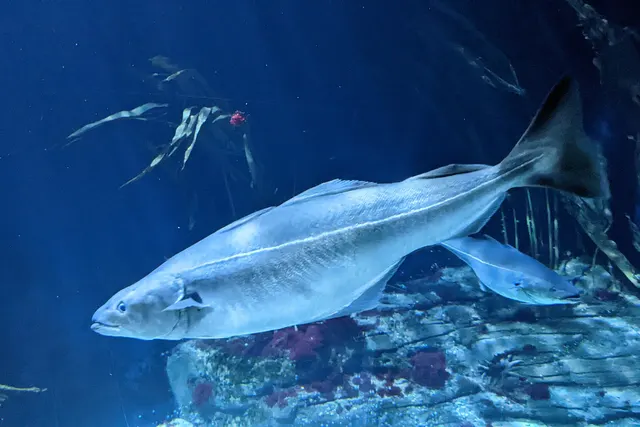 SaitheCongeners in Pollachius, taken over the same ground on the same tactics and confused constantly. The lateral line separates them: straight and pale in saithe, dark and arched over the pectoral in pollack. The lower jaw projects clearly in pollack and barely in saithe.
Where it lives
Where you will find it
- AngleseyThe rock-mark fish of the exposed north and west coasts, over kelp and boulder ground.
- Brittany and the French Atlantic coastOver the kelp edges, reef and boulder ground of the headlands and islands, where deep water lies close in and the tidal stream delivers food past a fish holding in the slack.
- Cardigan Bay and the sarnauOver the weeded crests and flanks of the sarnau and around the hard headlands, which is rough-ground fishing a long way from any rock coast.
- Clew Bay and AchillAssociated with the hard tidal currents at the narrows of this coast rather than with the rock generally: fish to the shore specimen weight follow the tide through the deep natural harbours on Achill and hold on the edge of the running water.
- Dublin Bay and the Wicklow coastAssociated with the rock heads and the broken ground off them, and — on the Wicklow piers — with a specific evening event: masses of small fish sweeping in on the flood under the angler's feet, taken on ragworm just under the surface.
- Pembrokeshire and the south-west Wales coastOver the kelp and gully ground where deep water comes close against hard rock, which puts a normally boat-caught fish within reach of a shore ledge on this coast.
- Portland Bill and the Portland RaceHolds on the rock and in the eddies, rising into the flow to intercept and dropping back, and is strongly associated with deep water close to structure.
- Scottish sea lochsAssociated with the kelp margins and steep rock sides of a loch, where deep water lies within a few metres of the shore — which is why a kayak can reach serious depth a short paddle from a slipway here.
16 more
- Shetland Fishing regions
- Skye and the Inner Hebrides Fishing regions
- Strangford Lough and the Ards coast Fishing regions
- The Atlantic coast of Ireland Fishing regions
- The Causeway and Antrim coast Fishing regions
- The Donegal coast and its sea loughs Fishing regions
- The East Antrim coast Fishing regions
- The Firth of Clyde Fishing regions
- The Isle of Man Fishing regions
- The Isles of Scilly Fishing regions
- The Kerry coast Fishing regions
- The Moray Firth Fishing regions
- The north-east England coast Fishing regions
- The Welsh coast and Anglesey Fishing regions
- The Yorkshire coast Fishing regions
- West Cork Fishing regions
Understanding this fish
- Fly fishing for pollack over rough ground and kelpThe fight is a race for cover rather than a fight for line, and every tackle decision follows from the first three seconds.
- Pollock and pollackWhat a British angler means, and not what an American recipe means.
- Saltwater fly fishing: what changesThe case for a sinking line in the salt. Pollack hold over rough ground and rise to take, so the fly is fished down and brought up rather than across — a vertical problem that a floating-line freshwater technique has no answer for.
Sources and evidence
- FishBase: a global information system on fishes — Froese, R. and D. Pauly, eds. — FishBase Consortium (Scientific institute)Relied on for: Family (Gadidae), maxima of 130 cm and 18.1 kg, maximum age 8 years, depth 40–200 m usually 40–100 m, trophic level 4.3, the absent chin barbel and sharply curved lateral line as the separation from P. virens, and Least Concern assessed 16 October 2013. Read during source review.States this directlyPassage read and verified
Why the 40 connections on this page are here, and the sources
Similar and related fish
Backed by research — 2 connections
Supported by peer-reviewed research or fisheries science. The sources are listed and can be checked.
Lesser sandeel
Recorded diet evidence identifies Ammodytes marinus as a food item of this predator at species level. The edge is written at that granularity and no further.
- FishBase: a global information system on fishes — Froese, R. and D. Pauly, eds. — FishBase Consortium (Scientific institute)Relied on for: Food items recorded for this predator, including Ammodytes marinus.States this directlyPassage read and verified
- FAO Species Identification Guides for Fishery Purposes and the FAO Species Catalogues — Food and Agriculture Organization of the United Nations (Scientific institute)Relied on for: Species account describing the diet of this predator in the region where Ammodytes marinus occurs.Background and mechanism onlyCitation checked — the work exists and is described correctly
Saithe
A congeneric identification comparison naming both binomials, resolving the naming collision that gives both species the name 'pollock' in different English-speaking regions.
- FishBase: a global information system on fishes — Froese, R. and D. Pauly, eds. — FishBase Consortium (Scientific institute)Relied on for: That Pollachius virens and Pollachius pollachius are congeners of the North-East Atlantic with overlapping distributions and depth ranges.States this directlyPassage read and verified
- The Fishes of the British Isles and North-West Europe — Macmillan, 1969 (Reference work)Relied on for: The morphological separation of Pollachius virens from Pollachius pollachius by lateral line form and by the degree of lower-jaw projection.States this directlyCitation checked — the work exists and is described correctly
How it is caught
What experienced anglers do — 5 connections
Widely and independently recommended by experienced anglers and specialist sources. This is real angling knowledge, not proof: controlled evidence for it is limited, and FishingHQ records it as convention rather than as a demonstrated effect.
Saltwater fly fishing
A species joined to a method genuinely used for it, on the strength of the biology that makes the method work rather than on the fact that somebody has tried it.
- FishBase: a global information system on fishes — Froese, R. and D. Pauly, eds. — FishBase Consortium (Scientific institute)Relied on for: Diet, habitat association, depth range, feeding behaviour and seasonal movement recorded for the species concerned.States this directlyPassage read and verified
- The Fishes of the British Isles and North-West Europe — Macmillan, 1969 (Reference work)Relied on for: Distribution, habitat and biology of the fishes of the British Isles and north-west Europe.States this directlyCitation checked — the work exists and is described correctly
A statement about how a species is fished, which is angling convention rather than biology and is labelled as such.
- Still Water Fly-Fishing — Andre Deutsch, 1952 (Specialist angling publication)Relied on for: Fly-fishing practice from a practitioner tradition: line control, depth management, retrieve and the reading of water.States this directlyCitation checked — the work exists and is described correctly
- Sea Angler — Bauer Media (Specialist angling publication)Relied on for: Contemporary UK sea angling practice as reported by practitioners: ground, tackle, presentation and seasonal timing.States this directlyCitation checked — the work exists and is described correctly
What anglers actually use a method or a lure for, recorded as convention.
- Still Water Fly-Fishing — Andre Deutsch, 1952 (Specialist angling publication)Relied on for: Fly-fishing practice from a practitioner tradition: line control, depth management, retrieve and the reading of water.States this directlyCitation checked — the work exists and is described correctly
- Sea Angler — Bauer Media (Specialist angling publication)Relied on for: Contemporary UK sea angling practice as reported by practitioners: ground, tackle, presentation and seasonal timing.States this directlyCitation checked — the work exists and is described correctly
Drift fishing
An established way this species is taken recreationally in north-west European waters.
- Sea Angler — Bauer Media (Specialist angling publication)Relied on for: Shore and boat practice in north-west European sea angling for the species and method described, presented across multiple independent contributors.States this directlyCitation checked — the work exists and is described correctly
- General angling website restatements of established technique — Various (Credible secondary source)Relied on for: Widely restated practice connecting this species to this method, recorded as practitioner consensus rather than as tested fact.Background and mechanism onlyCitation checked — the work exists and is described correctly
Jigging
An established way this species is taken recreationally in north-west European waters.
- Sea Angler — Bauer Media (Specialist angling publication)Relied on for: Shore and boat practice in north-west European sea angling for the species and method described, presented across multiple independent contributors.States this directlyCitation checked — the work exists and is described correctly
- General angling website restatements of established technique — Various (Credible secondary source)Relied on for: Widely restated practice connecting this species to this method, recorded as practitioner consensus rather than as tested fact.Background and mechanism onlyCitation checked — the work exists and is described correctly
Kayak fishing
Established angling practice for this species, recorded as convention. The note states the property of the animal or its water that makes the method the answer.
- Sea Angler — Bauer Media (Specialist angling publication)Relied on for: Established sea-angling technique and its application to this species.States this directlyCitation checked — the work exists and is described correctly
- General angling website restatements of established technique — Various (Credible secondary source)Relied on for: Widely restated practice connecting this species and method.Background and mechanism onlyCitation checked — the work exists and is described correctly
Spinning
An established way this species is taken recreationally in north-west European waters.
- Sea Angler — Bauer Media (Specialist angling publication)Relied on for: Shore and boat practice in north-west European sea angling for the species and method described, presented across multiple independent contributors.States this directlyCitation checked — the work exists and is described correctly
- General angling website restatements of established technique — Various (Credible secondary source)Relied on for: Widely restated practice connecting this species to this method, recorded as practitioner consensus rather than as tested fact.Background and mechanism onlyCitation checked — the work exists and is described correctly
Gear for this fish
What experienced anglers do — 5 connections
Widely and independently recommended by experienced anglers and specialist sources. This is real angling knowledge, not proof: controlled evidence for it is limited, and FishingHQ records it as convention rather than as a demonstrated effect.
Jigs and jig heads
A practitioner claim about which lure family answers this species' feeding or holding behaviour.
- Sea Angler — Bauer Media (Specialist angling publication)Relied on for: Established shore and boat lure practice for the species in north-west European seas.States this directlyCitation checked — the work exists and is described correctly
- General angling website restatements of established technique — Various (Credible secondary source)Relied on for: Widely restated lure selection for this species, recorded as practitioner consensus rather than as tested fact.Background and mechanism onlyCitation checked — the work exists and is described correctly
Metal jigs
A practitioner claim about which lure family answers this species' feeding or holding behaviour.
- Sea Angler — Bauer Media (Specialist angling publication)Relied on for: Established shore and boat lure practice for the species in north-west European seas.States this directlyCitation checked — the work exists and is described correctly
- General angling website restatements of established technique — Various (Credible secondary source)Relied on for: Widely restated lure selection for this species, recorded as practitioner consensus rather than as tested fact.Background and mechanism onlyCitation checked — the work exists and is described correctly
Ragworm
Two independent county pages naming ragworm for pollack from structure, one of them with a presentation depth and a hook size.
- Sea Angling in Ireland: the shore marks of Wicklow, Dublin, Louth and Meath — Sea Angling Ireland (Credible secondary source)Relied on for: A named contributor describing ragworm fished just under the surface for pollack on an evening flood, with the hook size.Passage read and verified
- Sea Angling in Ireland: the shore marks of Clare and the Shannon estuary — Sea Angling Ireland (Credible secondary source)Relied on for: A county directory naming locally dug harbour ragworm for small pollack and whiting from a deepwater pier.Passage read and verified
Sand eel
Named by a practitioner directory that ranks it above the alternatives and by a statutory guide independently.
- Sea Angling in Ireland: the shore marks of Mayo — Sea Angling Ireland (Credible secondary source)Relied on for: A county directory stating that the pollack and coalfish of a named pier prefer fresh or frozen sandeel, with the alternatives ranked behind it.Passage read and verified
- Inland Fisheries Ireland: South West Sea Angling Guide — the Kerry and Beara angling marks — Inland Fisheries Ireland, 2020 (Government fisheries body)Relied on for: The statutory body naming sandeel among the baits at the marks where it gives pollack over rough ground.Passage read and verified
Soft plastics
A practitioner claim about which lure family answers this species' feeding or holding behaviour.
- Sea Angler — Bauer Media (Specialist angling publication)Relied on for: Established shore and boat lure practice for the species in north-west European seas.States this directlyCitation checked — the work exists and is described correctly
- General angling website restatements of established technique — Various (Credible secondary source)Relied on for: Widely restated lure selection for this species, recorded as practitioner consensus rather than as tested fact.Background and mechanism onlyCitation checked — the work exists and is described correctly
Where it lives
Backed by research — 1 connection
Supported by peer-reviewed research or fisheries science. The sources are listed and can be checked.
Kelp forest
A habitat claim about where the species is found, held to a scientific standard.
- The Fishes of the British Isles and North-West Europe — Macmillan, 1969 (Reference work)Relied on for: Habitat association of Pollachius pollachius with rough and weed-covered ground.States this directlyCitation checked — the work exists and is described correctly
- FishBase: a global information system on fishes — Froese, R. and D. Pauly, eds. — FishBase Consortium (Scientific institute)Relied on for: Recorded habitat for Pollachius pollachius.States this directlyPassage read and verified
Where you will find it
Backed by research — 24 connections
Supported by peer-reviewed research or fisheries science. The sources are listed and can be checked.
Anglesey
A distributional claim about where a species occurs, which is a claim about the world and rests on the reference literature rather than on angling report.
- The Fishes of the British Isles and North-West Europe — Macmillan, 1969 (Reference work)Relied on for: Distribution, habitat association and biology of the fishes of the British Isles and north-west Europe.States this directlyCitation checked — the work exists and is described correctly
- Cefas science, advice and data on marine and freshwater environments — Centre for Environment, Fisheries and Aquaculture Science (Government fisheries body)Relied on for: UK marine fisheries science: distribution, survey data and the biological basis of management advice.States this directlyCitation checked — the work exists and is described correctly
Brittany and the French Atlantic coast
A claim that a place contains the ground, water and seasonal conditions the species is associated with. It is a distributional statement about the world, it rests on the regional reference literature, and it deliberately asserts nothing about access, permission or catch.
- FishBase: a global information system on fishes — Froese, R. and D. Pauly, eds. — FishBase Consortium (Scientific institute)Relied on for: Recorded distribution, depth range and habitat association for the species named.States this directlyPassage read and verified
- The Fishes of the British Isles and North-West Europe — Macmillan, 1969 (Reference work)Relied on for: Distribution and habitat association of the fishes of north-west Europe, including the continental coasts and seas named.States this directlyCitation checked — the work exists and is described correctly
Cardigan Bay and the sarnau
A claim that a place contains the ground, water and seasonal conditions the species is associated with. It is a distributional statement about the world, it rests on the regional reference literature, and it deliberately asserts nothing about access, permission or catch.
- The Fishes of the British Isles and North-West Europe — Macmillan, 1969 (Reference work)Relied on for: Distribution and habitat association of the marine, estuarine and freshwater fishes of the British Isles, including which coasts, estuaries and ground types a species occupies.States this directlyCitation checked — the work exists and is described correctly
- FishBase: a global information system on fishes — Froese, R. and D. Pauly, eds. — FishBase Consortium (Scientific institute)Relied on for: Recorded distribution, depth range and habitat association for the species named.States this directlyPassage read and verified
Clew Bay and Achill
A claim that a coast contains the ground and conditions the species is associated with. It is a distributional statement about the world, it rests on the regional reference literature, and it deliberately asserts nothing about access, permission or catch.
- The Fishes of the British Isles and North-West Europe — Macmillan, 1969 (Reference work)Relied on for: Distribution and habitat association of the marine and estuarine fishes of the British Isles and north-west Europe, including which coasts and ground types a species occupies.States this directlyCitation checked — the work exists and is described correctly
- FishBase: a global information system on fishes — Froese, R. and D. Pauly, eds. — FishBase Consortium (Scientific institute)Relied on for: Recorded distribution, depth range and habitat association for the species named.States this directlyPassage read and verified
Dublin Bay and the Wicklow coast
A claim that a coast contains the ground and conditions the species is associated with. It is a distributional statement about the world, it rests on the regional reference literature, and it deliberately asserts nothing about access, permission or catch.
- The Fishes of the British Isles and North-West Europe — Macmillan, 1969 (Reference work)Relied on for: Distribution and habitat association of the marine and estuarine fishes of the British Isles and north-west Europe, including which coasts and ground types a species occupies.States this directlyCitation checked — the work exists and is described correctly
- FishBase: a global information system on fishes — Froese, R. and D. Pauly, eds. — FishBase Consortium (Scientific institute)Relied on for: Recorded distribution, depth range and habitat association for the species named.States this directlyPassage read and verified
Pembrokeshire and the south-west Wales coast
A claim that a place contains the ground, water and seasonal conditions the species is associated with. It is a distributional statement about the world, it rests on the regional reference literature, and it deliberately asserts nothing about access, permission or catch.
- The Fishes of the British Isles and North-West Europe — Macmillan, 1969 (Reference work)Relied on for: Distribution and habitat association of the marine, estuarine and freshwater fishes of the British Isles, including which coasts and ground types a species occupies.States this directlyCitation checked — the work exists and is described correctly
- FishBase: a global information system on fishes — Froese, R. and D. Pauly, eds. — FishBase Consortium (Scientific institute)Relied on for: Recorded distribution, depth range and habitat association for the species named.States this directlyPassage read and verified
Portland Bill and the Portland Race
A distribution association between an animal and a kind of water, rather than a claim about any named mark.
- The Fishes of the British Isles and North-West Europe — Macmillan, 1969 (Reference work)Relied on for: Distribution, habitat association, depth and ground preference of fishes in British and north-west European waters.States this directlyCitation checked — the work exists and is described correctly
- FishBase: a global information system on fishes — Froese, R. and D. Pauly, eds. — FishBase Consortium (Scientific institute)Relied on for: Distribution, habitat association and depth range recorded for the species.Background and mechanism onlyPassage read and verified
Scottish sea lochs
A claim that a place contains the ground and conditions the species is associated with. It is a distributional statement about the world, it rests on the regional reference literature, and it deliberately asserts nothing about access, permission or catch.
- The Fishes of the British Isles and North-West Europe — Macmillan, 1969 (Reference work)Relied on for: Distribution and habitat association of the marine and estuarine fishes of the British Isles, including which coasts and ground types a species occupies.States this directlyCitation checked — the work exists and is described correctly
- FishBase: a global information system on fishes — Froese, R. and D. Pauly, eds. — FishBase Consortium (Scientific institute)Relied on for: Recorded distribution, depth range and habitat association for the species named.States this directlyPassage read and verified
Shetland
A distribution association between an animal and a kind of water, rather than a claim about any named mark.
- The Fishes of the British Isles and North-West Europe — Macmillan, 1969 (Reference work)Relied on for: Distribution, habitat association, depth and ground preference of fishes in British and north-west European waters.States this directlyCitation checked — the work exists and is described correctly
- FishBase: a global information system on fishes — Froese, R. and D. Pauly, eds. — FishBase Consortium (Scientific institute)Relied on for: Distribution, habitat association and depth range recorded for the species.Background and mechanism onlyPassage read and verified
Skye and the Inner Hebrides
A distribution association between an animal and a kind of water, rather than a claim about any named mark.
- The Fishes of the British Isles and North-West Europe — Macmillan, 1969 (Reference work)Relied on for: Distribution, habitat association and ground type of fishes in British and north-west European waters.States this directlyCitation checked — the work exists and is described correctly
- FishBase: a global information system on fishes — Froese, R. and D. Pauly, eds. — FishBase Consortium (Scientific institute)Relied on for: Distribution, habitat association and depth range recorded for the species.Background and mechanism onlyPassage read and verified
Strangford Lough and the Ards coast
A claim that a place contains the ground, water and seasonal conditions the species is associated with. It is a distributional statement about the world, it rests on the regional reference literature, and it deliberately asserts nothing about access, permission or catch.
- The Fishes of the British Isles and North-West Europe — Macmillan, 1969 (Reference work)Relied on for: Distribution and habitat association of the marine, estuarine and freshwater fishes of the British Isles, including which coasts, estuaries and ground types a species occupies.States this directlyCitation checked — the work exists and is described correctly
- FishBase: a global information system on fishes — Froese, R. and D. Pauly, eds. — FishBase Consortium (Scientific institute)Relied on for: Recorded distribution, depth range and habitat association for the species named.States this directlyPassage read and verified
The Atlantic coast of Ireland
A claim that a place contains the ground and conditions the species is associated with. It is a distributional statement about the world, it rests on the regional reference literature, and it deliberately asserts nothing about access, permission or catch.
- The Fishes of the British Isles and North-West Europe — Macmillan, 1969 (Reference work)Relied on for: Distribution and habitat association of the marine and estuarine fishes of the British Isles, including which coasts and ground types a species occupies.States this directlyCitation checked — the work exists and is described correctly
- FishBase: a global information system on fishes — Froese, R. and D. Pauly, eds. — FishBase Consortium (Scientific institute)Relied on for: Recorded distribution, depth range and habitat association for the species named.States this directlyPassage read and verified
The Causeway and Antrim coast
A claim that a place contains the ground, water and seasonal conditions the species is associated with. It is a distributional statement about the world, it rests on the regional reference literature, and it deliberately asserts nothing about access, permission or catch.
- The Fishes of the British Isles and North-West Europe — Macmillan, 1969 (Reference work)Relied on for: Distribution and habitat association of the marine, estuarine and freshwater fishes of the British Isles, including which coasts, estuaries and ground types a species occupies.States this directlyCitation checked — the work exists and is described correctly
- FishBase: a global information system on fishes — Froese, R. and D. Pauly, eds. — FishBase Consortium (Scientific institute)Relied on for: Recorded distribution, depth range and habitat association for the species named.States this directlyPassage read and verified
The Donegal coast and its sea loughs
A claim that a coast contains the ground and conditions the species is associated with. It is a distributional statement about the world, it rests on the regional reference literature, and it deliberately asserts nothing about access, permission or catch.
- The Fishes of the British Isles and North-West Europe — Macmillan, 1969 (Reference work)Relied on for: Distribution and habitat association of the marine and estuarine fishes of the British Isles and north-west Europe, including which coasts and ground types a species occupies.States this directlyCitation checked — the work exists and is described correctly
- FishBase: a global information system on fishes — Froese, R. and D. Pauly, eds. — FishBase Consortium (Scientific institute)Relied on for: Recorded distribution, depth range and habitat association for the species named.States this directlyPassage read and verified
The East Antrim coast
A claim that a coast or region contains the ground and conditions this species is associated with. It is a distributional statement about the world, it rests on the reference literature and on the institute that surveyed it, and it deliberately asserts nothing about access, permission or catch.
- The Fishes of the British Isles and North-West Europe — Macmillan, 1969 (Reference work)Relied on for: Distribution and habitat association of the marine fishes of the British Isles and north-west Europe, including which coasts and ground types a species occupies.States this directlyCitation checked — the work exists and is described correctly
- FishBase: a global information system on fishes — Froese, R. and D. Pauly, eds. — FishBase Consortium (Scientific institute)Relied on for: Recorded distribution, depth range and habitat association for the species named.States this directlyPassage read and verified
The Firth of Clyde
A claim that a place contains the ground, water and seasonal conditions the species is associated with. It is a distributional statement about the world, it rests on the regional reference literature, and it deliberately asserts nothing about access, permission or catch.
- The Fishes of the British Isles and North-West Europe — Macmillan, 1969 (Reference work)Relied on for: Distribution and habitat association of the marine, estuarine and freshwater fishes of the British Isles, including which coasts and ground types a species occupies.States this directlyCitation checked — the work exists and is described correctly
- FishBase: a global information system on fishes — Froese, R. and D. Pauly, eds. — FishBase Consortium (Scientific institute)Relied on for: Recorded distribution, depth range and habitat association for the species named.States this directlyPassage read and verified
The Isle of Man
A distributional claim about where a species occurs, which is a claim about the world and rests on the reference literature rather than on angling report.
- The Fishes of the British Isles and North-West Europe — Macmillan, 1969 (Reference work)Relied on for: Distribution, habitat association and biology of the fishes of the British Isles and north-west Europe.States this directlyCitation checked — the work exists and is described correctly
- Cefas science, advice and data on marine and freshwater environments — Centre for Environment, Fisheries and Aquaculture Science (Government fisheries body)Relied on for: UK marine fisheries science: distribution, survey data and the biological basis of management advice.States this directlyCitation checked — the work exists and is described correctly
The Isles of Scilly
A claim that a place contains the ground, water and seasonal conditions the species is associated with. It is a distributional statement about the world, it rests on the regional reference literature, and it deliberately asserts nothing about access, permission or catch.
- The Fishes of the British Isles and North-West Europe — Macmillan, 1969 (Reference work)Relied on for: Distribution and habitat association of the marine, estuarine and freshwater fishes of the British Isles, including which coasts, estuaries and ground types a species occupies.States this directlyCitation checked — the work exists and is described correctly
- FishBase: a global information system on fishes — Froese, R. and D. Pauly, eds. — FishBase Consortium (Scientific institute)Relied on for: Recorded distribution, depth range and habitat association for the species named.States this directlyPassage read and verified
The Kerry coast
A claim that a coast contains the ground and conditions the species is associated with. It is a distributional statement about the world, it rests on the regional reference literature, and it deliberately asserts nothing about access, permission or catch.
- The Fishes of the British Isles and North-West Europe — Macmillan, 1969 (Reference work)Relied on for: Distribution and habitat association of the marine and estuarine fishes of the British Isles and north-west Europe, including which coasts and ground types a species occupies.States this directlyCitation checked — the work exists and is described correctly
- FishBase: a global information system on fishes — Froese, R. and D. Pauly, eds. — FishBase Consortium (Scientific institute)Relied on for: Recorded distribution, depth range and habitat association for the species named.States this directlyPassage read and verified
The Moray Firth
A claim that a place contains the ground, water and seasonal conditions the species is associated with. It is a distributional statement about the world, it rests on the regional reference literature, and it deliberately asserts nothing about access, permission or catch.
- The Fishes of the British Isles and North-West Europe — Macmillan, 1969 (Reference work)Relied on for: Distribution and habitat association of the marine, estuarine and freshwater fishes of the British Isles, including which coasts, estuaries and ground types a species occupies.States this directlyCitation checked — the work exists and is described correctly
- FishBase: a global information system on fishes — Froese, R. and D. Pauly, eds. — FishBase Consortium (Scientific institute)Relied on for: Recorded distribution, depth range and habitat association for the species named.States this directlyPassage read and verified
The north-east England coast
A claim that a place contains the ground and conditions the species is associated with. It is a distributional statement about the world, it rests on the regional reference literature, and it deliberately asserts nothing about access, permission or catch.
- The Fishes of the British Isles and North-West Europe — Macmillan, 1969 (Reference work)Relied on for: Distribution and habitat association of the marine and estuarine fishes of the British Isles, including which coasts and ground types a species occupies.States this directlyCitation checked — the work exists and is described correctly
- FishBase: a global information system on fishes — Froese, R. and D. Pauly, eds. — FishBase Consortium (Scientific institute)Relied on for: Recorded distribution, depth range and habitat association for the species named.States this directlyPassage read and verified
The Welsh coast and Anglesey
A distributional claim about where a species occurs, taken from reference works on the fishes of the region rather than from angling report. It states presence and habitat association and asserts nothing about a fishery.
- FishBase: a global information system on fishes — Froese, R. and D. Pauly, eds. — FishBase Consortium (Scientific institute)Relied on for: Distribution, habitat association, depth range and feeding behaviour recorded for the species concerned.States this directlyPassage read and verified
- The Fishes of the British Isles and North-West Europe — Macmillan, 1969 (Reference work)Relied on for: Distribution, habitat and biology of the fishes of the British Isles and north-west Europe.States this directlyCitation checked — the work exists and is described correctly
The Yorkshire coast
A claim that a place contains the ground, water and seasonal conditions the species is associated with. It is a distributional statement about the world, it rests on the regional reference literature, and it deliberately asserts nothing about access, permission or catch.
- The Fishes of the British Isles and North-West Europe — Macmillan, 1969 (Reference work)Relied on for: Distribution and habitat association of the marine, estuarine and freshwater fishes of the British Isles, including which coasts and ground types a species occupies.States this directlyCitation checked — the work exists and is described correctly
- FishBase: a global information system on fishes — Froese, R. and D. Pauly, eds. — FishBase Consortium (Scientific institute)Relied on for: Recorded distribution, depth range and habitat association for the species named.States this directlyPassage read and verified
West Cork
A claim that a coast contains the ground and conditions the species is associated with. It is a distributional statement about the world, it rests on the regional reference literature, and it deliberately asserts nothing about access, permission or catch.
- The Fishes of the British Isles and North-West Europe — Macmillan, 1969 (Reference work)Relied on for: Distribution and habitat association of the marine and estuarine fishes of the British Isles and north-west Europe, including which coasts and ground types a species occupies.States this directlyCitation checked — the work exists and is described correctly
- FishBase: a global information system on fishes — Froese, R. and D. Pauly, eds. — FishBase Consortium (Scientific institute)Relied on for: Recorded distribution, depth range and habitat association for the species named.States this directlyPassage read and verified
Understanding this fish
What experienced anglers do — 2 connections
Widely and independently recommended by experienced anglers and specialist sources. This is real angling knowledge, not proof: controlled evidence for it is limited, and FishingHQ records it as convention rather than as a demonstrated effect.
Fly fishing for pollack over rough ground and kelp
Why it works, and what that rests on. Fly craft rests on established practitioner knowledge rather than on experiment, and the strength shown says so rather than borrowing an authority it does not have.
- FishBase: a global information system on fishes — Froese, R. and D. Pauly, eds. — FishBase Consortium (Scientific institute)Relied on for: Diet, habitat association, depth range, feeding behaviour and seasonal movement recorded for the species concerned.States this directlyPassage read and verified
- The Fishes of the British Isles and North-West Europe — Macmillan, 1969 (Reference work)Relied on for: Distribution, habitat and biology of the fishes of the British Isles and north-west Europe.States this directlyCitation checked — the work exists and is described correctly
Saltwater fly fishing: what changes
A fish or a water joined to the fly-fishing mechanism it is a worked example of, written only where the subject's own behaviour or physical character is what this page explains. The direction is the one FishingHQ writes this kind of connection in, and the one it already uses 176 times, and it is also the semantically correct one: the mechanism explains the fish, not the reverse.
- Sea Angler — Bauer Media (Specialist angling publication)Relied on for: British sea angling practice including shore fishing for bass, pollack and mullet, the ground each is found over and the presentation each takes.FishingHQ's interpretation of what it saysCitation checked — the work exists and is described correctly
- FAO Species Identification Guides for Fishery Purposes and the FAO Species Catalogues — Food and Agriculture Organization of the United Nations (Scientific institute)Relied on for: Distribution, habitat and feeding biology of coastal and tropical marine species, from regional identification guides prepared for fishery purposes.States this directlyCitation checked — the work exists and is described correctly
- Freshwater Fishes of the British Isles — HarperCollins (New Naturalist 75), 1992 (Reference work)Relied on for: Life history, feeding biology, habitat requirement and seasonal behaviour of the freshwater fishes of the British Isles.States this directlyCitation checked — the work exists and is described correctly
- FishBase: a global information system on fishes — Froese, R. and D. Pauly, eds. — FishBase Consortium (Scientific institute)Relied on for: Recorded environment, depth range, feeding biology and distribution of the species named.States this directlyPassage read and verified
Backed by research — 1 connection
Supported by peer-reviewed research or fisheries science. The sources are listed and can be checked.
Pollock and pollack
The spellings do not distinguish the species and the commercial names cross over.
- FishBase: a global information system on fishes — Froese, R. and D. Pauly, eds. — FishBase Consortium (Scientific institute)Relied on for: Distribution, morphology and nomenclature for Pollachius pollachius, Pollachius virens and Gadus chalcogrammus.States this directlyPassage read and verified
How FishingHQ labels evidence is explained in the evidence policy.