What does pollack eat?
What is established about how pollack feeds, kept separate from what anglers infer from it.
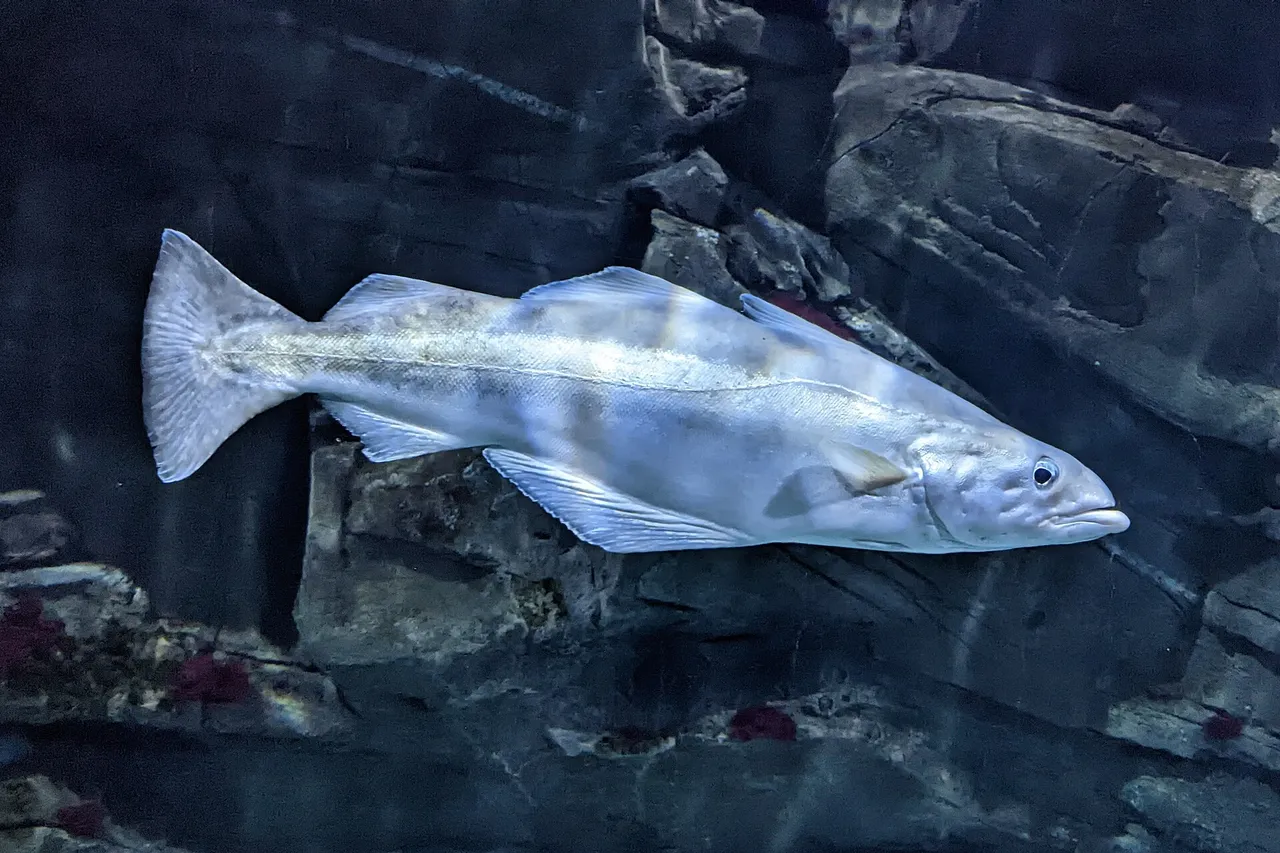
How this was identified, and who took it
Identified by: The projecting lower jaw, absent chin barbel and strongly arched lateral line are all visible in one frame. Those three together are exactly what separates pollack from saithe and from cod.Wilhelm Thomas Fiege — CC BY-SA 4.0, via Wikimedia Commons — source, licenceWhat is known about how it feeds
A pollack looks upwards. The fish holds over structure and hunts against the light above it, taking prey that is silhouetted, which is an unusual orientation among the gadoids and the single most useful thing to know about the species.
The one verified prey relationship is sandeel, which fits precisely: a slim, silver, mid-water shoaling fish moving above clean ground near reef edges is exactly what an upward-hunting ambush predator is positioned for.
FishBase places pollack at a trophic level higher than cod, which is worth noting because it runs against the intuition that the larger and more famous fish must be the more predatory one. Cod are opportunists that take a great deal of invertebrate material; pollack are more consistently piscivorous.
Vision dominates, consistent with hunting against the light, and feeding peaks at dawn and dusk and in the low light over deep reef. The species is also notably responsive to vibration, which places the lateral line alongside sight rather than behind it.
The vertical dimension is the seasonal one too. Pollack move deeper as the year progresses and are shallower and closer inshore in the warmer months, so the same population is accessible from the shore for part of the year and only from a boat for the rest.
The food
Prey with a verified dietary link to this fish. Each entry carries its own evidence, and each is written at the precision the source actually used: a named species where the source named one, a group or food category where it said “polychaetes”, “crustaceans” or “detritus” and meant it. That is why this list is shorter than the animal’s real diet rather than longer.
- Lesser sandeel — Ammodytes marinus
Pollack hunting over sandy ground and reef edges take sandeel heavily, which is why they hold in mid water above clean sand rather than on it.
Food with no page of its own here yet
These are real components of the diet, listed as plain text because FishingHQ has no page for them yet. Inventing pages to make the list look fuller would be the fabrication this whole approach exists to prevent.
- sprat and small herring
- juvenile pouting and poor cod
- prawns and shrimps
- small squid
- polychaete worms, in smaller fish
What anglers do with this
Everything below is interpretation, not finding. It is what experienced anglers conclude from the biology above, and the reasoning is usually sound and almost never tested. It is separated from the biology deliberately.
The upward-hunting habit is the fact the whole fishery rests on, and the inference is unusually specific: presentations worked above the fish are what the species is positioned to take, and offerings fished on the bottom are behind it. That is convention with a clear biological basis and it is held consistently wherever pollack are fished.
The responsiveness to vibration is used to argue for presentations that move rather than hang, and the reasoning follows from the sensory profile above.
The low-light feeding peak converts into the standard expectation about dawn, dusk and deep water. None of these is a tested comparison; all three are practitioner reasoning from documented behaviour.
What this does not establish
One verified prey relationship for a substantially piscivorous fish understates the diet considerably. Composition varies with depth, season and the size of the individual, and smaller pollack take far more invertebrate material than the single relationship suggests. Nothing here describes any particular mark.
Where this connects
These are the baits, lures, methods and explainers FishingHQ already joins to this fish — which is why the list is sometimes short. They are not chosen for this page, and a link here means an evidenced relationship exists, not that it follows from the diet.
Lures recorded for this species
Methods used for it
Where it lives
The science behind the feeding
This page covers feeding. The Pollack record covers identification, lifecycle, seasonal behaviour, handling and the sources behind all of it.
Reviewed 2026-08-12.