What does saithe eat?
What is established about how saithe feeds, kept separate from what anglers infer from it.
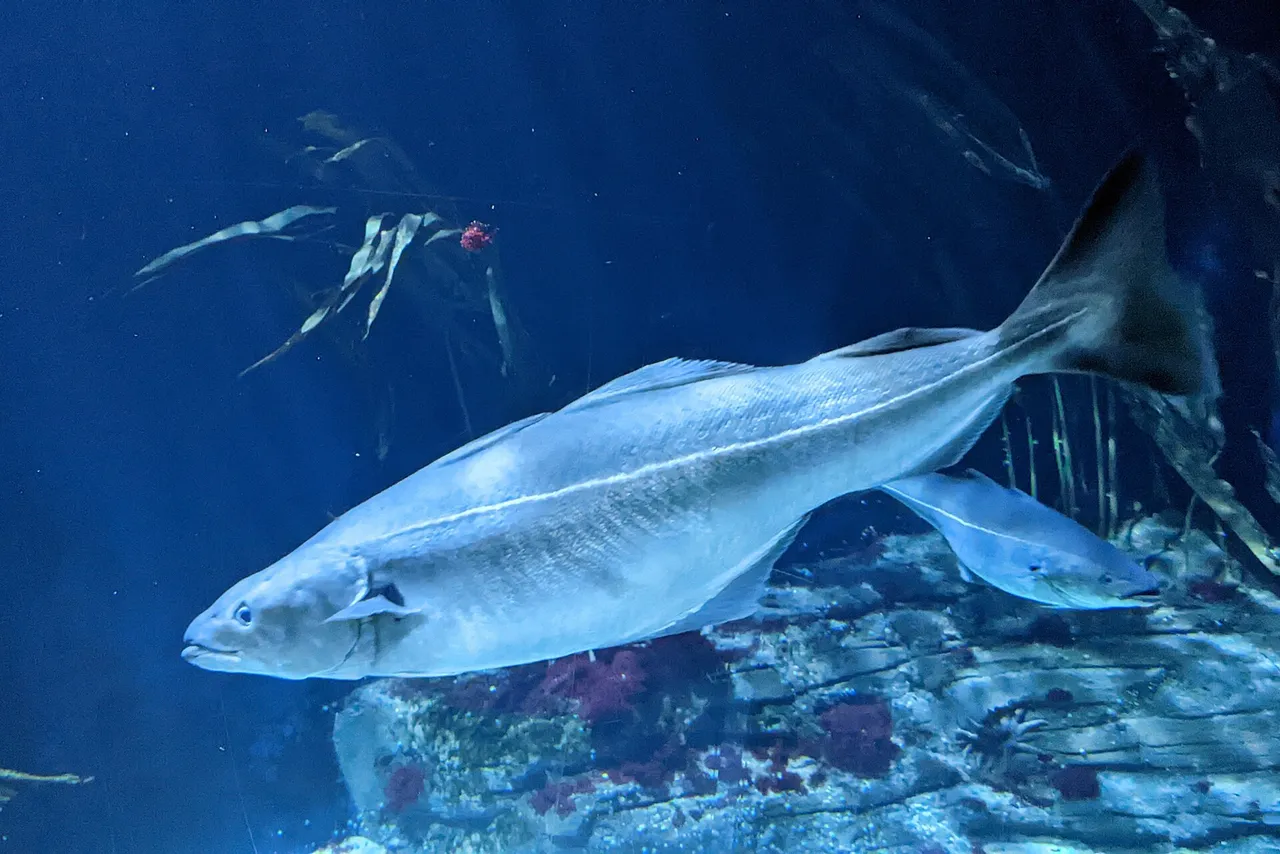
How this was identified, and who took it
Identified by: Full lateral view showing the straight pale lateral line running almost level from head to tail. That is precisely the character the saithe-versus-pollack comparison rests on, and it could not be clearer. Photographed in an aquarium.Wilhelm Thomas Fiege — CC BY-SA 4.0, via Wikimedia Commons — source, licenceWhat is known about how it feeds
Saithe are the gadoid that behaves like a pelagic fish, and both verified relationships describe a stage of that.
Smaller saithe feed heavily on planktonic crustaceans — euphausiids and copepods, recorded at group level — in mid water, which is a genuinely different way of making a living from anything a cod does. As the fish grows it becomes piscivorous, and sandeel is the relationship FishingHQ holds for that phase, standing alongside herring and sprat in the wider diet.
The transition is why juvenile and adult saithe are found in different places doing different things, and why the inshore shoals of small fish and the offshore shoals of large ones can look like separate species to an angler.
Hunting is fast, shoaling and sight-dominant, with the lateral line supporting in low light and at depth. Saithe pursue rather than ambush, and they do it in mid water over and around structure rather than on the seabed.
The consequence for the food web is that saithe occupy a position between the plankton feeders and the demersal predators, and move between the two over a lifetime. Few species on FishingHQ span that range so completely.
The food
Prey with a verified dietary link to this fish. Each entry carries its own evidence, and each is written at the precision the source actually used: a named species where the source named one, a group or food category where it said “polychaetes”, “crustaceans” or “detritus” and meant it. That is why this list is shorter than the animal’s real diet rather than longer.
- Lesser sandeel — Ammodytes marinus
Saithe feed on sandeel in mid water in dense fast-moving shoals, a very different hunting pattern from the cod working the same ground below them.
- Krill and planktonic crustaceans as prey — a group rather than a species: the evidence names the group
Smaller saithe feed heavily on planktonic crustaceans before becoming piscivorous, which is why juvenile and adult saithe are found in different places doing different things.
Food with no page of its own here yet
These are real components of the diet, listed as plain text because FishingHQ has no page for them yet. Inventing pages to make the list look fuller would be the fabrication this whole approach exists to prevent.
- herring and sprat
- small squid
- juvenile gadoids
- amphipods
What anglers do with this
Everything below is interpretation, not finding. It is what experienced anglers conclude from the biology above, and the reasoning is usually sound and almost never tested. It is separated from the biology deliberately.
The pursuit habit and mid-water feeding are the reasoning behind fast presentations worked well off the seabed, and saithe are among the more reliable species on a fast-moving offering for exactly that reason. This is convention with a clear behavioural basis.
The size-related shift explains a pattern anglers report consistently: the small shoaling fish taken close inshore and the large fish taken over deep structure respond to quite different approaches, and treating them as one problem produces poor results in both places.
The plankton-feeding phase in smaller fish is the likely explanation for shoals that are visibly present and uninterested, and it is an inference rather than an established cause.
What this does not establish
The plankton relationship is group-level and describes smaller fish; the sandeel relationship stands for a broader group of small shoaling fish taken by larger ones. Neither establishes proportions, and the balance shifts continuously with fish size and with what is locally dense. The account describes the north-east Atlantic.
Where this connects
These are the baits, lures, methods and explainers FishingHQ already joins to this fish — which is why the list is sometimes short. They are not chosen for this page, and a link here means an evidenced relationship exists, not that it follows from the diet.
Baits recorded for this species
Lures recorded for this species
Methods used for it
The science behind the feeding
This page covers feeding. The Saithe record covers identification, lifecycle, seasonal behaviour, handling and the sources behind all of it.
Reviewed 2026-08-12.