Haddock
Fish · Last reviewed 2026-08-10
The cod's smaller relative, marked with a black lateral line and a dark thumbprint, and one of the most important food fish in the North Atlantic.
Safety: barotrauma and pressure injury — can cause injury needing treatment. 4 more points apply here.
Barotrauma and pressure injury — Can cause injury needing treatment
Fish brought up from depth suffer swim bladder expansion and cannot return unaided, so release from deep water is largely ineffective.
What reduces it: Decide what will be kept before fishing deep. Where release matters, fish shallower ground. Return fish promptly rather than after a period on deck.
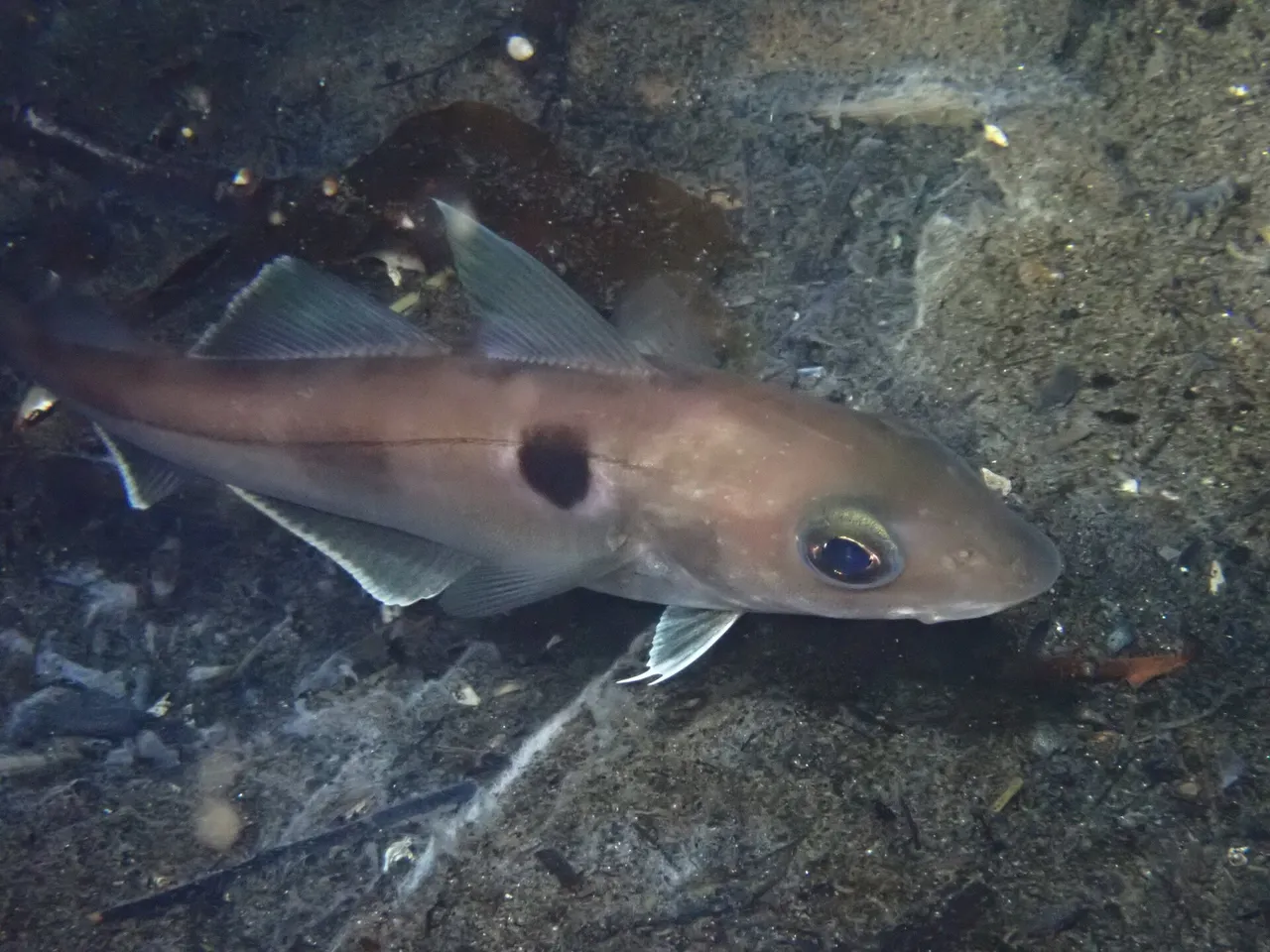
How this was identified, and who took it
Identified by: In situ over soft bottom. The dark thumbprint blotch above the pectoral fin — the character that settles haddock against cod in one look — is unmistakable, along with the dark lateral line, three dorsal fins and the small chin barbel.Vsevolod Rudyi — CC BY 4.0, via Wikimedia Commons — source, licence
Catching Haddock
Everything here on fishing for it. Each entry opens the page behind it.
- When
- Jun–Sept — months recorded at the places that document it, not a season for the whole range.
- Where
- 10 places FishingHQ documents — strongest claim anywhere: regular local target · From a boat, From the shore, On a charter, From a kayak
The haddock is a gadoid — the cod family — and shares the three dorsal fins and two anal fins that define the group. What separates it from cod at a glance is a pair of marks: a black rather than pale lateral line, and a distinct dark blotch above the pectoral fin, traditionally called the thumbprint or Saint Peter's mark.
It is a bottom-feeder rather than a predator in the cod's sense, taking invertebrates from and just above the seabed — worms, brittlestars, molluscs, crustaceans and fish eggs — with a small mouth set beneath a pointed snout. That diet is why haddock are caught on small baits fished hard on the bottom while cod in the same water take larger baits and lures higher in the column, and it is the single most useful thing an angler can know about fishing for them.
Commercially it is one of the most important fish in the North Atlantic and the mainstay of a great deal of the region's food economy. Stock status varies substantially between management areas, which makes generalisation useless: haddock in one part of the North Atlantic can be in reasonable shape while another stock is depleted.
Where Haddock is documented
Places where public sources describe this species as fished, with how it is fished and how strongly the evidence supports it. This is not a range map and it is not a recommendation — it is what has been written down about a fishery rather than a record of any individual catch, and being listed is never permission to fish.
Scottish sea lochs
5 documented places
Sea loch
Seasonal
From a boat
Around Jun, Jul, Aug, Sept
Sea loch
Recorded here
From the shore
Loch Inchard and Kinlochbervie
Sea loch
Seasonal
From a boat
Around Jun, Jul, Aug, Sept
Sea loch
Seasonal
From a boat
Around Jun, Jul, Aug, Sept
Sea loch
Recorded here
From the shore
The Solway Firth
1 documented place
Harbour wall
Repeatedly reported
From a kayak
Around Aug
Observed August 2022
Norway and the Nordic coast
3 documented places
Sound or strait
Recorded here
From a boat · On a charter
Island
Recorded here
From a boat · On a charter
Offshore bank
Recorded here
From a boat · On a charter
What these strengths mean
- Seasonal
- Well supported, and concentrated in part of the year rather than spread through it.
- Recorded here
- At least one credible public account of this species being caught here. That is all it means.
- Regular local target
- Fishing sources describe this as a normal local target here, not merely as caught.
- Repeatedly reported
- Several independent public accounts. Enough to say it happens more than once; not enough to call it a fishery.
When to fish for haddock
Where the places here state a season for haddock, it clusters in Jun–Sep. This is a count of how many documented places name each month — evidence about when people fish for it, not a prediction of what any particular day will produce.
| Jan | Feb | Mar | Apr | May | Jun | Jul | Aug | Sep | Oct | Nov | Dec |
|---|---|---|---|---|---|---|---|---|---|---|---|
| January: no place here names this month — no place names it. | February: no place here names this month — no place names it. | March: no place here names this month — no place names it. | April: no place here names this month — no place names it. | May: no place here names this month — no place names it. | June: 3 places name this month — many places. | July: 3 places name this month — many places. | August: 4 places name this month — most places. | September: 3 places name this month — many places. | October: no place here names this month — no place names it. | November: no place here names this month — no place names it. | December: no place here names this month — no place names it. |
4 of the 10 places that record catches of haddock state which months. The other 6 name no season, so they are counted in neither direction: the shape above is what the dated records say, not the whole picture. The dated records span 2 separate areas.
Identification
- Scientific name
- Melanogrammus aeglefinus
- Family
- Gadidae
- Water
- Saltwater
- Conservation status
- Vulnerable
- Regions
- Northern Europe, Britain & Ireland, Western Europe, Arctic & Subarctic, North America
- A BLACK lateral line running the length of the flank — cod have a pale one, and this is the fastest separation.
- A distinct dark blotch above the pectoral fin, the so-called thumbprint.
- Three dorsal fins and two anal fins, the gadoid family character; the first dorsal is notably tall and pointed.
- Small mouth set beneath a pointed snout, adapted to bottom feeding; a small chin barbel is present but much less prominent than a cod's.
- Body more slender than a cod's, silvery-grey with a purplish sheen above.
Size
- Typical
- 0.5–1.5 kg (1–3.3 lb)
- Large
- 2.5–4 kg (5.5–9 lb)
Exceptional: Over 6 kg (13 lb); maximum published weight 16.8 kg
Cold water, soft ground and a gadoid that stays near the bottom
Haddock occupy cold north Atlantic shelf waters and are more strictly demersal than the cod they are usually grouped with.
THEY STAY NEAR THE BOTTOM. Unlike cod, which will move up through the water column, and saithe, which hunt in midwater, haddock feed on and just above the seabed and rarely leave it. That is why they are taken on baits fished hard on the bottom and comparatively rarely on lures worked high.
SOFT AND MIXED GROUND IS THE PREFERENCE — sand, mud, gravel and shell rather than heavy rock and reef — because their diet is dominated by benthic invertebrates: worms, brittlestars, small crustaceans and molluscs, taken from and within the sediment.
THEY HAVE A SMALL MOUTH FOR A GADOID, which is the physical reason for that diet and the reason haddock are taken on smaller baits and hooks than cod from the same ground.
DEPTH IS TYPICALLY FROM A FEW TENS OF METRES TO SEVERAL HUNDRED, and it is size-structured, with larger fish generally deeper.
COLD WATER IS THE REQUIREMENT. Haddock are a boreal species, most abundant in the northern North Sea, around Iceland, the Faroes and the north-west Atlantic, and scarce at the southern edge of the range.
JUVENILES ARE PELAGIC BEFORE THEY SETTLE, drifting in the water column for months before adopting the bottom-associated adult habit, and the success of that settlement drives the enormous variability in haddock year-class strength.
AND THAT VARIABILITY IS THE FISHERY'S DEFINING FEATURE. Exceptional year classes recur irregularly and dominate the stock for years afterwards, which is why haddock abundance swings more than most demersal stocks and why assessment for the species leans heavily on recruitment surveys.
Backed by research — why, and the sources (2)
Supported by peer-reviewed research or fisheries science. The sources are listed and can be checked.
- The Fishes of the British Isles and North-West Europe — Macmillan, 1969 (Reference work)Relied on for: Distribution, habitat association, depth, ground preference and biology of fishes in British and north-west European waters.States this directlyCitation checked — the work exists and is described correctly
- ICES Advice on fishing opportunities, catch and effort — International Council for the Exploration of the Sea (Scientific institute)Relied on for: Stock assessment, the environmental drivers of stock distribution and abundance, and the scientific basis for advice in the sea areas concerned.States this directlyCitation checked — the work exists and is described correctly
Soft mouths, deep water, and why haddock rarely go back
Haddock present an unusual combination: a fish that is easily damaged in the mouth, taken from depths that guarantee pressure injury, in a fishery where quota and size rules generate discards.
THE MOUTH IS THE FIRST PROBLEM. Haddock have soft mouth tissue and are frequently hooked in a way that tears. Multi-hook rigs worked at depth compound it: a fish that is hooked, then dragged while the remaining hooks are baited or while other fish are played, arrives with damage that has nothing to do with how it is handled on deck.
THE DEPTH IS THE SECOND. Haddock are physoclistous and taken from depths where swim bladder expansion is severe. The stomach eversion and buoyancy familiar from other deep species occur here too, and a haddock returned at the surface commonly floats.
WHAT FOLLOWS. This is realistically a retention fishery, and the useful handling intelligence is about not catching fish you cannot keep: fish fewer hooks, use hook sizes that select against undersized fish, and move off a mark that is producing small fish rather than working through them. Selectivity at the rig is worth more than care at the rail.
ON DECK the fish is harmless — no teeth of consequence, no venomous spines, no significant handling risk to a person. The dispatch, if the fish is being kept, should be immediate and the fish chilled, because haddock flesh degrades noticeably faster than cod's.
AND THE BOAT IS THE ACTUAL DANGER. This fishing happens offshore, in cold water, often in poor conditions, with heavy leads swinging on deck. The fish will not hurt anybody. The circumstances routinely do.
What experienced anglers do — why, and the sources (2)
Widely and independently recommended by experienced anglers and specialist sources. This is real angling knowledge, not proof: controlled evidence for it is limited, and FishingHQ records it as convention rather than as a demonstrated effect.
- FishBase: a global information system on fishes — Froese, R. and D. Pauly, eds. — FishBase Consortium (Scientific institute)Relied on for: Dentition, fin and spine morphology, body form, air-breathing capability and distribution for the species, which are the anatomical facts the handling practice below follows from.States this directlyPassage read and verified
- General angling website restatements of established technique — Various (Credible secondary source)Relied on for: Widely restated angling practice for handling this species, recorded as practitioner consensus rather than as tested fact.Background and mechanism onlyCitation checked — the work exists and is described correctly
A gadid on a standard cycle, and why the daily tide matters more than the month
Haddock have an unremarkable seasonal pattern and a very pronounced daily one, and for an angler the second is far more actionable than the first.
THE SEASONAL PATTERN IS THE NORTH-EAST ATLANTIC GADID STANDARD. Movement to deeper spawning grounds in the colder half of the year, movement back to shallower feeding areas afterwards, with the recreational fishery generally following that inshore movement. It is driven by temperature and by the spawning requirement, it applies on a northern-hemisphere calendar throughout the species' range, and it is genuinely similar to what cod and whiting in the same water are doing.
WHAT DISTINGUISHES HADDOCK IS WHAT THEY EAT AND THEREFORE WHERE THEY ARE. Haddock feed predominantly on benthic invertebrates — brittlestars, worms, molluscs, crustaceans — rather than pursuing fish the way cod do at the same size. That ties them much more tightly to particular bottom types: clean sand, gravel, shell and mud where their prey lives, rather than to the rough ground and structure a cod uses. A haddock mark is a description of a seabed, and it does not move.
SO THE SEASONAL QUESTION LARGELY RESOLVES INTO A DEPTH QUESTION. The same ground is fished; the fish are on the shallower end of their range or the deeper end of it depending on the time of year and the water temperature.
AND THE TIDE GOVERNS EACH SESSION. A bottom-feeding fish over an offshore mark is fished at anchor or on a drift, and both are constrained by flow: too much tide and a bait cannot be held on the bottom at all, too little and a drift does not cover ground. That practical constraint is why boat fishing for haddock has a rhythm tied to the tidal cycle and to the spring–neap cycle, and it is a constraint on the boat rather than on the fish's appetite — a distinction worth keeping clear, because it is routinely reported as though haddock feed on a particular state of tide.
What experienced anglers do — why, and the sources (2)
Widely and independently recommended by experienced anglers and specialist sources. This is real angling knowledge, not proof: controlled evidence for it is limited, and FishingHQ records it as convention rather than as a demonstrated effect.
- FishBase: a global information system on fishes — Froese, R. and D. Pauly, eds. — FishBase Consortium (Scientific institute)Relied on for: Depth range, migration, spawning season and temperature association recorded for the species.States this directlyPassage read and verified
- ICES Advice on fishing opportunities, catch and effort — International Council for the Exploration of the Sea (Scientific institute)Relied on for: Stock distribution, seasonal movement between spawning and feeding grounds, and the assessment basis for the stock.States this directlyCitation checked — the work exists and is described correctly
Enormous fecundity, drumming males, and a stock that rebuilds in single spectacular years
Haddock reproduction explains one of the most distinctive features of the North Atlantic fisheries: the enormous, irregular year classes that dominate a stock for a decade.
SPAWNING IS A BROADCAST EVENT ON OFFSHORE GROUND IN LATE WINTER AND SPRING. Mature haddock gather on known spawning grounds and release eggs and sperm into the water; the eggs are buoyant and rise, and the larvae drift in the plankton for a period before settling. There is no nest, no care and no defence of anything.
FECUNDITY IS ENORMOUS AND THAT IS THE MECHANISM BEHIND THE VARIABILITY. A large female haddock releases a very large number of eggs, of which an almost vanishingly small fraction survive to recruit. When conditions in the plankton happen to align — the right food at the right time, the right transport, the right temperature — survival can be an order of magnitude better than usual, and the result is a year class large enough to dominate the stock for years. Several North Atlantic haddock stocks are effectively defined by a handful of such years.
WHICH MEANS RECRUITMENT IS ONLY LOOSELY RELATED TO SPAWNING STOCK SIZE. A big spawning stock improves the odds; it does not produce a big year class on its own, because the bottleneck is larval survival rather than egg supply. That is why stock assessments for this species treat recruitment as a highly variable input rather than as a predictable function.
THE MALES DRUM DURING COURTSHIP, which is worth stating because it is a real and well-documented behaviour: haddock produce sound using muscles against the swim bladder as part of spawning display, and the sound is part of how mates are found on a spawning ground. It is also, incidentally, a reason underwater noise is a genuine concern for the species.
MATURITY IS REACHED WITHIN A FEW YEARS and females grow larger and are more fecund with size, so the age and size structure of the spawning stock affects its reproductive potential and not just its biomass.
AND WHAT MAY BE CAUGHT IS AN ASSESSED AND NEGOTIATED MATTER, revised annually and differing between sea areas. Nothing above indicates what any current rule is.
Backed by research — why, and the sources (2)
Supported by peer-reviewed research or fisheries science. The sources are listed and can be checked.
- ICES Advice on fishing opportunities, catch and effort — International Council for the Exploration of the Sea (Scientific institute)Relied on for: Stock assessment and advice, including spawning stock biomass, recruitment and the reproductive parameters the assessment rests on.States this directlyCitation checked — the work exists and is described correctly
- FishBase: a global information system on fishes — Froese, R. and D. Pauly, eds. — FishBase Consortium (Scientific institute)Relied on for: Spawning season, fecundity, maturity and larval development for the species.Background and mechanism onlyPassage read and verified
Lifecycle and reproduction
Matures at three to four years and lives up to around twenty. Spawns in late winter and spring in deeper offshore water, producing pelagic eggs and larvae that drift before settling to the bottom. Recruitment is notably variable between years, with occasional very strong year classes dominating a stock for a decade — a pattern that makes single-year assessments misleading and is one reason haddock management works on multi-year data.
Broadcast spawning in deeper water in late winter and spring, with pelagic eggs and larvae and no parental care. Year-class strength varies enormously with conditions during the larval phase, producing the boom-and-bust recruitment pattern the species is known for. A strong year class can sustain a fishery for years and its absence can depress one for as long.
Feeding and senses
A bottom feeder taking marine worms, brittlestars, molluscs, crustaceans, sand eels and fish eggs, using a small inferior mouth to pick prey from and just above the seabed. The contrast with cod is the practically important point: haddock take small baits presented hard on the bottom, cod take larger baits and will come up for them.
Adapted to feeding on the bottom in the low light of deep shelf water, with the lateral line and taste contributing substantially alongside sight. The small mouth and picking behaviour mean that presentation matters more than attraction — a bait sitting properly on the bottom outfishes a more conspicuous one held above it.
Through the year
Moves between deeper spawning grounds in late winter and spring and shallower feeding areas at other times, with the recreational fishery generally following that inshore movement. Tidal flow governs the daily fishing on any mark. Northern-hemisphere calendar throughout the range.
Distribution
North Atlantic: on the European side from the Barents Sea and Iceland south to the Bay of Biscay, and on the western side from Greenland and Labrador south to New Jersey. A demersal species of the continental shelf, generally between about 40 and 300 m.
This is a biological range — where the species occurs, not a prediction that you will catch one. To browse the fishing geography FishingHQ holds, start at fishing places.
Why anglers care
A significant boat-fishing target across the northern part of its range, taken on small baited hooks fished on the bottom, frequently on multi-hook traces alongside cod and whiting. Highly regarded as a table fish and one of the most commercially important species in the North Atlantic.
Handling and returning
No spines or teeth of consequence; haddock are among the easier sea fish to handle. Wet hands and support the body. Fish taken from depth suffer barotrauma and cannot be released successfully from deep water, so the decision about what to retain should be made before fishing rather than at the surface. If retaining, bleed and chill promptly — haddock deteriorate quickly.
Going further
- What does haddock eat? — feeding biology, kept separate from what anglers infer from it.
- Haddock vs Atlantic cod — how to tell them apart.
Safety
Barotrauma and pressure injury is set out at the top of this page, where it cannot be missed.
Boat safety — Can cause injury needing treatment
This is offshore and inshore boat fishing in cold northern water, where immersion is rapidly incapacitating and conditions change quickly.
What reduces it: Wear a lifejacket. Check the forecast for the whole window. File a plan ashore and carry a means of calling for help.
Precautions that always apply here
- Wear a buoyancy aid or lifejacket. Cold water incapacitates strong swimmers within a minute, long before swimming ability matters.
- Tell somebody where you are going and when you expect to be back.
- Carry a charged phone in a waterproof case, or another means of calling for help.
Check the rules before you fish
Fishing laws, bylaws, access rules, seasons, bait restrictions and permitted methods vary by location and can change. Check the current rules from the relevant authority and the water you intend to fish before fishing.
Check with:
- Current national or regional law for where you are fishing
- Current local bylaws
- The relevant fisheries authority
- The landowner, club or fishery whose water it is
- Any restrictions specific to the species or the method you intend to use
Where to go next
Similar and related fish
Where you will find it
Understanding this fish
- Bivalve and gastropod molluscs as preySmall molluscs are a regular component of the diet, taken from soft sediment along with worms and small crustaceans.
- Polychaete worms as preyHaddock are benthic feeders working soft ground for worms and other buried invertebrates, which is a fundamentally different feeding strategy from the cod they are usually caught alongside.
Sources and evidence
- FishBase: a global information system on fishes — Froese, R. and D. Pauly, eds. — FishBase Consortium (Scientific institute)Relied on for: Scientific name, family placement in the Gadidae, a maximum length of 112 cm TL, a maximum published weight of 16.8 kg, a maximum reported age of 20 years.States this directlyPassage read and verified
- FishBase: a global information system on fishes — Froese, R. and D. Pauly, eds. — FishBase Consortium (Scientific institute)Relied on for: Environment, climate zone and depth range as recorded: Marine; demersal; oceanodromous ; depth range 10 - 450 m, usually 10 - 200 m . Temperate; 79°N - 36°N, 76°W - 62°EStates this directlyPassage read and verified
- FishBase: a global information system on fishes — Froese, R. and D. Pauly, eds. — FishBase Consortium (Scientific institute)Relied on for: The IUCN Red List category for Melanogrammus aeglefinus — Vulnerable, assessed 01 August 1996 — as republished by FishBase, the Red List itself being unreachable during review.States this directlyPassage read and verified
- ICES Advice on fishing opportunities, catch and effort — International Council for the Exploration of the Sea (Scientific institute)Relied on for: That North Atlantic gadoid stocks are assessed through international scientific advice, with status varying between management areas.States this directlyCitation checked — the work exists and is described correctly
Why the 5 connections on this page are here, and the sources
Similar and related fish
Backed by research — 1 connection
Supported by peer-reviewed research or fisheries science. The sources are listed and can be checked.
Atlantic cod
An identification and feeding comparison naming both binomials.
- FishBase: a global information system on fishes — Froese, R. and D. Pauly, eds. — FishBase Consortium (Scientific institute)Relied on for: That Melanogrammus aeglefinus and Gadus morhua are both Gadidae of the North Atlantic continental shelf with overlapping distributions.States this directlyPassage read and verified
- The Fishes of the British Isles and North-West Europe — Macmillan, 1969 (Reference work)Relied on for: The morphological separation of haddock from cod by lateral line colour and the shoulder blotch, and their differing feeding habits.States this directlyCitation checked — the work exists and is described correctly
How it is caught
What experienced anglers do — 1 connection
Widely and independently recommended by experienced anglers and specialist sources. This is real angling knowledge, not proof: controlled evidence for it is limited, and FishingHQ records it as convention rather than as a demonstrated effect.
Ledgering
A practitioner claim following from the species' verified feeding morphology.
- Sea Angler — Bauer Media (Specialist angling publication)Relied on for: Practitioner treatment of bait size and presentation for haddock in relation to cod on the same ground.Citation checked — the work exists and is described correctly
- General angling website restatements of established technique — Various (Credible secondary source)Relied on for: Widely restated practitioner guidance that haddock take small baits fished hard on the bottom.Citation checked — the work exists and is described correctly
Where you will find it
Backed by research — 1 connection
Supported by peer-reviewed research or fisheries science. The sources are listed and can be checked.
Shetland
A distribution association between an animal and a kind of water, rather than a claim about any named mark.
- The Fishes of the British Isles and North-West Europe — Macmillan, 1969 (Reference work)Relied on for: Distribution, habitat association, depth and ground preference of fishes in British and north-west European waters.States this directlyCitation checked — the work exists and is described correctly
- FishBase: a global information system on fishes — Froese, R. and D. Pauly, eds. — FishBase Consortium (Scientific institute)Relied on for: Distribution, habitat association and depth range recorded for the species.Background and mechanism onlyPassage read and verified
Understanding this fish
Backed by research — 2 connections
Supported by peer-reviewed research or fisheries science. The sources are listed and can be checked.
Bivalve and gastropod molluscs as prey
Recorded diet evidence identifies bivalve and gastropod molluscs as a food item of this predator at group level rather than to species. The edge points at the taxon record for that reason, and encoding it as a species-level claim would assert something the source does not.
- FishBase: a global information system on fishes — Froese, R. and D. Pauly, eds. — FishBase Consortium (Scientific institute)Relied on for: Food items recorded for this predator, given as bivalve and gastropod molluscs.States this directlyPassage read and verified
- FAO Species Identification Guides for Fishery Purposes and the FAO Species Catalogues — Food and Agriculture Organization of the United Nations (Scientific institute)Relied on for: Species account describing this predator's diet, recorded at the level of bivalve and gastropod molluscs.Background and mechanism onlyCitation checked — the work exists and is described correctly
Polychaete worms as prey
Recorded diet evidence identifies polychaete worms as a food item of this predator at group level rather than to species. The edge points at the taxon record for that reason, and encoding it as a species-level claim would assert something the source does not.
- FishBase: a global information system on fishes — Froese, R. and D. Pauly, eds. — FishBase Consortium (Scientific institute)Relied on for: Food items recorded for this predator, given as polychaete worms.States this directlyPassage read and verified
- FAO Species Identification Guides for Fishery Purposes and the FAO Species Catalogues — Food and Agriculture Organization of the United Nations (Scientific institute)Relied on for: Species account describing this predator's diet, recorded at the level of polychaete worms.Background and mechanism onlyCitation checked — the work exists and is described correctly
How FishingHQ labels evidence is explained in the evidence policy.